Atlas of Monferrato
Felizzano: sights, history and trails
Alessandria
- Elevation
- 114 m above sea level
- Area
- 25.01 km²
- Demonym
- Felizzaner
- Patron saint
- Saint Stephen
A closer look
Discovering Felizzano
Felizzano (FélixsanIPA: [f(ə)liˈsːn] in Piedmont) is an Italian municipality of 2 069 inhabitants[1] from the province of Alessandria, in Piemonte.
Landscape and area
Region · ClimateExplore this chapter
Region
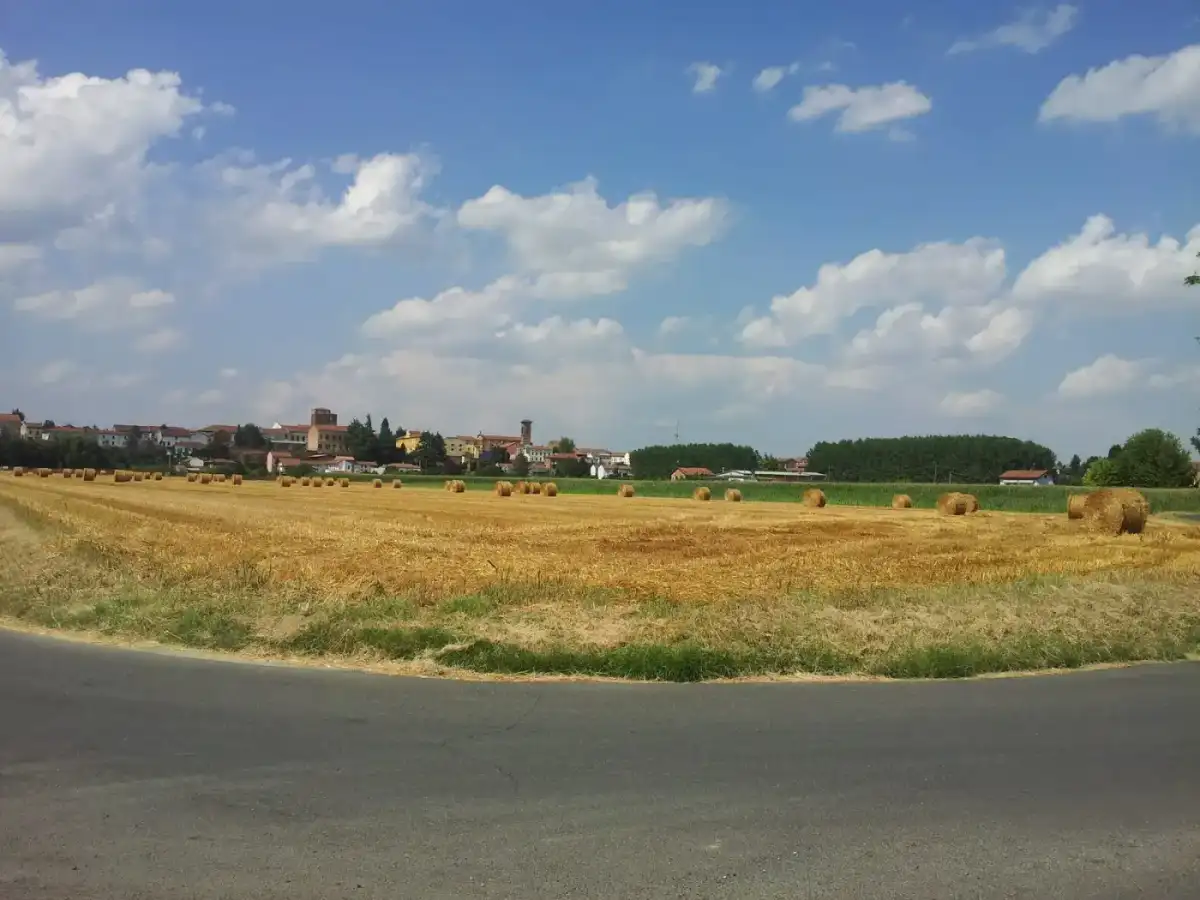
The town is located at 114 m above sea level, on a natural terrace in the valley of the Tanaro, surrounded by the hills of Monferrato. The valley floor, which near Castello d'Annone does not exceed one kilometer in width, beyond Felizzano progressively opens up, giving rise to the Po Valley.
Overwhelmed by the floods and adjacent to one of the main crossings of the middle course of Tanaro, the village is the last point where the forado is at the same time obliged by the narrowness of the valley floor and dominated by the top, before the plain opens and the alternatives multiply. At the Roman times, the Via Fulvia, which connected Tortona ad a Asti and that, most likely, crossed the river right near Felizzano; in medieval times the stretch between Asti and Alessandria constituted a segment of the street of France. In the 15th century, following the division of Marquisate of Monferrato in two non-continuous territories, the "free road of Monferrato" was established, which through Felizzano guaranteed to the goods of the marquisate a path without duties; since the route crossed Milan territory, it was for centuries subject to litigation with the government of Milan.[4]
Climate
The climate is of subcontinental temperate type, typical of the inner Po Valley, with cold winters and foggy summers and hot and sulky summers; precipitation, mainly distributed in spring and autumn, are around 600 mm annually.
History of Felizzano
Ancient age. · Medieval Age · Modern ageExplore this chapter
Ancient age.
The name Felizzano is a clear example of predial place name, which during the Roman era was used to indicate a land possession. The use of the surnamen Felix. instead of a kindness, however, suggests a late ancient origin.
Medieval Age
The first historical mention is of the year 880, when the cortem de filiciano was donated to the abbots of the Milanese monastery of Sant'Ambrogio by Carlo il Grosso, on the occasion of the archbishop of Milan Ansperto. Passed under the Alermic Domain, in the second half of the XI century (within 1085) the court of Felizzano was exchanged by the Marquis Bonifacio del Vasto with the castle of Dego, land of Ardizzone, son of Otto II of Monferrato. Before 1125, Emperor Henry V of Franconia declared the only supremacy on "posses, goods and dignity of the sons of Ardizzone" to Marquis Ranieri I. The concession became a reason for discord in 1135, when William V asserted it against the firstborn Ardizzino; in the same year Ardizzino gave his share of Felizzano to the municipality of Asti.
William V gained control of the village in 1155, after the destruction of Asti by Federico Barbarossa, and began its fortification with a wall. The Marquis also dates back to the foundation of a hospital in the village, which on 17 April 1160 Pope Alexander III put under apostolic protection by entrusting him to the Knights of the Hospitaller.[5] The supremacy of the Marquis on Felizzano was repeatedly reiterated by imperial diplomas until 1172, when William surrendered to the Lombard League, who held him besieged in his castle of Mombello Monferrato: between the conditions imposed there was the return of the castle felizzanese to the Astians. The destinies of the village and Marquis crossed for the last time in May 1186, when Felizzano's men swore to William and his sons Corrado and Bonifacio; according to Aldo Settia the act allows to postpone at 1186 the date traditionally received for his departure towards the Oltremare, from which he would not have returned.[6]
In 1213 the Marquis William VI, to finance the war against Alessandria, sold half of the castle Felizzano to the commune of Asti. The first certain news concerning a municipal organization is 1266, when the commune de Filiçano, represented by the mayor Giacomo Carraria, appears involved in a lawsuit with the Felizzano church of San Salvario, the hospitaliers and the monastery of San Bartolomeo di Azzano d'Asti.[4] In 1292, after the death of the Marquis William VII, left to die prisoner to Alessandria, the castle was occupied by the people of Asti, who held it until 1303, when the Ghibelline faction handed over Asti to the armies of Monferrato, Saluzzo and Incisa. The origins of the military tower can be traced back to this Asti parenthesis, which dominated the entire circuit of the walls from the central square. In 1310, after the dedication of Asti to Henry VII, the emperor ordered the rulers of the city to return Felizzano and the other castles in the countryside that it had illegitimately owned.[4]
On 7 March 1307, the Marquis Teodoro I invested in the port and transit of Felizzano some families of the place, subtracting the concession to the Marquises of Incisa who traditionally held it: the village was indeed a snout road of crucial importance on the stretch of the street of France that from Asti led to Alessandria.[7] The community's weight is given to the parliament held in Chivasso in 1320, in which Felizzano was set up to supply three armed militias to the trade mark army. In 1370 the village passed, along with Casale Monferrato, under the dominion of the Viscontis; in 1395, with the birth of the Duchy of Milan, it was included in the county of Alessandria. Precisely the location in the Milanese territory was the basis of the road franca del Monferrato, the duty-free route that through Felizzano connected the two distinct areas into which the marquisate was divided, and which was the subject of dispute with the government of Milan for centuries.
In 1412, the Alexandrian territory was occupied by the company of victorious leader Facino Cane; at the death of these Giorgio Valperga, Count of Mazzé, who had miliated his orders, he enlisted with Filippo Maria Visconti in the dispute over the Viscount succession and was commissioned to compose the disputes opened in the Alexandrian by the heirs of Facino. In September of the same year he obtained from the Duke, along with his brother Giovanni, the investiture of the fief of Felizzano.[8] Grown up at the court of Sigismund of Luxembourg and engaged for most of the life in Hungary and on the Ottoman front, Valperga did not reside in the village.
In 1447 the death of Filippo Maria Visconti without legitimate heirs led Milan's citizens to proclaim the Ambrosian Republic. Charles of Orléans, Count of Asti, sold the duchy and ordered Rinaldo of Dresden to attack the Milanese lands; the Franco-Astigian troops occupied Annone and strinsero d' Siege Felizzano, who surrendered to unobserved pacts, and abandoned the village and the castle in the sack and on fire before they were defeated at a time. Bosco Marengo. With the Peace of Lodi in 1454 the village was ceded as a fief to Guglielmo, brother of the Marquis Giovanni IV of Monferrato.
Modern age
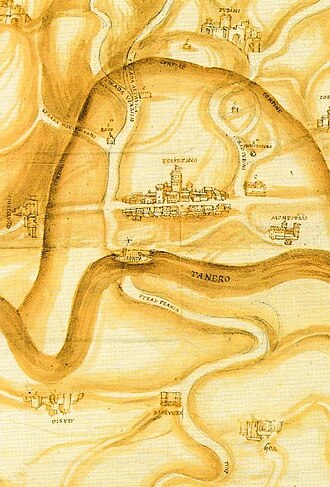
The feudal investitures to the Marquis of Monferrato were renewed until 1533, when the Paleologi dynasty of Monferrato was extinct. Felizzano then returned to the duchy of Milan, which by the end of the century would become a first imperial province and later the Spanish Crown.
The 2 September 1617, during the first war of succession of Monferrato, the village, which was then born to allied Spain in Mantua, was attacked by the army of Carlo Emanuele I, moved by Vercellese at night along with his sons Thomas and Vittorio and flanked by French troops under François de Bonne, Duke of Lesdiguières, who led the vanguard. At the request of surrender the garrison, composed according to sources from 1500 Thirty-six mercenaries in the money of Spain and many inhabitants, he answered with a refusal; dismantled the castle in 1543, the defenders had no other shelter than some saxus wagons placed quickly at the outlet of the streets, and however they rejected three assaults before giving in to the fourth. Most of them were swept by sword, the assailants took nine flags of the Trentin and two banners of inhabitants, and the village was abandoned to the sack. The Duke then headed towards Alessandria but finding it already strengthened, he disconnected and, in folding towards the Astisan, burned down Felizzano before to be siege the fortress of Annone.[9][10] The annexation to the Savoy duchy was made by imperial concession in 1707, during the Spanish Succession War.
For most of the modern age Felizzano It has a special legal status. Thanks to the privileges obtained by the Marquises of Monferrato in 1447 and 1452 and confirmed in 1535 by the duke of Milan Francesco II Sforza, who ensured to the village exemption from duties on the imported for local consumption and free export of products of its territory, the community sold the status of "separate land" with respect to the peasantry of Alessandria, together with Castello di Annone, Cassine, Pasturana And Refrancore; in 1566 the ordinary Magistrate at the entrances of the duchy of Milan established that those lands provided for themselves to the collection of the tributes, outside the control of the commissioner of the peasant. Felizzano was also immediate land, i.e. a place not enfeoffed and directly dependent on the jurisdiction of the prince, a condition that was reconfirmed in 1648 and, after the transition to the Savoy, by Vittorio Amedeo II in 1707. Local government was the responsibility of a council of six members, who on a bimonthly rotation exercised the offices of mayor, reasoned, appraiser and visitor of rural damage, chosen from among the resident owners.[4]
This order was less in the course of the eighteenth century. In 1744 Felizzano was granted in fief with a trade mark title to Francesco Sibaldi, exponent of an Alexandrian decurional family; in 1752 they alienated their feud to the Alexandrian patrizio Leonardo Colli, from which they descended General Luigi Colli di Felizzano and Minister Vittorio Colli di Felizzano.[11]
Contemporary age
From 1802 onwards Piemonte passed under French rule. During this period the Canton of Felizzano, under which the municipalities of Castello di Annone, Cerro Tanaro, Masio, Quargnento, Quattordio And Solero. With the defeat of Napoleon and the consequent return of the Savoys, Felizzano became the district capital.
As a sabaudo domain, it was first incorporated into the Kingdom of Sardinia, in 1847, and later in the Kingdom of Italy, in 1861. In 1849, to break down the costs of the Turin-Genova railway, the Sardinian government decided to deviate the course of Tanaro instead of building two bridges, thus causing the removal of the river from the inhabited center. Of the so-called remediation Tanaro Morto the engineer Emanuele de Ferrari.
Representative Paolo Ercole, who served as mayor and city councillor for most of his life, contributed to the development of Felizzano through the allocation of state funds for the construction of some great works, including paving the flooring of the Street and the Market Square (which were subsequently named after Hercules), the construction of the bridge over the Tanaro and the school building.
Symbols
The coat of arms of the municipality is a truncated shield and it shows: a gold-backed cross on a red background, a medieval symbol of the hospitality; a natural cup on a silver background, a symbol of toll that, until modern age, was imposed on passersby.
The banner is a blue cloth.
What to see in Felizzano
Military architecture · Religious architectureExplore this chapter
Military architecture
- Medieval fortifications
- Wall belt in terracotta, started by Guglielmo V del Monferrato. In the 13th century, the court was enriched with twelve semicircular towers, of which two survive. The northern section seems to have been removed in the 17th century, while the southern part is still standing, although weakened over the centuries by repeated cediments: its conservation also owes itself to the function of support of the terrace on which the town rises. The castle that enclosed it was dismantled in 1543, but the walls continued to be a characteristic element of the inhabited center at least until the middle of the nineteenth century.[4]
- Medieval tower
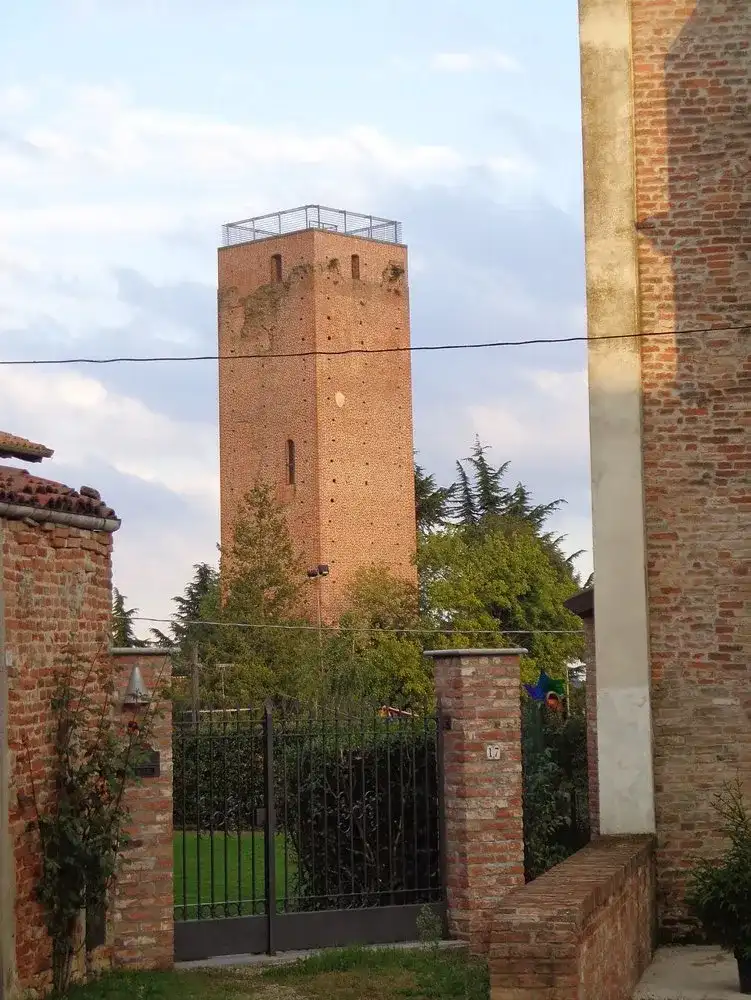
- Located in the north-western corner of Piazza Paolo Ercole, it was probably built towards the end of the 13th century. The tower, called Torre dei Cova by the name of the family that built it[13], has a square base, a height of 26 meters and was used as a command center for the entire defensive system of the castle. Worthy of note are the high coffered ceiling, the splay slits, the narrow ogival windows and the Ghibelline battlements. On the two upper floors there are round-headed windows, refined by alternating terracotta and tuff rings, according to the Asti-Monferrato style.
-
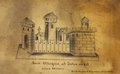 Drawing of the walls of Felizzano, XIV century
-
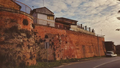 West side of the wall
-
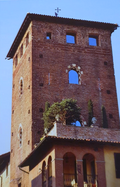 Tower of Felizzano
-
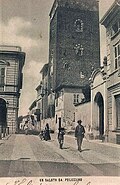 Tower of Felizzano in 1867
Religious architecture
- Church of San Michele and San Pietro
- Already attested in 1285 as a Benedictine priory subordinate to the Abbey of Grazzano; of the ancient Romanesque structure remain the side walls and the robust bell tower, about 27 meters high and ending in a well preserved square cell in terracotta with ogival biphres. Between 1629 and 1633 the church was enlarged and renovated by the will of the felizzanese Marco Antonio Platone, archivist and secretary of the secret council of the duchy of Milan; the facade and interior were realized according to the baroque taste and in obsessive to the rules of construction promoted by the Council of Trent. The plant, in fact, has a unique nave, with five chapels per side, ending in an absidal presbyterial area. Among the side chapels is that of Santo Stefano, patron of the village from the beginning of the 16th century, which is of municipal juspatronate: the cult of the protector is therefore administered by the civil authority inside the parish building. On the altar is placed the altarpiece Martyrdom of Santo Stefano, painted by the Roman Costantino Borti, while the large altarpiece by Saint Michael the Archangel in choir was commissioned in 1758 by the Municipality to the farmhouse Vittorio Amedeo Grassi.[14] The canon preserves two precious paintings, on the table, by Gandolfino d'Asti.
- Church of St. Peter
- Already active in 1195, it has preserved the title and functions of parish until 1948. The last renovation, in 1932, provided a neo-Gothic façade with exposed brick wall parameter, enriched by a protiro surmounted by roses and flanked by windows with glazed terracotta decorations. Of great interest is the paving in terracotta inside, rediscovered in a good state during a restoration of 2015. In the choir of the church ten terracotta tiles are preserved in oriental workmanship.
- Church of San Rocco
- Located outside the town, at the bifurcation of the ancient streets that from Felizzano led to Montemagno And Viarigi. The small church, dating back to the end of the 14th century, remained known until the 16th century as the church of San Salvario, only to be consecrated to San Rocco after the plague epidemic of 1478. Only the brick apse testifies to its medieval origins, as the structure was transformed into the current building with a gabled façade following the new name. The internal space is divided into three naves, of which the central, wider one is covered with a barrel vault supported by round arches. Between 1813 and 1822, the municipal cemetery was built next to the church, in execution of the Edict of Saint Cloud.
- Church of Santa Maria of the source
- So called from the beginning because under its floor spring clear and fresh waters. The oldest part of the building is the apse in full masonry, with cornices in terracotta painted white and red, placed towards the end of the fourteenth century. The rest of the building, late Gothic, was built in the sixteenth century, at two camps with vaulted cruising and acute arches ribbed in terracotta. The church was annexed to a convent of Minori Reformati, known as Santa Maria del Fonte and placed outside the village according to the custom of order; the convent is suppressed by the first half of the nineteenth century.[10] They date back to the last thirty years of the 19th century, when the building was already reduced to a rural church, the porticoed atrium and the small bell tower.
-
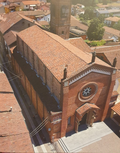 Aerial view of San Pietro
-
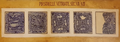 Syrian Mattonelle di San Pietro
-
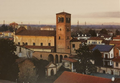 Detail of the bell tower of San Michele
-
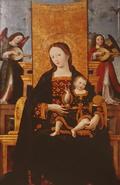 Gandolfino from Roreto, Madonna and Child with Music Angels
-
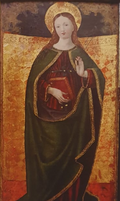 Gandolfino from Roreto, Santa Apollonia
-
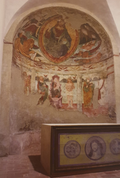 Iconographic plant of the decorative apse of San Rocco
-
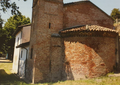 Abside of Santa Maria della Fonte, particular
-
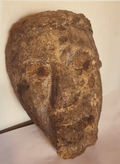 Sculpture in stone effigiant a male face in Santa Maria della Fonte, XII century
Society
Demographic evolution · Traditions and folkloreExplore this chapter
Demographic evolution
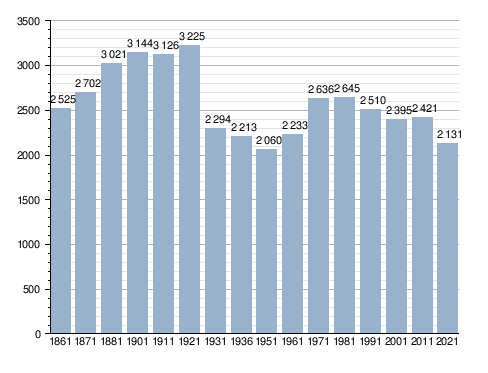
Inhabitants registered[15]
Traditions and folklore
One of the most ancient traditions of the country was born during the plague of 1630: the epidemic, described extensively in I Promessi Spoi, arrived in the duchy of Milan because of mercenaries engaged in the succession war of Monferrato, and also reached Felizzano. The inhabitants of the fort entrusted themselves to their patron, St. Stephen, offering him symbolically ten Silver Filipinos. Since then, on December 26 of each year we recall the donation: during the Mass, a child breaks from a large cere the ten coins to leek them to the Saint in front of the presence of the city council and all the institutions of the country. After the ceremony, the traditional award of the most worthy students in the country and the mayor's annual speech.[16]
Culture
Education · EventsExplore this chapter
Education
Felizzano is equipped with primary and secondary school of the first level. The latter is also frequented by pupils from neighbouring municipalities.
Events
Infrastructure and transport
Roads · RailwaysExplore this chapter
Roads
Felizzano is crossed by the SR 10. In addition, together with Quattordio, is served by the A21 motorway with a special toll booth.
Railways
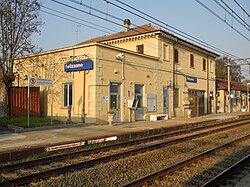
Felizzano is equipped with a train station on the Turin-Genova railway line.
Administration
Below is a table relating to the administrations that have succeeded one another in this municipality.Explore this chapter
Below is a table relating to the administrations that have succeeded one another in this municipality.
| Period | First citizen | Match | Load | Notes | |
|---|---|---|---|---|---|
| June 25, 1985 | 7 June 1990 | Franco Davolio | Italian Communist Party | Mayor | [19] |
| 7 June 1990 | April 24, 1995 | Luigi Cornelio | Italian Socialist Party | Mayor | [19] |
| April 24, 1995 | June 14, 1999 | Gian Domenico Serralunga | left | Mayor | [19] |
| June 14, 1999 | June 14, 2004 | Gian Domenico Serralunga | civic list | Mayor | [19] |
| June 14, 2004 | June 8, 2009 | Gino Polastri | civic list | Mayor | [19] |
| June 8, 2009 | May 27, 2014 | Stefania Pianta | list: Felizzano for all | Mayor | [19] |
| May 27, 2014 | May 26, 2019 | Luca Cerri | Lista civica: I love Flissan | Mayor | [19] |
| May 26, 2019 | June 9, 2024 | Luca Cerri | Lista civica: I love Flissan | Mayor | [19] |
| June 9, 2024 | in office | Luca Cerri | Lista civica: I love Flissan | Mayor | [19] |
Sport
EquitationExplore this chapter
Equitation
The municipality of Felizzano reported a victory at the Palio di Asti, on 22 April 1784 (San Pietro di Felizzano), with Giovanni Bodone said Dance, on a red English horse.
Notes
Explore this chapter
- ^ to b Monthly demographic balance for the year 2026 (provisional data), up demo.istat.it, ISTAT.
- ^ Seismic classification (XLS), up risks.protezionecivile.gov.it.
- ^ Table of degrees/day of Italian Municipalities grouped by Region and Province (PDF), in Law 26 August 1993, n. 412, annex A, National Agency for New Technologies, Energy and Sustainable Economic Development, 1 March 2011, p. 151. URL consulted on 25 April 2012 (archived fromoriginal url on 1 January 2017).
- ^ to b c d And Sandro Lombardini, Felizzano, up Historical-territorial sheet of the common Piedmont, Inter-university Center for Territorial History «Goffredo Casalis», University of Eastern Piemonte, 2002.
- ^ Giuliana Albini, The wealth of the order of S. John (XIV-XV century).
- ^ Aldo A. Settia, Guglielmo V of Monferrato and his return to Palestine, in Monferrato: political, economic and cultural crossroads between the Mediterranean and Europe, 2000.
- ^ Enrico Lusso, Taking possession of the territory and new settlement balances, in Aldo A. Settia (ed.), «When you sell brand Grecus in land Montisferrati». The advent of Theodore The Paleologos in the 7th centenary (1306-2006), Casale Monferrato, 2008.
- ^ Roberto Damiani, Giorgio Valperga, in Venture conducers; the reference biography is L. Barengo, George of the Counts of Valperga, Lord of Mazzé. A European of the 15th century.
- ^ Quinto Gho, Felizzano and the succession wars of Monferrato, extracted from Magazine of history, art and archaeology for the provinces of Alessandria and Asti, 1973.
- ^ to b Goffredo Casalis Historical-statistic-commercial geographical dictionary of the States of S. M. the King of Sardinia, s.v. Felizzano.
- ^ Felizzano, up City Futura online. Retrieved 21 October 2022.
- ^ Piedmontese civic coat of arms, vol. I, Regional Council of Piemonte, 2016, p. 215, ISBN 978-88-96074-98-5.
- ^ Redazione, Felizzano: villages in Monferrato, up Great Monferrato, 2 June 2023. Retrieved 12 August 2026.
- ^ The Parish Church of San Michele Arcangelo, up Parish of Felizzano.
- ^ Data taken from:
- Resident population of the municipalities. Censuses from 1861 to 1991 (PDF), up ebiblio.istat.it, ISTAT.
- Resident population - Time series, up exploredati.istat.it.
Please note: 2021 data refers to permanent census data as of December 31 of that year.
- ^ The Filipino Rite, centuries-old tradition that recalls the rescue from plague, up The Press, 27 December 2016. Retrieved 21 October 2022.
- ^ Main events - Municipality of Felizzano, up www.comune.felizzano.al.it. Retrieved 21 October 2022.
- ^ Copy filed, up alessandrianews.it. Retrieved 21 January 2019 (archived fromoriginal url on 22 January 2019).
- ^ to b c d And f g h the https://amministratori.interno.it/
Bibliography
Explore this chapter
- Restoration crafts in Felizzano, edited by Monica Fantone and Antonella Barbara Caldini, Il Prato, 2020
- Luigi Pizzamiglio, Relatione de gl'vltimi progression made by S.A.S. in the state of Milan, 1617
- Goffredo Casalis Geographical-historical-commercial dictionary of the states of s. m. the King of Sardinia, 1833
- Vittorio Angius, On the noble families of the monarchy of Savoy, 1841
- Quinto Gho, Bricciche di storia felizzanese, 1964
- Giuseppe Sergi (edited by), Castles from Alessandria from Casale all around, Turin, Milvia Editions, 1986
- Gasparolo Francesco (edited by), Alessandrino cartator up to 1300,1930
- Mauro Piantato, Paolo Ercole, 1995
- Roberto Maestri, Rinaldo Merlone, Aldo A. Settia, Ranieri, first Marquis of Monferrato, 2011
Where to stay · Felizzano
Find stays on Booking.comThe area, step by step
Trails and routes in Felizzano

Asti, Alessandria and surroundings
The Wine and Flavor Route · Wine Rivers · Cavalcavia–Oviglio
Asti, Alessandria and surroundings
Sentiero dal tanaro alle colline
 WalkingAround the starting point
Asti, Alessandria and surroundings