- Elevation
- 225 m above sea level
- Area
- 10.33 km²
- Demonym
- Cortazzonesi
- Patron saint
- san Second of Asti
A closer look
Discovering Cortazzone
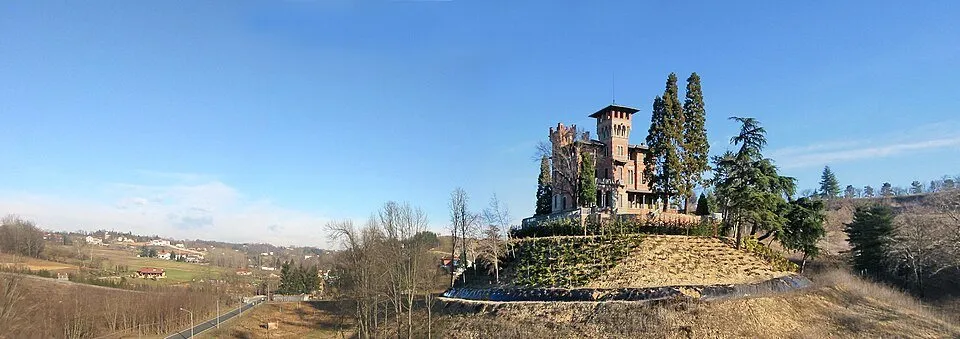
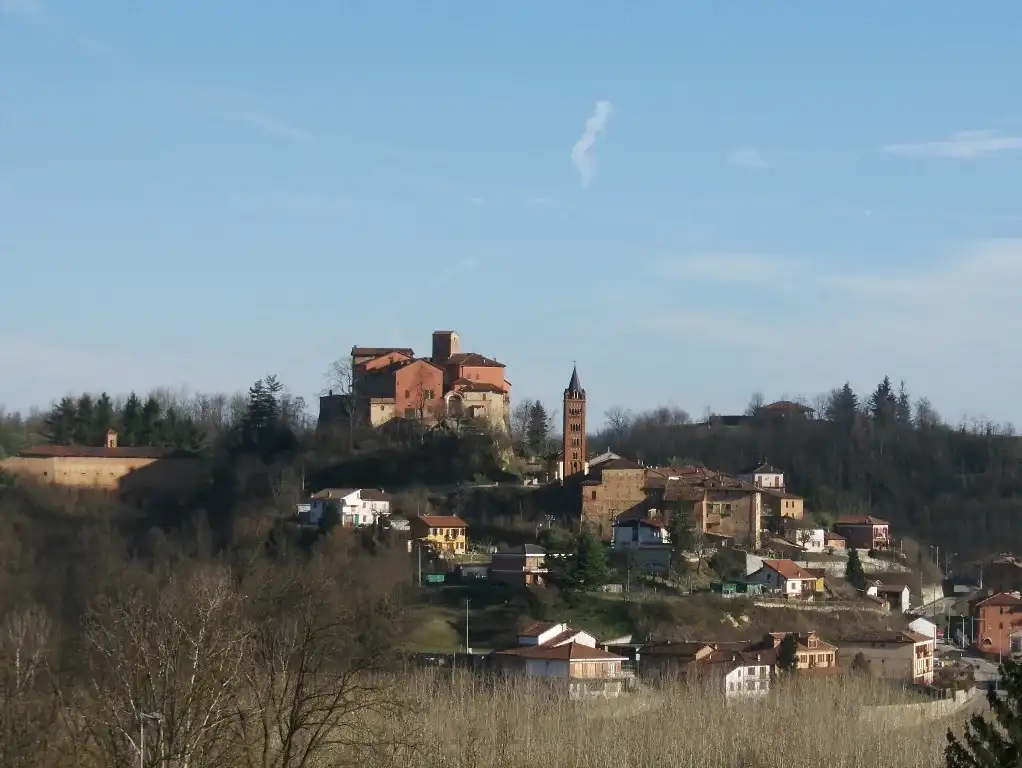
Cortazzone (♪ ♪ in Piedmont) is an Italian municipality of 601 inhabitants[1] from the province of Asti, belonging to the consortium of the union of Alto Astigiano municipalities.
History of Cortazzone
SymbolsExplore this chapter
It is believed that the origin of the village dates back to the end of the 9th century. The toponym presumably derives from Curtis Azonis (name still present in the coat of arms of the Municipality), from the name of the first Lord Azzone (identified by some with the Count of Modena) who in 1094/1095 donated it to the bishopric of Pavia, who enfeoffed it to the Monks of the Red Tower of Asti. From these the fiefdom passed in 1314 to the powerful Pelletta banking family, also vassals of the bishop of Pavia. In 1370, in the castle of Cortazzone, Jacopo dal Verme and Rinaldo de Bulendorf, captains of Galeazzo II, granted the castle of Cortazzone to Giovanni Asinari and Enrichetto Pelletta, obtaining in exchange the oath of loyalty of the two Asti people and members of their families to the Visconti and their commitment to fight the lord's adversaries[4].
The Pellettas ruled over the territory for about four centuries, except for the short period (1374/1395) of Viscontian domination in which it was infeuded to the Dal Verme[5], particularly in the person of Luchino Novello[6], son of Luchino Dal Verme, together with his brother and leader Jacopo Dal Verme.
Extinguished the main branch of the dynasty, the village passed to the descendant of a cadet branch (Irene Pelletta) and from her, following marriage in 1734, to the Count of Favria and later to his son Vittorio Amedeo count of Govone. On his death (1792) he read the fief to the Order of Saints Maurizio and Lazzaro, which dominated the territory until 1860, when he sold it to lots thus marking the passage from the feudal economy to the small peasant property.
The town followed the historical fortunes of Italy, with its small and great facts of everyday life and news, the most serious of which was in 1990 the mysterious and efferato assassinaio del Parroco, Don Guglielmo Alessio.[7]
Symbols
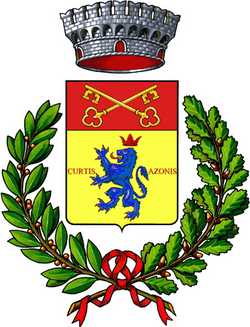
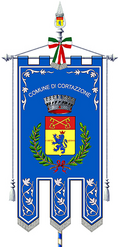
The coat of arms and gonfalone were granted by the decree of the President of the Republic of 6 November 1996.[8]
The banner is a blue cloth.[8]
What to see in Cortazzone
Church of San Secondo in the capital · Church of San Secondo di MongigliettoExplore this chapter
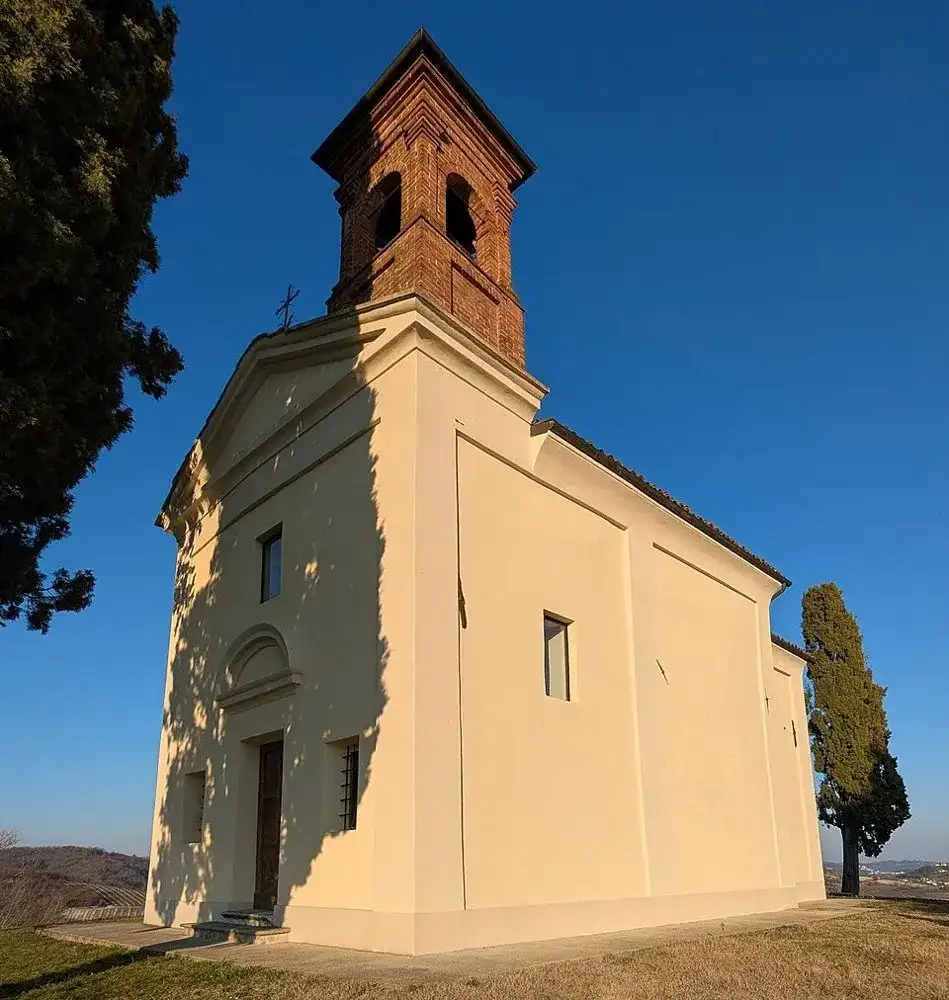
Church of San Secondo in the capital
Church of San Secondo di Mongiglietto
Surely it is one of the most fascinating and mysterious buildings in Italy. The first document attesting the existence of this ancient temple dates back to 1041, but the present building is at least before the year one thousand. It rises on a small relief at 241 meters above the sea level whose name, Mongiglietto, makes understand that it is located on an ancient pagan place of worship: in Latin it could be Mons. Jovis (Mount of Jupiter) or Mons Iubili (Monte della Gioia) and in this second case the place would have been the site of very ancient orgiastic rites which in the form of ecclesiastically controlled prostitution continued until after the year one thousand.
Since the places of worship maintained the same location, it is also probable that previously the hill was sacred to the cult of the Celts and that in the shadow of the oaks human sacrifices were carried out. This evocative thesis, would be further strengthened by the anthropomorphic image that creates the flow of the 5 valleys in the area, a sure meeting place for primitive peoples. The hill of the church, located right in the lower part of this hypothetical human figure, would allude to the significant symbolic importance of the place in question.
Until 1660 it was in the center of Cortazzone, then the inhabitants, for mysterious reasons, moved to the hill where the village is currently located, and the ancient church remained abandoned, along with the small cemetery surrounding it.
The location and orientation of the temple are not random; the church has an east-west orientation shifted some degrees compared to the precise astral alignment used at the time, so that it is perfectly parallel to a vein flowing at 21 meters deep. Below the point where the altar rises, this vein crosses with another almost perpendicular which flows six metres deeper, while a third vein is flowing more superficially, at 14 meters deep, passes under the baptismal font, then it crosses with the first vein under a ritual circle that stands at the center of the temple, and then with the second, to the right of the altar.
There are countless symbols, many of which have an arcane meaning, perhaps ascribable to the ancient and mysterious Order of Templar Knights. One of these is the Phoenix, a mysterious bird that according to a legend that is lost in the night of time, lived in the desert for 500 years, and who felt close to death, built a nest by woven aromatic herbs, myrrh and cinnamon, then it was lying to you burning from the rays of the sun. Three days later, from his ashes a Phoenix would be resurrected, which immediately flew to the city of Heliopolis to announce its resurrection.
There are then two-fide sirens with the two extended tails to the back, apparently in an orgyistic position, and female figures represented in the same way. Probably sexual in nature is also the image scratched on the outside wall of a man and a woman, and two breasts, perhaps to symbolize Mary Magdalene assimilated to Isis. There are also cosmological images, including a representation of the solar eclipse of 26 January 1153, and symbols that indicate different constellations, including Pegaso, the snake, fish and others, in a symbolism whose meaning has been lost in the night of time.
The shells on the facade remind us that the place was used for the shelter of pilgrims headed to Rome or Jerusalem. The "Celtic knots" instead further recall the Celtic origin of the sacred place, and indirectly the bloody rites that practiced druids. While a knot of Solomon, along with the tree of life, recalls ancient Jewish cults and primitive Christianity.
Of other images, however, the meaning is lost in the dawns of history and are not immediately understandable.
Society
Demographic evolution · Foreign ethnic groups and minoritiesExplore this chapter
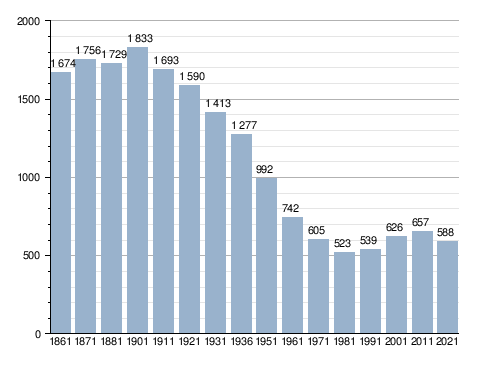
Demographic evolution
Inhabitants registered[9]
Foreign ethnic groups and minorities
According to ISTAT data on 1 January 2013 the resident foreign population was 53 people and account for 8.1% of the entire resident population. The nationalities most represented by their percentage of the total living foreign population were:
- Romania 42 79.25%
- Albania 1 1.89%
- Ukraine 1 1.89%
- Spain 1 1.89%
- United Kingdom 1 1.89%
- France 1 1.89%
- Ecuador 1 1.89%
- Dominican Republic 1 1.89%
- Venezuela 1 1.89%
- Morocco 1 1.89%
- Ethiopia 1 1.89%
- China 1 1.89%
Administration
Below is a table relating to the administrations that have succeeded one another in this municipality.Explore this chapter
Below is a table relating to the administrations that have succeeded one another in this municipality.
| Period | First citizen | Match | Load | Notes | |
|---|---|---|---|---|---|
| June 24, 1985 | May 23, 1990 | Giovanna Gandolfo Fex | - | Mayor | [10] |
| May 23, 1990 | April 24, 1995 | Carlo Foglia | Christian Democracy | Mayor | [10] |
| April 24, 1995 | June 14, 1999 | Carlo Foglia | center | Mayor | [10] |
| June 14, 1999 | June 14, 2004 | Simonetta Ventura | civic list | Mayor | [10] |
| June 14, 2004 | June 8, 2009 | Simonetta Ventura | civic list | Mayor | [10] |
| June 8, 2009 | May 26, 2014 | Francesco Chiara | List of Towns with you | Mayor | [10] |
| May 26, 2014 | May 26, 2019 | Francesco Chiara | List of Towns with you | Mayor | [10][11] |
| May 26, 2019 | June 10, 2024 | Francesco Chiara | List of Towns with you | Mayor | [10] |
| June 10, 202 | in office | Federico Tollio | Civic list Cortazzone | Mayor | [10] |
Image gallery
Explore this chapter
-
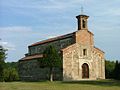 Romanesque church of San Secondo
-
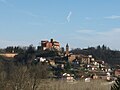 Cortazzone seen from the hill of Mongiglietto
-
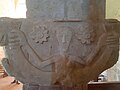 Capitello S.Second of Cortazzone
-
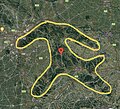 The flow of the valleys: a meeting of populations
Notes
Explore this chapter
- ^ to b Monthly demographic balance for the year 2026 (provisional data), up demo.istat.it, ISTAT.
- ^ Seismic classification (XLS), up risks.protezionecivile.gov.it.
- ^ Table of degrees/day of Italian Municipalities grouped by Region and Province (PDF), in Law 26 August 1993, n. 412, annex A, National Agency for New Technologies, Energy and Sustainable Economic Development, 1 March 2011, p. 151. URL consulted on 25 April 2012 (archived fromoriginal url on 1 January 2017).
- ^ (EN) Fabio Romanoni, "Intrare vel exire non porantant nisi aves". The siege of Casale in 1370, in Monferrato Art and History, XXVI, 2014. Retrieved 18 September 2019.
- ^ History of Cortazzone, up mepiemont.net.
- ^ Family Dal Verme on Gallica - Famous families of Italy. From Verme di Verona / P. Litta Litta, Pompey (1781-1851), up gallica.bnf.fr.
- ^ La Stampa, Asti e Provincia, up archivelastampa.it, 18 October 1990.
- ^ to b c Cortazzone, up AraldicaCivica.it. Retrieved 6 November 2011.
- ^ Data taken from:
- Resident population of the municipalities. Censuses from 1861 to 1991 (PDF), up ebiblio.istat.it, ISTAT.
- Resident population - Time series, up exploredati.istat.it.
Please note: 2021 data refers to permanent census data as of December 31 of that year.
- ^ to b c d And f g h the http://amministratori.interno.it/
- ^ Municipality of Cortazzone - Lists and results, La Repubblica,[1]
Where to stay · Cortazzone
Find stays on Booking.comThe area, step by step