- Elevation
- 357 m above sea level
- Area
- 11.41 km²
- Demonym
- aramenghesi
- Patron saint
- Saint Anne
A closer look
Discovering Aramengo
Aramengo (Aramengh in Piedmont) is an Italian municipality of 569 inhabitants[2] from the province of Asti in the Piemonte.
Landscape and area
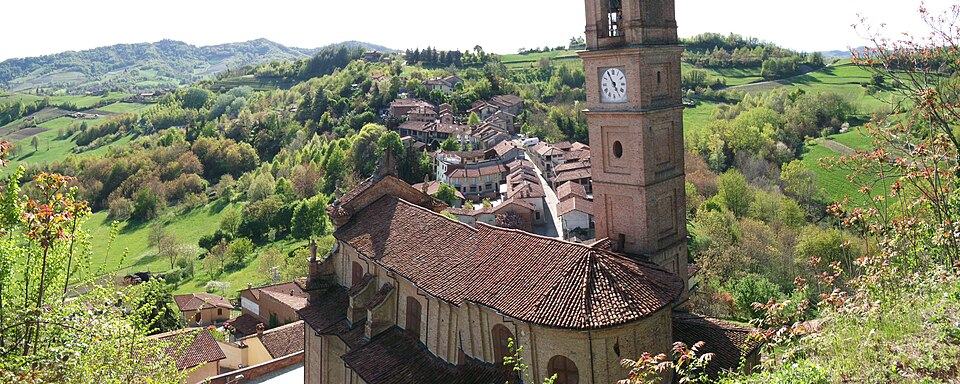
The municipality is located in a hilly area of Monferrato, in the north part of the province of Asti , on the border with that of Turin .Explore this chapter
The municipality is located in a hilly area of Monferrato, in the north part of province of Asti, on the border with that of Turin.
It is located near the former state Chivasso-Asti, and is four km from the nearest railway station on the line that connects the same cities. The territory of the municipality extends on the ridge located between the valleys formed by the Versa and Stura streams to the east and the Meinia stream to the west; both the capital and the hamlets are located at a height of between three hundred and four hundred meters above sea level.
Origins of the name
The origin of the name must be linked to a Germanic voice, given the suffix -engo , (also common to several other towns in the same area), from the...Explore this chapter
The origin of the name must be connected to a Germanic voice, given the suffix -engo, (also common to numerous other inhabited centers in the same area), from German -ing. The root could indicate a personal name, again of German origin, or refer to a hermitage, of which, however, there is no longer any historical memory.
Going to Copper, originally a dialectal form of the phrase go ramingo, has, in Italian colloquial jargon, the meaning of go to ruin (and therefore would have no relevance to Aramengo).[5]
Other sources bind it instead to the municipality of Astigiano, that in the Middle Ages, being the "most peripheral commune of the duchy", was chosen as a place of confino for the "condemned for crimes related to the heritage - and especially for the authors of failures ...".[6]
History of Aramengo
SymbolsExplore this chapter
The events of the place are connected in time to the Radicati family, feudal lords of a very vast territory including numerous neighboring municipalities.
The high sovereignty, in addition to a portion of feudal dominion, first broke out with the Marquis of Monferrato around 1429 and then the Dukes of Savoy. However, the Radicati progressively ceded feudal shares to several lords including the Curtet di Grosso, the Biglione di Pogliano, the Borda di Piobesi and others until they reached the Balbiano di Aramengo, owners of different properties in the municipality also nowadays. Aramengo was also a feud of Count Francesco Morelli (1761–1841).[7]
Symbols
The coat of arms and gonfalone of the Municipality were granted by decree of the President of the Republic of 18 July 2006.
The barb is taken from the coat of arms of the Balbiano family (of red, to the golden crowned barb; to the head of the Empire[9]).
The gonfalone is a drape party of red and white.[8]
What to see in Aramengo
Parish church of Sant'Antonio Abate · Church of San Giorgio · Church of the Madonna della NeveExplore this chapter
Among the valuable buildings present in the municipality we can find the parish of Sant'Antonio Abate, the Romanesque church of San Giorgio (fraction Masio), the church of Madonna della Neve (fraction Marmorito) and the sanctuary of Santa Maria (fraction Gonengo).
Parish church of Sant'Antonio Abate
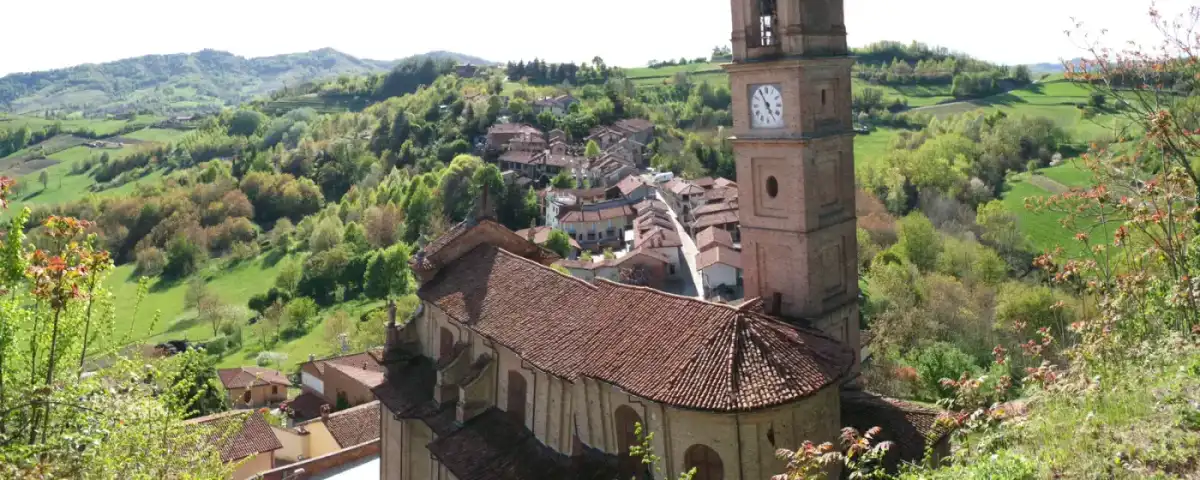
The church of Sant'Antonio Abate is an interesting building in late Baroque style built between 1770 and 1791, connected to a large bell tower; inside, of neoclassical imprint, there are the rich altar and valuable carved woods, especially in the apse and sacristy. In the parish there are also valuable paintings by Guglielmo Caccia, called the Moncalvo.
Church of San Giorgio
The small rural church of San Giorgio, located in the locality Masio, is Romanesque and dates back to the end of the 13th century. It is notable especially for the apse part. The church has been recently restored and is included in the hiking project of the "Rete del Romanico" which, thanks to volunteers, allows its visit with some openings in summer.
Church of the Madonna della Neve
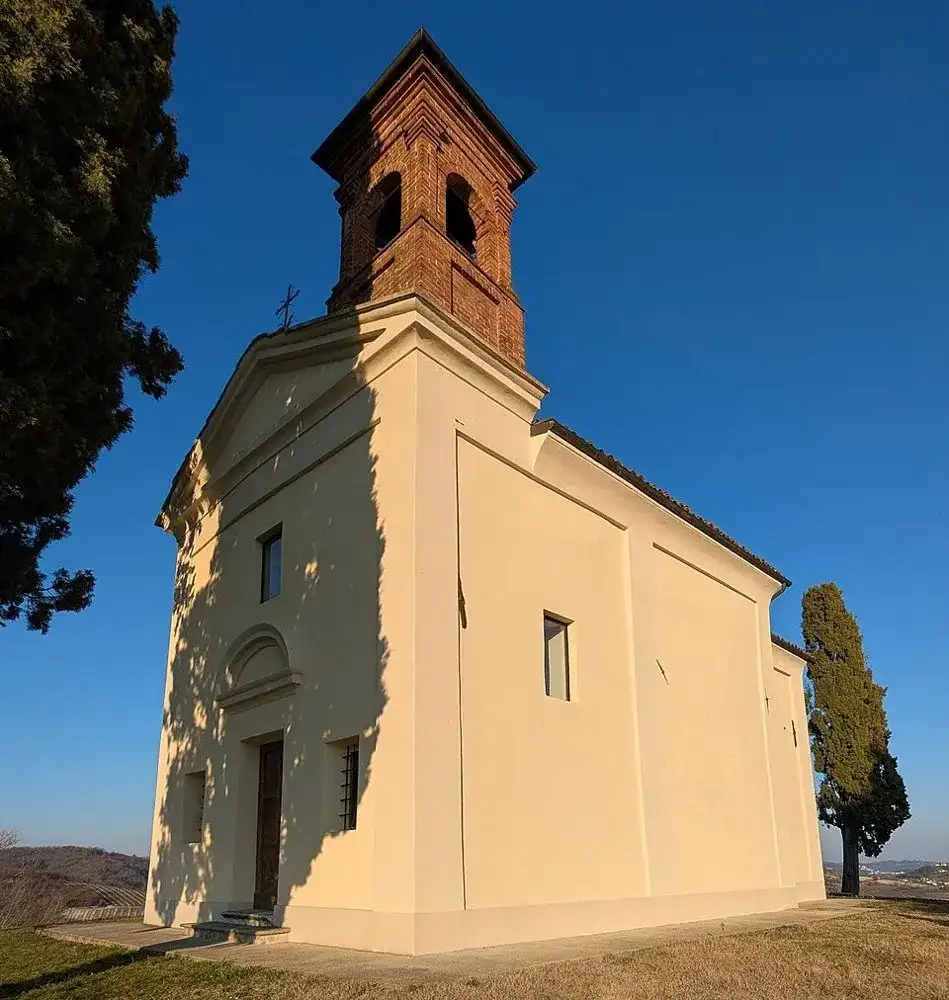
The church of the Madonna della Neve was built in 1839 and was a parish church until 1986.
Big Bench
More recent construction, the presence of the Giant bench "Bonardina" in Marmorito fraction, artistic installation that falls into the initiative "Big Bench Community Project" with number 90.
Society
Demographic evolution · Foreign ethnic groups and minoritiesExplore this chapter
Demographic evolution
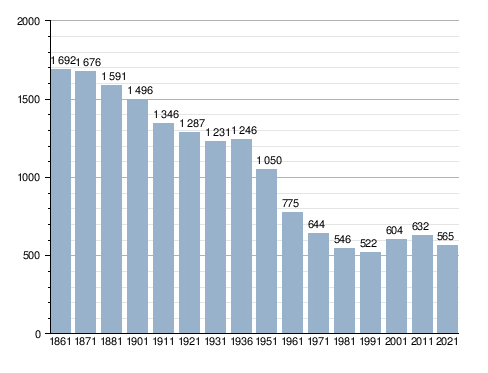
The resident population is It's halved. in one hundred years, starting from 1911.
Inhabitants registered[10]
Foreign ethnic groups and minorities
According to ISTAT data at 31 December 2018 the resident foreign population was 45 people, equivalent to 8% of the total.
The most represented nationalities based on their percentage of the total resident population were:
- Romania 22 (3.9 %)
- Peru 10 (1.5 %)
Economy
The population is mainly devoted to agriculture, as well as industrial and commercial activities outside the municipal territory, especially in Turin and Chivasso .Explore this chapter
The population is mainly devoted to agriculture, as well as industrial and commercial activities outside the municipal territory, especially in Turin and Chivasso.
In farms the breeding of Piedmontese cattle is widespread. Other typical products are meats, honey and the famous white truffle.
The wine production is particularly characterized by the production of wines typical of the area, including Barbera, Freisa and Cortese.
Administration
Below is a table relating to the administrations that have succeeded one another in this municipality.Explore this chapter
Below is a table relating to the administrations that have succeeded one another in this municipality.
| Period | First citizen | Match | Load | Notes | |
|---|---|---|---|---|---|
| June 10, 1985 | May 21, 1990 | Luigia Nicola | Christian Democracy | Mayor | [11] |
| May 21, 1990 | April 24, 1995 | Amalia Emanuel | civic list | Mayor | [11] |
| April 24, 1995 | June 14, 1999 | Amalia Emanuel | Forza Italia | Mayor | [11] |
| June 14, 1999 | May 11, 2004 | Francis | civic list | Mayor | [11] |
| May 11, 2004 | June 14, 2004 | Lorenzo Micheluzzi | Comm. pref. | [11] | |
| June 14, 2004 | June 8, 2009 | Francesco Tavolato | civic list | Mayor | [11] |
| June 8, 2009 | May 26, 2014 | Francesco Tavolato | Lista civica Aramengo, Together to build | Mayor | [11] |
| May 26, 2014 | May 26, 2019 | Christian Massaia | civic list Together to build | Mayor | [11] |
| May 26, 2019 | in office | Giuseppe Marchese | civic list Share and renew | Mayor | [11] |
Events
Explore this chapter
- Patronage of Sant’Anna - 26 July
- Feast of St. Roch (French of Aramengo) - 16 August
Notes
Explore this chapter
- ^ Municipality of Aramengo : Municipal Administration and Mayor - City of Aramengo and city, Asti, Piemonte, up www.comune-italia.it. URL consulted on 4 August 2026.
- ^ to b Monthly demographic balance for the year 2026 (provisional data), up demo.istat.it, ISTAT.
- ^ Seismic classification (XLS), up risks.protezionecivile.gov.it.
- ^ Table of degrees/day of Italian Municipalities grouped by Region and Province (PDF), in Law 26 August 1993, n. 412, annex A, National Agency for New Technologies, Energy and Sustainable Economic Development, 1 March 2011, p. 151. URL consulted on 25 April 2012 (archived fromoriginal url on 1 January 2017).
- ^ I'm sorry, in Treccani.it – online vocabulary Treccani, Rome, Institute of the Italian Encyclopedia. Retrieved 1 July 2015.
- ^ Why do you say "go to ramengo"?, in focus.it, 12 April 2012. Retrieved 1 July 2015.
- ^ Rose Necchi, Morelli d'Aramengo, Francesco, in Biographic dictionary of Italians, vol. 76, Rome, Institute of the Italian Encyclopedia, 2012. Retrieved 18 October 2020.
- ^ to b Aramengo (Asti) D.P.R. 18.07.2006 concession of coat of arms and gonfalone, up Italian Government, Office of Honors and Araldica, 2006. Retrieved 18 October 2020.
- ^ G.B. of Crollalance, Historical-blasonic Dictionary, volume I, p. 81.
- ^ Data taken from:
- Resident population of the municipalities. Censuses from 1861 to 1991 (PDF), up ebiblio.istat.it, ISTAT.
- Resident population - Time series, up exploredati.istat.it.
Please note: 2021 data refers to permanent census data as of December 31 of that year.
- ^ to b c d And f g h the http://amministratori.interno.it/
Where to stay · Aramengo
Find stays on Booking.comThe area, step by step