Atlas of Monferrato
Castagnole delle Lanze: sights, history and trails
Asti
- Elevation
- 271 m above sea level
- Area
- 21.57 km²
- Demonym
- castagnolese
- Patron saint
- Peter the Apostle
A closer look
Discovering Castagnole delle Lanze
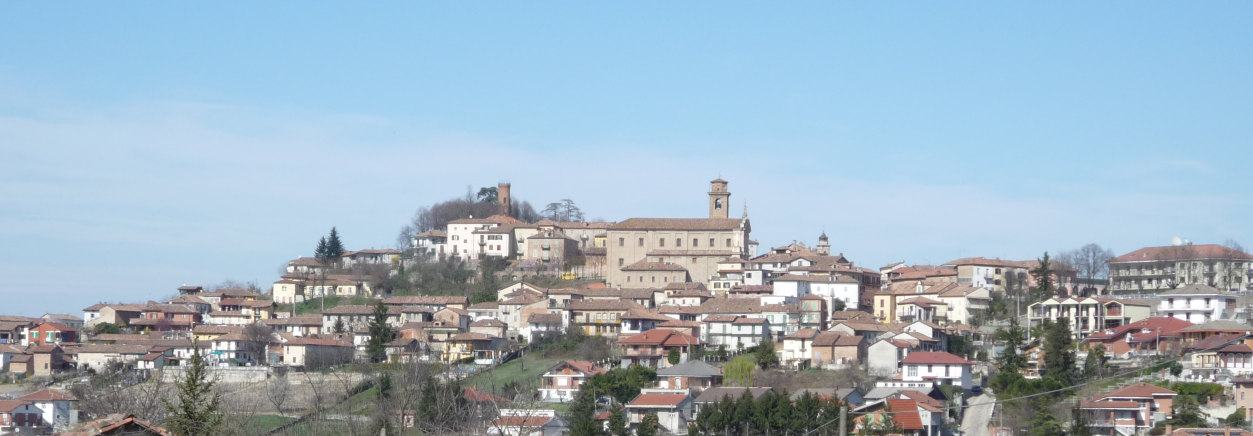
Castagnole delle Lanze (Castignola dle Lanse in Piedmont) is an Italian municipality of 3 672 inhabitants[1] from the province of Asti in the Piemonte. It is part of the association of the most beautiful villages in Italy.
Landscape and area
Castagnole delle Lanze has a geographical and territorial position that places it on the edge of the Langhe and Monferrato, the inhabitants have therefore coined the motto...Explore this chapter
Castagnole delle Lanze has a geographical and territorial position that places it on the edge of Langhe and Monferrato, the inhabitants therefore coined the motto "Castagnole Lanze: Between Langa and Monferrato". This definition is in any case improper, since the municipal area does not border the Monferrato, but is part of the Astesana territory. All municipal life is affected by this proximity to the Asti area and the Albese area: the municipality is in fact province of Asti, but the parishes belong to the diocese of Alba.
The activity of the wine production, which is driving for the economic life of the country, also affects quality of grapes typical of the two zones: that is Barbera d'Asti, Dolcetto d'Alba and Moscato d'Asti.
The administration of Castagnole, to help local producers, in 2010 created the initiative "Adopt a row", which allows to adopt ten meters of rows of Barbera d'Asti vine, receiving in exchange 10 bottles of wine "Lanze". This initiative is unique in its kind in Italy.
History of Castagnole delle Lanze
SymbolsExplore this chapter
In Roman times, in the places where the municipality of Castagnole delle Lanze was built a branch of the Via Emilia that connected Acqui Terme in Pollenzo (Pollentia), this was demonstrated by the excavations carried out at the beginning of the twentieth century.
In the Middle Ages, the cards of Codex Astensis place Castagnole among the land belonging to the counts of Loreto. Among these, those who had greater relations with the community of Castagnole were probably Manfredo I, from 1190 Marquis of Busca and Count of Loreto. The Marquis inaugurated the Lancia dynasty from the appellation that had earned himself having served as a lanciferous, in youth, at the court of Federico Barbarossa. The combination between the Lancia dynasty and the attribute "of the Lanze" (of the Lance) is necessary, as Castagnole is the only Piedmontese municipality to be able to give thanks to such a name. Also from the Codex Astensis it is possible to assume that in Castagnole Lanze there was a medieval castle as a residence of the count; the castle was probably destroyed in 1255 with the fall of the Count of Loreto.
Discordant documents accredit that Bianca Lancia (also known as White of Agliano Terme) was either the daughter of Manfred I or of Boniface of Agliano, with whom Manfred's widow had remarried. Bianca Lancia was the last wife of Emperor Frederick II of Swabia: it is therefore very probable that Bianca's son, Manfredi, King of Sicily, who died in the battle of Benevento and the founder of the city of Manfredonia, descends from Manfredo. Manfredi is celebrated by Dante in the Divine Comedy: "...He was blond and handsome and of gentle appearance...".
Starting from the 13th century Castagnole entered the domains of the Municipality Asti, then forever following its history, vicissitudes and subjugation to the various lords who controlled it.
In the 14th century, the place of Castagnole was part of the domains of Visconti: from the municipal maps an oath of loyalty of the Community of Castagnole delle Lanze in Valentina Visconti, who had received such a fief with all the rest of the "Patria Astese" for the wedding with Luigi I di Valois-Orléans, Duke of Orléans. It should be noted that from the end of the 14th to the beginning of the 17th century, Castagnole Lanze was part of the Captainship of Astesana, and as such it was never infeuded, but subjected to the direct dominion of the governor of Asti. At the same time, the village was fortified by a strong wall with cylindrical towers, of which unfortunately few traces remain.
After alternating events the territory passed, in 1573, to Emanuele Filiberto di Savoia. From this moment on, the municipality is subjected to two lords: on the one hand the fief of the Asinari and on the other hand the lordship of the family of Catalano Alfieri, Lord of Magliano and Castagnole. In 1797, the Alfieri Counts Birago di Borgaro Torinese (who took the name of Birago-Alfieri), instead, to the Asinari, for inheritment, the Marquises Carron of Saint Thomas, whose lordship was built in 1836. With the Marquis of Saint Thomas and with the Birago-Alfieri family he ceased in Castagnole delle Lanze every feudal domination residue, and since 1850 the municipality followed the destinies of Savoia house and then of the Kingdom of Italy.
Starting from the end of800 Castagnole had a great development of the wine industry, with the opening of several companies that soon became leader in the production of vermouths and sparkling wines. The Second World War did not touch the country particularly, except in two allied air raids on the railway station and some guerrilla actions between partisans and troops of the Republic of Salò. In the second post-war period Castagnole, as well as almost all of northern Italy, had a great economic and industrial development, thanks also to the contribution of labor from other regions of Italy.
Symbols
The coat of arms of the municipality of Castagnole delle Lanze was recognized by the decree of the head of the government of 13 August 1929.[4]
The gonfalone is a truncated drape of white and red.
What to see in Castagnole delle Lanze
Parks · Palazzo dei Conti Alfieri · Parish Church of San Pietro in VincoliExplore this chapter
Parks
The Remembrance Park is located in the historic center, also nicknamed "Paese Alto".
Inside it you can see various tree essences, shrubs and herbaceous of great ornamental value. There are in fact specimens of Ginkgo biloba, Cercis siliquastrum (the so-called Judas Tree), Acer campestre (or Field Maple), Tilia Cordata (linden) e Cedrus deodara (Atlas cedar).
The park is also home to a panoramic tower built in the second half of the 19th century by Count Paolo Ballada of Saint Robert who served as an astronomical observatory. As we read in the Codex Astensis (Codice Astense), it rises where once a manor was erected destroyed in 1255 during the struggles that opposed the Astigians and the Count of Loreto.
Around the tower there is a public green area, where a path to know the passions and studies of the Count develops. Paolo Ballada di Saint Robert.
Among his studies were botany, hypsometry, mountain, ballistics, physics.
Palazzo dei Conti Alfieri
The Palace is located between Via Ruscone and Via Auberti. The area on which the building is located belongs to the “Contrada castello”, in the historical center of Castagnole delle Lanze.
The palace, dating back to the 15th century, preserves traces of the medieval structure. The oldest nucleus of the palace was used as a Castagnolese dwelling and as a court by Catalano Alfieri.
In 1704 we have news of a fire and therefore the current aspect of the palace should date back to that time.
The last Alfieri (family) of Magliano died in combat against the French in 1793, without direct descent, and the fief of Castagnole passed to the Birago-Alfieri.
The latter retained their possessions of Castagnole Lanze until 1861-62.
The remaining part of the house was owned by the historian De Canis. In 1862 the Palace passed to the Auberti (family).
In 1864 it was used as a school and later as a municipality.
The building stands out for its precious portals, the elegant cornice, the remarkable decorations of vaults and staircase, gardens. The façades, the stables, courtyards and interiors have been restored since 2015.
Parish Church of San Pietro in Vincoli
In 1771 Count Carlo Giacinto Alfieri built at his expense the current major altar, originally still in wood, and the marble balustrade. The interior has many frescoes and many sculptures and a rich decoration in stucco and gold. In particular, an uninterrupted series of angels delimites the inner perimeter of the church under the upper balcony.
Cross of the Poncini
The “Croce dei Poncini” takes its name from the illustrious Poncino family, which originated in Switzerland, was set up in Castagnole in the early 17th century, acquiring, in this valley, numerous lands, including the Garera farmhouse. The presence of the cross is evidenced by a letter from 1774, in which we mention the " [...] public road, beginner from the Royal Road called Tinella, and tending up to the public road, that from it place of Costigliole tends to the south-west of Castagnole until the Cross called de' Poncini, what road [...] is very frequented not only by the Bovari, and Cavallanti wine drivers from the Monferrato, and from the places of Calloso, and Canelli to the City of Turin, than from other traffickers such road". The frequent transit on this road artery had to contribute, perhaps already in the seventeenth century, to make the cross "de' Poncini" a significant point of reference for travellers and traders who from here passed. In the 20th century it was remembered a first cross, dating back to 1903, which consisted of a simple pole, curved by the weather, stuck in the ground. The cross was replaced in 1980, then again in 2015.
Society
Demographic evolutionExplore this chapter
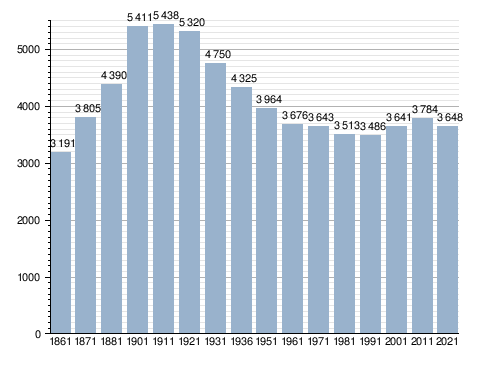
Demographic evolution
Inhabitants registered[5]
Economy
TourismExplore this chapter
Tourism
Castagnole delle Lanze received the Orange Flag, a tourist and environmental quality certificate of Touring Club Italiano[6].
Anthropic geography
UrbanismExplore this chapter
Urbanism
The municipality of Castagnole delle Lanze has a concentric plant that extends in two distinct urban areas:
- The old town, in the hilly village of San Pietro (Paese Alto), characterized by dwelling buildings dating back to the eighteenth century and firstly to a Baroque parish of 1701 (San Pietro in Vincoli) and to the churches of San Rocco and the brotherhood of the White Baptists.
- The new village, developed from the early decades of the twentieth century, in the town of San Bartolomeo, where the main economic activities are concentrated and in particular wine production.
Administration
TwinningExplore this chapter
Below is a table relating to the administrations that have succeeded one another in this municipality.
| Period | First citizen | Match | Load | Notes | |
|---|---|---|---|---|---|
| June 13, 1985 | May 25, 1990 | Renzo Masengo | Christian Democracy | Mayor | [7] |
| May 25, 1990 | April 24, 1995 | Renzo Masengo | Christian Democracy | Mayor | [7] |
| April 24, 1995 | June 14, 1999 | Gianfranco Fassone | centre-right | Mayor | [7] |
| June 14, 1999 | June 14, 2004 | Roberta Filippa Ferretti | civic list | Mayor | [7] |
| June 14, 2004 | June 8, 2009 | Marco Violardo | civic list | Mayor | [7] |
| June 8, 2009 | May 26, 2014 | Marco Violardo | civic list | Mayor | [7] |
| May 26, 2014 | May 25, 2019 | Calogero Mancuso | Civic list Chestnut Project | Mayor | [7] |
| May 26, 2019 | in office | Calogero Mancuso said Carlo | Chestnuts list to the future | Mayor | [7] |
Twinning
 Brackenheim[without source]
 Charnay-lès-Mâcon[without source]
 Zbroslaw[without source]
 Tarnalelesz[without source]
 Valledolmo[without source]
Infrastructure and transport
RailwaysExplore this chapter
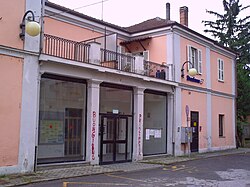
Railways
The municipality is served byThe same station railway station on the railway Alessandria-Cavallermaggiore and end of line for Asti and Mortara. Since June 2012 the Region Piemonte replaced the railway service with cars departing from Piazza Lucchini.
The station remained in disuse for 6 years until November 2018, when it was reopened to tourist traffic[8] a few days a year.
From 11 September 2023, she returned to the service of the country with the reactivation of railway routes between Asti and Alba.
Notes
Explore this chapter
- ^ to b Monthly demographic balance for the year 2026 (provisional data), up demo.istat.it, ISTAT.
- ^ Seismic classification (XLS), up risks.protezionecivile.gov.it.
- ^ Table of degrees/day of Italian Municipalities grouped by Region and Province (PDF), in Law 26 August 1993, n. 412, annex A, National Agency for New Technologies, Energy and Sustainable Economic Development, 1 March 2011, p. 151. URL consulted on 25 April 2012 (archived fromoriginal url on 1 January 2017).
- ^ Castagnole delle Lanze, decree 1929-08-13 DCG, recognition of coat of arms, up Heraldic office - Municipal files, Central State Archives. Retrieved 9 August 2026.
- ^ Data taken from:
- Resident population of the municipalities. Censuses from 1861 to 1991 (PDF), up ebiblio.istat.it, ISTAT.
- Resident population - Time series, up exploredati.istat.it.
Please note: 2021 data refers to permanent census data as of December 31 of that year.
- ^ Castagnole delle Lanze: what to see, where to sleep, where to eat | Touring Club, up Touring Club Italiano. Retrieved 6 May 2024.
- ^ to b c d And f g h http://amministratori.interno.it/
- ^ Discover the Asti - Castagnole delle Lanze - Nizza Monferrato, up railways.it. Retrieved 12 November 2018 (archived fromoriginal url on 16 November 2018).
Bibliography
Explore this chapter
- Remo Gianuzzi "CASTAGNOLE LANZE from the Romans to the present day", 1977
- Marta Roggero "Application GIS in the management of urban green. First experiences in Collegno and Castagnole Lanze", 2014
- LANZE CASTAILS. Pictures and memories of a century
- C. F. Gapello, Castagnole delle Lanze - Geologia - Storia - Documenti - Notizie, La tipografica torinese, Torino, 1964
- Don Boarino, Historical memories of Castagnole Lanze
- Chestnuts Lanze from the 17th to the 19th century - Lineamenti per una storia, La voce, Castagnole delle Lanze, April 1999
- Lino Cane, The Parish of St. Peter in Vincoli
Where to stay · Castagnole delle Lanze
Find stays on Booking.comStories, places and people
More about Castagnole delle Lanze and the surrounding area
Follow a thread of history and see where it leads.
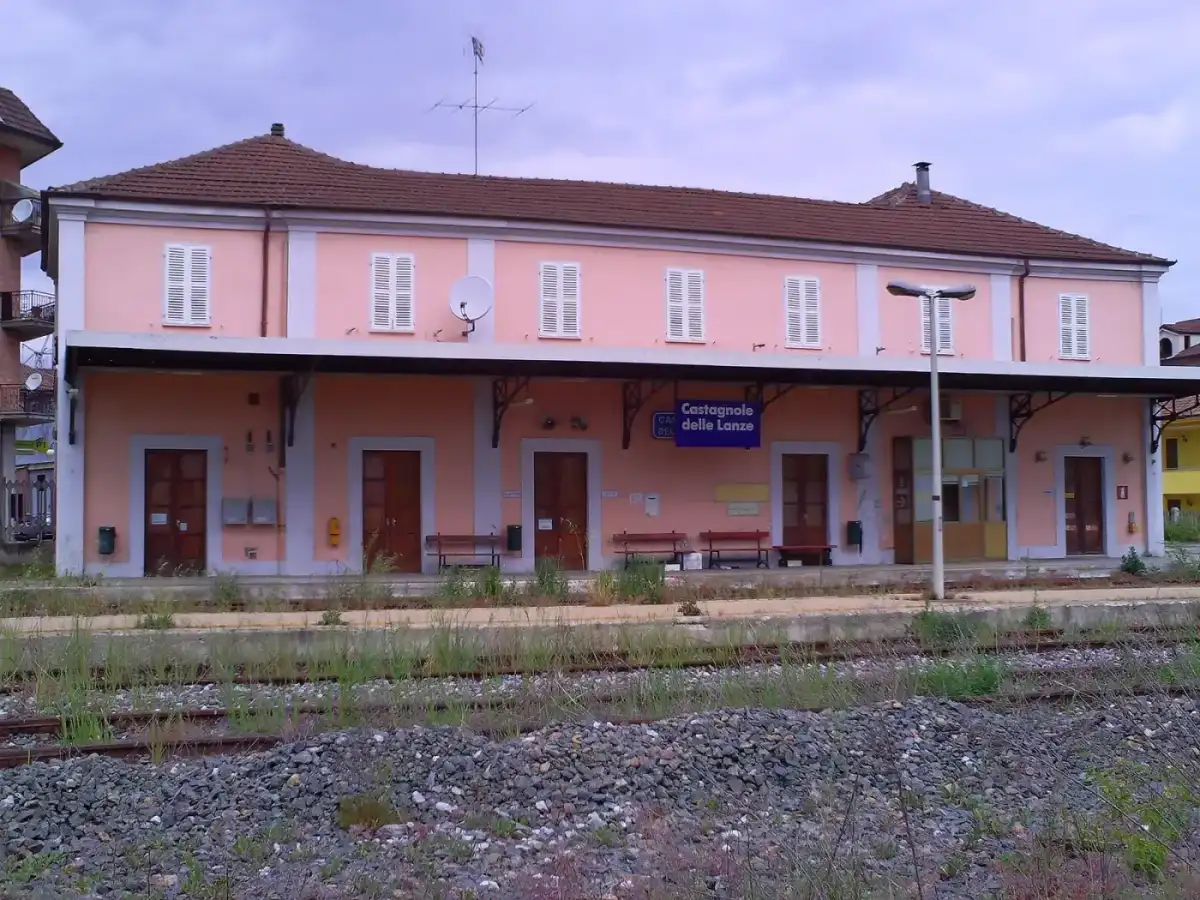 Neq00 · CC BY-SA 3.0
Castagnole delle Lanze Station
The station Castagnole delle Lanze is a railway station located along the line Alessandria-Cavallermaggiore, and origin of the line for Asti .
Read the storyPaolo Ballada di Saint Robert
Paolo Ballada di Saint Robert (June 10, 1815 – November 21, 1888) was an Italian mountaineer and entomologist. Together with Quintino Sella and Bartolomeo Gastaldi he founded the Italian Alpine Club, of which he was also director. Important promoter of scientific culture, technologist and military among the best of his time, he knew to unite pure science, applied science, art and social interests in a synthesis among the highest. He deserves to have kept the scientific prestige of the Kingdom of Italy high abroad
Read the storyThe area, step by step