A closer look
Asinari: at a glance
The House of Asinari is a Piedmontese aristocratic family native to Asti.
Origins and development
The legendary origins of the family, according to Manno, date back to a certain Asinio degli Asinari, abbot of the Abbey of Novalesa, who would have welcomed Charlemagne during...Explore this chapter
The legendary origins of the family, according to Manno, date back to a certain Asinio degli Asinari, abbot of the Abbey of Novalesa, who would welcome Charlemagne during his coming in Piemonte. According to the Manno, other sources mention an Asinaro leader of Vitige, king of the Goths.
According to Serafino Grassi, Enrico Asinari was mayor of Asti at the time of the city's fire by Federico Barbarossa in 1164.[1]
The certain news of the family appear in the first half of the thirteenth century with the presence of two well-known households even if they are shortened in a single "hospice". From this period are a Razone or Raxone Asinari, consul, and Ratio, Guglielmo and Giovanni, credendari of the Municipality of Asti.
In the thirteenth century, Federico Asinari of Loreto was the captain of the Astese cavalry sent to Terrasanta for the crusade of 1215. In this period the family also developed its business vocation: Opicino and Giovanni Asinari opened docks in Asti and Genoa, and among their debtors the bishop of Asti. Raymond in the middle of the 13th century was one of the first cives of the unfeuded municipality of a municipal castle of the peasant, that of Dusino San Michele; he later joined the De Castello Ghibellines in the civil struggles of Asti and gave rise to Dusino's branch. The alliance with the Guttuari family, the Sicilian family of Astigiana spicco, was not only political but also commercial: the Asinari held a counter in compromise to Asti for about seven years, from 1291 to 1298.
Boniface and Thomas were active at the end of the 13th century in Savoy and Burgundy. These two characters gave rise to the lines of San Marzano Oliveto And Camerano Casasco.
Civil war in Asti and exile
After this first phase of financial expansion, the Asinari suffered a setback due to the discording towns with the Guelph faction of Solaro . The victory...Explore this chapter
After this first phase of financial expansion, the Asinari suffered a setback due to the discords of the city with the Guelph faction of the Solaro. The victory of the Guelph side inevitably led to the exile of most Asinarians allies to the Guttuaries. After an ephemeral return to the city, which was led by Henry VII, the final victory of the Guelphs in 1314, brought the Asinars out of the city walls until 1339 with the coming of the Marquis of Monferrato before and the Visconti then. Tolomeo Asinari, involved in civil struggles, was exiled with the family and dedicated himself to the commentary of De consolatione philosophie manuscript in 1309 and illuminated by Filippo di Altavilla (it is preserved in Vienna). This resulted for almost forty years a virtually total absence of the family from major city offices and a development of the same in the farmland and abroad.
The sons of Bonifacio, Alexander and Bonifacio in society with his uncle Bonomo developed and expanded the activity in Burgundy, becoming the financiers of Count Eude IV of Burgundy in 1334.
Camerano's line mainly orientated its interests in Switzerland and Germany (Berna, Freiburg, Cologne).
In the 14th century the family was so developed that it had branched out in five lines: the branch of San Marzano (invested with the fiefs of Canelli, Bellangero, Moasca, San Marzano, Vesime, San Giorgio, Mombaldone, Montechiaro d'Asti, Cartosio[2] And Malvicino), the Camerano branch (with the Belotto fiefdoms, Camerano Casasco), the Casasco branch and the Dusino branch, Costigliole d'Asti and There were in disgrace with the branches of San Marzano and Casasco and later originated the branch of Costigliole that at the end of the seventeenth century joined the Verasis family.
Internal dissides
The family encouraged its economic and commercial power to the point so that more than once characters of the various branches were in contrast:Explore this chapter
The family encouraged its economic and commercial power to the point so that more than once characters of the various branches were in contrast:
- In 1368, Antonio Asinari of San Marzano, occupied with the weapons the part of Costigliole owned by the Camerano and the quarrel was translated until 1382
- In 1373 and 1378, the continued patrimonial litigation between the members of the branch of Camerano had led the brothers Michele and Tommaso to imprison his cousin Manuele, until the intervention of the lawyer Raimondino Pallido
- In 1378 Petrino di Casasco was banned from the city of Asti for assaulting the castellano of Camerano
- In October 1385, an arbitral curia was pronounced on the divergences between the House and the Casasco group in interests in Germany where it emerged that conflicts were born for the continuous quarrels between the neighbouring territories vented with the killing of Guglielmo Asinari of Casasco in Villafranca by the castellano dei Camerano.[3]
Historians do not agree to consider this climate of litigiosity the main cause of family decline in foreign trade, because at the end of the fourteenth century the branch of San Marzano in Burgundy seems almost entirely missing, as well as the branch of Camerano that ceased its activity in Rhineland.
Some family members moved north to Flanders and Mosa area, maintaining their activity until the middle of the fifteenth century.
With the passage of Asti County under the Orléans, all the branches of Asinari in a century ceased feneratia activity turning into territorial nobility and consolidating its power in about a dozen castles.
Asinari di Camerano e di Casasco
It was certainly the most wealthy branch of the family operating in Renania. He was strong ties with the Pallium or Pallid, the Alion, the Montafia and the Roero. Even the Wild...Explore this chapter
It was certainly the most wealthy branch of the family operating in Renania. He was strong ties with the Pallium or Pallid, the Alion, the Montafia and the Roeros. Even the Wild had blood ties with them. This dense network of relationships allowed the Asinari to Camerano Casasco to enlarge and develop their wealth at home and abroad, until the dissids that were born between the two families for territorial claims.
The branch of Camerano was extinct in the 17th century and the fief passed to Ghirone di Valperga count of Masino, while the branch of Casasco ended at the beginning of the 18th century.[4]
Asinari di San Marzano
Boniface in 1280 left his wealth to his children. Bonifacio and Thomas became a co-owner of the fief of San Marzano .Explore this chapter
Boniface in 1280 left his wealth to his children. Bonifacio and Thomas became a co-owner of the fief San Marzano Oliveto.
In 1771, Filippo Valentino (died in 1780) was unfeuded the first Marquis of San Marzano and Caraglio[5]. His marquis Filippo Antonio was a state councilor and sent by Napoleon Bonaparte as ambassador to Berlin. He became count of the Empire in 1808 and senator and regent of Piemonte in 1813.[6][7]
From the Marquis and then Count Filippo Antonio Maria and his wife Polissena of the Church of Cinzano originated numerous children including: the marquis Carlo Emanuele, a field helper of Vittorio Emanuele I, one of the chiefs of the motions of 1821[8]; Count Ermolao diplomat and Minister for Foreign Affairs[9]; Guido, from whose line was born Lieutenant General Alexander who fought during the wars of Independence and in the campaign for the War of Abissinia[10] and Colonel Carlo Alberto (1833 - ), who had the medal for the battle of Custoza and was vice-governor of the Duke of Aosta[11].
The title of Earl passed from Ermolao (eight year old since he was born in the 1800s last son before obtaining the title by his father Philip Antonio Maria) then to his sons Philip (1835-), Britanius (1839-), and then Joseph Sigray (1842-1898).[12][13]
Asinari di Costigliole d'Asti
Originated by the Asinari branch of San Marzano, the chief was Alexander and his brother Bonifacio. The first had Secondino and Giorgio, first lord of Costigliole ( 1341...Explore this chapter
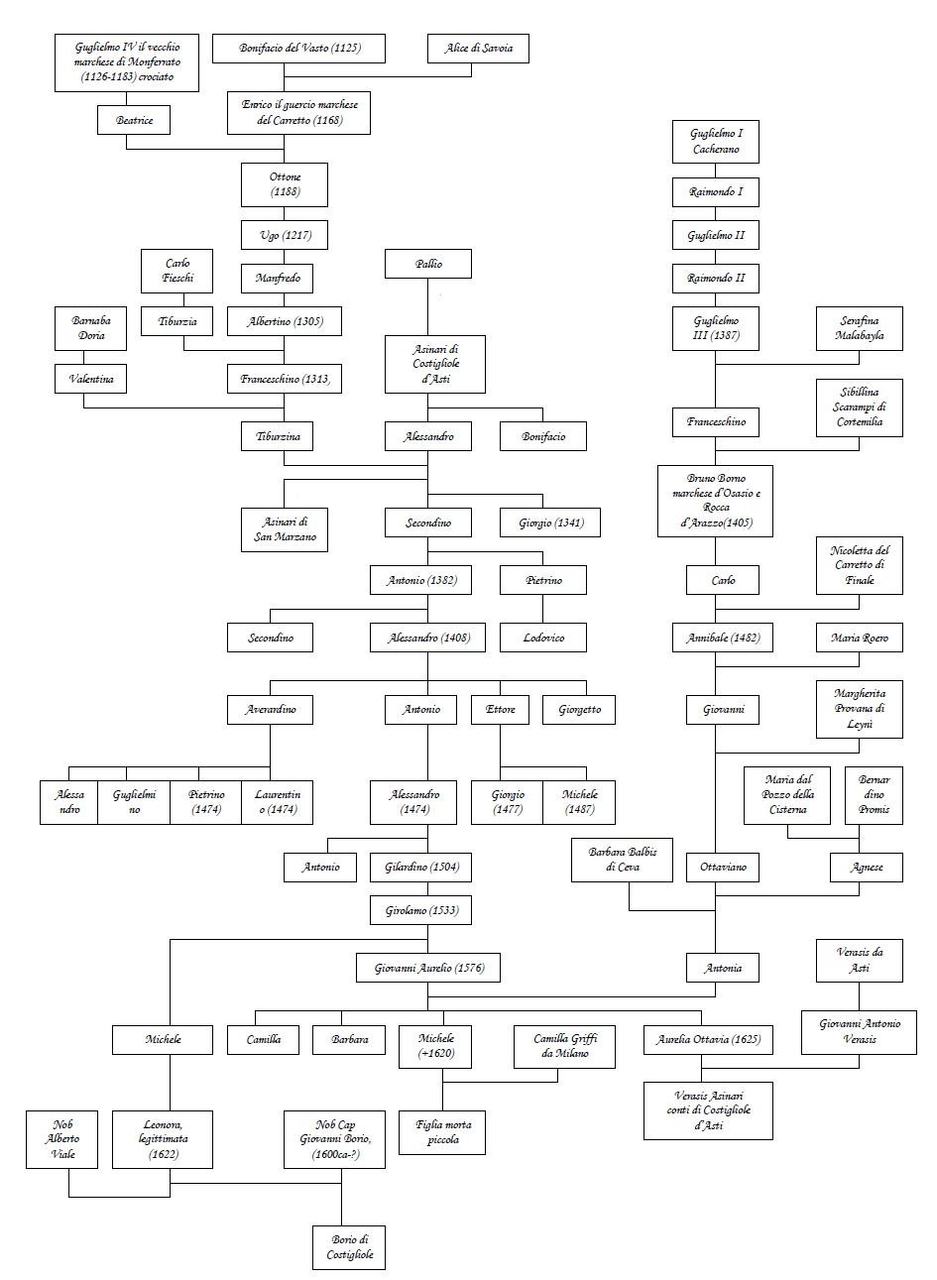
Originated by the Asinari branch of San Marzano, the chief was Alexander and his brother Bonifacio. The first had Secondino and George, the first lord of Costigliole (1341). Antonio, son of Secondino was the second lord (1382). The successors were Alexander, Antonio, Alessandro, Gilardino, Girolamo, Giovanni Aurelio.
Giovanni Aurelio (1576) married Antonia Cacherano d'Osasco and Rocca d'Arazzo and had Michael (died in 1620) and Aurelia Ottavia. Michele married Camilla Griffi from Milan and had a daughter who died small and an illegitimate daughter, Leonora, legitimized in 1622, who first went to marry the noble Giovanni Borio da Costigliole, captain of artillery of S.A., then to Alberto Viale. Count Aurelio Asinari noted that the family would be extinct due to the presence of female descendants.
As two of the three daughters (Barbara and Camilla) nuns clarisse in Asti, in the will of 24 May 1620, the count left the entire family heritage to the firstborn Aurelia Ottavia, provided that the son-in-law assumed name and coat of arms Asinari. When she married with the knight Giovanni Antonio Verasis, she was invested in the fief Costigliole d'Asti and all the possessions of the Asinari family, with the clause to add to the surname of her husband her own, founding the dynasty of the Asinari Verasis and decreting the extinction of the Asinari.
In 1854, Count Francesco Verasis Asinari of Costigliole d'Asti and Castiglione Tinella married the famous Virginia Oldoini and from this he had a son, Giorgio.
Households
Fitted and articulated was the settlement of the Asinari family in the city of Asti. In the area of Porta Arco (at the entrance to Piazza Alfieri, near the Teatro Alfieri) is...Explore this chapter
Fitted and articulated was the settlement of the Asinari family in the city of Asti. In the area of Porta Arco (at the entrance to Piazza Alfieri, near the Teatro Alfieri) is identified the oldest housing nucleus of the family, here was mentioned a "solarium Assinariorum" (1197 - 1198).
In the same area, but in later times, a palace owned by San Marzano is the Spanish Palace near Alfieri Theatre. The building still presents many friendly weapons in the interior porch of the Avalos family, owner of the building in the 15th century.
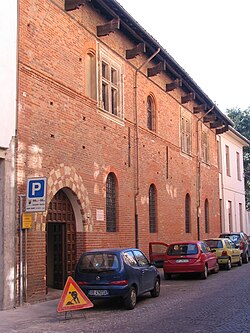
The Verasis-Asinari lived in the building in via Natta, between Via Milliavacca and Via Giobert still used as the seat of the conservatory "G. Verdi". It dates back to the 14th century, but was renovated in the Renaissance period. Built in sandstone and brick, it was part of a larger building complex of Gothic architecture, including Cattedrale, Giobert, Natta and Milliavacca streets. To the left of the door there was a tower reported in the map of the Theatrum Statuum Sabaudiae of 1671. The main floor has Renaissance "crossed" windows similar to those present in Palazzo Mazzola. In the 16th century the house became the property of the Verasis family. In the 19th century, Count Luigi Verasi-Asinari abandoned the palace to live in a luxurious palace in Turin and in 1933 the palace became the property of the Municipality of Asti.
The Asinari of San Marzano also owned a building in Corso Alfieri, corner via Carducci in the area once defined "caneto degli Asinari". The palace was inhabited by the family until the beginning of the 19th century, in the 18th century the tower was demolished.[14]
Also in the area, between Carducci streets, Caracciolo Massaia and Varrone, there was a "contrata Assinariorum" (1338). The area was still inhabited between the 16th and 17th centuries by some nobles of the family: the Asinari of Gresy, those of Soglio and Casasco. In the San Paolo district, Manuele and Bartolomeo Asinari had one in the fourteenth century "domus" near the convent of San Francesco.[15]
Coat of arms
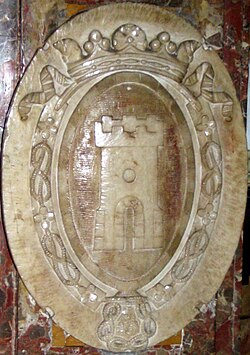
Shield :From the blue to the golden tower, the silver ferrata door, with the silver and red borderExplore this chapter

Lo stemma degli Asinari, è l'unico esempio in Asti di araldica con all'interno una costruzione architettonica (la torre). È probabile che questo si possa riferire alle molte infeudazioni della famiglia sul territorio astigiano. La bordura bianco-rossa dello stemma si rifà alla tipica bicromia delle famiglie legate all'Impero.[16]
Shield: From the blue to the golden tower, the silver ferrata door, with the edge made of silver and red
Cimiero: Asino nascente, alato d'oro
Motto: TV. ALFIN. VOLA.
Genealogy
Explore this chapter
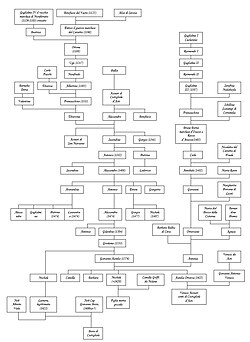
Genealogical tree in the main traits.
| Bonifacio †1280 | Raimondo 1254 | ||||||||||||||||||||||||||||||||||||||||||||||||||||||||||||||
| San Marzano Line | Camera line | Dusino Line | |||||||||||||||||||||||||||||||||||||||||||||||||||||||||||||
| Alexander | Bonifacio | Thomas | |||||||||||||||||||||||||||||||||||||||||||||||||||||||||||||
| Giorgio †1339 Lord of Costigliole d'Asti | Corrado †1372 | Franceschino †1367 Lord of Casasco | |||||||||||||||||||||||||||||||||||||||||||||||||||||||||||||
Gallery of portraits
Explore this chapter
-
 La Contessa di Castiglione, photographed by Pierre-Louis Pierson (about 1863-66)
Notes
Explore this chapter
- ^ Fat S., History of the City of Asti vol I, II. Ed anastatic, Atesa ed. 1987
- ^ The Asinari, up common.cartosio.al.it.
- ^ Renato Bordone, A family of Lombardi in Rhine Germany at the second half of the fourteenth century: the Asinari family, Journal of History Art Archeology for the provinces of Alessandria and Asti, Year CV, Year 1996.
- ^ Damn V., Asti ancient and noble houses. Il Portichetto 1982, pg.41
- ^ He had three sisters; Rosalia (death 1813), Luisa, and Carlotta. The first was a great grandmother of King Vittorio Emanuele II, through his marriage to Carlo Emanuele Balbo Bertone of Sambuy. Vittorio Emanuele, Prince of Savoy, Count of Turin (1870- ), up gsteinbe.intrasun.tcnj.edu (archived fromoriginal url on 9 July 2012).; Family tree André DECLOITRE - GeneaNet.
- ^ Damn V., Asti ancient and noble houses. Il Portichetto 1982, pg.38
- ^ Asinari Di San Marzano Filippo Antonio in the Treccani Encyclopedia.
- ^ Asinari Di San Marzano Carlo Emanuele Marchese Di Caraglio in the Treccani Encyclopedia.
- ^ Asinari Di San Marzano Ermolao in the Treccani Encyclopedia.
- ^ Asinari Di San Marzano Alessandro in Dizionario Biografico – Treccani.
- ^ A photo was for sale in May 2012 at the site ICharta - the ecommerce of paper collectors.[interrupted link] currently present in the private collection of J.P. van Dijk
- ^ Family tree André DECLOITRE - GeneaNet.
- ^ It is not, however, clear the question of the allocation of the title of Earl to the firstborn concerning the next line of the accounts of San Marzano: http://www.rivstoricavirt.com/rivstoricavirt_sito/CorpoNobt%E0.html[interrupted link]
- ^ Gabiani N., The towers of the fort houses and medieval noble palaces in Asti, A. Forni ed. 1978
- ^ Bera G., Asti buildings and palaces in the Middle Ages. Gribaudo Editore Se Di Co 2004 ISBN 88-8058-886-9
- ^ Natta-Soleri C., Fe' D'Ostani B., Adoption and diffusion of the weapon of kindness at the Astigian patriziate, from Araldica astigiana, Allemandi (edited by Bordone R.), C.R.A. 2001, pg.67
Bibliography
Explore this chapter
- A. Goria, «Asinari.». In: Biographic Dictionary of Italians, Vol. IV, Rome: Institute of the Italian Encyclopedia, 1962
- G. Bera, Asti buildings and palaces in the Middle Ages. Gribaudo Editore Se Di Co 2004 ISBN 88-8058-886-9
- A. White, Asti Medieval, Ed CRA 1960
- Asti at the time of revolution. Ed CRA 1960
- Renato Bordone, Araldica astigiana, Allemandi C.R.A. 2001
- From charity to credit. C.R.A. 2005
- L. Castellani, The businessmen. Politics and money Piemonte and Europe (1270 - 1312). Department of History of the University of Turin 1998 ISBN 88-395-6160-9
- Iron, Arleri, Campassi, Antique Cronists Auctionists, ed. dell'Orso 1990 ISBN 88-7649-061-2
- Nicola Gabiani, Asti in his main historical memories vol 1, 2,3. Tip. Vinassa 1927-1934
- The towers of the fort houses and medieval noble palaces in Asti, A. Forni ed. 1978
- Stefano Giuseppe Incisa, Asti in his churches and inscriptions C. R.A. 1974
- V. Damn it. Asti ancient and noble houses. The Portichetto 1982
- A.M. Patron, The Astigian House in Savoy, Dep. Subalpina of homeland history, Turin 1959
- Peyrot A., Asti and Astigiano, typ. Torinese Ed. 1983
- Quintino Sella, Codex Astensis here De Malabayla Comuniter nuncupatur, del Code detto De Malabayla, memoria di Quintino Sella, Accademia dei Lincei, Rome 1887.
- Stefano Giuseppe Incisa, Asti in his churches and inscriptions C.R.A. 1974.
Continue your journey