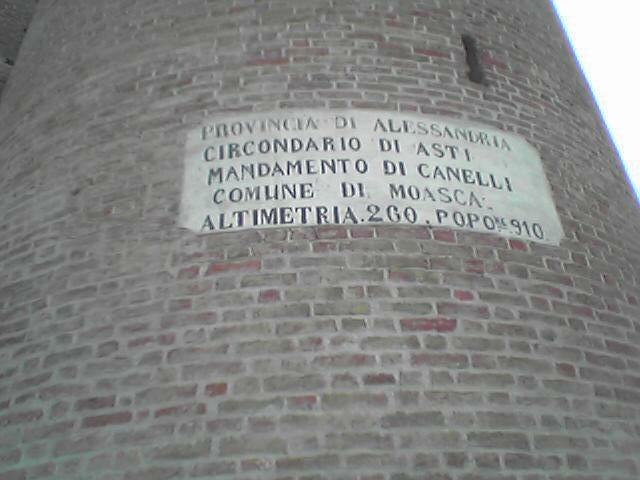
- Elevation
- 260 m above sea level
- Area
- 4.16 km²
- Demonym
- Mochaschesi
- Patron saint
- Saint Peter
A closer look
Discovering Moasca
Moasca (Moasca or Muzzle in Piedmont) is an Italian municipality of 509 inhabitants[1] from the province of Asti in the Piemonte. It is part of the Community Collinare between Langa and Monferrato including municipalities Canelli, Calosso, Castagnole delle Lanze, Coazzolo, Costigliole d'Asti, San Marzano Oliveto, Montegrosso d'Asti.
Landscape and area
The municipality is located between the Belbo River and Nice, about 25 km south of Asti . Coming from Calosso, along the valley that descends from Canelli (now 6 km from Moasca) the village...Explore this chapter
The municipality is located between the river Belbo And Nice, approximately 25 km south of Asti. Coming from Calosso, along the valley that descends from Canelli (6 km away from Moasca) the town appears to rest gently on a green hill, with a vast and flat top. The territory extends for approximately 4.13 km² on the hilly reliefs.
History of Moasca
SymbolsExplore this chapter
Symbols
The coat of arms and gonfalone were granted with DPR on 8 September 2000.
The gonfalone is a rectangular drape party of blue and yellow.
What to see in Moasca
The parish church · The castleExplore this chapter
The parish church
The parish church dedicated to St. Peter and the town hall is located in the centre of the village. The parish church is from the end of the seventeenth century and has remarkable reasons for interest. On the left of the parish church, of the same age, stands the fine church of San Rocco, in terracotta, with bell tower and porch, seat of the brotherhood of the Battuti.
The castle
The existing parts of the castle of Moasca are what remains of the building built in 1351 as we learn from an enigmatic written still today on the top of the entrance portal. The previous fortification was razed to the ground in 1308, after a long and difficult siege, are not known either origin or form. In order to understand the events that led to the destruction of the primitive castle it is necessary to remember the bloody intestine struggles that disturbed the municipality of Asti in the fourteenth century. The latter were linked to the clashes between Guelphs and Ghibellines. The reconstruction of the new castle, on the ruins of the previous one, took place only in 1351. Under the property of the Secco Suardo the interior of the medieval construction had certainly been embellished and made more comfortable. Of particular interest was, without doubt, the winery: it occupied the entire underground area of the castle; from the latter it still accessed the underground tunnels defined by the historian Astigiano "bottoms" used as prisons. The current municipal administration has started a program of recovery and enhancement of the existing structure proposing, after implementing urgent restoration interventions, the recovery of the vast basement.
Society
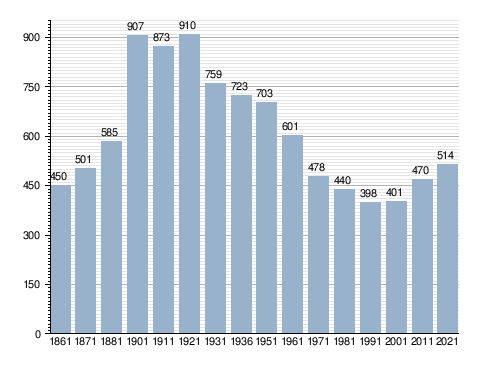
Demographic evolutionExplore this chapter
Demographic evolution
Inhabitants registered[5]
Economy
The economy is mainly based on agriculture: the cultivation of vine constitutes the primary source of income for farmers. Barbera d'Asti wines, Moscato...Explore this chapter
The economy is mainly based on agriculture: the cultivation of vine constitutes the primary source of income for farmers. Barbera d'Asti wines, Moscato d'Asti and Asti Spumante are undoubtedly the flagship of the enology of the place.
Administration
Below is a table relating to the administrations that have succeeded one another in this municipality.Explore this chapter
Below is a table relating to the administrations that have succeeded one another in this municipality.
| Period | First citizen | Match | Load | Notes | |
|---|---|---|---|---|---|
| 1 July 1985 | May 26, 1990 | Giuseppe Scaglione | - | Mayor | [6] |
| May 26, 1990 | April 24, 1995 | Giuseppe Scaglione | - | Mayor | [6] |
| April 24, 1995 | June 14, 1999 | Giuseppe Scaglione | center | Mayor | [6] |
| June 14, 1999 | June 14, 2004 | Andrea Ghignone | civic list | Mayor | [6] |
| June 14, 2004 | June 8, 2009 | Andrea Ghignone | civic list | Mayor | [6] |
| June 8, 2009 | May 26, 2014 | Maurizio Bologna | civic list | Mayor | [6] |
| May 26, 2014 | May 26, 2019 | Andrea Ghignone | Civic list Parità transparency | Mayor | [6] |
| May 26, 2019 | in office | Andrea Ghignone | Civic list We Moasca | Mayor | [6] |
Notes
Explore this chapter
- ^ to b Monthly demographic balance for the year 2026 (provisional data), up demo.istat.it, ISTAT.
- ^ Seismic classification (XLS), up risks.protezionecivile.gov.it.
- ^ Table of degrees/day of Italian Municipalities grouped by Region and Province (PDF), in Law 26 August 1993, n. 412, annex A, National Agency for New Technologies, Energy and Sustainable Economic Development, 1 March 2011, p. 151. URL consulted on 25 April 2012 (archived fromoriginal url on 1 January 2017).
- ^ Piedmontese civic coat of arms, vol. II, Regional Council of Piemonte, 2016, p. 303, ISBN 978-88-96074-98-5.
- ^ Data taken from:
- Resident population of the municipalities. Censuses from 1861 to 1991 (PDF), up ebiblio.istat.it, ISTAT.
- Resident population - Time series, up exploredati.istat.it.
Please note: 2021 data refers to permanent census data as of December 31 of that year.
- ^ to b c d And f g h https://amministratori.interno.it/
Where to stay · Moasca
Find stays on Booking.comThe area, step by step