Atlas of Monferrato
Montegrosso d'Asti: sights, history and trails
Asti
- Elevation
- 244 m above sea level
- Area
- 15.42 km²
- Demonym
- Montegrosses
- Patron saint
- San Rocco
A closer look
Discovering Montegrosso d'Asti
Montegrosso d'Asti (Mongròs in Piedmont) is an Italian municipality of 2 323 inhabitants[1] from the province of Asti in the Piemonte.
The entire area is part of the UNESCO World Heritage Site.
Landscape and area
The municipality of Montegrosso d'Asti is located about 15 km from Asti, in the historical and wine region of Astesana .Explore this chapter
History of Montegrosso d'Asti
Origins of the territory · The Low Middle Ages · Between Guelphs and GhibellineExplore this chapter
Origins of the territory
Five million years ago, the Astisan presented itself as a deep sea no more than 200 meters. The territory where Montegrosso would have been located in the center of a sea basin. After the accumulation of sediments, mostly transported to sea by watercourses, provoked the rise of the seabed and the formation of sand deposits that went to constitute the upper layers of numerous hill reliefs. Two/three million years ago, the territory was like a vast covered plain, dotted with ponds and swamps. Fossils testify to which fauna had its habitat in it: rhinoceros, mastodons, elephants, hyenas and cheetahs. A million and eight hundred thousand years ago the so-called Ice Age began. The fossils of this period present a modified biotic environment due to the harshest climate: the conifers abound and the mammuth appears.[4].[This paragraph is inappropriate here: it does not contain specific information about Montegrosso. It would be better in a section of the voice on the Province of Asti.]
The Low Middle Ages
The local tradition traces back to 1134 the foundation of the country, when the survivors of a pestilence that struck the nearby places would settle on the hill of the current inhabited trying to escape the epidemic in place. Also according to tradition the Marquis Bonifacio del Vasto would have made you build a castle with two towers that were later destroyed by Federico Barbarossa. In fact Montegrosso was born as a villanova at the initiative of the municipality of Asti, who on 18 January 1198 granted citizenship to the inhabitants of some villages in the Tiglione valley together with the right to join forces for the foundation of a new inhabited centre.[5] It was the villages of Monte Leuco (today Bricco Lu in the municipality of Costigliole d'Asti), of Messadio (now a hamlet of Santo Stefano di Montegrosso), of Caprarolio (formerly in the municipality of Isola d'Asti) of Vigliano d'Asti and Island, which the City of Astese wanted to remove from direct or indirect control exercised there by Manfredi I Lancia count of Loreto. The pacts were signed by Anselmo Piria di Monteleuco, Anfosso Camolato di Messadio, Enrico Mosca and Astesano Moranio on their behalf and the Homines that from then on they were under the jurisdiction of Astigiana. The villanova of Montegrosso was realized shortly after: in 1205 it is already built and active[6] and in 1207 there is the church of San Secondo[7]. Since then the town remained uninterruptedly under the direct dominion of Asti, and from the mid-14th century it was permanently included in the Districtus Civitatis Astensis, a territorial formation composed of twenty municipalities and villages that could not be ceded in fief but which had to remain in the patrimony of the Astese Republic[8].
Between Guelphs and Ghibelline
That's right. status of a country village forced Montegrosso a heavy involvement in the course of civil wars that in the first decades of the fourteenth century saw opposition in Asti the members of the Guelph party and the Ghibelline Party to the conquest of power over the city and its vast territory. The most dramatic events took place in the year 1316. In March, the Astisan Ghibellines, which the Guelphs had driven out of the city, under the command of Marquis Incisa della Rocchetta attacked Montegrosso at night and managed to capture it with ease thanks to the betrayal of a certain Giacomo Gambino; the terrified inhabitants fled, but many were imprisoned and forced to pay heavy ransomsoms; the sack attackers[9] making the country a basis for their guerrilla operations. The Guelph reaction did not wait long: the following 26 July the Astilian army, commanded by the Angevinian siniscal Ricciardo Gambateisa, besieged Montegrosso, winning in four days the resistance of the occupants and expelling it on 30 July. The retaliation was terrible, and the country was not only plundered again, but also burned and destroyed.[10].
According to some scholars of the 19th century Cardinal Bertrando del Poggetto, sent by Pope John XXII to counter the expansionism of Matteo Visconti, settled in Montegrosso in 1319 and the following year hosted the future king of France Filippo di Valois, who had come up with an army of thousand knights to support the Guelph cause. In fact, the events took place in the city of Asti, where the cardinal resided between 6 August 1320 and 19 February 1322[11]. Towards the middle of the fourteenth century the ancient castle, originally composed of a two-storey stronghold placed on a strong embankment[12], was enlarged and qualified with the addition of two lateral wings and four cylindrical corner towers, two of which were then demolished in subsequent periods[13].
The Roero of Montegrosso.
Not being Montegrosso a feudal country, the Municipality of Asti elected you Podestà, while the governor of the city appointed it Castellano. The first lasted one year, and was chosen among the members of the Astigian Municipal Council; the second, who was in charge of military defence, had a vital character and not often hereditary. Already in 1385 we find a Bartolomeo Roero in the charge of Podestà[14] and later Castellania is permanently entrusted to its descendants, who from the beginning of the XVI will take the title Roero di Montegrosso[15]. The Roero family was one of the richest and most influential families in Asti, enriched disproportionately in the 13th and 14th centuries with the practice of trade and lending, and later became a purely feudal dynasty with the acquisition of a large number of villages and lands in Astesana and in the whole Piemonte. In 1618 Duke Carlo Emanuele I of Savoy Lord of Asti and his County, in need of money, abolishes the ancient Districtus Civitatis Astensis of which Montegrosso is a part, and has the sale of jurisdictions of the twenty countries that compose it. The sale and infeudation of Montegrosso will take place in 1619 for the benefit of Giovanni Bartolomeo Roero, who dies without children in 1659, leaving the fief in inheritance to his brother Percivalle. On the death of him without sons, Montegrosso is divided in half between the two daughters: Antonia Girolama married Coardi di Carpeneto and Silvia Margherita married Gonteri di Cavaglià. In 1715 the fief passed to the sons of the last descendants of the Roero di Montegrosso: Filiberto Giacinto Gonteri, Marquis of Cavaglià and Nicola Coardi, Count of Quarto and Carpeneto. In 1758 he was sent to the Marquis Carlo Maurizio Gonteri resident in Casale Monferrato and Baron Carlo Cesare Coardi of Carpeneto living in Turin. In 1789 the entire feud became in the hands of Carlotta Gonteri who brought it to dowry to her husband Alessandro Doria Eleazzaro Marquise del Maro and Cirié[16].
Montegrosso in the middle of the 18th century
In 1748 the Treaty of Aachen put an end to the long war of Austrian succession which had heavily involved the Kingdom of Sardinia: Asti and the lands of theAstesana They were invaded and occupied by Franco-Spanish troops between 1745 and 1746, bearing heavy war damage. In order to facilitate reconstruction, the Finance Intendents were required to draw up detailed reports on the state of the provinces entrusted to them. The steward of the province of Asti, Count Giovan Francesco Balduini of Santa Margherita, carried out his reconnaissance between 1750 and 1753, and the detailed report that followed it constitutes a precious historical document that allows us to know in detail the economic, demographic and social conditions of the lands of Asti during those years.[17]. Below are some paragraphs and some interesting data.
The country
"He is a united and not divided place in borders, located above a hill surrounded by small valleys (...) distant gives foreign states, that is from the Pavese miles forty, and from the Genovesato miles twenty-five. The goods of this territory consist of meadows, vineyards, fields and woods. (...) For common pastures, we serve seventy tables of zerbid around the walls of the Castle, and other ten plates of zerbid in the region of Bagnerio, such as, although they are not enough for the grazing of all the beasts of the place, however, to this end the repeated streets and meadows of the valleys. The forests, to be all sold and of reason of the inhabitants, are nothing but for their mouths, and since the soil is of its nature of good quality and well cultivated, beyond the plants, which are observed in good number, maximum of dead[18] He insinuated himself to the administrators to plant others. (...) Here there are no preconditions or risses, and of the heads of house n° 317 that composes the pre-eminent place, the most doviziosi that they will have thousand lire of annual income are the lords: Giovanni Serra, Giovanni Battista Curto, Francesco Capra and Giambattista Bianco. The others maintain themselves and with the economy and agriculture of their goods, because industry cannot carry them any useful means to be free of trade and manufacturing, which for ignorance of peasants would not find a way to introduce. (...) The judge is non-resident, and there is a notary, a doctor, a special and a surgeon."
Economic reality: wine, truffles and fatigue
"Of the annual income (...) inhabitants do not have enough for their maintenance, for whose supplement, as it can ascend to six hundred bags of granules, is part traced with the price of 250 carra of wine that, overflowing to their use, mostly sells in the cities of Turin and d'Asti, and on the other hand they are urged to procacciarsele with their daily labors and glue reaping of the grains and risi in the province of Lomellina, as well as research of tarufoles, such as in time of abundant finding can profit them lire three hundred annual"
The castle
"The feudal castle, which remains located in the middle of the place, formed to the ancient with high and strong walls, equipped with civil dwelling, can serve to shelter the urban troops in occasion of wars, as is followed in the last invasion of the enemy".
Agriculture
From the data of the Report in specific tables, it is learned that the agricultural area of the municipality of Montegrosso was 4.279 days[19] (1,646 hectares). The vineyards occupied the largest part, equal to 1,791 days (689 hectares). The total production of wine in 1750 was found to be 3,750 hectoliters, equal to a very low yield of approximately 5.5 hectoliters per hectare.[20] However, as previously reported, more than a thousand hectolitres were marketed on the Asti and Turin markets.
The arable fields occupied 1,300 days (500 hectares). The wheat harvest was 3.625 quintals, the corn of 849 quintals.[21].
The stable meadows occupied 971 days (373 hectares). Already very important was the breeding of silkworm, from which 6000 kilograms of cocoons were obtained. Less important is the production of hemp and flax, which ascended altogether to 2,250 kg fiber.
The cattle breeding was widespread, indeed essential for the livelihood of peasant families. At the time, there were 128 working oxes and 336 triple-actitude cows, i.e. work, milk and meat. It should be noted that, on average, every family of Montegrosso owned at least one head of cattle.
Symbols
The coat of arms and gonfalone of the municipality of Montegrosso d'Asti were granted by decree of the President of the Republic of 18 February 2011.[22]
The three wheels and the motto are drawn from the blason of the Roero family.
The gonfalone is a truncated drape of red and yellow.
Society
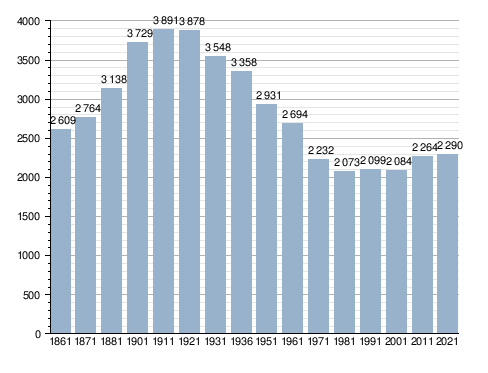
Demographic evolutionExplore this chapter
Demographic evolution
Inhabitants registered[23]
Infrastructure and transport
Railway linesExplore this chapter
Railway lines
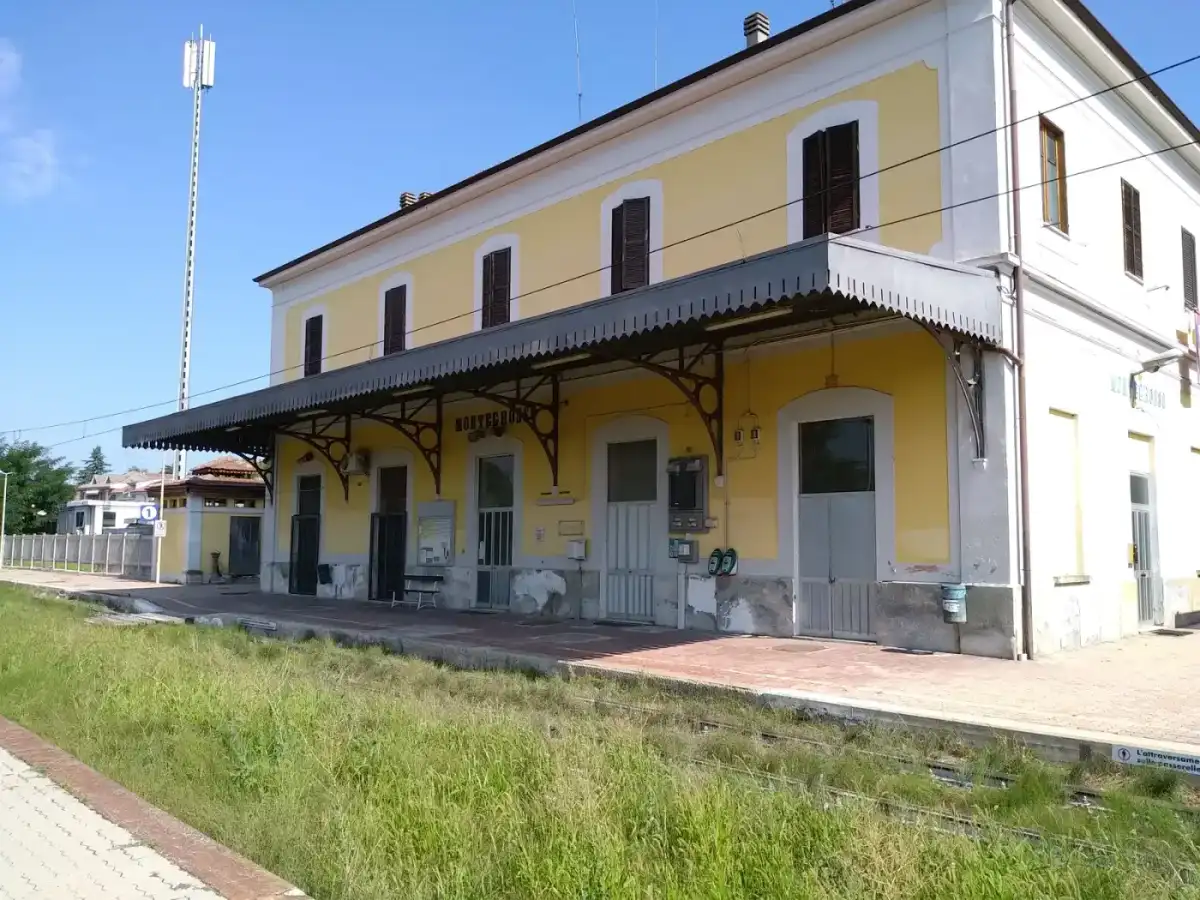
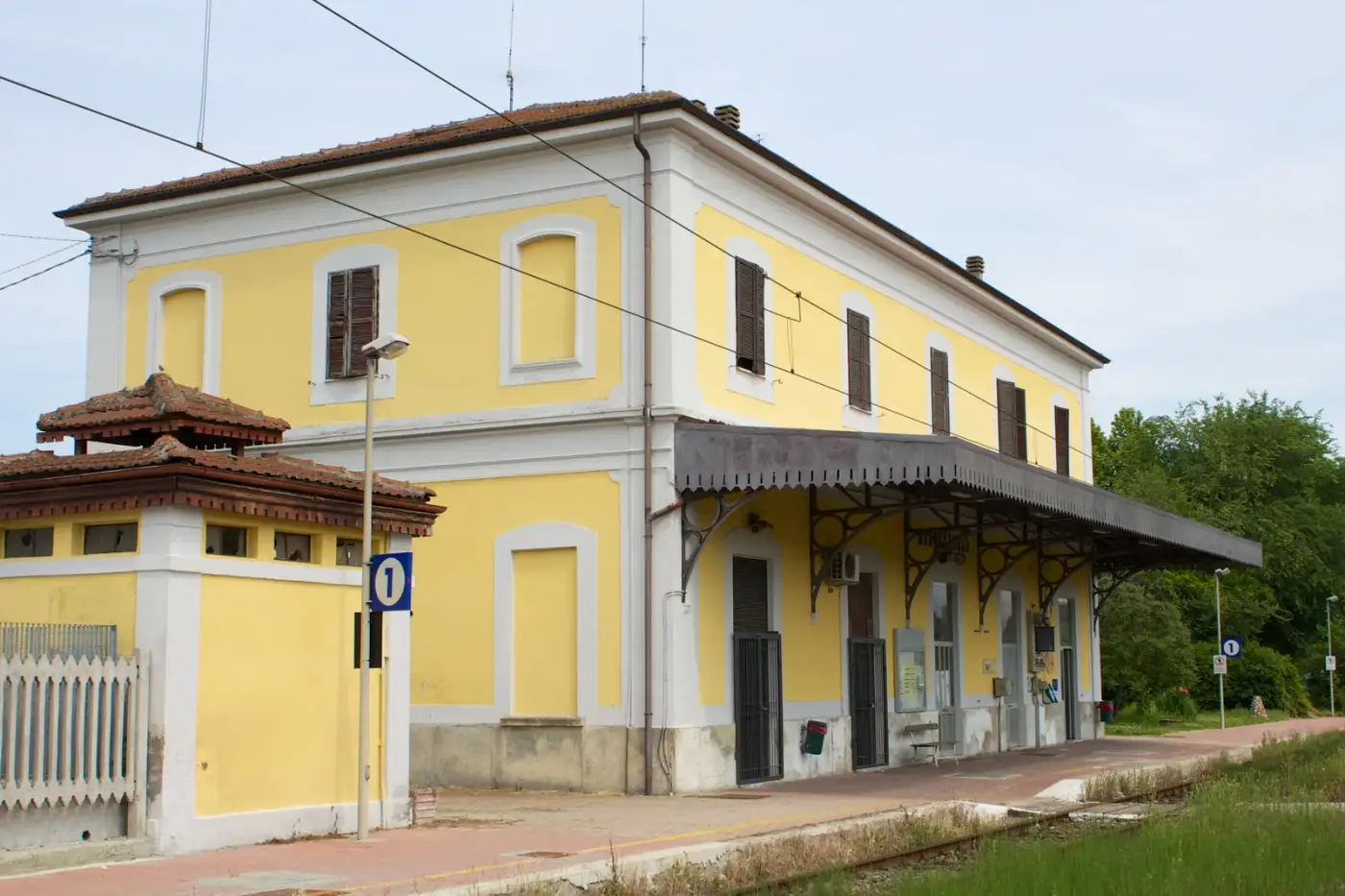
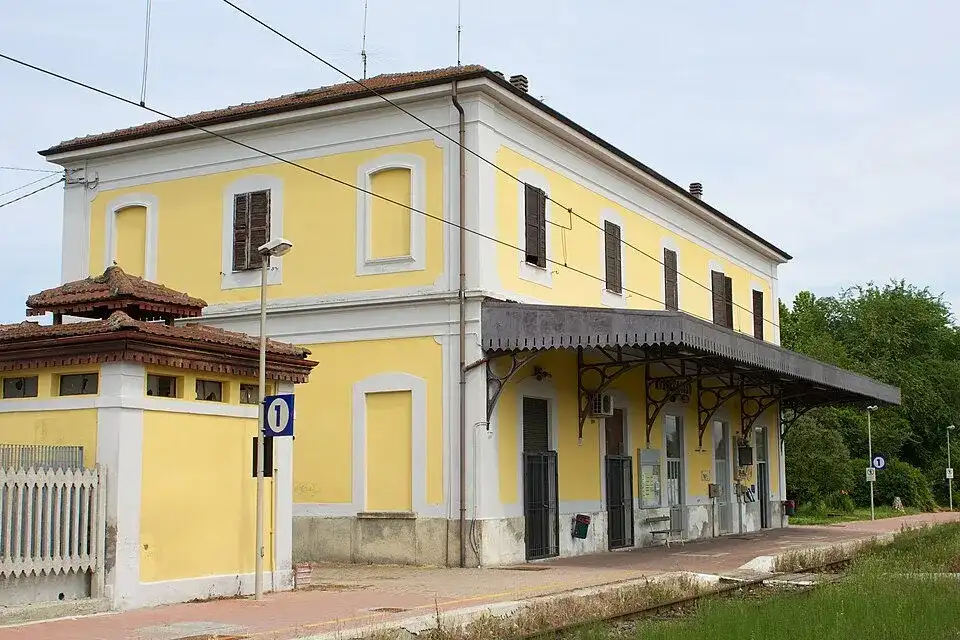
At the ex Montegrosso Station, now only stopped, passes the Asti–Genoa railway line. The airport is served by the director's regional trains Asti–Acqui Terme.
Inside the premises of the building, accessible from the square in front, is the Municipal Library, entitled to Enrico Paulucci.
Administration
Below is a table relating to the administrations that have succeeded one another in this municipality.Explore this chapter
Below is a table relating to the administrations that have succeeded one another in this municipality.
| Period | First citizen | Match | Load | Notes | |
|---|---|---|---|---|---|
| November 28, 1986 | June 10, 1990 | Franco World | Italian Democratic Socialist Party | Mayor | [24] |
| June 10, 1990 | November 17, 1993 | Luciana Piumatti Adamo | - | Mayor | [24] |
| November 17, 1993 | June 27, 1994 | Court of Justice | Comm. Overtime | [24] | |
| June 27, 1994 | May 25, 1998 | Delphine World Pia | - | Mayor | [24] |
| May 25, 1998 | May 28, 2002 | Mauro World | civic list | Mayor | [24] |
| May 28, 2002 | May 29, 2007 | Mauro World | civic list | Mayor | [24] |
| May 29, 2007 | 7 May 2012 | Marco Curto | civic list | Mayor | [24] |
| 7 May 2012 | June 10, 2017 | Marco Curto | list Civic Montegrosso for all | Mayor | [24] |
| June 11, 2017 | June 12, 2022 | Marco Curto | list Civic Montegrosso for all | Mayor | [24] |
| June 12, 2022 | in office | Monica Masino | list Civic Montegrosso for all | Mayor | [25] |
Image gallery
Explore this chapter
-
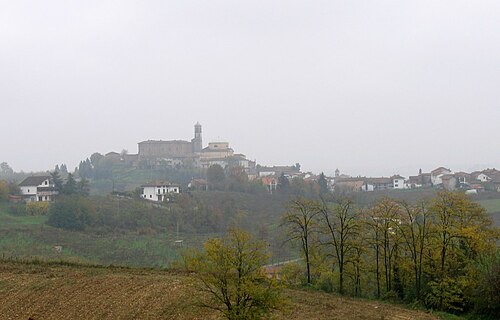 Montegrosso Country seen from Vigliano d'Asti
-
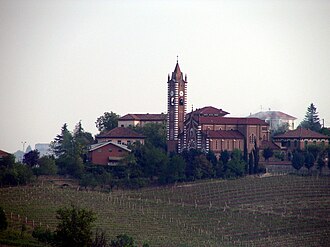 Santo Stefano di Montegrosso
Notes
Explore this chapter
- ^ to b Monthly demographic balance for the year 2026 (provisional data), up demo.istat.it, ISTAT.
- ^ Seismic classification (XLS), up risks.protezionecivile.gov.it.
- ^ Table of degrees/day of Italian Municipalities grouped by Region and Province (PDF), in Law 26 August 1993, n. 412, annex A, National Agency for New Technologies, Energy and Sustainable Economic Development, 1 March 2011, p. 151. URL consulted on 25 April 2012 (archived fromoriginal url on 1 January 2017).
- ^ Laura Cantamessa, Edvige Zoppegni, Paleo-environmental evolution of Astigiano, Asti, 1995.
- ^ "Codex Astensis qui de Malabaila communiter nucupatur", document 276.
- ^ "Codex astensis..." Cit. document 311
- ^ "Codex astensis..." cit. document 562
- ^ Renato Bordone: "Asti provincial capital and heritage of a medieval state", in “Society and history”, 44 (1989), pp.283-302
- ^ Memorial of Guglielmo Ventura, chapter 86, in "Chronic Antiques Auctionists" edited by Natale Ferro, Elio Arleri, Osvaldo Campassi; Alessandria 1990, p.129
- ^ Memorial of Guglielmo Ventura, cap. 93, in "Austrous chronic antics" cit. p.133
- ^ Memorial of Guglielmo Ventura, chapters 102, 103, 105, in "Austrous chronic antics" cit. p.141 and following
- ^ The original 13th century house is still visible and it forms the north side of the current castle; at its corners are still evident traces of the two demolished towers.
- ^ The expansion and modernization works had as a reference model the nearby castles of Costigliole d'Asti and Moasca.
- ^ Historical architect of the Municipality of Asti, Ordinati Comunali of the year 1385, manuscript.
- ^ State Archives of Turin, Chamber of Accounts, Senate, s. II, cat. 22, Cairo Scaramps.
- ^ Francesco Guasco di Bisio: "feudal dictionary of the Sardinian States and Lombardy" Pinerolo 1911, p. 1075
- ^ Giovan Francesco Balduini di Santa Margherita: "General Report of the Intensive Asti on the state of the Province" edited by Società di Studi Astesi, 2010. Introduction by Andrea Merlotti.
- ^ Leaf jelly for the breeding of silkworm.
- ^ The "day" is the typical Piedmontese unit of surface: it is equivalent to 3,810 square meters.
- ^ The figure should not be surprising, and it is part of the average productions of the hills of the Astigian period. The vineyards of the time are mostly in promiscuous culture, with low density rows of hectare strains, cultivated in arable or stable meadow and scattered with fruit trees.
- ^ In contrast to the Lombard, Venetian and Emilian plains, corn cultivation spread on the hills of Astigian only during the first half of the eighteenth century.
- ^ Montegrosso d'Asti (Asti) D.P.R. 18.02.2011 concession of coat of arms and gonfalone, up Presidency.governo.it.
- ^ Data taken from:
- Resident population of the municipalities. Censuses from 1861 to 1991 (PDF), up ebiblio.istat.it, ISTAT.
- Resident population - Time series, up exploredati.istat.it.
Please note: 2021 data refers to permanent census data as of December 31 of that year.
- ^ to b c d And f g h the http://amministratori.interno.it/
- ^ elections. interno.gov.it, https://elezioni.interno.gov.it/comunali/scrutini/20220612/scrutiniGI010070760 Missing title for url
url(help).
Where to stay · Montegrosso d'Asti
Find stays on Booking.comStories, places and people
More about Montegrosso d'Asti and the surrounding area
Follow a thread of history and see where it leads.
The area, step by step
Trails and routes in Montegrosso d'Asti
 Mountain bikeAround the starting point
Asti, Alessandria and surroundings