- Elevation
- 399 m above sea level
- Area
- 15.72 km²
- Demonym
- warming
- Patron saint
- Saint Alexander Sauli
A closer look
Discovering Calosso
Calosso (Calòs in Piedmont) is an Italian municipality of 1 096 inhabitants[2] from the province of Asti in the historical territory ofAstesana, in Piemonte.
It rises on a high hill whose name derives from the Roman kindness Callocius or Callucius, as indicated by Olivieri in 1965.
It is located not far from the municipalities of Canelli And Costigliole d'Asti, among the valleys of Nice and Tinella. With its 399 meters of altitude on the sea level is the highest country in the diocese of Asti, and it constitutes an exceptional view over the wholeAstesana and the neighbouring Langhe.
History of Calosso
SymbolsExplore this chapter
The first document in which the country is mentioned is an act of 960 that mentions a certain Arimanno de Calocio as witness of a permutation of land by Brunengo, Bishop of Asti between 934 and 964.
At the beginning of the 12th century Calosso joined the consortium of Acquosana together with the lords of Agliano Terme, Vinchio, Canelli, San Marzano Oliveto And Castelnuovo Calcea. Consortium created to protect minor fiefdoms from the expansionist aims of the abstaining families (such as the Asinari, the Roeros, the Solaros, i Natta etc.).
In 1318, the commune was involved in the phases of civil war which broke out in the surrounding area. Asti between the Solar Guelphs and the De Castello Ghibellines. The Guelphs, in addition to the castle of Moasca, they also destroyed the castrum of Calosso that was immediately rebuilt. Towards the end of independence of the Free Municipality of Asti and precisely in 1377, the entire fief of Calosso is purchased by the noble quay of Astigiano Percivalle Roero. Ten years later, in 1387, we find Calosso among the possessions of Valentina Visconti's dowry, married to Luigi d'Orléans. Following the marriage, Asti County became entirely French possession. They'll be followed by a hundred and fifty years of French rule.
In 1531 Calosso, with the County of Asti, became part of the territories controlled by Savoy and with the beginning of the 17th century and the War of Succession of Monferrato, is involved in an infinite series of occupations by various passing armies. In fact, at the beginning of the 17th century Calosso was besieged by the Spanish and later recovered by the Savoy, thanks also to Captain Catalano Alfieri who, at the head of the French troops, made cingere of huge marshes throughout the castle.
Fortunately with the peace of the Pyrenees of 1659, Calosso loses its strategic importance and its castle, as an imposing sixteenth century fortress, is transformed into a country residence of the Roero family.
The fortified complex was rebuilt several times after the previous war events. In the south, in addition to the tower lowered on a cylindrical base connected to the palace by an arch, there is the so-called "old castle", where the church of San Martino is located, already mentioned in 1203, inside the fortified city.
Symbols

The coat of arms and gonfalone of the municipality of Calosso were granted by decree of the President of the Republic Carlo Azeglio Ciampi of 19 July 1999.[5]
- Coat of arms
- Banner
The gonfalone is a white drape with the edge of red.
- Flag
The flag is a red rectangular drape at the cross of white.
What to see in Calosso
The castle of CalossoExplore this chapter
The castle of Calosso
For more than a millennium its imposing silhouette has been vigilant, from the top of the hill that stands between the valleys of Nice and Tinella, on the town of Calosso. Longevous testimony of the events that occurred to this small village, the castle marks its history through the eras, retraceable, until lost in the Middle Ages. Because from here, from before the year 1000, it starts its history, as this period is found the first traces, albeit vague, of its existence. Traces that, although confused by the numerous interventions made to its original structure following war events and restructurings, allow to fix the highlights of the evolution of the ancient manor. In fact, we know that in 1318 the village of Calosso is involved in the conflict between the guelphs of the Solaro family and the Ghibelline faction of De Castello di Asti. The Guelphs destroy the entire castrum of Calosso.
In 1377, the entire fief of Calosso was purchased by a noble Astigian banker, the Marquis Percivalle Roero di Cortanze.
In 1387 Calosso with his castle was one of the possessions of the dowry of Valentina Visconti, who married Luigi d'Orléans.
On October 11, 1592, during a pastoral visit, St. Alexander Sauli, bishop of Pavia (diocese from which Calosso was dependent), was "surprised by a serious and dangerous disease in the castle of that place, where Fr Ercole Roero had stayed" (according to G.S. De Canis, 1816).
The death of the bishop aroused such an impression that in 1683 the chamber of the castle was converted into public oratory and, in his honor and perpetual memory, the inhabitants of Calosso indicated on the same day the patronal feast.
At the gates of 1600, we find Calosso besieged by the Spaniards and later recovered by the Savoy, thanks also to Captain Catalano Alfieri who, at the head of the French troops, cries enormously swamped all the castle.
We then go to the Peace of the Pyrenees of 1659, when the fortress of Calosso loses its strategic importance and is transformed by the Roero family of Cortanze, lords of Calosso, in an elegant and noble country residence, to take on the connotations still presently found. Following these transformations the castle loses its original physiognomy of the imposing 16th-century fortress that cingeva within its walls the entire historical village, composed among other buildings, by the church of San Martino. The cylindrical turret remains and the access arch to the reception. Currently of small size compared to the original one, the structure is traceable to a series of L-shaped bodies, dominated by the massive cylindrical tower adorned by hanging arches and perfectly intact guelph merlons.
Of particular interest are then the five hundred-century bastions, which were also unaltered, which characterize the north side of the fortress. The walls of this segment, overlooking the large park, still presents the wounds and openings of the crates, structure bomb proof, introduced after the adoption of artillery, both offensive - aimed at hosting vents from fire - that defensive, intended to shelter men and materials; moreover it is still possible to see a posterla, narrow and low passage through the walls. The access to the inner courtyard is presided over by a typically sixteenth-century portal that, in ornamentation of the upper section of the stipete, the coat of arms of the Roero family, depicting three wheels, and the Gavigliani family, depicting two roses divided by a horizontal band.
The current owners are the Conti Balladore Pallieri, direct descendants of the Roero di Cortanze.
Society
Demographic evolution · Foreign ethnic groups and minorities · ReligionExplore this chapter
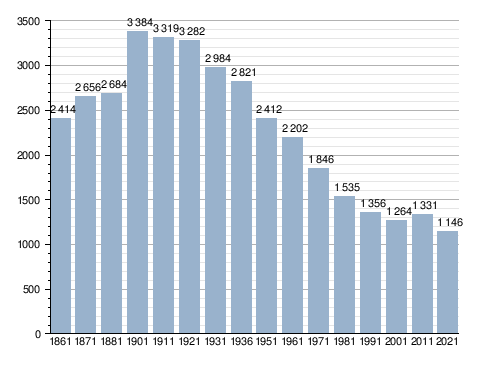
Demographic evolution
Inhabitants registered[7]
Foreign ethnic groups and minorities
According to ISTAT data at 31 December 2009, the resident foreign population was 147 people. The nationalities most represented by their percentage of the total population living were:
- Macedonia Republic 81 6,09%
- Bulgaria 21 1.58%
Religion
The parish
There is little documentary information on the parish of San Martino. Intitled in San Martino, bishop and confessor, raised in the last decades of the '600, the church presents itself with a facade rich of friezes in its central, high and slender part, consisting of two superimposed bodies divided with hysenas and ending with a timpane. Towards the end of the 19th century, the baroque construction was deeply restructured: in 1896, in fact, the building was expanded on its sides, at the expense of the side chapels. It was evident that then the 18th century frescoes attributed to De Canis and to the youth period of the canellese Giovanni Carlo Alberti, lived between 1670 and 1727. Between 1929 and 1930, the decorations of the vault and walls were made by Monsignor Bosio's express will. On the side of the sail rises the bell tower of 42 meters.
Culture
Events · The Rapulé Fair [ 8 ]Explore this chapter
Events
The Rapulé Fair [ 8 ]
The municipal administration of Calosso organizes every year the Rapulé Fair, which generally takes place on the third weekend of October and takes its name from the "rapulin" collection operation, that is the smaller bunches that remain after the harvest of grapes.
The festival offers a wine and wine tasting with wines and typical dishes between crotìn, the cellars dug in the tuff that preserve the best wine.
The village of the country comes for two days animated by music, exhibitions and theatrical events. The Rapulé Fair is an ideal opportunity to visit the Calosso Castle, kindly open for the occasion by the owners, the Baroque Church and the restored wooden choir of the Parish of San Martino and the four ancient steps of the historic center.
Economy
The farms in the country are very numerous and flourishing. The most practiced cultivation is the vine, and fruit trees. There are many DOC wines, among which...Explore this chapter
The farms in the country are very numerous and flourishing. The most practiced cultivation is the vine, and fruit trees. There are many DOC wines, among which we can remember Moscato d'Asti and Barbera d'Asti Superiore.
Administration
Below is a table relating to the administrations that have succeeded one another in this municipality.Explore this chapter
Below is a table relating to the administrations that have succeeded one another in this municipality.
| Period | First citizen | Match | Load | Notes | |
|---|---|---|---|---|---|
| June 10, 1985 | May 28, 1990 | Gualtiero De Michelis | Christian Democracy | Mayor | [9] |
| May 28, 1990 | April 24, 1995 | Gualtiero De Michelis | Christian Democracy | Mayor | [9] |
| April 24, 1995 | June 14, 1999 | Franca Serra | centre-right | Mayor | [9] |
| June 14, 1999 | June 14, 2004 | Franca Serra | civic list | Mayor | [9] |
| June 14, 2004 | June 8, 2009 | Francesca Dalcielo | civic list | Mayor | [9] |
| June 8, 2009 | May 26, 2014 | Giuseppe Ugonia | civic list | Mayor | [9] |
| May 26, 2014 | May 27, 2019 | Giuseppe Ugonia | Civic list People ideas commitment | Mayor | [9] |
| May 27, 2019 | May 22, 2025 | Pierfrancesco Migliardi | civic list Living and improving together | Mayor | [9] |
Image gallery
Explore this chapter
-
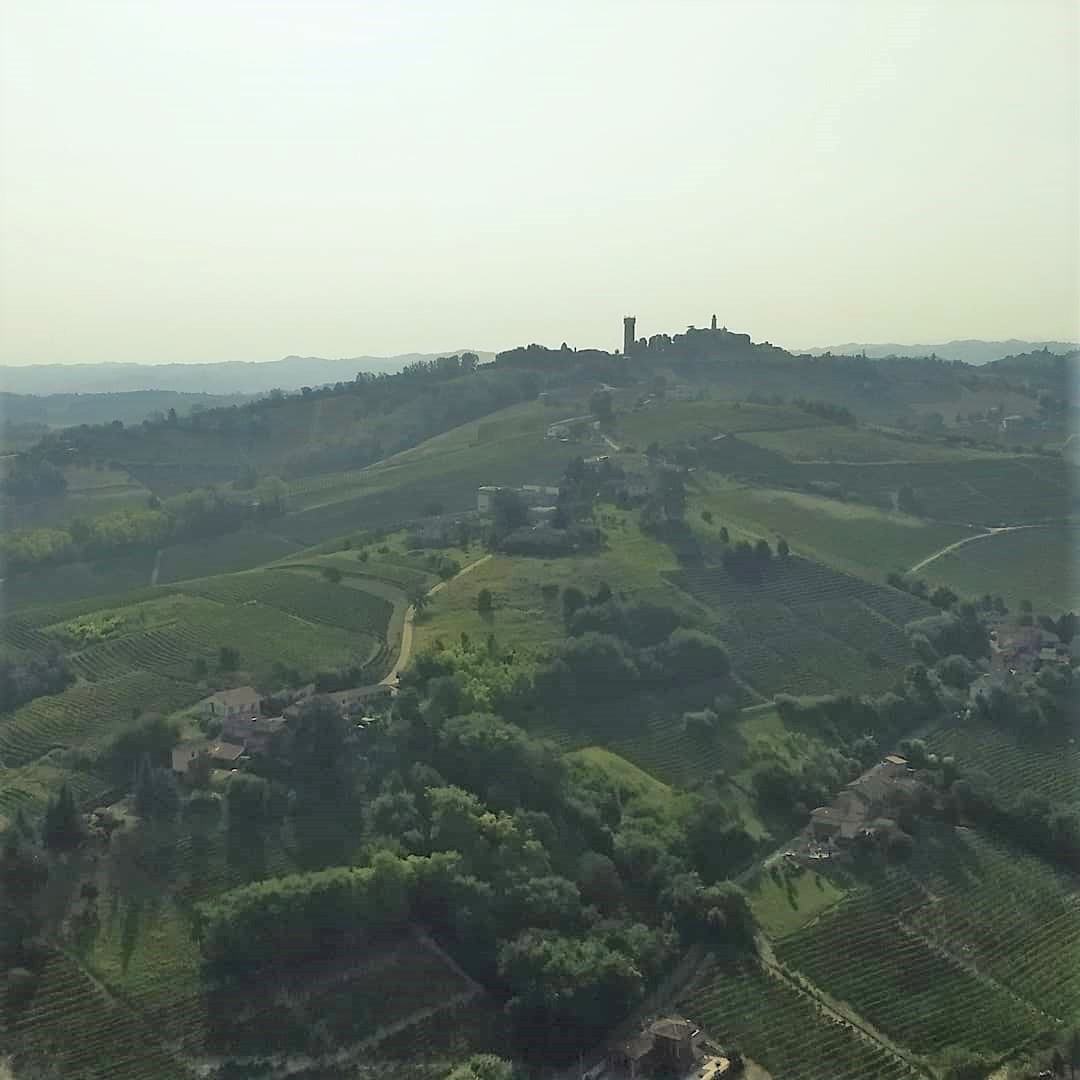
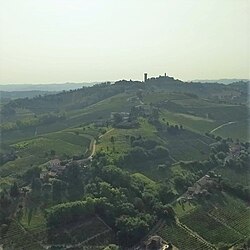 Aerial view of the rural landscape near Calosso
Notes
Explore this chapter
- ^ Municipality of Calosso : Municipal Administration and Mayor - City of Calosso and city, Asti, Piemonte, up www.comune-italia.it. URL consulted on 5 August 2026.
- ^ to b Monthly demographic balance for the year 2026 (provisional data), up demo.istat.it, ISTAT.
- ^ Seismic classification (XLS), up risks.protezionecivile.gov.it.
- ^ Table of degrees/day of Italian Municipalities grouped by Region and Province (PDF), in Law 26 August 1993, n. 412, annex A, National Agency for New Technologies, Energy and Sustainable Economic Development, 1 March 2011, p. 151. URL consulted on 25 April 2012 (archived fromoriginal url on 1 January 2017).
- ^ Calosso, decree 1999-07-19 DPR, concession of coat of arms and gonfalone, up Heraldic Office, Municipal Issues, Central State Archives. Retrieved 19 July 2026.
- ^ Piedmontese civic coat of arms, vol. I, Regional Council of Piemonte, 2016, p. 86, ISBN 978-88-96074-98-5.
- ^ Data taken from:
- Resident population of the municipalities. Censuses from 1861 to 1991 (PDF), up ebiblio.istat.it, ISTAT.
- Resident population - Time series, up exploredati.istat.it.
Please note: 2021 data refers to permanent census data as of December 31 of that year.
- ^ The Fair, up fairdelrapule.it. Retrieved October 17, 2016.
- ^ to b c d And f g h http://amministratori.interno.it/
Bibliography
Explore this chapter
- Piero Bussi, People Calosso: from the early 20th century. Editorial Minigraf, 2000.
- Various authors, I love Calosso. Estel editions, 2010.
- Don Romano Serra, Churches and bell towers: history and stories of Calosso. Editions Word Amica, 1998
- Piero Bussi, Look, it looks like a garden. Ed.. Municipality of Calosso, 2024
Where to stay · Calosso
Find stays on Booking.comThe wine landscape
This village in wine country
Follow the link between the country, the vineyards and the neighboring territories.
The area, step by step