A closer look
Natta (family): at a glance
Natta is one of the most important families in the country for the number of soldiers, literates, religious and jurist who has produced over the centuries.
It belongs to the group of noble Astigian families grouped in Astigian house, which following trade and money-making activities throughout Western Europe, became considerably rich, consequently contributing to the expansion of the Asti municipality in the medieval period.
Origins
The Marquis Giacomo and Virginio Natta, gave to the prints in the eighteenth century the history of the family, making it imaginatively traced back to Numa Pompilio according to king of Rome.Explore this chapter

The Marquis Giacomo and Virginio Natta, gave to the prints in the eighteenth century the history of the family, making it imaginatively traced back to Numa Pompilio according to king of Rome.
From that hood, the family would have branched out through three lines: Mamercini, Ruffi and Natti. From the last line, a member moved to Asti and from there he went to Genoa, Como, Alessandria And Casale Monferrato.[1]
According to the historian Aldo di Ricaldone the family was of manfredinga origin, so frank. The first certain news dates back to the 12th century, according to Serafino Grassi, in 1168 during the foundation of the city of Alessandria It is likely that the family gave its contribution to the establishment of the new city. An Oberto Natta, in fact appears as an advisor to Alessandria in 1190.
Francesco Guasco confirms thesis of Grassi placing them gentlemen of Bergoglio, a locality near Alessandria, which with six other municipalities contributed to the foundation of the city.
Surely the Natta were present between the 12th - 13th century as feudal lords in many places of the province of Asti: Alfiano Natta, Burio, Castelnuovo Calcea, Cerro Tanaro, Colcavagno, Isola d'Asti, Tonco And Viarigi and had lordly residences also to Moncalvo, Nizza Monferrato and Asti.
Development
Guglielmo Natta was Lord of Tonco in the 13th century.Explore this chapter
William Natta was lord of Tonco in the 13th century.
Enrietto Natta, a descendant of his (dead in 1472)[2] became lord of Castelnuovo and in 1435 he was infeuded by the Marquis of Monferrato of the fief of the avo.
Sixteen years later, he also obtained the fiefs of Baldesco and Fubine and after a few years Murisengo.[3]
His fourteen sons (seven males and seven females), scattered throughout the world. Piemonte and five of them divided the family into the branch of Asti (Tommaso) Cerro Tanaro (Giorgio), Alfiano Natta (Gian Giacomo), Isola d'Asti (Secondino) e Nizza Monferrato with Augustine who became extinct after a few decades.
Enrietto, ambassador of the Marchesi del Monferrato, also became a general vicar in 1410; on his death he left an important patrimony with a vast territorial extension between San Marzanotto and Montemarzo, still known today as "Valle Natta" .
Family's leading characters
Explore this chapter
- Secondino Natta, lord of Isola d'Asti, ambassador of Teodoro II of Monferrato to Giovanni di Lusignano, king of Jerusalem and Cyprus in 1412, concluded the marriage agreement between the Monferrato and the Paleologo and accompanied the bride Sofia to Venice headed to Jerusalem.
Carlo d'Orleans, who became lord of Asti appointed him as vicar general and in 1448 sent him as ambassador to the Duke of Milan. - Giorgio Natta was a famous medieval jurisprudence, studied in Pavia and was commissioned by the Marquis of Monferrato to establish the exact boundaries of the marquisate and the state of Milan in 1450. He was appointed Count Palatine by Pope Innocent VIII and published some works of legal matter present in many European libraries such as Avignon, Cologne, Frankfurt.
The most important work is called "Sopra la Clementina", in honor of Clement V, where the decisions of the Council of Vienne of 1311 are collected. - Marco Antonio Natta, also the jureconsulto, poet and artist, son of Secondino capostipite of the line of Isola d'Asti, wrote many works with a legal, literary and religious character. In 1557 Duke William Gonzaga appointed him judge of the Tribunal of his Wheel. He became a senator of Casale and was buried at Asti in the Collegiate Church of San Secondo in the family chapel.
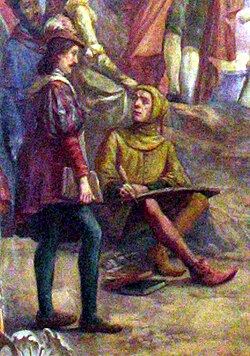
It is depicted with Giorgio Natta in a fresco in the Town Hall of Asti di Paolo Arri that portrays fourteen illustrious astigians surrounding Vittorio Alfieri.
Households
The oldest residential agglomeration of the Natta family, is located in the area of Piazza Statuto (the ancient Piazza dei Porci), in Rione San Secondo .Explore this chapter
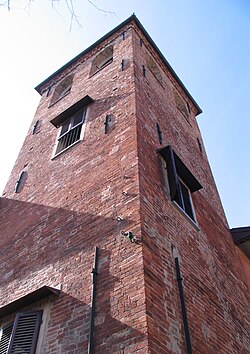
The oldest residential agglomeration of the Natta family, is located in the area of Piazza Statuto (the ancient Piazza dei Porci), in Rione San Secondo.
Some cards of the 15th century, already mention the presence of the noble family in this area due to the presence of three buildings, all contiguous, located at the beginning of Via Q.Sella, which for this reason was called in the 17th century Contrada of the lords Natta.
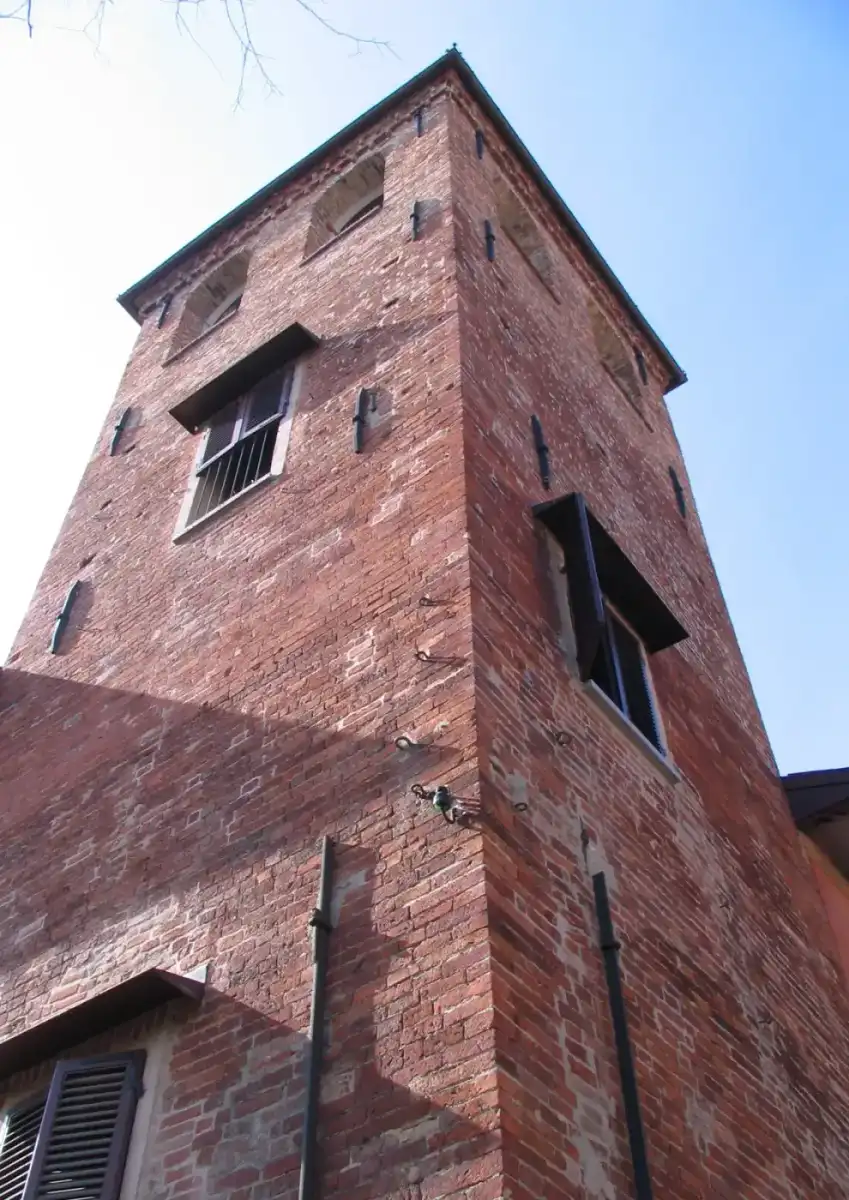
In via Natta, at the corner with Via Milliavacca, in Rione Cathedral stands a tower that with the nearby building formed a strong house of the family very well equipped and solid.
The tower, belongs to the first period, probably built in the 11th century, originally the tower was much taller, but it was then mowed like many others in the city.
The family was in possession of it with the adjacent palace around the 17th century.
The style of the tower is Gothic but the two windows on top are not contemporary of the rest of the building as they were opened perhaps in the 19th century
Coat of arms
As the Astigian aristocracy is the result of a purely urban and mercantile aristocracy, many coats of arms like that of Natta are referred to as the talking weapon, that is, that which makes...Explore this chapter
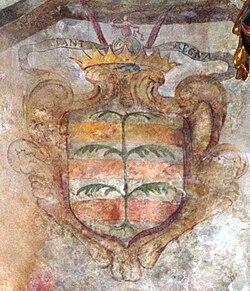
As the Astigian aristocracy is the result of a purely urban and mercantile aristocracy, many coats of arms like that of Natta refer to the speaking weapon, that is that which makes the symbol of his own house directly from the name (at that time the function) of the owner of this weapon.
Natta (Nata) in Piedmontese means cork and therefore the family adopted the symbol of the cork oak in their coat of arms. The coat of arms thus comes to resemble that of the powerful Valperga family, counts of Canavese, one of the largest in the medieval Piemonte.
However, the shield also has pieces (three bands), this could mean that the family originally raised only a simple silver shield with three red bands on which the speaking weapon was added.[4]
Shield: Silver with three bands of red, green cork oak, six branches, purple acorn, cross-section
Cimiero: the figure of justice, born
Motto: For. Me. Stant. Regna.
Genealogy
Explore this chapter
Main genealogy of the Natta family.
| William Lord of the Tonco 13th century | |||||||||||||||||||||||||||||||||||||||||||||||||||||||||||||||||||
| Enrietto Lord of the Castelnuovo Calcea, Tonco, Fubine, Murisengo Baldwin 1458 | |||||||||||||||||||||||||||||||||||||||||||||||||||||||||||||||||||
| Giorgio Line of Cerro Tanaro | Gian Giorgio Line of Alfiano Natta | Thomas Line of Asti | Secondary Line of Isola d'Asti | Augustine Line of Nizza Monferrato | |||||||||||||||||||||||||||||||||||||||||||||||||||||||||||||||
| Marco Antonio 1557 | |||||||||||||||||||||||||||||||||||||||||||||||||||||||||||||||||||
Notes
Explore this chapter
- ^ Head D., The Natta, Il Platano, Year II, number 6, Asti, November-December 1977
- ^ Vincenzo De Conti, Historical news of the city of Casale and Monferrato, Volume 4, Casale, 1840, p. 242. The author specifies under the chapter of the year 1472: "In this year Enrietto Natta also ended his life". The oft-cited year 1458 is a probable historiographical typo.
- ^ Castellani L., The families of the Astigiano patriziato, from Araldica astigiana, Allemandi (edited by Bordone R.), C.R.A. 2001, pg.124
- ^ Natta-Soleri C. and Fe D'Ostani B., Adoption and diffusion of the weapon of kindness at the Astigian patriziate, in Renato Bordone and Cassa di Risparmio di Asti (ed.), Araldica astigiana, Allemandi, 2001, p. 66.
Bibliography
Explore this chapter
- Bera G., Asti buildings and palaces in the Middle Ages. Gribaudo Editore Se Di Co 2004 ISBN 88-8058-886-9
- White A.,Asti Medieval, Ed CRA 1960
- Asti at the time of revolution. Ed CRA 1960
- Bordone R., Araldica astigiana, Allemandi C.R.A. 2001
- From charity to credit. C.R.A. 2005
- Iron, Arleri, Campassi, Antique Cronists Auctionists, ed. dell'Orso 1990 ISBN 88-7649-061-2
- Gabiani Nicola, Asti in his main historical memories vol 1, 2,3. Tip. Vinassa 1927-1934
- The towers of the fort houses and medieval noble palaces in Asti,A.Forni ed. 1978
- Incisa S.G., Asti in his churches and inscriptions C. R.A. 1974
- Damn V., Asti ancient and noble houses. The Portichetto 1982
- A.M. Patron, The Astigian House in Savoy, Dep. Subalpina of homeland history, Turin 1959
- Peyrot A., Asti and Astigiano , typ. Torinese Ed. 1983
- Saddle Q., Codex Astensis here De Malabayla Comuniter nuncupatur, del Code detto De Malabayla, memoria di Quintino Sella, Accademia dei Lincei, Rome 1887.
- S.G. Incense, Asti in his churches and inscriptions C.R.A. 1974.
- Head D., "History of Monferrato", ed. If.Di.Co. 1996.
Continue your journey