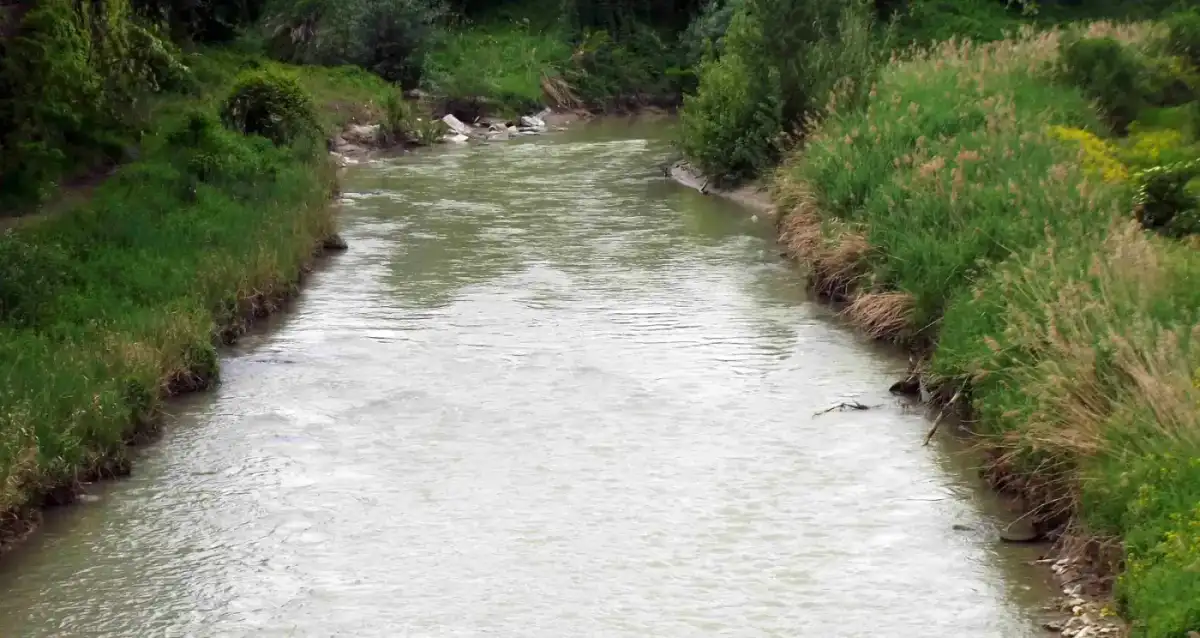
A closer look
Belbo: at a glance
The Belbo (Berb or Belb in Piedmont) is a stream (95 km, basin 469 km2) of Piemonte south-eastern, main right tributary of the Tanaro after the Bormida.
In its path it is interested in the provinces of Cuneo, Asti and Alessandria.
The course of the stream
Born from the Langhe on the border between Liguria and Piemonte at about 800 m of altitude near Montezemolo (in the province of Cuneo), initially flowing into a green basin...Explore this chapter
Born from the Langhe on the border between Liguria and Piemonte at about 800 m of altitude near Montezemolo (in the province of Cuneo), initially flowing into a natural conca protected in a special nature reserve of the Sorgenti del Belbo.
Immediately the valley is deepened so that the creek falls for a few km in a narrow valley bottom enclosed between harsh and unstable tuff reliefs where it enriches the contribution of several streams. Here it is the territory of many municipalities such as San Benedetto Belbo, Niella Belbo, Bossolasco, Feisoglio and Cravanzana.
After Cravanzana the slope of the valley increases considerably so that the Belbo flows more bumpy forming a few swallows and triggering some suggestive erosion processes on the left bank (calanchi). In this stretch crosses Rocchetta Belbo and Cossano Belbo where at times it is widened considerably.
Once in Santo Stefano Belbo (still in the province of Cuneo) crosses the northern part of the village receiving from left the modest contribution of its main tributary, Tinella (24 km, 1 m3/s), a small stream coming from the Langhe particularly capricious in the rainy season. From this confluence turns sharply from south to north entering province of Asti in the Monferrato. Here it flows channeled through the entire town of Canelli (in province of Asti) where it receives the Rio Rocchea from the right and the Rio Trionzo from the left. The slope begins to decrease and the stream deepens its bed. The average flow rate is very modest.
Continuing sinuous then leaves the municipality of Calamandrana coming to Nizza Monferrato, where it flows channeled again, still receiving the small contribution from the left Nice, another fearful watercourse in case of heavy rainfall.
From Nice onwards the Belbo still slows down its race by flowing with meandering trend and thus reaching the municipality of Incisa Scapaccino, where you enter the Monferrato hills for a short stretch, crossed by a bridge, and then continue with a sinuous path to Castelnuovo Belbo, where it begins to be heavily dammed.
Close to Bruno then enters province of Alessandria crossing the municipalities of Bergamasco, Oviglio to reach near Villa del Foro where it flows from right into the river Tanaro.
Hydrological system
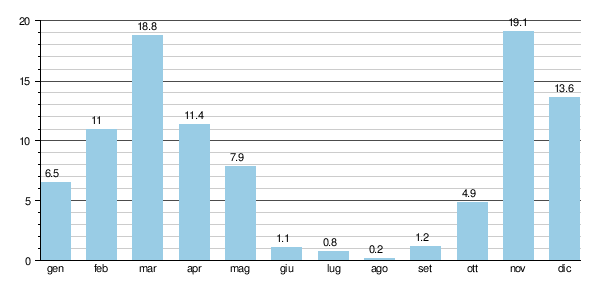
Monthly average portExplore this chapter
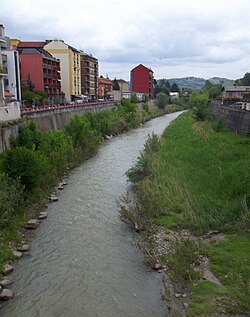
The Belbo is a streamlined water course due to its peculiar aspects:
- the particular conformation of its very long and narrow collection basin, a factor that favors the overlap of floods of tributaries with the main water course.
- the very high slope of the hive in the middle-high section and the presence of the reliefs of the Langhe from the very unstable and fragrant slopes.
- the almost completely waterproof nature of the crossed territories (marne and clay), very little effective in absorbing rainfall and slowing down the speed of the current.
Due to these factors, the stream has a non-dissimil behaviour from that of South Italy's fiumares: in case of abundant rainfall on the high basin, the propagation downstream of consequent waves of full occurs in very fast times (between two and three hours to reach the mouth in the Tanaro) with essentially short but furious and destructive flood peaks, also due to the enormous solid transport that characterize them.
Belbo floods can usually be more ruinous in the rainy months (October-November).
On the other hand, for periods of dryness, Belbo presents very strong summer magres that see almost zero superficial sightings (though perennial).
In any case, there is no shortage of fresh but violent showers during the drought period, as the response of the high basin in case of heavy rains is always immediate.
The annual average rate is at the confluence with the Tanaro at about 8 m3/s, a rather modest value compared to the drained territory.
Monthly average port
Hydrometric station: confluence Tanaro (1951 - 1991)
Floods
The history of the Belbo valley is full of catastrophic floods: for example, in 1948 when the stream produced a full ruin that flooded Canelli and Nice...Explore this chapter
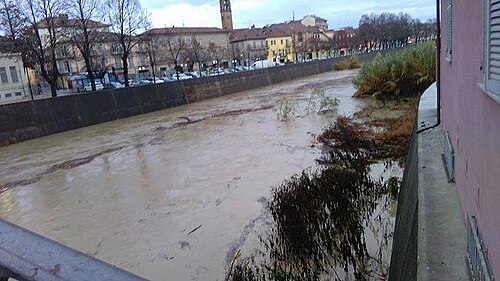
The history of valley of the Belbo It is full of catastrophic floods: for example in 1948 when the stream produced a full ruin that flooded Canelli And Nizza Monferrato or even worse in 1968 when after 380 mm of rain in a few hours caused a real catastrophe from the source to the mouth, submerged Santo Stefano Belbo and Nizza Monferrato. The Belbo and the Tanaro they also caused aflood in November 1994. After three days of uninterrupted rain (over 200 mm in 24 hours only on 5 November), the Belbo swelled, reaching exceptional flow values of 1,330 m³/s at Santo Stefano Belbo and at Castelnuovo Belbo of almost 1000 m3/s. (respectively 220 and 167 times the normal flow!), thus transciting for the entire length of its course and devastating almost all its valley bottom. Particularly shocked by the fury of the waters were the municipalities of Rocchetta Belbo, Cossano Belbo, Santo Stefano Belbo, Canelli (the most affected center which also counted three victims) e Incisa Scapaccino; only Nizza Monferrato was spared by the disaster while suffering heavy damage to the adjacent roads to the water course and flooding of some basement.
Decreasely less damage after the full of 27 April 2009, in which there were only a few scanned floods in the lowest area of Incisa Scapaccino and flooding in the fields around Bergamasco, with the interruption of the road between the town and the railway station. On that occasion it caused more problems Tanaro when the full came the next day.
During the full of the Tanaro in November 2016, which caused floods and damage along much of the river, especially in the Cuneo region, also Belbo suffered a considerable increase, but thanks to previous maintenance work of the banks the stream is defluted without particular problems.
The Belbo in Literature
Explore this chapter
Notes
Explore this chapter
- ^ AA.VV., Processed I.c/5 (PDF), in Water Protection Plan - Review of 1 July 2004; Characterization of hydrographic basins, Region Piemonte, 1 July 2004. Retrieved 8 May 2014 (archived fromoriginal url on 25 February 2012).
- ^ to b AA.VV., Processed I.c/7 (PDF), in Water Protection Plan - Review of 1 July 2004; Characterization of hydrographic basins, Region Piemonte, 1 July 2004. Retrieved 8 May 2014 (archived fromoriginal url on 3 March 2016).
- ^ Last edition: Cesare Pavese, The moon and the bonfires, Turin, Einaudi, 2005. ISBN 9788806174194
- ^ Beppe Fenoglio, in Romances and stories, Turin, Einaudi - Gallimard, 1991. ISBN 88-446-0002-1
Continue your journey