Atlas of Monferrato
Calamandrana: sights, history and trails
Asti
- Elevation
- 151 m above sea level
- Area
- 12.79 km²
- Demonym
- calamandranesi
A closer look
Discovering Calamandrana
Calamandrana (Calamandran in Piedmontese, Camendran in its variety of Astigiana) is an Italian municipality of 1 636 inhabitants[2] from the province of Asti in the Piemonte. The country extends over an area of 12.79 km2.
In the country is very flourishing wine activity. From the point of view of the economy, even if in recent times some industries of significant productive importance have settled in the plain of Belbo, the hard hoof remains that agricultural, with numerous winery companies in the flattering part of the territory and with as many wineries in the hill.
Landscape and area
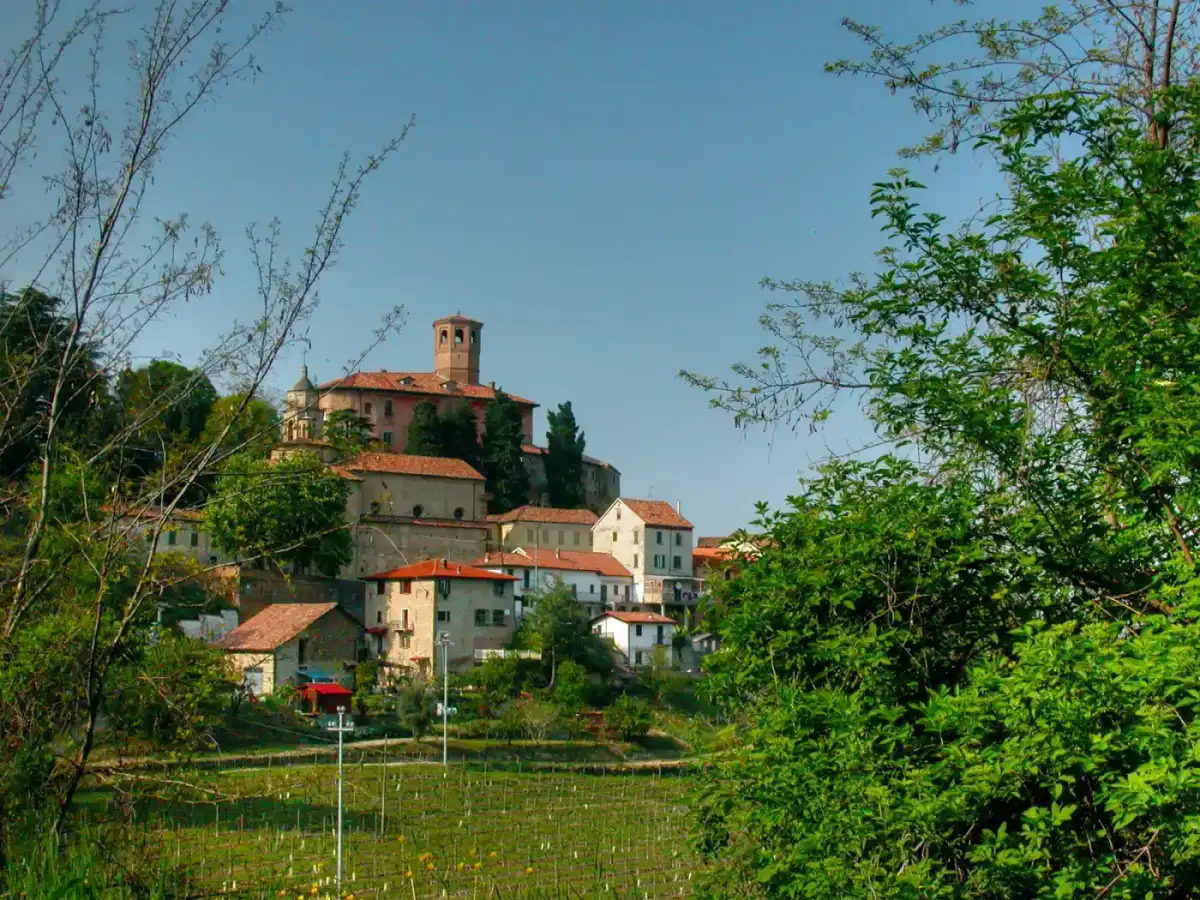
Calamandrana is situated between the cities of Nizza Monferrato and Canelli . The municipality is divided into two areas (Calamandrana Alta and Calamandrana Bassa) and consists of several centres...Explore this chapter
Calamandrana is located between the cities of Nizza Monferrato and of Canelli. The municipality is divided into two areas (Calamandrana Alta and Calamandrana Bassa) and is made up of several inhabited centres: Quartino (Town Hall), Boidi, Bruciati, Chiesa Vecchia, Case Vecchie, Ferrai, Garbazzola, San Vito, Valle Chiozze and Valle San Giovanni.
Origins of the name
The first mention of the name "Calamandrana" appears in a public document of the year 1129 where reference is made to a manso, that is, a farm of this territory donated by...Explore this chapter
The first mention of the name "Calamandrana" appears in a public document of the year 1129 where reference is made to a mansus, that is a farm of this territory donated by the castellano Guglielmo, son of Amedeo, to the monastery of Santa Maria near Acqui.
It could be tempted to trace the name Calamandrana (with five "a") to the expression "calan the herds" because the main nucleus of the inhabitants lived, in the past, the hill with at the top of the Castle and the old peasants brought to the grazing the flock "to the plain".
"Calamandrana" derives, however, more likely from a dwarf oak which in Piemonte is called "calamandrina", since the hills were once covered with thickets of elms and oaks. In some eighteenth-century atlases the name Calamandrana is clearly written Calamandrina.
History of Calamandrana
SymbolsExplore this chapter
The lands of Calamandrana probably had already been inhabited in ancient times by Ligurian people of Celtic origin who were defeated by the Romans in 200 BC.
In the 12th century Calamandrana passed to be part of the Marchesato del Monferrato, but for a short time. At the beginning of the 13th century Boniface del Vasto, submissive to Alessandria, sold the country to the San Marzano di Canelli. During the battle for the annexation to the Alexandrian fief, the people of Calabria left the plain and found shelter in the Church of San Giovanni Lanerio, where they built the new center of Nice della Paglia (currently) Nizza Monferrato). In 1232 the territory of Calamandrana passed back to the Marchesi del Monferrato that they gave it to Marquisate of Incisa and then to pass Asinari in 1305.
In 1657 the town was granted by the Duke of Mantua to the Marquis Giovanni Maria Piccolomini, and then passed, 15 years later, to the Count Matovano Matteo Quinciani. In 1682 the Calabrian Francesco Maria Cordara, who became Count, began the construction of the Castle, which remained intact until today.
In 1943 many soldiers fled from the barracks took refuge in Calamandrana, during the dissolution of the Italian army. The pastor Don Emilio Carozzi and the population helped them. In the same year, a partisan formation was created in Calamandrana. Towards the end of 1944, numerous clashes took place, during which people were threatened and looted houses. By the end of 1945, partisans returned to force. You could control it Canelli and the road to Nice. In this situation the City Hall was also burned.
Symbols
The coat of arms and gonfalone were granted by decree of the President of the Republic of 24 May 1957[5][6]
The gonfalone is a red and white drape.[6]
What to see in Calamandrana
Religious architecture · Church "San Sebastiano" (Calamandrana Alta) · Church "Immaculate Conception" (Calamandrana Alta)Explore this chapter
Religious architecture
Church "San Sebastiano" (Calamandrana Alta)
A single road, via Maestra, crosses the old town from east to west, for those coming from the provincial road, going up from Del Pozzo street.
The church of San Sebastiano, recently restored, is located on the left. It was probably built in the 18th century as a Confraternita, it is built in bricks with a deep portico on the façade of the hut, in neoclassical style. It has recently been the subject of restoration. Worth visiting are the frescoes present.
Church "Immaculate Conception" (Calamandrana Alta)
Along the underwater road of the ancient village, you will reach the baroque parish dedicated to the Immaculate Conception. Along with the different Cappelle campestri that stood, by the population, in the farest fractions, it is not difficult to imagine that the presence of the Castle provided a building for Christian worship at the height of noble families who resided here. From the Baroque period, the Church of the Immaculate Conception refers to historical richness and stratification. Its arch and part of the apse are cut out from the ancient walls of the castle. Signed as a parish church since the 18th century, it is named in previous documents as an oratory of the castle and seat of the brotherhood of Disciplinates.
Sacred Heart Church of Jesus (Calamandrana Bassa)
In the “piana” between 1952 and 1953, the new parish church was erected, dedicated to the Sacred Heart of Jesus, later decorated in 1962 with apsidal paintings by Piero Dalle Ceste and with a precious mosaic.
Romanesque church San Giovanni delle Conche
In the San Giovanni valley, today a hamlet of Calamandrana, stood the Romanesque church dedicated to San Giovanni alle Conche, on top of a low hill. Church rich in historical events, especially during the Middle Ages has changed image over the centuries. The current image of San Giovanni delle Conche is totally changed compared to the primitive. In Romanesque style only remains the apse, which is framed in the right side of the current church. Simmetrically, another apse was built, similar, but smaller and neo-Gothic style, while a third, much higher, placed north, is late Baroque and closes the interior space of the presbytery. A fourth element, the bell tower with a square plan, volumetrically accords the two apses, Romanesque and late Baroque, to the body of the church.
This intersection game then made space within the almost circular building. Inside the walls are decorated with nineteenth-century frescos of popular work; the figures appearing in the Romanesque apse's catin, however, seem to recalcate, in the iconography, precedents and more ancient frescoes. The wall structure of the entire building is brick. Only in the Romanesque apse we find sandstone shells: both in the "throat" frame, placed attic, and in the traditional theory of hanging arches, resting on mensoline, both in the stipetes and false arches, to re-entry glands, of the three windows. Geometric decorations are sculpted on monolithic blocks in which arches and wreaths have been carved. Each of the three fields of the apse is scanned by hysenes that connect to the hanging arches through small capitals, decorated with very stylized phytomorphic drawings, including also a human head. The bricks and the corners are well filled: this fact and shaping of mortar beds indicate restoration interventions not far away.
From August 2020 the Romanesque church of San Giovanni alle Conche in Valle San Giovanni enters the circuit "Chiese a Porte Aperte", promoted by the Regional Consulta for Ecclesiastic Cultural Heritage of Piedmont and Valle d'Aosta, in agreement with the Municipality of Calamandrana. The project, also funded by FCRT and Regione Piemonte, will allow you to visit the church through the use of an App. In fact it will be enough to register for the site www.cittaecattedrali and then download the "Close to Open Doors" App on your mobile phone to book free admission, enter and make a visit listening to the narrating voice (daily from 9.00 to 18.00). In addition to the church of Valle San Giovanni you can visit another 27 places, gathered in six territorial circuits.
Civil architectures
Calamandrana Castle
The primitive fortified complex was destroyed and immediately rebuilt during the 13th century. The destruction dates back to 1225, when a bloody battle between Astigiani and Alessandrini took place, for supremacy in the valley of Belbo. The Alessandrini, victorious, razed the Calamandrana castle to the ground, considered by them a serious threat. The fortification was rebuilt towards 1237, when the territory returned, definitively, between the properties of Asthesis by Frederick II.
After several feudatories, in 1606 Federico Gonzaga defended his wife, Eleonora de' Medici; it will be only in 1685 that the Duke of Mantua will invest with the title of Count a calamandranese, Francesco Maria Cordara. It is practically due to him the current structure of the castle as it was precisely Count Cordara who made some considerable changes based on the original structure.
The complex suffered significant damage during the earthquake of 1886 and, for fear of a collapse, the loggia was demolished and mowed the octagonal tower, rebuilt then in 1964, by the then owner, Mr. Giambattista Parodi, with hand-made recovery bricks and in a faithful way to what was to be the original, deusable from Gonin prints.
Today the building has a rather irregular planimetric setting and is partly plastered and partly brick and exposed stones. The underground structures are preserved: cellars, walks and the cistern of the ancient fortress. In 1983 it was the renovation of the ceiling of the 19th century living room.
Society
Demographic evolution · Foreign ethnic groups and minoritiesExplore this chapter
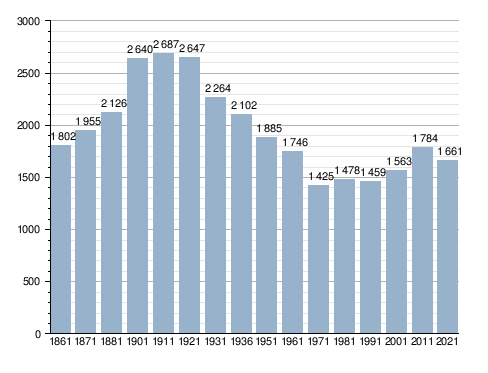
Demographic evolution
Inhabitants registered[8]
Foreign ethnic groups and minorities
According to ISTAT data at 31 December 2009, the resident foreign population was 196 people. The nationalities most represented by their percentage of the total population living were:
- Republic of Macedonia 69 3,90%
- Romania 54 3,05%
- Morocco 28 1.58%
Culture
EventsExplore this chapter
Events
- The patronal festival of the Quartino, in August
- Livestock fair, on the first Monday of August
- Calamandrana Alta Festival
- All Saturday mornings at the main square of the village Piazza Dante, "Mercato della Terra Amica" in collaboration with agricultural organizations, where farmers and artisans of the territory sell their products directly to km zero
- Through Festival, July
Anthropic geography
HamletsExplore this chapter
Hamlets
The main regions or hamlets of Calamandrana are: Boidi, Bruciati, Case Vecchie, Chiesa Vecchia, Ferrai, Garbazzola, Quartino, San Vito, Valle San Giovanni.
Administration
TwinningExplore this chapter
Below is a table relating to the administrations that have succeeded one another in this municipality.
| Period | First citizen | Match | Load | Notes | |
|---|---|---|---|---|---|
| June 12, 1985 | April 22, 1987 | Claudio Solito | civic list | Mayor | [9] |
| April 22, 1987 | May 18, 1990 | According to Scanavino | Italian Communist Party | Mayor | [9] |
| May 18, 1990 | April 24, 1995 | According to Scanavino | Italian Communist Party, Democratic Party of the Left | Mayor | [9] |
| April 24, 1995 | June 14, 1999 | According to Scanavino | centre-left | Mayor | [9] |
| June 14, 1999 | June 14, 2004 | Massimo Fiorio | civic list | Mayor | [9] |
| June 14, 2004 | June 8, 2009 | Massimo Fiorio | civic list | Mayor | [9] |
| June 8, 2009 | May 26, 2014 | Fabio Isnardi | list of cities Fabio Isnardi mayor | Mayor | [9] |
| May 26, 2014 | May 26, 2019 | Fabio Isnardi | civic list Peace freedom work | Mayor | [9] |
| May 26, 2019 | 09 June 2024 | Fabio Isnardi | civic list Peace freedom work | Mayor | [9] |
Twinning
 Kisapostag
Sport
Explore this chapter
Notes
Explore this chapter
- ^ Municipality of Calamandrana : Municipal Administration and Mayor - Municipality of Calamandrana and city, Asti, Piemonte, up www.comune-italia.it. URL consulted on 5 August 2026.
- ^ to b Monthly demographic balance for the year 2026 (provisional data), up demo.istat.it, ISTAT.
- ^ Seismic classification (XLS), up risks.protezionecivile.gov.it.
- ^ Table of degrees/day of Italian Municipalities grouped by Region and Province (PDF), in Law 26 August 1993, n. 412, annex A, National Agency for New Technologies, Energy and Sustainable Economic Development, 1 March 2011, p. 151. URL consulted on 25 April 2012 (archived fromoriginal url on 1 January 2017).
- ^ Calamandrana, up Heraldic Office, Municipal Issues, Central State Archives.
- ^ to b Coats of arms and gonfalone of the Municipality of Calamandrana, up Collection of drawings from the coat of arms of municipalities and cities, Central State Archives. Retrieved 13 October 2024.
- ^ Piedmontese civic coat of arms, vol. I, Regional Council of Piemonte, 2016, p. 84, ISBN 978-88-96074-98-5.
- ^ Data taken from:
- Resident population of the municipalities. Censuses from 1861 to 1991 (PDF), up ebiblio.istat.it, ISTAT.
- Resident population - Time series, up exploredati.istat.it.
Please note: 2021 data refers to permanent census data as of December 31 of that year.
- ^ to b c d And f g h the http://amministratori.interno.it/
Where to stay · Calamandrana
Find stays on Booking.comStories, places and people
More about Calamandrana and the surrounding area
Follow a thread of history and see where it leads.
 user:Luca.grieco · Public domain
Province of Asti
The province of Asti ( Province of Ast in Piedmont) is an Italian province of Piemonte of 207 128 inhabitants, with capital Asti .
Read the story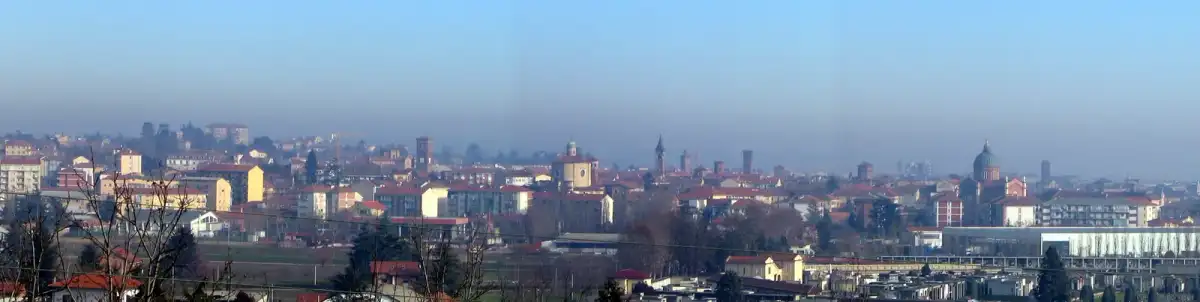 Faberh di Wikipedia in italiano · Public domain
Asti
Asti ( Listen , Ast in Piedmont and in the Astigiano dialect) is an Italian town of 73 681 inhabitants, capital of the homonymous province of Piedmont today commonly called Astigiano and main center of the historical region of Astesana . Roman Municipium, known as Hasta, was the seat of the duchy of Asti, Longobard Duchy of Neustria. Free common in the Middle Ages, with the right to "battle money", was one of the most important shopping centers between the 12th and 13th century, when its merchants developed commerce and credit throughout Europe.
Read the story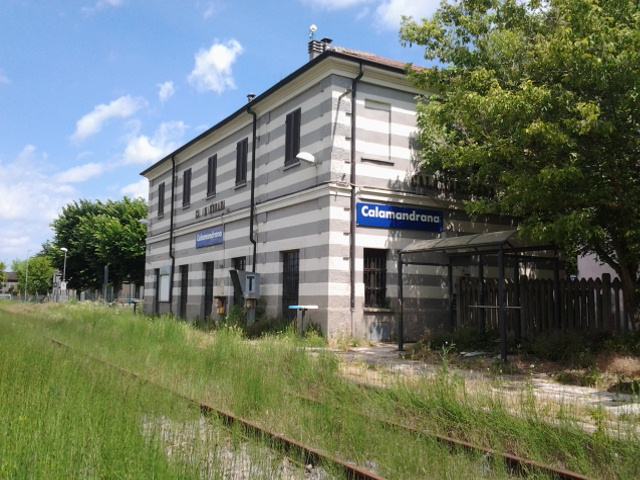 Fabioantonello · CC0
Calamandrana Station
The station Calamandrana is a railway stop of the line Alessandria-Cavallermaggiore at the service of the homonymous municipality.
Read the storyThe area, step by step
