- Elevation
- 260 m above sea level
- Area
- 10.86 km²
- Demonym
- antignatis
- Patron saint
- Saint Stephen
A closer look
Discovering Antignano
Antignano (Antignan in Piedmont) is an Italian municipality of 962 inhabitants[2] from the province of Asti, in the historical territory ofAstesana in the Piemonte.
Landscape and area
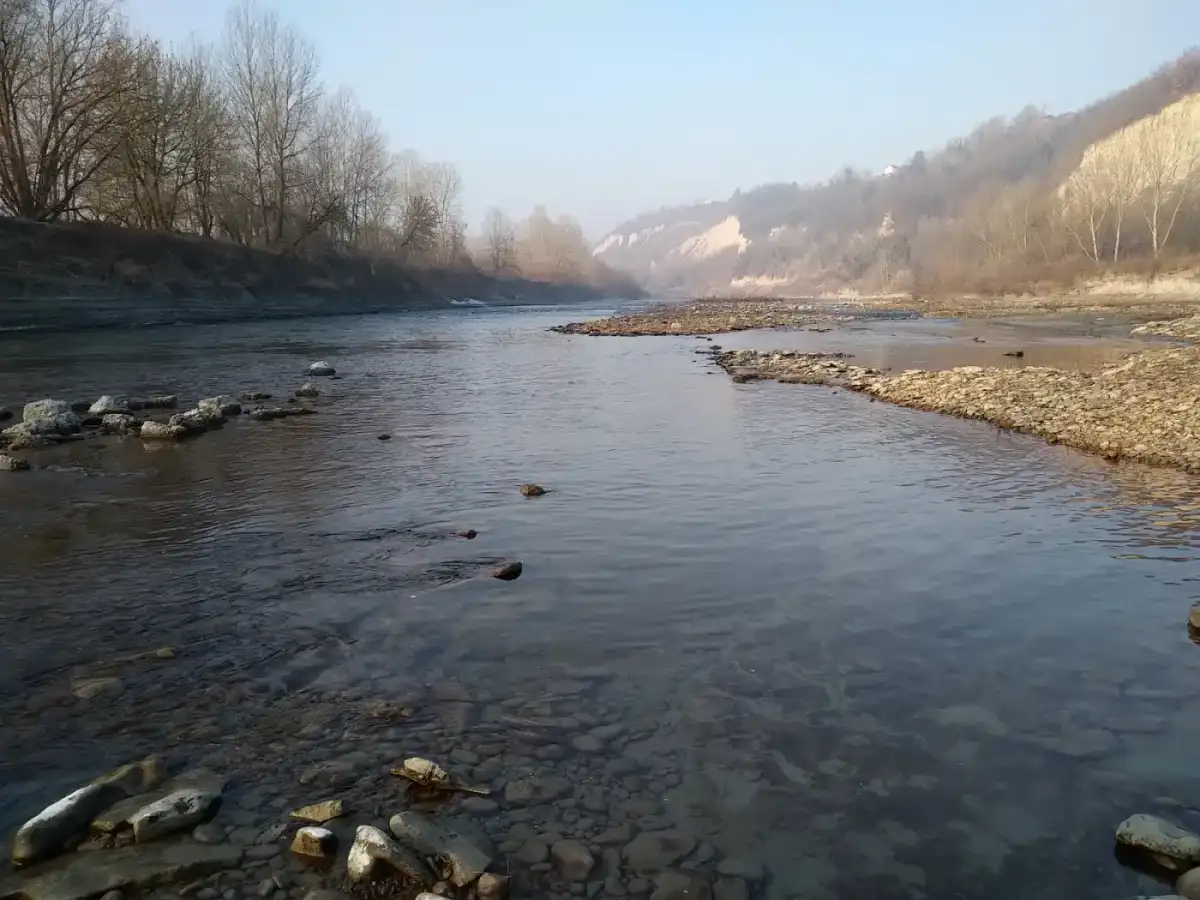
It is located about 13 km from Asti, on the road that leads from Variglie to Alba . It is a small town, overlooking the hills of Astesana .Explore this chapter
Origins of the name
On his name the medieval documentation proposes several variants: it goes from Anteljanus, which appears at the end of the 10th century along with Anterjanus, to Antessianus and more...Explore this chapter
On its name the medieval documentation proposes several variants: it goes from Anteljanus, which appears at the end of the 10th century together with Anterjanus, ad Antessianus and again Antonianus. It later settled into the official Italian name: Antegnanus, Antignanus. It is not clear which noble name it can be compared to: probably Antenius or Antelius, however both of Latin origin. Note that Antignano is also a well-known neighborhood of Livorno.
the present name, instead of uncertain medieval source, derives rather, in a transparent and convincing way, from that of the "antesignani" legionaries — light elite troops, constituting the vanguard of a legion — to which the advance of Antignano had been, since the time of its constitution, entrusted by the Roman "municipal" — then a kind of colony — in the current meaning and not with a success that still lasts, the lives, like all Roman veterans did in half of Europe. Through the centuries Antignano has always fulfilled such a defensive vocation that still today manifests itself with the remains of the castle on the top of its hill.
History of Antignano
SymbolsExplore this chapter
The first certain news is from the year 870, when it appears among the possessions of Ludovico II, Emperor of the Holy Roman Empire.
Based on recent studies (prof. Renato Bordone) is thought that the village was home to a parish church until the end of the 10th century, probably the parish church of San Giovanni, still existing and close to the center of the town, already mentioned in a document of 964. Starting from the assumption that in all countries the church was in the inhabited center, it can be assumed that the first nucleus of Antignano stood around the church of San Giovanni.
In the year 1000, the new parish church dedicated to St. Stephen, the present cemetery chapel, was built and the town moved around it. During the construction of the new town was built also the castle, which is traced only in a document of 1165.
Between the 10th and 11th centuries, De Antignano, who was very close to the bishop of Asti, were infeuded as lords of the country; it is thought that until then the country has enjoyed a certain freedom of action and that, following the arrival of new lords, its destiny was linked to the fate of the city of Asti. Asti. In a document from 1159, Emperor Frederick I Barbarossa also included the town of Antignano among the places subjected to the bishop of Asti.
Despite the latter trying to limit the local lordships much, the De Antignano managed to maintain a certain autonomy: in 1165 the castle was still under their direct control (unlike the nearby villages of Celle, Revigliasco and Variglie) and as evidenced by a document of 1237 were lords of four vasals.
When in the 14th century Asti passes under the Orléans, Antignano follows the fate of the city and on 18 May 1387 swears loyalty to new lords.
In 1419 Giovanni Turco, commander of the army of the lord of the Monferrato, after having unsuccessfully attempted to occupy the citadel of Asti, besieged Antignano. Defeated, he was forced to flee and abandon the siege engines, which the citizens of Antignano paraded through the streets of Asti.
Between the end of 1400 and the beginning of 1500, the village moves to the present site where the town is rebuilt and a new castle; in a document of 1585 it turns out that the parish church of Santo Stefano was now outside the village and in a state of abandonment and that the inhabitants used for religious functions the oratory of the Blessed Virgin Mary, probably the chapel of the Castle, demolished in 1908 by now pericular to realize the current parish church.
Of this second castle it is still possible to see part of the wall in front of the baroque church of San Rocco. There is no news of the lords of Antignano from the 14th century until 1618.
During the Orleanese domination it is thought that they were podestà to administer the municipality, among which he was appointed in 1386 Francesco Ponte.
In 1618 Antignano is now under the control of the Savoy who appoint as a feudal lord Gaspare Berlinghieri. The Berliners will keep the country until 1646 when it passed to Malabayla or Malabaila. In 1700 gentlemen from the village are the Roero di San Severino, who since the mid-18th century have passed the lordship to Malabaila.
In 1797 During the revolutionary motions that led to the founding of the Republic of Astese (1797) an anti-gnanese participant Giuseppe Merlone, then fuciated along with the organizers of the revolt on August 22. The country held an ambiguous behaviour towards the republic: in fact, despite having a favourable opinion on Republicans, they preferred not to stand on the side of the latter for fear of the reprisals that would have arisen from the Savoy.
On 18 May 1846 Antignano gave birth to Francesca Armosino. Born in Saracchi, at the time under the municipality of Antignano and ceded after that of San Martino at the end of 1880, descended from a noble Armenian family emigrated to Italy to escape the persecutions of the Turks against Christians, Francesca was the last wife of Giuseppe Garibaldi, from which she had three children: Manlio, Clelia and Rosita (dead to eighteen months). In the historical archive of the municipality there are two letters regarding the General. The first is the missive sent to him by the Antignan community to be happy with the Armosino wedding, the second is Garibaldi's response to the community. In 1880 Garibaldi himself came to Antignano to visit the property of his wife.
In the early years of World War II, between 1941 and 1943, Antignano was one of the designated municipalities as a free intervening site for foreign Jews.[5] Two families stayed there (4 people in all), then moved to the Ferramonti camp in early 1943.[6]
Symbols
The coat of arms and gonfalone of the municipality of Antignano were granted by decree of the President of the Republic of 7 March 2001.[7]
The banner is a blue cloth.
Society
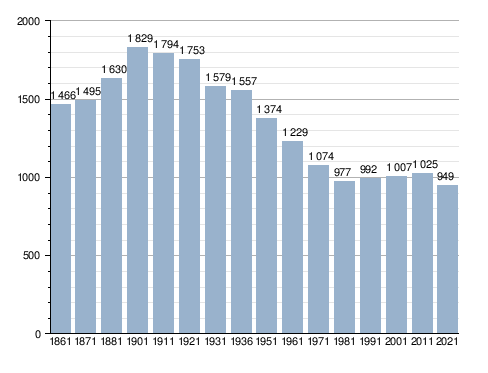
Demographic evolutionExplore this chapter
Demographic evolution
Inhabitants registered[9]
Culture
An important event is the Via Crucis, which takes place on Good Friday and in which 130 people participate in period costumes and about fifty technicians. Every year in April...Explore this chapter
An important event is the Via Crucis which takes place on the Good Friday and in which 130 participants in period costumes and about fifty technicians participate. Every year in April, a suggestive representation takes place through the streets of the country: tens of people in costume retrace the various moments of Christ's passion, from prayer in the garden of Gethsemane to the Cross. All historical stages are commented and followed by a narrative voice and three voices for the dialogue of characters.
Anthropic geography
In addition to the center, the municipality of Antignano includes the villages of: Perosini, Nicola, Gonella , Morgnano, Montefiglie, Lanci, Genovesi, Marelli and Premes.Explore this chapter
In addition to the center, the municipality of Antignano includes the villages of: Perosini, Nicola, Gonella, Morgnano, Montefiglie, Lanci, Genovesi, Marelli and Premes.
Economy
Natural areasExplore this chapter
Antignano is known, as well as for the production of excellent Barbera and Grignolino, also for the production of an ancient variety of corn "Mais eight files of Antignano".
Natural areas
Infrastructure and transport
Between 1882 and 1935 the municipality was served by the Asti-Canale tramway.Explore this chapter
Between 1882 and 1935 the municipality was served by the Asti-Canale tramway.
Administration
Below is a table relating to the administrations that have succeeded one another in this municipality.Explore this chapter
Below is a table relating to the administrations that have succeeded one another in this municipality.
| Period | First citizen | Match | Load | Notes | |
|---|---|---|---|---|---|
| June 11, 1985 | May 25, 1990 | Franco Bosso | civic list | Mayor | [11] |
| May 25, 1990 | April 24, 1995 | Franco Bosso | civic list | Mayor | [11] |
| April 24, 1995 | October 23, 1998 | Carlo Musso | center | Mayor | [11] |
| October 23, 1998 | June 14, 1999 | Giovanni Icardi | Comm. Overtime | [11] | |
| June 14, 1999 | June 14, 2004 | Francesco Bosia | civic list | Mayor | [11] |
| June 14, 2004 | June 8, 2009 | Francesco Bosia | civic list | Mayor | [11] |
| June 8, 2009 | May 26, 2014 | Angelo Borgogno | civic list | Mayor | [11] |
| May 26, 2014 | May 26, 2019 | Alessandro Civardi | civic list Insieme per Antignano | Mayor | [11] |
| May 26, 2019 | in office | Alessandro Civardi | civic list Insieme per Antignano | Mayor | [11] |
Sport
In the territory of Antignano has been operating in sports field since 1979 A.S.D. Polisportiva Libertas Antignano, a company that has become famous also at regional level for the great...Explore this chapter
In the territory of Antignano has been operating in sports field since 1979 A.S.D. Polisportiva Libertas Antignano, a company that has become famous also at regional level for the great results achieved in Futsal. The Libertas Antignano, in fact, after a few years on, has devoted itself exclusively to the sport promotion for young people of the country in the season 2022-2023 has given birth to Libertas Antignano Futsal. In only three seasons starting from the F.I.G.C. Championship. D series the formation of President Umberto Gonella with 2 promotions reached in only 3 years in the season 2024-2025 got the pass for the Serie C1 championship.
Notes
Explore this chapter
- ^ Municipality of Antignano : Municipal Administration and Mayor - Municipality of Antignano e città, Asti, Piemonte, up www.comune-italia.it. URL consulted on 4 August 2026.
- ^ to b Monthly demographic balance for the year 2026 (provisional data), up demo.istat.it, ISTAT.
- ^ Seismic classification (XLS), up risks.protezionecivile.gov.it.
- ^ Table of degrees/day of Italian Municipalities grouped by Region and Province (PDF), in Law 26 August 1993, n. 412, annex A, National Agency for New Technologies, Energy and Sustainable Economic Development, 1 March 2011, p. 151. URL consulted on 25 April 2012 (archived fromoriginal url on 1 January 2017).
- ^ The municipalities of the Astiginan that have hosted foreign Jews interned are: Agliano Terme, Antignano, Asti, Canelli, Castelnuovo Don Bosco, Cocconato, Mombercelli, Montechiaro d'Asti, Montiglio, Nizza Monferrato, San Damiano d'Asti, Villanova d'Asti.
- ^ Foreign Jews interned in Piemonte. Both the spouses Alessandro Rosenbach and Elsa Rogonizinski (then moved to Macchiagodena, in the province of Campobasso) and Margherita Wondrak and their daughter Weininger (who remained in Ferramonti) survived the Holocaust.
- ^ Antignano, decree 2001-03-07 DPR, concession of coat of arms and gonfalone, up Heraldic office - Municipal files, Central State Archives. URL consulted on 9 November 2021.
- ^ Piedmontese civic coat of arms, vol. I, Regional Council of Piemonte, 2016, p. 17, ISBN 978-88-96074-98-5.
- ^ Data taken from:
- Resident population of the municipalities. Censuses from 1861 to 1991 (PDF), up ebiblio.istat.it, ISTAT.
- Resident population - Time series, up exploredati.istat.it.
Please note: 2021 data refers to permanent census data as of December 31 of that year.
- ^ astipaleontologico.it, https://www.astipaleontologico.it/aree-protette/riserve-naturali-della-piana-del-tanaro/ Missing title for url
url(help). - ^ to b c d And f g h the http://amministratori.interno.it/
Bibliography
Explore this chapter
- Renato Bordone, Cities and territory in the Middle Ages. The company from the Franks domain to the municipal affirmation.
- Renato Bordone, Araldica Astigina.
- Gaspare Bosio, History of the church of Asti.
- G. Assandria, The Green Book of the Church of Asti.
- Gian Secondo De Canis, Astigian Corography.
- Chronic Antiques Auctionists, Cassa di Risparmio Ai Asti edition.
- Ada Peyrot, Auctions and Asti.
- Anna Maria Cotto Meluccio, Notary Cartridges of the Capitolar Archive of Asti.
- Notaries of the Capitol Archive of Asti: the registers of Iacobus Sarrachus, notary of the bishop's vicar (1309-1316).
- Carlo Vassalo and Gabotto F., The church of the Ss. Apostles in Asti.
- Stefano incisa and Gabiani Nicola, Republican Revolution and Counterrevolution of Asti in 1797: Synchronous diary by Stefano Incisa, with unpublished documents
Where to stay · Antignano
Find stays on Booking.comThe area, step by step
