- Elevation
- 491 m s.l.m.
- Area
- 16.52 km²
- Demonym
- cudddling
- Patron saint
- Saints Fausto and Felice
A closer look
Discovering Cocconato
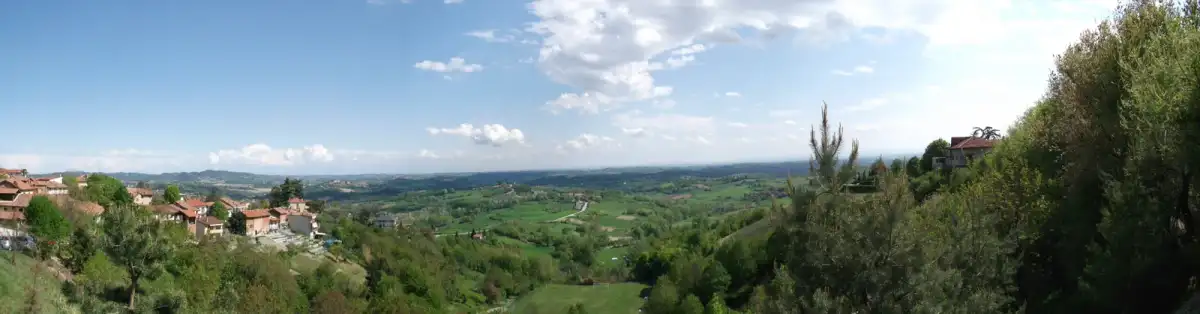
Cocconato (Cocon [kəkər] in Piedmontese, Cocn [kər] in monferrino dialect) is an Italian municipality of 1 422 inhabitants[1] from the province of Asti in the Piemonte.
History of Cocconato
SymbolsExplore this chapter
Cocconato was in the Middle Ages the main center of the comitale family of manfreding roots[4] and seat of an imperial fief until 1586. It is subject for several centuries to the diocese of Vercelli, today it is part of the Diocese of Casale Monferrato.
In the territory of the municipality of Cocconato during World War II, between 1940 and 1943, 70 non-Italian Jews from Eastern Europe were interned (including families with children):[5] this does not mean the existence of a concentration camp (such as those organized - after September 8, 1943 - by the Nazis or repubblichines in Borgo San Dalmazzo, Fossoli, Bolzano, Risiera di San Sabba and other minors), but rather an obligated domicile comparable to the institute of the confino.[6]
36 of the refugees in Cocconato in summer 1943, net of continued transfers. With the German occupation, the group quickly dispersed. In the end all internees managed to save themselves (finding mostly refuge in Switzerland)[7] and no Jew, Italian or foreign, was arrested in Cocconato.[8]
In Cocconato found the death of anti-fascist Giovanni Corvi, arrested in Sondrio by the republics, then transferred to San Martino di Rosignano Monferrato in the province of Alessandria and finally picked up by the Nazis and transferred "to unknown destination", as attested by his death certificate present at the municipality of Cocconato and found after long research.
Symbols
The coat of arms, gonfalone and flag were granted by decree of the President of the Republic of 19 November 1999.[9]
- Coat of arms
The municipal coat of arms is inspired by that of the Radicati family, Cocconato accounts, which carried a shield truncated: at the first of black, at the golden eagle, crowned with the same; at the second of gold, to the chestnut rooted in natural.
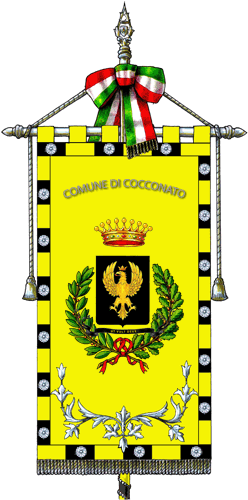
- Banner
- Flag
The flag is truncated with black and yellow.[9]
What to see in Cocconato
Several buildings of historical interest, including:Explore this chapter
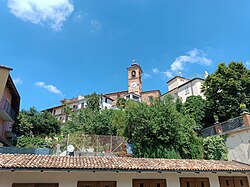
Several buildings of historical interest, including:
- Municipal Palace, dating back to the 15th century, rare example of a late Gothic civil building
- Parish church of 16th century origin, entitled Santa Maria della Consolazione
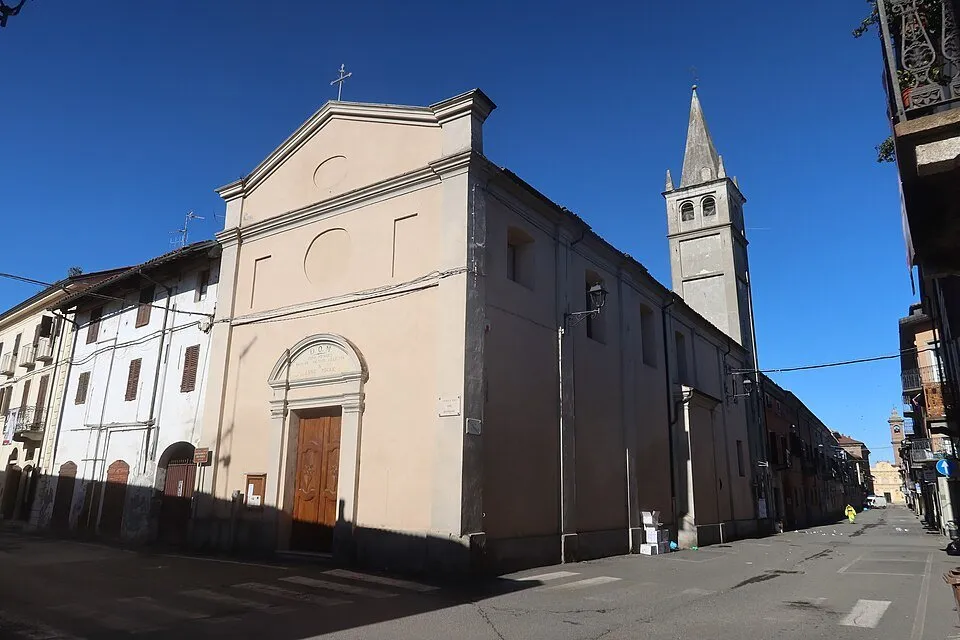
- Church SS. Trinity, at the beginning of Via Roma, with its covered portico
Society
Demographic evolution · Traditions and folkloreExplore this chapter
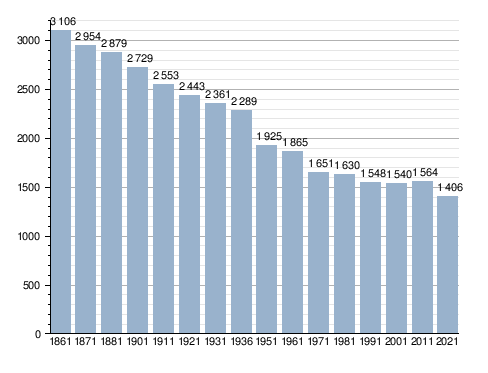
Demographic evolution
Inhabitants registered[11]
Traditions and folklore
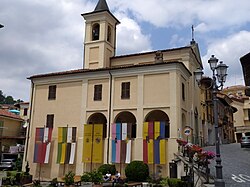
In summer 1970[12] the patronal association of Cocconato decided to establish the Palio degli Asini.
The six villages of Cocconato participate in the Palio: Airali, Brina, Colline Magre, San Carlo, Torre, Tuffo.
To them is added the neighboring country of Moransengo[12].
Economy
TourismExplore this chapter
In Cocconato was founded and is still home to the Conbipel, a chain of clothing stores.
Tourism
Since 2019 it is associated with “The most beautiful villages in Italy”.[13]
Infrastructure and transport
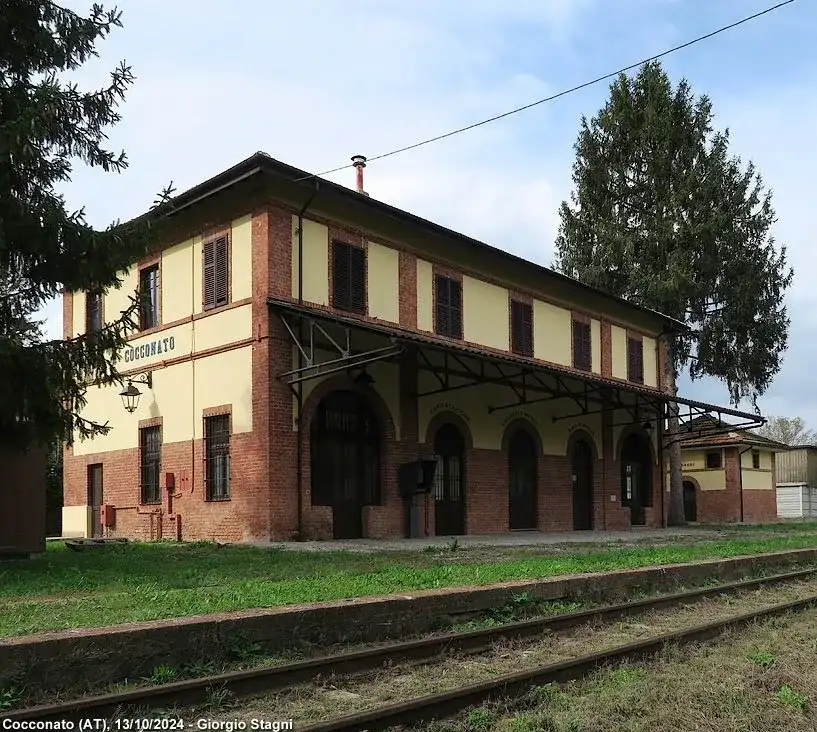
Cocconato station, active between 1912 and 2011, was located along the ceased Chivasso-Asti railway.Explore this chapter
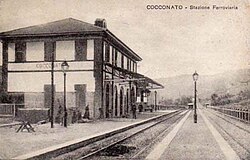
Cocconato station, active between 1912 and 2011, was placed along the ceased Chivasso-Asti railway.
Administration
Twinning · Other administrative informationExplore this chapter
Below is a table relating to the administrations that have succeeded one another in this municipality.
| Period | First citizen | Match | Load | Notes | |
|---|---|---|---|---|---|
| 6 June 1985 | 1 June 1990 | Bruno Marchetti | Christian Democracy | Mayor | [14] |
| 1 June 1990 | April 24, 1995 | Michelangelo Montanaro | civic list | Mayor | [14] |
| April 24, 1995 | June 14, 1999 | Claudio Casaleggio | - | Mayor | [14] |
| June 14, 1999 | June 14, 2004 | Carlo Scagno | civic list | Mayor | [14] |
| June 14, 2004 | June 8, 2009 | Giovanna Ferrero | civic list | Mayor | [14] |
| June 8, 2009 | May 26, 2014 | Michele Marchisio | civic list | Mayor | [14] |
| May 25, 2014 | May 24, 2019 | Monica Marello | Civic list Per Cocconato | Mayor | [14] |
| May 26, 2019 | 2024 | Umberto Faglio | civic list | Mayor | [14] |
Twinning
 Caissargues
Other administrative information
Cocconato was the capital of hilly community Versa Union Astigiano.

Notes
Explore this chapter
- ^ to b Monthly demographic balance for the year 2026 (provisional data), up demo.istat.it, ISTAT.
- ^ Seismic classification (XLS), up risks.protezionecivile.gov.it.
- ^ Table of degrees/day of Italian Municipalities grouped by Region and Province (PDF), in Law 26 August 1993, n. 412, annex A, National Agency for New Technologies, Energy and Sustainable Economic Development, 1 March 2011, p. 151. URL consulted on 25 April 2012 (archived fromoriginal url on 1 January 2017).
- ^ Armando Tallone, Cocconato, in Treccani.it – Online encyclopedias, I Appendix, Rome, Institute of the Italian Encyclopedia, 1938.
- ^ The municipalities in the Astiginano area which hosted interned foreign Jews are: Agliano, Antignano, Asti, Canelli, Castelnuovo Don Bosco, Cocconato, Mombercelli, Montechiaro d'Asti, Montiglio, Nizza Monferrato, San Damiano d'Asti, Villanova d'Asti.
- ^ Nicoletta Fasano, The precarious refuge: foreign Jews interned in Asti (1941-1945) (PDF), up israt.it. Retrieved 8 September 2017 (archived fromoriginal url on 21 August 2016).
- ^ Foreign Jews interned in Piemonte.
- ^ Among the victims of Auschwitz there is a native of Cocconato, Guido Zaccaria Luzzati, who was arrested in Asti on 19 February 1944. CDEC Digital library.
- ^ to b c Decree of the President of the Republic (DPR) – 19/11/1999 (PDF). Retrieved 12 November 2021.
- ^ to b The Stemma, up Municipality of Cocconato. Retrieved 14 May 2026.
- ^ Data taken from:
- Resident population of the municipalities. Censuses from 1861 to 1991 (PDF), up ebiblio.istat.it, ISTAT.
- Resident population - Time series, up exploredati.istat.it.
Please note: 2021 data refers to permanent census data as of December 31 of that year.
- ^ to b Institution of the Palio, up common.cocconato.at.it. Retrieved 30 October 2015 (archived fromoriginal url on 15 February 2015).
- ^ Claudia Solaro, Umberto Fasoglio: “Cocconato tra ‘I Borghi più belli d’Italia” sia un tow for the whole territory”, up atnews.it, 25 February 2020.
- ^ to b c d And f g h http://amministratori.interno.it/
Bibliography
Explore this chapter
- Zampicinini Franco, A family of carradori and trebbiatori: the Ferrero di Cocconito, in “I Quaderni di Muscandia”, n. 4 (2005), pp. 101–113.
- Zampicinini Franco (edited by), Cocconato and surroundings. Images of yesterday: work, Torino, Il Punto, 2006.
- Zampicinini Franco (edited by), Cocconato and surroundings. Images of yesterday: party moments, Turin, Il Punto, 2008.
- Zampicinini Franco (edited by), The Palio degli Asini (1970-2009), Turin, Il Punto, 2009.
Where to stay · Cocconato
Find stays on Booking.comThe area, step by step
Trails and routes in Cocconato
 Mountain bikeAround the starting point
Asti, Alessandria and surroundings
Tre giorni attorno a Cocconato #1 Anello sud/est
 CyclingAround the starting point
 Mountain bikeAround the starting point
Astigiano area
Montiglio, Cocconato, Montiglio
 WalkingAround the starting pointCyclingAround the starting point
 WalkingAround the starting point