- Elevation
- 400 m above sea level
- Area
- 5.37 km2
- Patron saint
- Sant'Agata and San Vitale
A closer look
Discovering Moransengo
Moransengo (Moranseng or Morarseng in Piedmont) is a hamlet of 186 inhabitants of the town of Moransengo-Tonengo in province of Asti in the Piemonte.
Autonomous commune until 2022, from 1 January 2023 merged with the municipality of Tonengo to give life to the new commune of Moransengo-Tonengo[4].
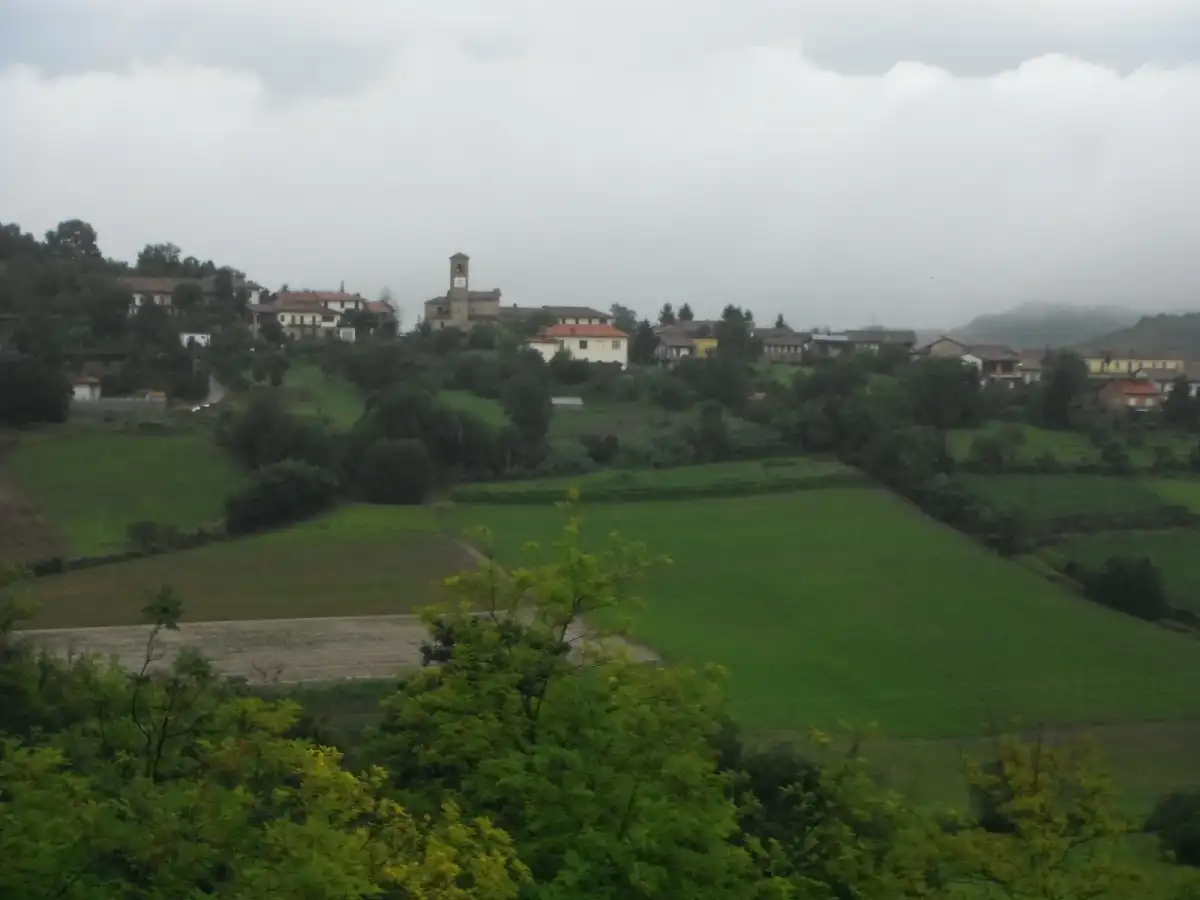
Landscape and area
Country of Monferrato located 400 meters above sea level, in the province of Asti, is spread over an area of 540 hectares and has a population of 192 inhabitants.Explore this chapter
Country Monferrato located 400 meters above sea level, in the province of Asti, it develops on an area of 540 hectares and has a population of 192 inhabitants.
The village is aligned on a high watershed. From the hill group of Tonengo, Moransengo and Aramengo some of the most important water courses in Monferrato are born: Stura, Versa and Triversa.
Confinante con Brozolo (TO), Brusasco (TO), Cavagnolo (TO), Cocconato (AT), Tonengo (AT), il comune di Moransengo was part of the Collinare Alto Astigiano Community.
History of Moransengo
SymbolsExplore this chapter
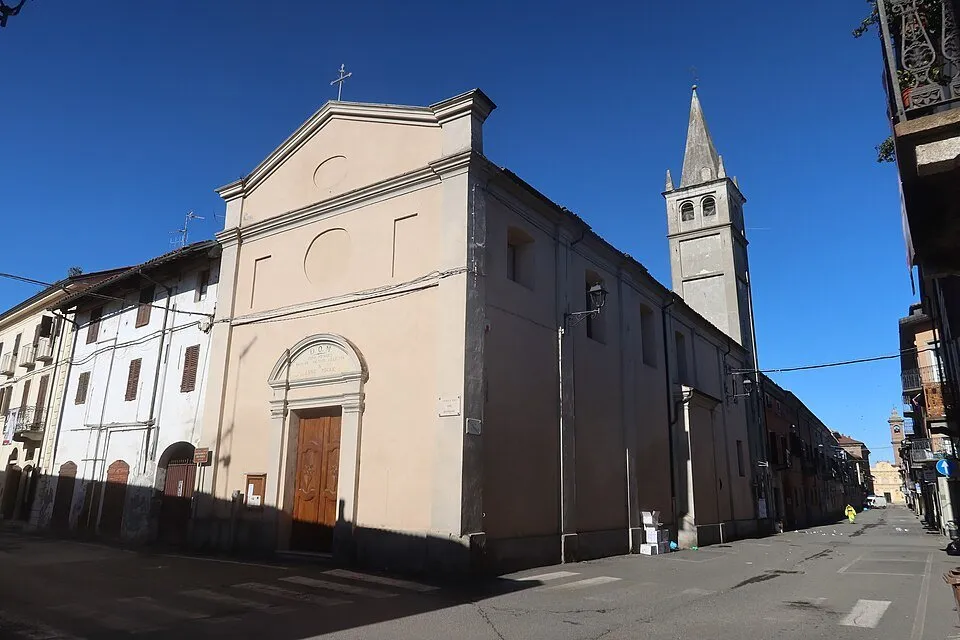
The village lies on a long hilltop that dominates the valley: its territory is intensely cultivated with vineyard. Like other countries in the area the suffix -engo is to indicate its Germanic origin and more exactly Lombardy. Since its origins under the high lordship of Monferrato, it has passed over the centuries under the dominion of many families: in 1164 it was again subjected to the Marquis of Monferrato that kept him long, transmitting it to his descendants. It was later infeuded to some dominant families the territory of Montiglio Monferrato. At the entrance to the town you can see the eighteenth-century Parish Church of Saints Agata and Vitale, with a façade in the warm color of terracotta.
The original name Muratianum Astensium, assigned to it by the Latins, was subsequently changed to Moranseng, after the settlement, around 700 d.C., of a village of populations of Lombard origin. Nothing is known from the early Middle Ages; however, it is certain that it was a fief of the bishop of Vercelli. In the 1164 Federico Barbarossa confirmed the dominion of the Marquis Guglielmo il Vecchio in Monferrato. Until the beginning of the ‘700 the history of the place will remain tied to the events of the lordship of Montiglio.
At the top of a high hill rises the Castle, of ancient origin: in 1680 it was purchased by merchant Carlo Andrea Galiziano who assumed the title of Conte, and his descent remained long mistress of the country. In 1704, following the siege of French troops who plundered the country and burned the castle, the town was moved to the present parish church and the Castle underwent radical transformations that led it to assume the current aspect of stately residence, now destined for private housing. The manor, consisting of two bodies united at angle, of different height, presents the most interesting part in the main facade, preceded by a double staircase. Recently, the current property has accomplished a wise restoration, destinating part of the interior to collection of contemporary art and the natural park of cultural events.
Symbols
The coat of arms and gonfalone were granted by decree of the President of the Republic of 10 December 1990.[5]
The gonfalone was a drape party of blue and red.
Society
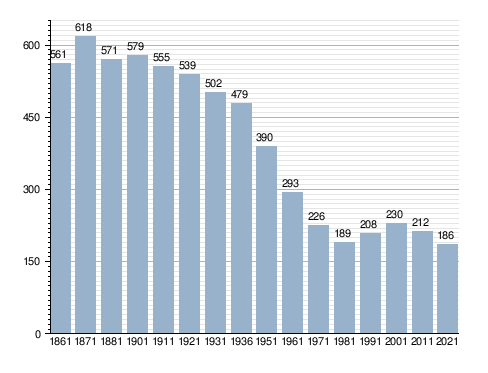
Demographic evolutionExplore this chapter
Demographic evolution
Economy
The economy of the country has not undergone significant changes and is almost exclusively agricultural. There are some cattle farms of Piedmontese breed and two livestocks of...Explore this chapter
The economy of the country has not undergone significant changes and is almost exclusively agricultural. There are some cattle farms of Piedmontese breed and two rabbit farms.
A farmer is dedicated to the interesting activity of cultivating and providing medicinal plants to a cooperative.
Relevant for the economy are also the cutting and marketing of wood, both fine and firewood, and viticultural cultivation.
Administration
Below is a table relating to the administrations that have succeeded one another in this municipality.Explore this chapter
Below is a table relating to the administrations that have succeeded one another in this municipality.
| Period | First citizen | Match | Load | Notes | |
|---|---|---|---|---|---|
| June 4, 1985 | January 16, 1988 | Anna Maria Rissone | Christian Democracy | Mayor | [8] |
| January 16, 1988 | May 25, 1990 | Pietro Savino Nicola | Christian Democracy | Mayor | [8] |
| May 25, 1990 | April 24, 1995 | Pietro Savino Nicola | Christian Democracy | Mayor | [8] |
| April 24, 1995 | June 14, 1999 | Giuseppe Nervo | center | Mayor | [8] |
| June 14, 1999 | June 14, 2004 | Giuseppe Nervo | civic list | Mayor | [8] |
| June 14, 2004 | June 8, 2009 | Piera Sesia in Cats | civic list | Mayor | [8] |
| June 8, 2009 | May 26, 2014 | Massimo Ghigo | civic list | Mayor | [8] |
| May 26, 2014 | May 26, 2019 | Massimo Ghigo | list civic Campanile and grape bunch | Mayor | [8] |
| May 26, 2019 | December 31, 2022 | Massimo Ghigo | list of Campania with Spiga and Vite | Mayor | [8] |
Notes
Explore this chapter
- ^ Date Istat - Resident population as of 31 December 2019.
- ^ Seismic classification (XLS), up risks.protezionecivile.gov.it.
- ^ Table of degrees/day of Italian Municipalities grouped by Region and Province (PDF), in Law 26 August 1993, n. 412, annex A, National Agency for New Technologies, Energy and Sustainable Economic Development, 1 March 2011, p. 151. URL consulted on 25 April 2012 (archived fromoriginal url on 1 January 2017).
- ^ Arianna Bank Data Regulation, up airnna.cr.piemonte.it. Retrieved 4 January 2023.
- ^ Moransengo, up Central State Archive. Retrieved 1 January 2023 (archived fromoriginal url on 1 January 2023).
- ^ Moransengo, up araldicacivica.it. Retrieved 15 November 2021.
- ^ Data taken from:
- Resident population of the municipalities. Censuses from 1861 to 1991 (PDF), up ebiblio.istat.it, ISTAT.
- Resident population - Time series, up exploredati.istat.it.
Please note: 2021 data refers to permanent census data as of December 31 of that year.
- ^ to b c d And f g h the https://amministratori.interno.it/
Where to stay · Moransengo
Find stays on Booking.comThe area, step by step