Atlas of Monferrato
Castelnuovo Don Bosco: sights, history and trails
Asti
- Elevation
- 245 m above sea level
- Area
- 21.61 km²
- Demonym
- castelnovesi
- Patron saint
- San Rocco
A closer look
Discovering Castelnuovo Don Bosco
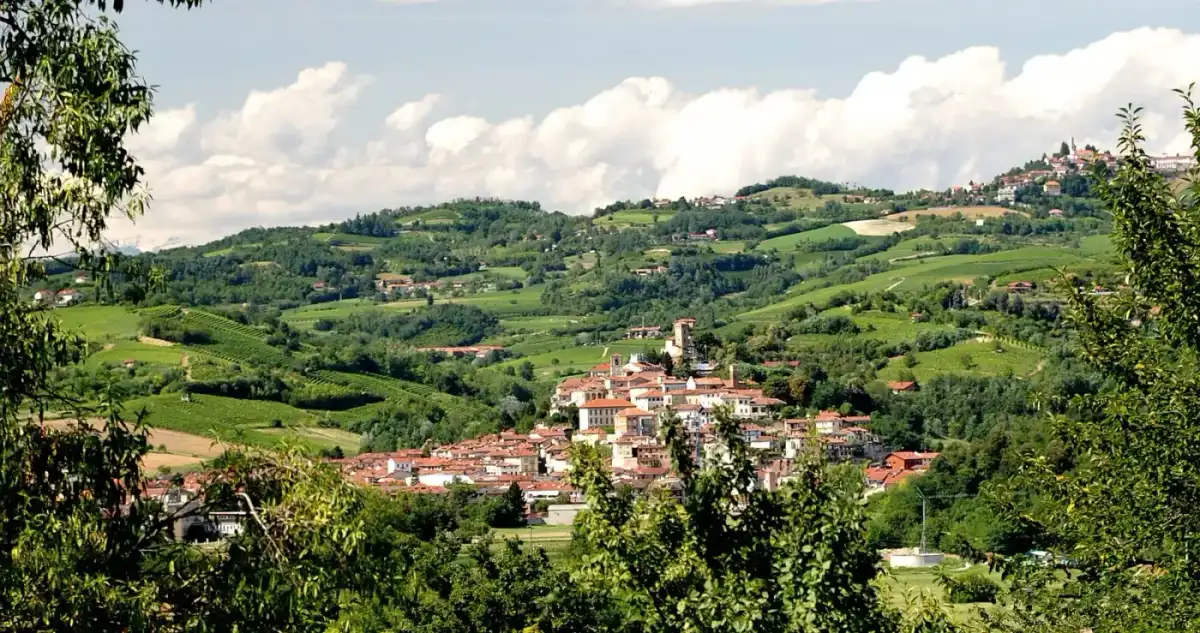
Castelnuovo Don Bosco (until 1930 Castelnuovo d'Asti – Castelneuv d'Ast in Piedmont) is an Italian municipality of 3 101 inhabitants[2] from the province of Asti in the Piemonte. It is part of the Union of Municipalities - Collinare Community "Alto Astigiano".
Landscape and area
The village is located at the north-western end of the province of Asti in the historical territory of Astesana, on a slightly elevated hill, close to the confluence between...Explore this chapter
The village rises at the north-western end of the province of Asti in the historical territory ofAstesana, on a slightly elevated hill, near the confluence of the Nevissano and Bardella rivers. The town was called Castelnuovo d'Asti before he was given the surname of the most illustrious citizen. The origin of the name is to be connected to the presence of a castle around which stands a village, from the back to the year 1000. Around the village there are rural villages of particular interest: Bardella, Cascine Grosse, Morialdo, Il Bricco, Nevissano, Mistrassi and Vironi, Mondonio, Cascine Garesio, Ranello and the area of Madonna della Neve.
History of Castelnuovo Don Bosco
SymbolsExplore this chapter
For half he belonged to the lords of Riva and for the other to the counts of Biandrate, to be given in sovereignty by the emperor to the Marquises of Monferrato.
First submissive to the municipality of Asti, it was then made fief in 1288 to the lords of Rivalba and the lords of Piea, until, after being controlled for a certain time by the marquises of Monferrato, it definitively returned to be part of the Country of Astese in the second half of the fourteenth century. The important location was inserted by Gian Galeazzo Visconti in the Capitanato d'Astesana, territorial grouping made up of fourteen countries of great strategic importance, not unfeoffable but directly subjected to the authority of the Governor of Asti.[5] In 1618 Carlo Emanuele I of Savoy, Count of Asti and Lord of the Astesana, for impelling financial needs established and put on sale the feudal titles of the localities of the Capitanate, giving them to the best bidders.
Castelnuovo d'Asti was granted in 1619 to Count Ernst von Mansfeld, until after his death he was given to his natural sister Matilde of Savoy, wife of Charles of Simiana. These preserved the lordship of the place until 1716, when Irene Simiana, the last heir of the family, married with Michele Imperiale, prince of Francavilla[6]
Interesting is the report on the economic and administrative conditions of the country compiled by the Intendent of the Province of Asti Count Balduini di Santa Margherita in 1750. Castelnuovo counted at the time 360 families, corresponding to a population among 1 800 and the 2 000 inhabitants. Agricultural lands were considered of good quality, and if cereal crops were just enough to local needs, production and sale of wine was sufficiently integrated the income of farmers. The vineyards were well occupied at the time 1 800 Piedmontese days (692 acres) 4 500 (1 730 acres) constituting the municipal territory. Wine production was of 1 800 "carra"[7] from ten brethren, equal to 9 000 Hectolitres. They were also produced 2 299 grain bags, equal to about 2 000 Fifth, and 1 158 maize grain bags, equal to about 1 000 Fifth. In that year they were working in Castelnuovo 497 cattle and goats 500 sheep, whose milk was intended for the production of rhinos. At the time two annual fairs were held, one the 26 March and the other on December 1st; very important was the weekly market, during which chickens and dairy products were traded in the area[8].
In the years of World War II, between 1941 and 1943, 45 Jewish refugees were interned in Castelnuovo (including families with children), from the Balkans.[9] After September 8, 1943, with the German occupation, the group (in the meantime reduced to 20 people due to the numerous transfers to Ferramonti or other locality of internment) promptly dispersed. In the end, all internees managed to save themselves (mostly finding refuge in Switzerland, others headed south to meet the Allied Army).[10]
Symbols
- Coat of arms
The municipal coat of arms was recognized by decree of the head of government of 13 January 1937.[11]
- Banner
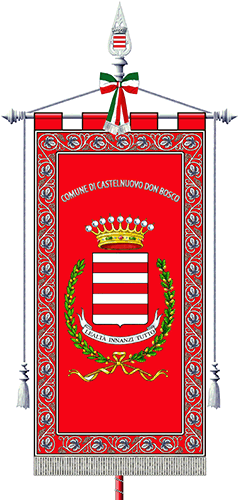
Municipal gonfalone, flag and motto "Loyalty above all" which accompanies the shield were granted by decree of the President of the Republic of 2 July 2002.[11]
What to see in Castelnuovo Don Bosco
In the historic centre of the capital and at the highest point of the country, stands the medieval tower with a square structure, refurbished in the fifteenth century (inserted in the circuit...Explore this chapter
In the historic center of the capital and at the highest point of the town, stands the medieval tower with square structure, restructured in the fifteenth century (inserted in the circuit "Open Castles" of the Basso Piemonte) which, with some adjacent ruins, is what remains of the castle that once dominated the inhabited. Next to it stands a sanctuary dating back to the late eighteenth century, dedicated to the Madonna del Castello erected in Baroque form.
The parish church of Sant'Andrea is also located in the upper part of the village with a simple façade dating back to the 18th century. The interior is central and there is a painting by Guglielmo Caccia called "the Moncalvo".
Around the cult building there are some valuable buildings dating back to different eras, from the Middle Ages to Liberty: at this last period the Casa Filipello is adorned by a garden.
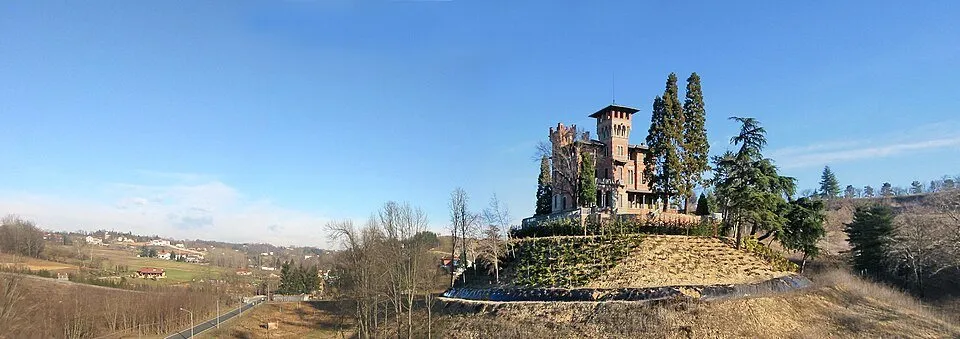
Going down to the lower part of the village there are other remarkable buildings such as the church of San Bartolomeo, in 18th century style, and the palace of Rivalba (the chapel is also part of the system "Castelli Aperti") located in a square entirely dominated.
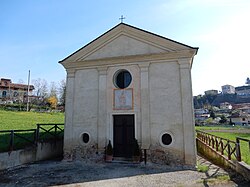
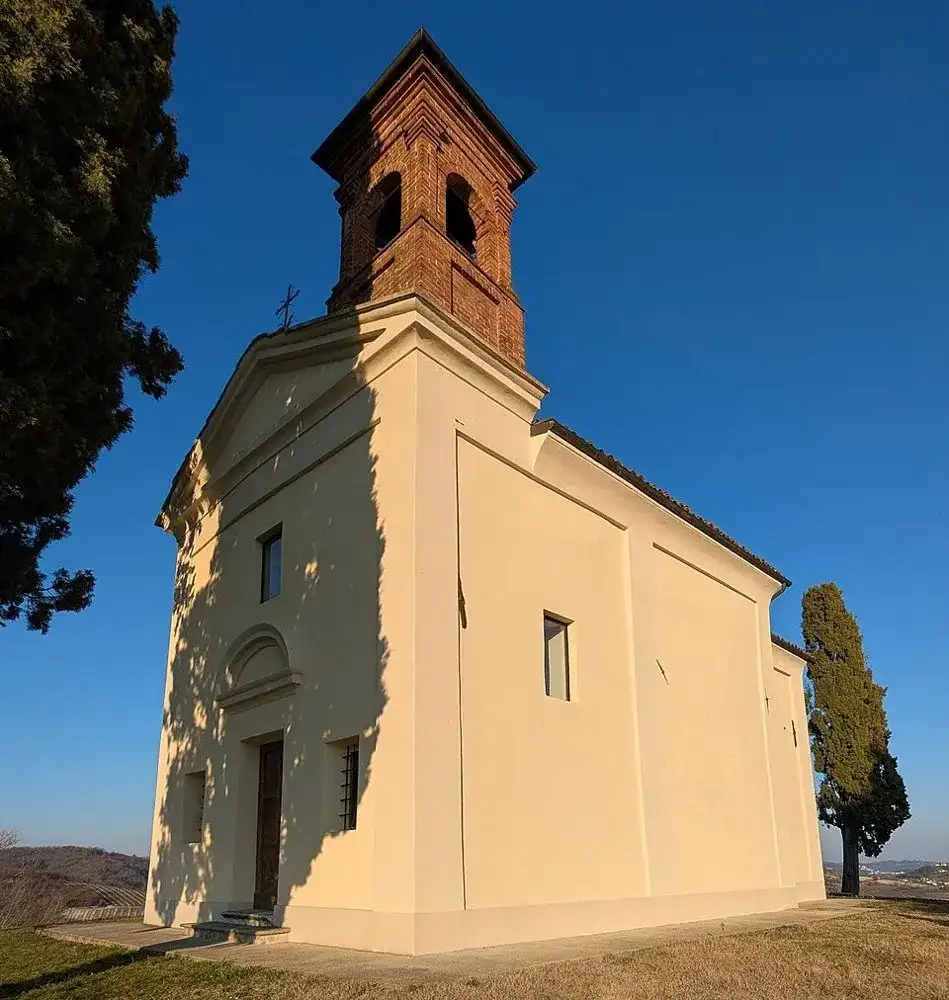
In the vicinity of the village, along the road that leads to Berzano di San Pietro is the small church of Sant'Eusebio in Romanesque style: the façade was restored in the eighteenth century, while the rest of the building still has medieval characteristics, with some hanging arches remaining in the apse.
Also in Romanesque style there are three other buildings of worship placed in isolated places: the church of Santa Maria di Cornareto, in Nevissano, the rural church of San Michele Arcangelo in Bardella and that of Santa Maria di Rasetto in the hamlet Mondonio.
The first was in bad condition until the year 2000, when it underwent a radical restoration, eliminating the ruins of the classroom and the ruins of the bell tower already collapsed a century before, saving and consolidating the only Romanesque apse, with front closure as chapel.
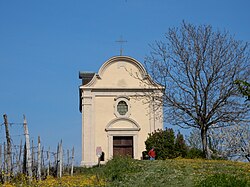
The second is located on a panoramic hill on the path that connects Castelnuovo Don Bosco with the Abbey of Vezzolano. The third is still used: located on a hill near the town of Garesio, it appears quite integrated in the outside, less the eighteenth century facade inside which insists a portico built at the beginning of the twentieth century, with stone apse and brick structure.
In addition to the basilica of Don Bosco in the hamlet Colle Don Bosco, in the village was dedicated to the Saint, in 1898 a statue, work of sculptor Giovanni Antonio Stuardi[13], located in the lower part of the main square.
Society
Demographic evolutionExplore this chapter
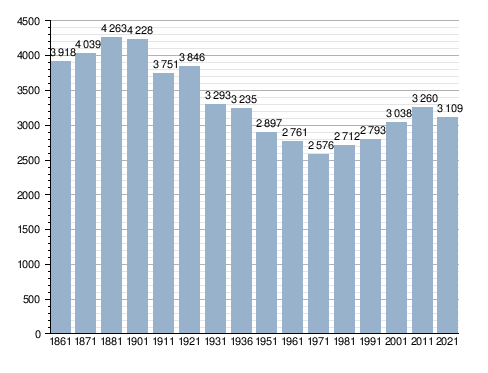
Demographic evolution
Inhabitants registered[14]
Anthropic geography
HamletsExplore this chapter
Hamlets
Bardella, Mondonio San Domenico Savio - an independent commune until 1929 - Morialdo (I Becchi is a reon of Morialdo, now: Colle Don Bosco in honor of the Holy born ivi), Nevissano and Ranello.
Economy
In the territory of the municipality there is also the vine that gives rise to DOC wine productions, especially malvasia and freisa . Among the craft activities that...Explore this chapter
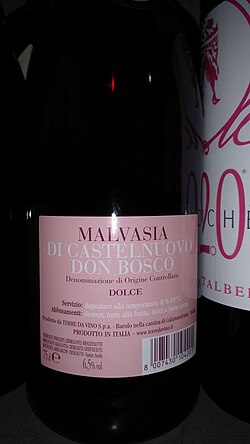
In the territory of the municipality there is also the vine that gives rise to DOC wine productions, especially malvasia and freisa. Among the craft activities that have had a remarkable development we can count the working of the junch and the vimine, with which are manufactured furniture and other furnishing objects. In Bardella, about 2 km from the country, there are sulphurous sources. They are cold sources used for the care of the digestive and skin apparatus. In addition to Castelnuovo is the factory of ICP AVIATION.
Administration
Below is a table relating to the administrations that have succeeded one another in this municipality.Explore this chapter
Below is a table relating to the administrations that have succeeded one another in this municipality.
| Period | First citizen | Match | Load | Notes | |
|---|---|---|---|---|---|
| 1896 | 1921 | Spirit Moved | Mayor | ||
| June 24, 1985 | June 10, 1990 | John Ravine | - | Mayor | [15] |
| June 10, 1990 | December 18, 1993 | John Ravine | civic list | Mayor | [15] |
| January 16, 1994 | April 24, 1995 | Giorgio Musso | Christian Democracy | Mayor | [15] |
| April 24, 1995 | June 14, 1999 | Giorgio Musso | center | Mayor | [15] |
| June 14, 1999 | June 14, 2004 | Giorgio Musso | civic list | Mayor | [15] |
| June 14, 2004 | June 8, 2009 | Happy Andre | civic list | Mayor | [15] |
| June 8, 2009 | May 26, 2014 | Giorgio Musso | civic list | Mayor | [15] |
| May 26, 2014 | May 27, 2019 | Giorgio Musso | Civic list Project Castelnuovo | Mayor | [15] |
| May 27, 2019 | June 9, 2024 | Antonio Rago | Civic list Project Castelnuovo | Mayor | [15] |
| June 9, 2024 | in office | Umberto Musso | List of people Castelnuovo Noi | Mayor | [15] |
Sport
In the sports field Castelnuovo Don Bosco gave birth to Luigi Marchisio, champion of Giro d'Italia in 1930 . As a recognition he was named the gym of...Explore this chapter
In the sports field Castelnuovo Don Bosco gave birth to Luigi Marchisio, champion of Giro d'Italia in 1930. As a recognition he was named the gym of Castelnuovo.
Notes
Explore this chapter
- ^ Municipality of Castelnuovo Don Bosco: Municipal Administration and Mayor - Municipality of Castelnuovo Don Bosco e città, Asti, Piemonte, up www.comune-italia.it. URL consulted on 4 August 2026.
- ^ to b Monthly demographic balance for the year 2026 (provisional data), up demo.istat.it, ISTAT.
- ^ Seismic classification (XLS), up risks.protezionecivile.gov.it.
- ^ Table of degrees/day of Italian Municipalities grouped by Region and Province (PDF), in Law 26 August 1993, n. 412, annex A, National Agency for New Technologies, Energy and Sustainable Economic Development, 1 March 2011, p. 151. URL consulted on 25 April 2012 (archived fromoriginal url on 1 January 2017).
- ^ Serafino Grassi, History of the city of Asti, vol. II, Asti, 1817, p. 58.
- ^ Luigi Cibrario: Genealogic news of noble families of the ancient states of the monarchy of Savoy, Turin, 1866, p. 193.
- ^ Carra is an ancient measure for liquids used in Piemonte equal to about 493 liters, divided into 10 breezes. In the Langhe it could vary to about 591 liters.
- ^ Giovanni Francesco Balduini di Santa Margherita, General Report of the Instituto d'Asti on the state of the Province - 1750/1753, edited by the Società di Studi Astesi, Volpiano, 2010.
- ^ The municipalities of the Astiginan that have hosted foreign Jews interned are: Agliano Terme, Antignano, Asti, Canelli, Castelnuovo Don Bosco, Cocconato, Mombercelli, Montechiaro d'Asti, Montiglio, Nizza Monferrato, San Damiano d'Asti, Villanova d'Asti.
- ^ Foreign Jews interned in Piemonte. Of the former inmates at Castelnuovo Don Bosco, the only one deported to Auschwitz was Irene Fuchs, arrested in the Turin area, who was among the few to return from the extermination camps. CDEC Digital Library.
- ^ to b Castelnuovo Don Bosco, up Central State Archive. Retrieved 12 November 2021.
- ^ Coat of arms and banner, up Municipality of Castelnuovo Don Bosco.
- ^ Life, up The works of the sculptor Stuardi.
- ^ Data taken from:
- Resident population of the municipalities. Censuses from 1861 to 1991 (PDF), up ebiblio.istat.it, ISTAT.
- Resident population - Time series, up exploredati.istat.it.
Please note: 2021 data refers to permanent census data as of December 31 of that year.
- ^ to b c d And f g h the j http://amministratori.interno.it/
Where to stay · Castelnuovo Don Bosco
Find stays on Booking.comThe wine landscape
This village in wine country
Follow the link between the country, the vineyards and the neighboring territories.
The area, step by step
Trails and routes in Castelnuovo Don Bosco


Asti, Alessandria and surroundings
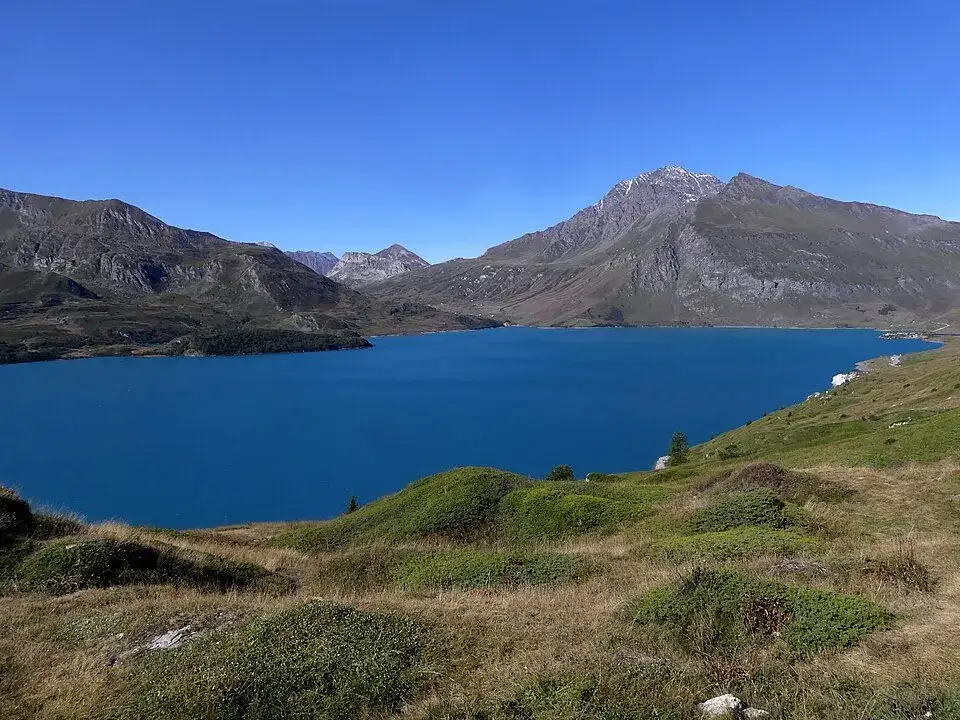
Moncucco Torinese - Lago - Chieri - Castelnuovo Don Bosco - Moncucco
 Mountain bikeAround the starting point
Asti, Alessandria and surroundings
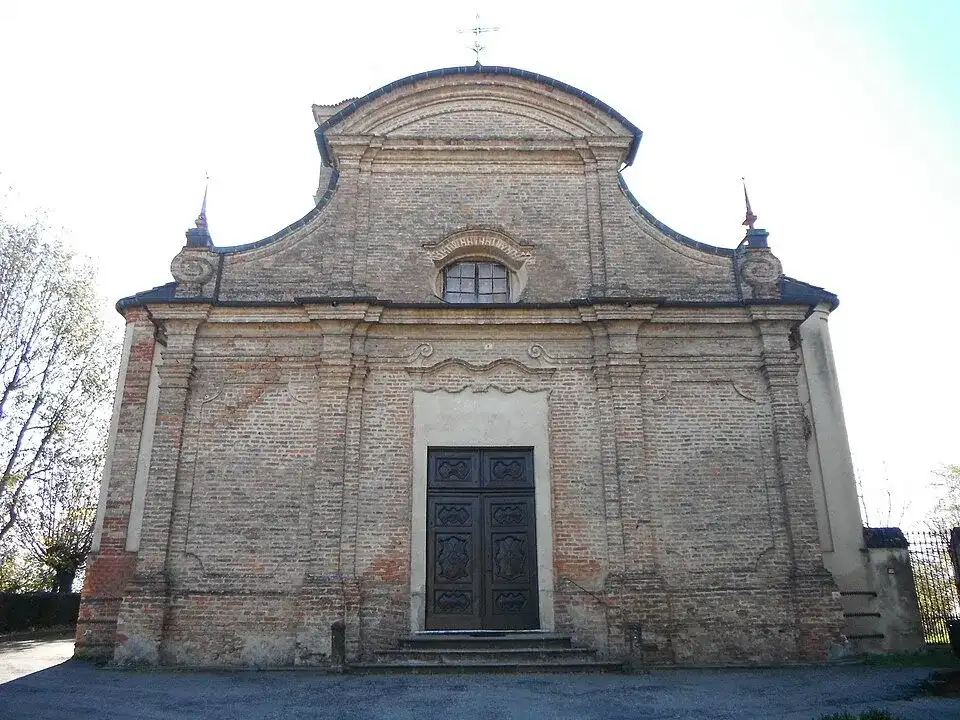
La Via Francigena verso il mare
 Mountain bikeAround the starting point
 WalkingAround the starting point

 CyclingAround the starting point
 WalkingAround the starting point