Atlas of Monferrato
Passerano Marmorito: sights, history and trails
Asti
- Elevation
- 320 m above sea level
- Area
- 12.03 km²
- Demonym
- passeranese
- Patron saint
- Saints Peter and Paul
A closer look
Discovering Passerano Marmorito
Passerano Marmorito (Passeiran in Piedmont) is an Italian municipality of 440 inhabitants[1] from the province of Asti in the Piemonte.
History of Passerano Marmorito
SymbolsExplore this chapter
 |
Like other lands of Low Monferrato, the territory that constitutes today's municipality of Passerano Marmorito was in ancient times inhabited by Ligurian populations and subsequently subject to Roman domination. In the 9th and 10th centuries, powerful groups of Frankish bloodlines, who descended into Piemonte with Charlemagne, settled in places not far from Passerano, but the information relating to this period is somewhat uncertain. The origin of the name of Passerano, attested since 1001 as Passerianus, is probably a predial, that is, a name referring to a farm, to a fundus possessed by a rich family of time, obtained by adding to the person name Passerius suffix -anus.
In imperial diplomas the place appeared first in 1164, when Federico Barbarossa, who with the second descent into the peninsula had managed to impose himself on the municipalities of northern Italy, assigned by the decree of Belfort the territories of Passerano, Schierano and Primeglio (and many others belonging to the county of Cocconato) to the Marquis Guglielmo V of Monferrato. Between the 12th and 13th centuries, Oberto and his son Manfredo are the local lords, somehow connected with the Marquis of Monferrato.
Their supremacy over the village lasted until the middle of the 12th century, when, in 1186, thanks to the intervention of Emperor Henry VI, the territories of Capriglio, Marmorito, Primeglio, Schierano (and others) came under the control of the powerful family of the counts of Cocconato. The counts of Cocconato formed a consortium, known as the Radicati. At the beginning of the 13th century, Passerano was added as a fief to the dominion of the Radicati counts (around 1277). In 1369 Charles IV of Bohemia subjected the county again to the marquisate of Monferrato (in that period led by the Paleologhi family), arousing the reaction of the Radicati who, turning to the Viscontis, lords of Milan, obtained the restoration of the previous situation. In 1458 the consortium, which at the time numbered as many as forty lords, obtained total autonomy.
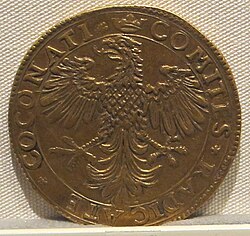
In 1503 Emperor Maximilian submitted Cocconato's accounts to his son-in-law Philipbert II of Savoy: a complex diplomatic affair came about when Emperor Charles V established the ancient privileges. In 1500 the county was the scene of some clashes to be placed inside the war between France and Spain for the dominance on the continent: in 1526 the territory was occupied by the imperial troops led by Fabrizio Maramaldo and the castle of Passerano was laid under siege. The siege was removed only after the intermediation of Marquis Vittoria Colonna, widow of the lieutenant of Charles V Fernando Francesco d'Avalos. Charles V himself, with a 1530 diploma, restored the ancient autonomy of the Radicati County, which also obtained the privilege of beating gold and silver coins.
At Passerano's tick, they worked skillful counterfeiters of the most important ticks in Turin and Milan: they imitated German heels, French pinnacles, Venetian coins and Lombards. In 1550 the Spanish, during the sixteenth century Italian Wars, occupied and strengthened Passerano Castle; the following year the Marshal of France Charles I of Cossé, Count of Brissac, impeded in his anti-imperial campaign by the resistance against Passerano, expelled the castle and after the surrender of the Spanish garrison blown up the fortifications that surrounded it. In 1586 the Radicati counts submissed the Duke of Savoy Carlo Emanuele I. The mint, for his part, continued its activity until 1598, when the privilege of beating money was revoked by the Duke of Savoy due to the continuing coniction of false coins. From the 17th century, the entire territory was found at the mercy of the conflicts of succession for the marquisate of Monferrato and the duchy of Mantua to it united (1614-15, 1627-30).
The clashes between the imperial and Spanish armies against the French one devastated the same castle of Passerano and led to a reduction in the territories of the County. The peace negotiations ended with the Cherasco agreement of 1631, with which Mantua and Monferrato remained to the heir Gonzaga-Nevers, while the Dukes of Savoy obtained an extension of their control over the lands of the Piedmontese countryside. After the fall of the Savoy state following the Napoleonic advance, Passerano was part of the Tanaro Department, which had been divided into three arrondissement: Acqui, Alba and Asti. The Napoleonic regime fell in 1814, the territories of Piemonte they returned under the control of the Savoy, returned with the new ruler Vittorio Emanuele I[4][5].
Symbols
The coat of arms and gonfalone were granted by decree of the President of the Republic of 19 September 1996.[6]
- Coat of arms
The coat of arms of the city refer to the coat of arms of the Radicati, feudal lords of the town, who brought one inquarified shield: at 1st and 4th of black, the golden eagle, crowned with the same; at 2nd and 3rd of silver, to the chestnut rooted in natural.
- Banner
What to see in Passerano Marmorito
Passerano Castle · Castle of Primeglio · Castle of SchieranoExplore this chapter
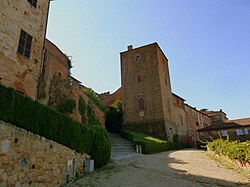
Passerano Castle
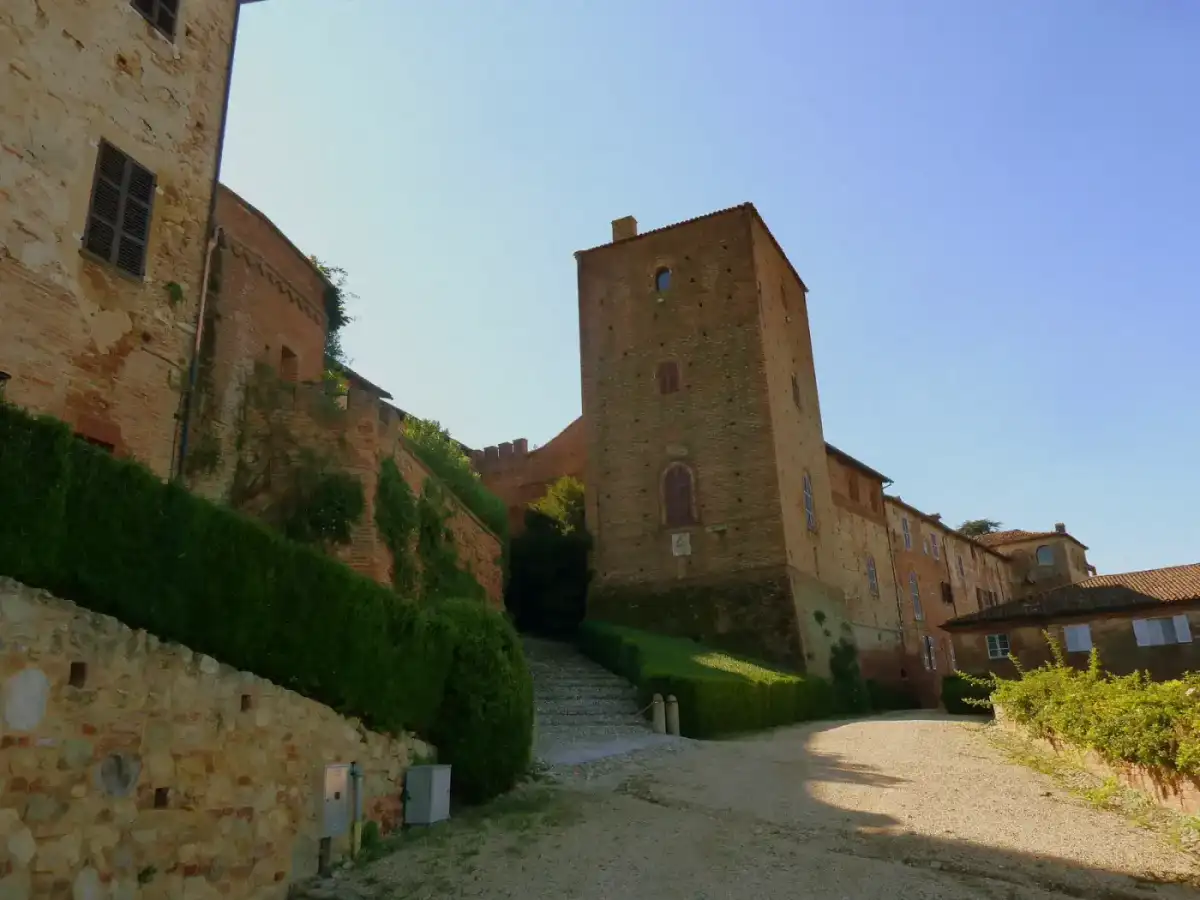
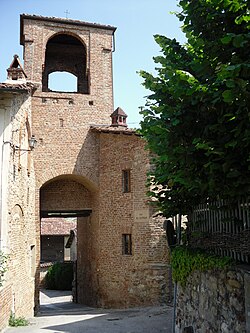
It stands out imposing on the village with its irregular structure and its remarkable dimensions. Its current construction was built in the fourteenth century and expanded over the next three centuries, but its origin is attested to the Early Middle Ages. In 1550 he was occupied by the Spanish and fortified, in the following year he was attacked and expelled by the French Marshal Brissac. In 1617, the castle was again devastated and only in the middle of the century Alessandro Radicati was eager to restore the ancient manor. The south-west part was built, and later north of the main building, which had turned into a factory, defended by towers and Bertesches, built the so-called "Palazzina del conte Adamo", a minor building decorated with four side towers. In the 19th century the castle was restored and preserved until today without substantial alterations. Through the medieval gate, which rises to the right of the mint, you enter the fence, from where you can admire the church baked and the wide portal of access to the building. The two oldest parts are connected by a wing built in the 17th century: the north side stands out for two towers (there were four of them once) located at the corners, while the south part contains a square tower and has an external wall with a rich frieze and sharp arched windows. The interior of the castle presents stucco and furnishings preserved with scrupulous care. Of particular interest are the rooms of the upper floor, to which it is accessed through an imposing staircase adorned by two sandstone capitals of the first Gothic depicting the signs of the zodiac. The main room is enriched by a coffered ceiling, signed by a certain Grana Cake in 1484, finely carved, whose decorations, bright colors, represent the coats of arms of many noble houses. On the lower floors you can visit the rich library and apartments of Count Giovanni Battista Radicati. In the tower room, finally, are collected relics of German musician Robert Schumann, brought there by Julie Schumann (1845-1872), third daughter of Robert and Clara, who stayed in this castle having married at Lichtental, near Baden-Baden, on 22 September 1868, Count Vittorio Amedeo Radicati of Marmorito.
Castle of Primeglio
Surrounded by a lush park (currently partially abandoned), in a suggestive position, it presents itself today with changed characteristics compared to the ancient manor. These changes are attributed to the reconstruction by the Radicati, after the attack of the French troops in 1598, and to successive and massive restructuring interventions, the most significant of which occurred at the end of the nineteenth century. On the side of the main building you can still find the remains of the ancient medieval walls accompanied by a wound.
Castle of Schierano
The castle of Schierano remains today that the large square stone tower used as a bell tower of the church of San Grato.
Castle of Marmorito
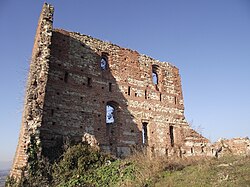
Over the centuries many times depreated and plundered to date there are only wall shreds. At the castle of Marmorito is linked an ancient legend that sees a lord of the Radicati in love with a young vercellese. The Count kidnapped the maiden and took her to the castle; unpredictablely the girl returned interest in the Radicati, but the bishop of Vercelli assaulted the castle and, finding it empty, burned it. The two lovers, along with the staff of the castle, had escaped through an underground that dug in Passerano.
Zech
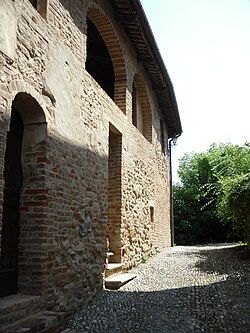
In 1526 Emperor Charles V sanctioned the autonomy of the Radicati in their county and granted the further privilege of beating gold and silver coins, a concession that was fully realized only when the state of war ended. The first coins were issued from 1589 by Passerano's mint, still existing building, located on the left of the entrance door of the castle fence. One of the first mint masters in Passerano was Tommaso Roglia, from Turin, who had taken in the contract, besides the tick of Passerano, other ticks of Monferrato. The initial "T R" letters by Tommaso Roglia appear on different coins beat at Passerano. In Passerano's mint were mainly counterfeit coins of the great ticks; in fact, they were minted coins of very low alloy, so that the mint made large sums. In addition to the local coins, they imitated low-alloy lumbar, venetian, Swiss, German and French coins. The mint continued its activity until 1598, when the privilege was revoked by the Duke of Savoy, as it continued to mint counterfeit coins. The building, skillfully restored, is now used as a library and hall for civil ritual weddings.
Parish of Saints Peter and Paul.
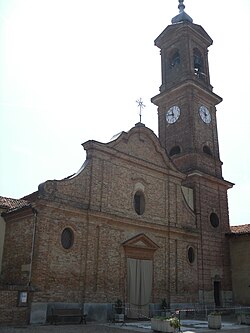
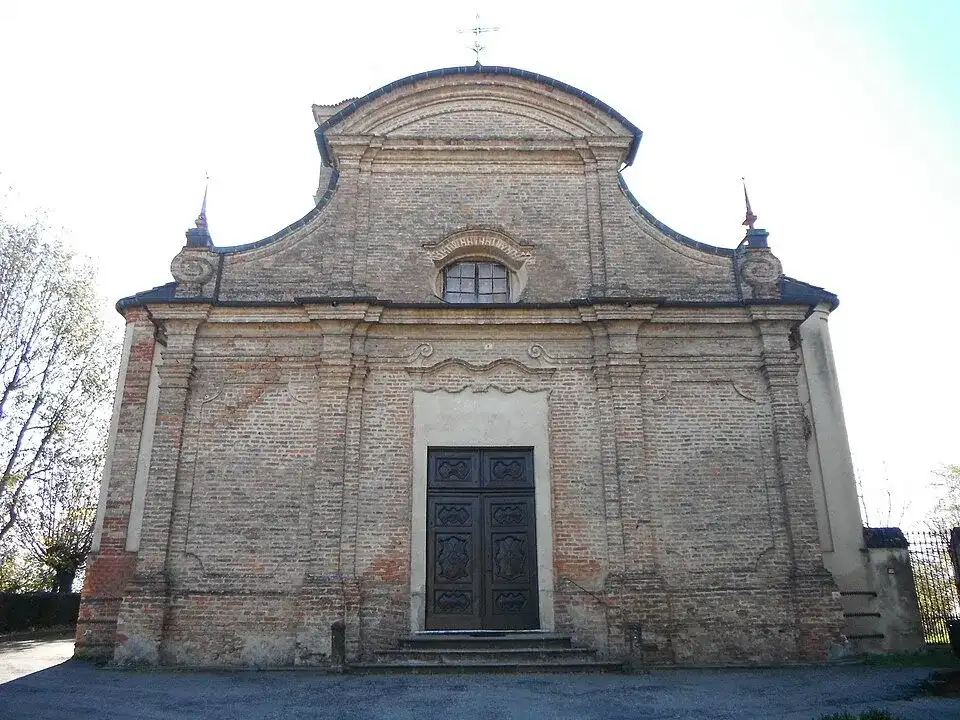
Late Baroque style, has a simple brick façade with a pleasant curvilinear crown and a beautiful bell tower, also in terracotta, in line with the facade itself. Inside the decorations are simple, in shades of blue, pink and white. The church consists of three aisles, a central and two lateral and is illuminated with natural light that filters from finely designed ovoid windows.
Churches of San Grato and San Sebastiano in Schierano
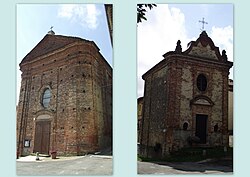
Both in baroque style and without bell tower (the medieval tower of the lost castle is used as a bell tower of San Grato), San Grato represents the main church, while San Sebastiano, not far from the previous one, was once home to a confraternity.
Church of San Lorenzo in Primeglio
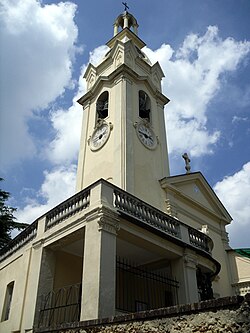
Dating back to the seventeenth century, it presents itself to a central nave with lateral arches; in the center of the facade stands the statue of the protector "San Lorenzo". The bell tower, originally Romanesque, raised and restored at the beginning of the twentieth century by the parishioners who contributed to the construction of the canon, the church's loggia and the erection, in the centre of the square, of the statue of Mary Helper. The church, on the back side, is connected, through a Roman arched bridge, to the castle so that, to the nobles of time, direct access to the church itself.
In the valley that divides Primeglio from Passerano, in "Monasté", a small monastery dedicated to San Michele was once erected. The history of this building is ancient. In the list of the properties of the Church of the end of the 13th century, but no longer in the following ones, there is a "prioratus de Primelio", whose dependence is indicated on the "monasterium sancti Januarii", that is to say by the Abbey of San Genuario di Lucedio. The priory is to be identified with the church of San Michele di Primeglio («ecclesia sancti Michaelis extra et prope locum Primelij que vocatur Ecclesia Monasterii») which is still existing at the beginning of the 17th century (pastoral visit of 1606), but broken («diruta») and apparently no longer linked to the abbey of Lucedio. The dedication to San Michele refers to a origin definitely before the XII century, when for the abbey mother the added title of San Genuario began to prevail on the primitive one, in fact, of San Michele[7]. It is now reduced to a ruin of which the oldest part remains almost intact (the Romanesque stone apse) and would require re-evaluation, given the importance of the site. On the right side you can still see the remains of a tomb, that of the Marchioness Benedetta d'Ovando y Pereyra who, at the time, had the church restored, allocating her own shrine there. The altar, recovered, was placed in the church of "La Madonnina".
Church of the Immaculate Conception in Marmorito
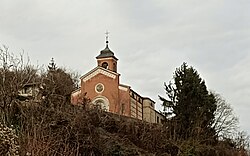
The Church of the Immaculate Conception, in fraction Marmorito, is currently a subsidiary church of the parish of Saints Peter and Paul,[8], but in the past it was the seat of a separate parish.[9] It is isolated from the other buildings of the village, not far from the top of the hill that houses the ruins of the castle. In 1891 the bell tower was raised, which is located posteriorly to the building, on the left looking at the facade. The rest of the church was deeply modified in 1904. It is rectangular and with semicircular apse. Inside it is divided into four camps and on the sides there are some chapels.[8]
Society
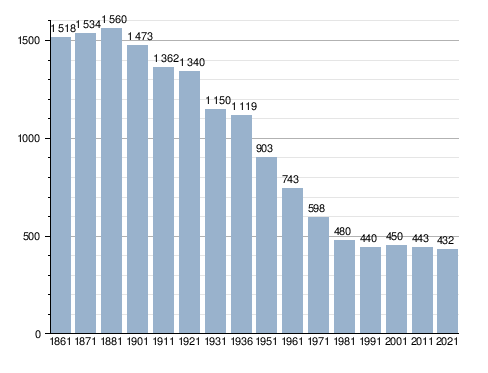
Demographic evolutionExplore this chapter
Demographic evolution
Inhabitants registered[10]
Culture
Passerano Marmorito in the mass cultureExplore this chapter
Passerano Marmorito in the mass culture
Passerano became famous in the early 1980s thanks to Giorgio Faletti who, playing Carlino's character on TV show Drive In, recited the phrase "I'm from Passerano Marmorito, the town is small... people murmur!".
Administration
TwinningExplore this chapter
Below is a table relating to the administrations that have succeeded one another in this municipality.
| Period | First citizen | Match | Load | Notes | |
|---|---|---|---|---|---|
| 6 June 1985 | June 10, 1990 | Enrico Massaia | - | Mayor | [11] |
| June 10, 1990 | April 24, 1995 | Tommaso Cerrato | Christian Democracy | Mayor | [11] |
| April 24, 1995 | June 14, 1999 | Franco Matta | center | Mayor | [11] |
| June 14, 1999 | June 14, 2004 | Franco Matta | civic list | Mayor | [11] |
| June 14, 2004 | June 8, 2009 | Flavio Bertello | civic list | Mayor | [11] |
| June 8, 2009 | May 26, 2014 | Silvana Bruna | civic list | Mayor | [11] |
| May 26, 2014 | May 27, 2019 | Davide Massaglia | civic list Together for Passerano | Mayor | [11] |
| May 27, 2019 | in office | Davide Massaglia | civic list Together for Passerano | Mayor | [11] |
Twinning
Since 2011 he has been twinned with the French commune of Beauvoisin, in Drôme (Provence).[without source]
Notes
Explore this chapter
- ^ to b Monthly demographic balance for the year 2026 (provisional data), up demo.istat.it, ISTAT.
- ^ Seismic classification (XLS), up risks.protezionecivile.gov.it.
- ^ Table of degrees/day of Italian Municipalities grouped by Region and Province (PDF), in Law 26 August 1993, n. 412, annex A, National Agency for New Technologies, Energy and Sustainable Economic Development, 1 March 2011, p. 151. URL consulted on 25 April 2012 (archived fromoriginal url on 1 January 2017).
- ^ Doglio Cotto E., Borgnino R, Travelling through forests and vineyards, between art and nature.
- ^ Institutional site, up common.passeranomarmorito.at.it.
- ^ Passerano Marmorito, up Central State Archive.
- ^ Marco Battistoni, Card on Passerano, up centrocasalis.it, 2005. Retrieved 10 July 2023 (archived fromoriginal url on 1 December 2014).
- ^ to b Church of the Immaculate Conception, up Ecclesiastical goods in WEB (BEWEB), CEI - National Office for ecclesiastical cultural heritage and religious buildings. Retrieved 11 January 2025.
- ^ AA.VV., Royal Decree 17 October 1935, in Official Journal legislation and official provisions, Establishment. printing press for the state administration, p. 109. Retrieved 11 January 2025.
- ^ Data taken from:
- Resident population of the municipalities. Censuses from 1861 to 1991 (PDF), up ebiblio.istat.it, ISTAT.
- Resident population - Time series, up exploredati.istat.it.
Please note: 2021 data refers to permanent census data as of December 31 of that year.
- ^ to b c d And f g h http://amministratori.interno.it/
Bibliography
Explore this chapter
- Maria Clotilde Daviso di Charvenson e Maria Alda Benedetto (edited by), The statutes of the consortium of Cocconato, Subalpine Deputation of Homeland History, 1965.
- Luca Gianazza, Passage, in Italian ticks up to Unity, Rome, Polygraphic Institute and State Mint, 2011.
- Renato Tartaglino, History of Cocconato, E.T.P editions, 1966.
- Franco Venturi, Alberto Radicati di Passerano, Einaudi, UTET reprint.
Where to stay · Passerano Marmorito
Find stays on Booking.comThe wine landscape
This village in wine country
Follow the link between the country, the vineyards and the neighboring territories.
The area, step by step