Atlas of Monferrato
San Martino Alfieri: sights, history and trails
Asti
- Elevation
- 257 m above sea level
- Area
- 7.21 km2
- Demonym
- Sanmartini
- Patron saint
- San Martino
A closer look
Discovering San Martino Alfieri
San Martino Alfieri (San Martin d'Ast in Piedmont) is an Italian municipality of 656 inhabitants[1] from the province of Asti in the Piemonte.
It rises in Astesana, in the tourist area called "Le Colline dei Fiumi", on the watershed of Tanaro and of the Bourbon, in control of the important director of dorsal that united Asti Roero. Coming out of the town, in the direction of Govone, you enjoy an extraordinary landscape given by the 257 meters altitude of the ridge of the hill that runs parallel to the Tanaro. It gently sinks down to the valley, full of vegetation and large cultivated spaces. The road of dorsal towards Antignano, with strong panoramic and landscape values, presents placid panoramas where the presence of work in the fields and vineyards is always current, creating one of the cultural heritages of the area.
From the fourteenth century the village belonged to the Solaro family, but in 1615, by order of the Savoy, it passed to the Alfieri di Magliano. In 1863 he took the name of San Martino al Tanaro, modified at the end of the century in San Martino Alfieri, in homage to the family of the same name.
In the hamlet of Saracchi was born the third wife of Giuseppe Garibaldi, Francesca Armosino, and in 1880 he hosted the hero in the house still visible today. In the hamlet of Marelli rises the house where Monsignor Giuseppe Marello, founder of the Oblates of St. Joseph, proclaimed Saint by Pope John Paul II in 2001.
The 18th-century castle, privately owned, is well preserved: the park was expanded in the 800 by Xavier Kurten, German landscape architect, and by Ernesto Melano, who also owes to the urban planning of the village and the project of the parish church of San Carlo and Santa Maria, built (1829-1833) in neo-classical style, which preserves the 16th century polyptych of Defendente Ferrari, with episodes of the life of the Virgin.
The town is built on a long ridge following the left bank of Tanaro over two opposing nuclei: on one side the Castle and on the other the original nucleus, in the form of a reception, separated by a saddle with road crossing. The original nucleus is divided into a set of squares and squares, connected by short alleys. In it all the main functions are carried out for the community: civic, social, religious and tourist.
The activity and personal history of Benedetto Alfieri bind San Martino Alfieri to Piovà Massaia. In one place, the architect dwelt and designed the 18th century extensions of the family castle, while in the other it was the creator of one of the architectural masterpieces of Monferrato Astigiano, the Parish.
The village is 14 km from Asti in the south-west direction and 16 km from Alba (CN). The agriculture, in particular viticulture, has its revenge on the industry, in fact we find fine vines of barbera, grignolino, bonarda and white. The "Bottega del vino", in Piazza Caduti, with tasting-exposition room, promotes the wines and products of the territory. Among the culinary specialties of agnolotti, wetsuit caud, cured meats, roasts and mixed boiled meats.
History of San Martino Alfieri
SymbolsExplore this chapter
The words San Martino appear in 1020 as Castro here saytur Sancti Martini. The determinant "Alfieri" derives from the Alfieri family, feudal lords between 1665 and 1671.
The village, to which more than any other is pertinent to the definition of "Colline Alfieri", belonged in ancient times with its primitive castle, to the Lords of Govone and then passed to the family of Solaro, who held the fief of San Martino until the 17th century, when they began to give some parts. The first of the "Alfieri" that almost completely had the fief of San Martino was Caesar, considered the chief of the branch called San Martino. In 1615, however, Carlo Emanuele I of Savoy had donated to Urbano Alfieri, his colonel of cavalry, the jurisdiction and feudal goods of San Martino that would be the spectator of Pandolfo Solaro and his brothers, but fell in disgrace.
Caesar Alfieri devoted his whole life to the family and to the purchase of goods. The son Carlo Antonio Massimiliano, in 1696, began the building of the castle that replaced the most ancient manor. The son of Carlo Antonio, Cesare Giustiniano became, by purchase, Marquis of Support, a title that inherited his successors. He married Paola Gabriella Solaro of Govone and had nineteen children.
During the fief of Roberto Carlo Alfieri, in 1783, San Martino had the honour to receive King Vittorio Amedeo III of Savoia with his wife Antonietta Ferdinanda, who from Govone, where they were on holiday, visited him with a lot of ladies and knights.
By the will of the Marquis Carlo Emanuele Alfieri was built the parish church of San Martino, on design of the cav. Ernesto Melano, architect of His Majesty, during the years 1828-1832, under the title of San Carlo Borromeo. In neoclassical style, the parish church of San Martino preserves a fine triptych from Defendente Ferrari school and one of its chapels was precisely the Alfieri.
A woman of the Alfieri family, Constance, married Roberto d'Azeglio, brother of Maximus, and both were true benefactors of the people.
Symbols
The coat of arms of San Martino Alfieri was granted by royal decree of 25 September 1886, when the Municipality still had the old name of San Martino al Tanaro.[4]
The gonfalone is a blue and red drape party.
Anthropic geography
Hamlets · Fagnani · Firano, Pero and QuagliaExplore this chapter
Hamlets
Fagnani
Small hamlet that begins after the sports field where every year La sagra del barbera takes place. This hamlet includes the small church of San Giuseppe where every evening the villages meet to chat at the moonlight. In addition, every year there is a rosary accompanied by a refreshment and the following morning a Mass. If you continue on a dirt road at the end of the village you reach the Tanaro River.
Firano, Pero and Quaglia
Eight chapels located in the hamlets Marelli, Firano, Pero, Quaglia and Saracchi form an ideal cross-country trail that winds through the Tanaro River and the Borbore stream, crossing hills cultivated with vines, woods and small meadow alleys.
Marelli
Along the director of Govone there is the hamlet Marelli that takes its name from the family of the same name Marello. This portion of the territory was the ancient connection of the lands of the fiefs of the Solaro di San Martino and Govone. The place is remembered because it gave birth to St. Joseph Marello (1844-1895), who lived here childhood until the transfer of the family to Turin. The house is still existing today, even if it was transformed by casket to the manor house.
Saracens
Coming out of the village, in the direction of Antignano, you can see the Saracchi hamlet, in the past belonging to the municipality of Antignano, where is Palazzo Garibaldi. The building was built by Giuseppe Garibaldi, who lived there for some time, after marrying Francesca Armosino, his last wife, native to this hamlet.
What to see in San Martino Alfieri
Castle and park of the Marchesi Alfieri · Parish Church of San Carlo Borromeo and Santa Maria · Church of the Holy AnnunciationExplore this chapter
Castle and park of the Marchesi Alfieri
The castle, built from 1696 to 1721 on the design of Antonio Bertola, preserves the original furniture of the rooms. The current construction is on the opposite height to that where the reception was formed.
18th century building surrounded by large secular trees offers a valuable Orangérie and, today, you can admire the result of an intervention requested in 1815 by the Marquis Carlo Emanuele Alfieri di Sostegno by Xavier Kurten, a German landscape architect who had the task to transform the formal garden into a park according to the new romantic English taste, allowing the Piemonte to approach the local culture to European tastes in which romanticism is a dominant phenomenon and the taste for the art of gardens its direct manifestation. He expanded the park using the collaboration of architect Ernesto Melano already known in the village. To these we also owe the urban planning and the project of a new parish church and the town house.
Those who are lucky enough to visit the castle of San Martino cannot help but stop in front of the many memories of its illustrious owners and eminent people with whom they had relations of kinship, friendship, business; they are busted, portraits, prints, manuscripts that allow to reconstruct a whole world that is not forgotten, because in it sinks the roots that present.
Parish Church of San Carlo Borromeo and Santa Maria
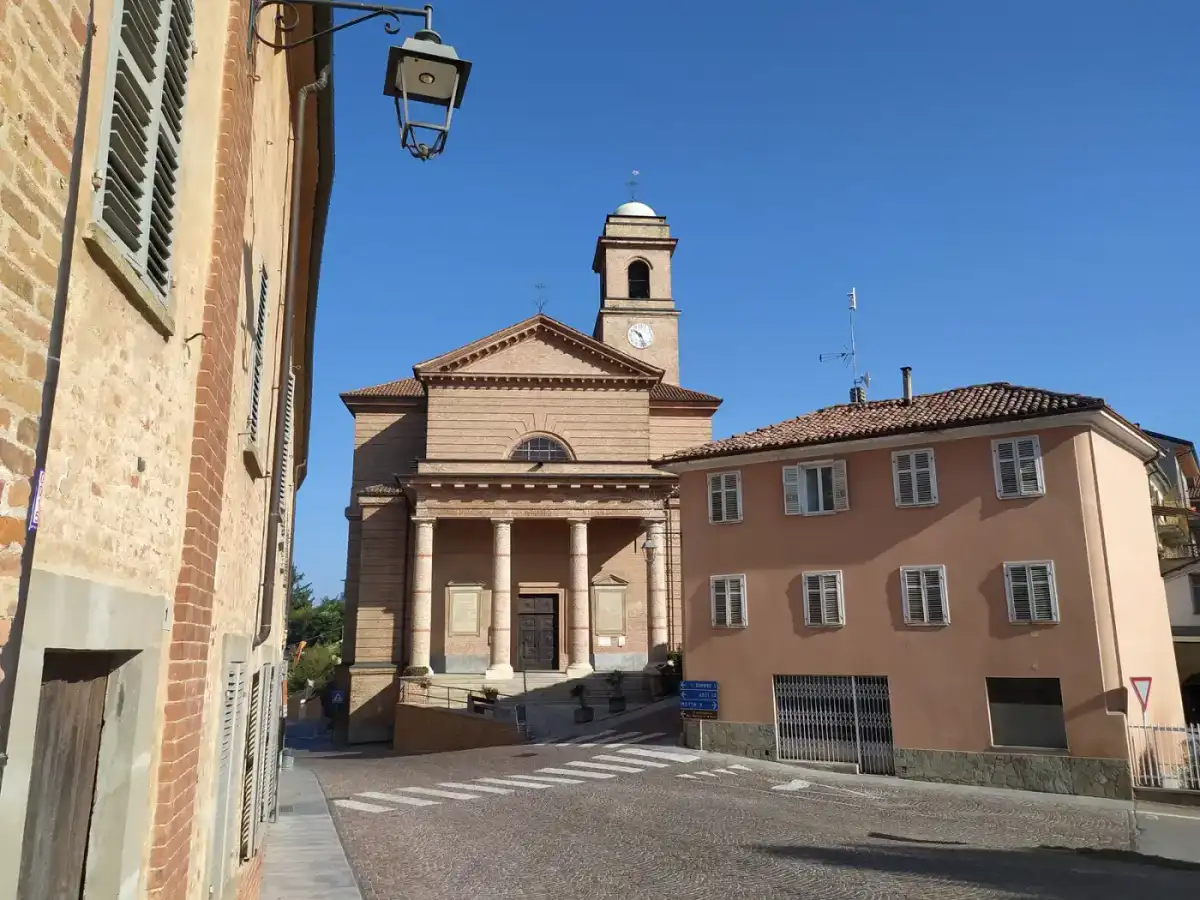
The building was built from 1829 to 1833, replacing the previous one, no longer suitable for the needs of the population and now billy, which was near the southern side of the castle of Alfieri.
For interest of the Marquis Carlo Emanuele Alfieri, the design was entrusted to the architect Ernesto Melano. Reached the agreement between the parties, it was possible to proceed to demolition of the old parish church, which was decoded on 9 June 1829 with the transfer of the SS. Sacramento in the Brotherhood.
The Gazzetta Piemontese On December 24, 1829, he reported the initiative as "...the parish church of San Martino di Govone, placed on a summit far from the big part of the village, makes it desirable for that population to see it transported to the floor, for the greater happiness to go there, maximum in the rough season. Mr. Marchese Carlo Emanuele Alfieri of Support, owner of the Castle of that place, whose religious piety is united with a generous and beneficial heart, according to the votes of those inhabitants, determined to build at his expense a new parish church on the site the most welcoming. M. putting mind to the manifest utility that redefines pro of the Commune to send and effect the beneficial division of the Marquis, applauded to the magnanimous resolution of the noble Character and placed the seal with his sovereign approval".
The new church was consecrated on June 23, 1833 by Bishop Lobetti under the title of San Carlo Borromeo, in memory of the ancient kinship between the family of the Saint and the house of the Alfieri. Memorabilia were the festivities and great the contest of the population.
The building, in neoclassical style, is characterized by a grandiose pronao from the Doric columns, reminiscent of those of the Pantheon of Rome. Inside there is a valuable triptych of the Defendente Ferrari school. The strict architecture of the engineer Cavaliere Ernesto Melano had foreseen the construction of three altars, the major of which is marble up, and a harmonious structure such as the vaulted drawers and the rich frieze below.
The church festival is an example of a road trip and is divided into a space that acts as an entrance to the reception and another on which the Town Hall faces. The roadside festival is important for its location on the pass between the Borbore Valley and the Tanaro Valley.
Church of the Holy Annunciation
In 1572 a bishop's decree approved the construction of an oratory with altar dedicated to San Martino as the seat of the Society of lay disciplines. The construction works lasted from 1696 to 1721, by architect Antonio Bertola. The Church of Santissima Annunziata, located near the Castle, became the seat of the Brotherhood of Battuti. It had its own economic resources with which it carried out important restoration works such as the wooden choir and the organ in the second half of the eighteenth century and the bell in 1885.
From the beginning of the 20th century, the church was closed for a few decades and was only officiated on the occasion of the festivities. He then had a new destination as a parish hall and requested numerous restoration and adaptation.
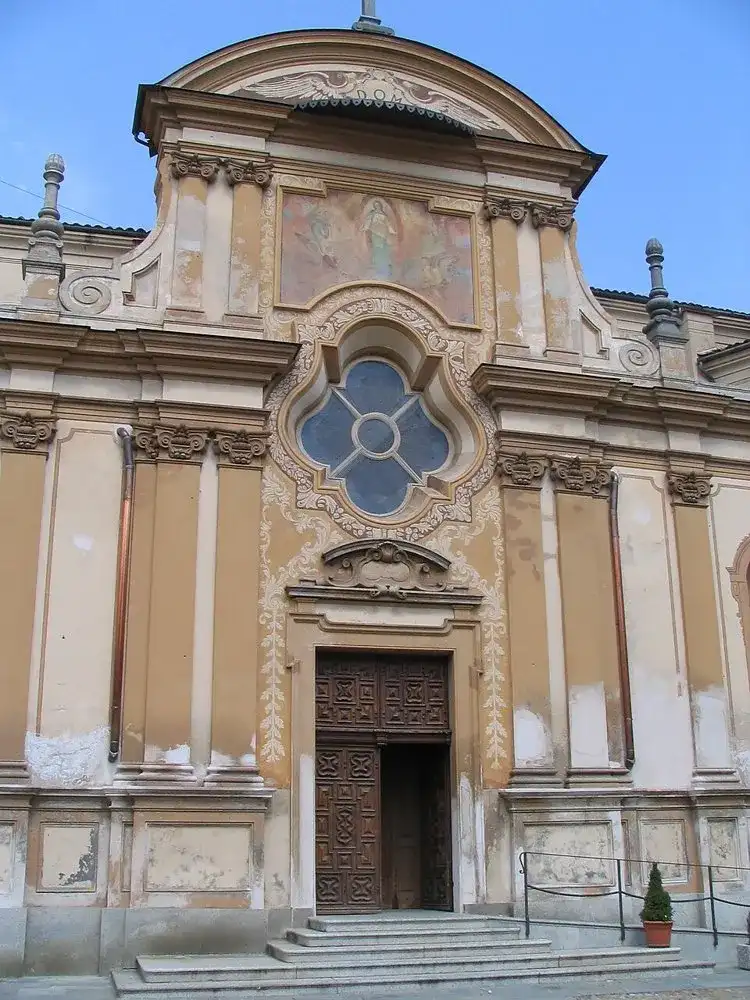
The facade is characterized by a simple rose window frescoed with the image of San Martino.
The building, now decomposed, has been used as a multipurpose room and used for demonstrations by the municipal administration and Pro Loco.
Palazzo Garibaldi
Worthy of note is the simple house built by Giuseppe Garibaldi in Saracchi, birthplace of his wife Francesca Armosino.
A tombstone commemorates today that gesture of gratitude and gratitude towards her who, before being her legitimate wife, had been at his side by giving him the three sons, Clelia, Teresita and Manlio.
The fountains
The lower part of the accommodation, which overlooks the main road through the mural that surrounds the reception itself, houses a beautiful nineteenth century exedra with fountain coeva, while on the square back to the parish church, next to the Town Hall, another beautiful fountain, with more modern taste, contributes to embellish a corner of the village.
Tourism and events
La Bottega wine · The Pro Loco and the events · Barbera FestivalExplore this chapter
La Bottega wine
The "Bottega del vino" is dedicated to Piedmontese wines and the promotion of the territory. It has the task of enhancing and promoting this important agricultural and cultural heritage, linked to the deepest traditions of these hills, but also open to technical-scientific innovation. It is located at the premises of municipal property, on the ground floor of the Palazzo Comunale; the rooms were completely renovated and consist of a tasting-exhibition room, a warehouse and a bathroom equipped for disabled. In its new headquarters it offers the best of food and wine culture.
The Pro Loco and the events
The Pro Loco di San Martino Alfieri is a splendid reality that takes place in 1996; for the truth it is the re-edition of a group, very active in the early eighties, which participated in the major events at the provincial level. The main purpose is cultural and tourist development aimed primarily at the valorization of local productions in favor of those companies, and are no longer many, than our land have made their reason for life.
The main activity of Pro Loco is the organization, especially in summer, of the main events of the country. But it is at the table that Pro Loco can best enhance its hospitality skills, making available to visitors its products and especially quality wines of local producers. Among the various specialties, the dishes offered more frequently are agnolotti to the sauce of meat and the large mixed boil with bagpipe.
Barbera Festival
The "Sagra del Barbera" is the main festival of the country, held every year between the second and third decade of July. A theatrical show in openness, a great stand gastronomic, with traditional Piedmont specialties and local wines, the evenings of music and dances on stake for all ages and a conclusive pyrotechnic show are the characteristic elements now well established of the event.
In the middle of the cam... of our vineyards
Every year, indicating between the months of May and June, is always very welcome the event called "In the middle of the cam... of our vineyards", food and wine walk among the rolling hills of Asti overlooking the Tanaro, with stops at panoramic points of absolute beauty and originality. The walk includes stops at refreshment points, where entertainment will be offered with the re-proposal of living paintings of rural life, with tasting of local gastronomic products (agnolotti, boiled meat, cured meats, cheeses and Monferrato appetizers) combined with prestigious local wines. The event attracts the curiosity of many Italian and foreign tourists.
Administration
Other administrative informationExplore this chapter
Below is a table relating to the administrations that have succeeded one another in this municipality.
| Period | First citizen | Match | Load | Notes | |
|---|---|---|---|---|---|
| June 3, 1985 | May 25, 1990 | Giovanni Bussolino | Christian Democracy | Mayor | [6] |
| May 25, 1990 | April 24, 1995 | Giovanni Bussolino | Christian Democracy | Mayor | [6] |
| April 24, 1995 | June 14, 1999 | Vittorio Massano | center | Mayor | [6] |
| June 14, 1999 | June 14, 2004 | Vittorio Massano | civic list | Mayor | [6] |
| June 14, 2004 | June 8, 2009 | Michele Ruella | civic list | Mayor | [6] |
| June 8, 2009 | May 26, 2014 | Michele Ruella | civic list | Mayor | [6] |
| May 26, 2014 | May 26, 2019 | Andrea Gamba | civic list Impegno and transparency | Mayor | [6] |
| May 26, 2019 | in office | Andrea Gamba | civic list Impegno and transparency | Mayor | [6] |
Other administrative information
San Martino Alfieri, after having been part of the Union of Common Hill Communities "Colline Alfieri", from 1 January 2016 joined the Union of Common Hill Communities "Castelli tra Roero e Monferrato".
Society
Demographic evolutionExplore this chapter
Demographic evolution
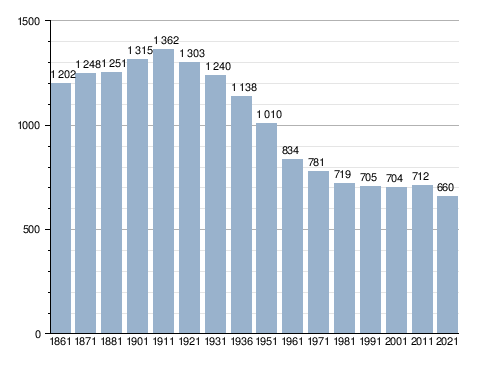
In the last hundred years, since 1921, the resident population has halved.
Inhabitants registered[7]
Notes
Explore this chapter
- ^ to b Monthly demographic balance for the year 2026 (provisional data), up demo.istat.it, ISTAT.
- ^ Seismic classification (XLS), up risks.protezionecivile.gov.it.
- ^ Table of degrees/day of Italian Municipalities grouped by Region and Province (PDF), in Law 26 August 1993, n. 412, annex A, National Agency for New Technologies, Energy and Sustainable Economic Development, 1 March 2011, p. 151. URL consulted on 25 April 2012 (archived fromoriginal url on 1 January 2017).
- ^ San Martino Alfieri already S. Martino al Tanaro, decree 1886-09-25 RD, concession of coat of arms, up Central State Archive. Retrieved 29 September 2024.
- ^ Draft of the coat of arms of the Municipality of San Martino Alfieri already San Martino al Tanaro, up ACS, Collection of drawings from the coat of arms of municipalities and cities. Retrieved 29 September 2024.
- ^ to b c d And f g h http://amministratori.interno.it/
- ^ Data taken from:
- Resident population of the municipalities. Censuses from 1861 to 1991 (PDF), up ebiblio.istat.it, ISTAT.
- Resident population - Time series, up exploredati.istat.it.
Please note: 2021 data refers to permanent census data as of December 31 of that year.
Where to stay · San Martino Alfieri
Find stays on Booking.comThe wine landscape
This village in wine country
Follow the link between the country, the vineyards and the neighboring territories.
The area, step by step