Atlas of Monferrato
Piovà Massaia: sights, history and trails
Asti
- Elevation
- 300 m above sea level
- Area
- 10.14 km²
- Demonym
- rainy
- Patron saint
- Saint George
A closer look
Discovering Piovà Massaia
Piovà Massaia (Rain in Piedmont) is an Italian municipality of 556 inhabitants[1] from the province of Asti in the Piemonte. In 1940 he assumed the second part of his name to celebrate Cardinal Guglielmo Massaia, born here in 1809.
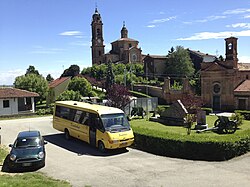
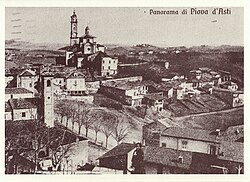
The village is like a castle town overlooking the beautiful hills of Monferrato and consists of two opposing nuclei. The one, Cornegliano, housed the castle in the place where today the Baroque parish church and a beautiful nineteenth-century building are set up as a parochial cinema, with exhibitions and temporary exhibitions, as well as a permanent on the life and works of Cardinal Guglielmo Massaia, cappuccino in Ethiopia. The other, Bricco, ancient site of the reception, is located on a height placed in front of the castle site. The "country road", overlooked by the eighteenth-century municipal building, connects the two villages. The two nuclei are clearly perceivable, even from afar, in their distinctive characteristics of highland settlements: Cornegliano by virtue of the imposing parish church and Bricco for its compactness on the second hill.
An ancient castle of the Radicati, called Castello di Plebata, was built between the thirteenth and fourteenth century and rose on the hilly spur of Mount Cornegliano. When the village moved close to this new castle, it abandoned the ancient church of San Giorgio, expanding the church of San Michele, which later became the parish church of the town. The existence of the moat surrounding the castle, at least in the toponomas, is witnessed by Via Fossale, which together with via Ricci delimites the perimeter of ancient fortifications.
The Marquis Ricci, around 1770, built a palace on the site of the ancient castle. In the project, the palace and the new Parish had to form a single building united by a arcaded gallery. The built tunnel was destroyed at the end of the 19th century. The area of the parish church festival, which coincides with the site of the ancient Castle today disappeared, is a panoramic point from which the gaze can range on the green hills.
The most important event, which is celebrated every year on the first Sunday of June, is the fair of Menta.
History of Piovà Massaia
The origins · From 450 to 1000 · From 1000 to 1700Explore this chapter
The origins
It is believed that the hill was formed in the oligo-myocenic period and consists of marns rich in fossils and sandstone. The abundance of fossil shells, the discovery of a dolphin, a whale, a rhinoceros occurred in the middle of 1800, give us an idea of the environment and climate of our region in those remote times. The primitive man would have come to you only in the Neolithic period; no one would know precisely who the first inhabitants were. The following lines were chronologically the Ligurians, the Umbrians, the Etruscans and the Celts. The first would have arrived around the 17th century BC. Among the various tribes we will remember the taurines that settled in Turin, the Lavi or Libeci in the vercellese and the Eburiates who occupied the Astisan up to our hill. The Romans had settled in Turin, Asti, Chieri but little is known of the Roman colonization of Piovà. Lapidary inscriptions were found at Piea (the ancient Pleia). Incorporated into the empire our territory, then called Liguria, was part of the IX region.
From 450 to 1000
The fall of the Roman Empire and the barbaric invasions of Odoacre, Goths, and Byzantines from 476 to 518 mark the decadence of our cities that become semi-rural inhabited. It seems that under the Lombards (568-773), Cocconato belonged to the Duchy of Asti and that the Church of Vercelli obtained these lands during the domination of Charlemagne. Probably the village of Piovà began to form with the Plebanate of Meyrate, which was located near the current cemetery, dedicated to the church of San Giorgio. We're in 1041. Meanwhile Cocconato had become the capital of an important county, and Plebata, that is, Piovà was part of it. Piovà is called Plebata. The name is derived from the Latin Plebe = Plebs; and pieve was called in the early days of the Church the union of the faithful subject to one bishop. There is a document that highlights the close relationship between Mayrate and Plebata dated 1339 in which Piovà is indicated by the name of Plebata of Mayrate. Like the other villages in the surrounding area, Plebata shares the events of Cocconato County and the fates of the Radical Counts. The Radicati in 999 had seized the property for the Church of Vercelli for following King Arduino in the war against Emperor Frederick Barbarossa, who assigned Cocconato to Guglielmo di Monferrato; later the Radicati were rehabilitated.
From 1000 to 1700
Investitures and allowances were held by Frederick II of Svevia in 1249, from Carlo d'Angiò to Charles V in the 1530s. Piovà began its development in the shadow of the ancient parish church but developed mainly towards the hilly spur of Montecomigliano, when the Radicati built the old castle called Plebata Castle. The parish also left the ancient seat of St. George to move to the castle in the church of San Michele. The name of Montecomigliano changed to Plebata. The Community of Plebata appeared for the first time in an act of 12 August 1339 moved to the castle of Chivasso. After a long period of peace, the wars between Duke Amedeus IX of Savoy and Marquis William VIII of Monferrato, which occupied Piovà in 1431, were not delayed. Meanwhile, the ancient power of the Radicati already supported from 1458 by the Duke of Milan Francesco Sforza and on 8 February 1586 Cocconato was finally submitted to Duke Carlo Emanuele I of Savoia. The village of Piovà has long been owned by the Marchesi del Monferrato followed the fate of the Marchesato. In 1617 after the war between the Savoy and the Gonzaga supported by the King of Spain, Piovà remained still at the Gonzaga; for Monferrato were terrible years. The struggles were continually between Savoiardi, Spanish, French and in 1625 Piovà was burned by the Spanish. The plague which had already been slaughtered in 1503,1522, 1530 was added to the war and famine. The men of Piovà, sworn to the Duke of Mantua and Monferrato Charles II of Gonzaga-Nevers, are in 1637. In 1682 Fr. Pietro Francesco Barberis, who died in a generous offer of Fr. Pietro Francesco Barberis, parish priest and vicar of Piovà, opened a school for the education of children and help those who wanted to enter religious orders. The community also wanted to subject the local taxes, the watering of troops in winter. It was the first signs of a bitter contrast with the feudal lord Count Ricci who protracted from 1674 until 1727. After the victory of the Piedmontese on the French and the liberation of Turin on September 7, 1706, Vittorio Amedeo II of Savoia had Monferrato, Sicily and the title of King. The king came into possession of Marchesato del Monferrato on 16 August 1708.
From 1700 to today
During the French Revolution, the Piedmontese populations remained faithful to the monarchy; things changed with Bonaparte's victories and the constitution in 1798 of a provisional government in Turin. The 27 snowy, year VII of the French Republic, 16 January 1799, was celebrated in Piovà the republican festival of "Regeneration". But if the republican regime had suppressed feudal rights and municipalities had received some advantage, state taxes pressed on citizens. The dissatisfaction was also growing for the Leva that took away the youth sent to fight in distant lands. The fall of Napoleon and the subsequent Restoration were welcomed with joy. They followed the wars for the unity of Italy, concluded with the annexation of Trento and Trieste. The monument to the Falls reminds the Piovatesi who immolated themselves for the Homeland.
Symbols
The coat of arms and gonfalone of the municipality of Piovà Massaia were granted by decree of the President of the Republic of 29 September 2011.[4]
- Coat of arms
- Banner
What to see in Piovà Massaia
Parish church · Romanesque church of San Martino di Castelvero · Church of SantoncoExplore this chapter
It is worth noting the peculiarity of the presence in this small village of 13 churches, some of which also of great historical and architectural importance.
Parish church
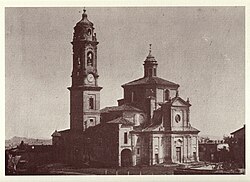
The parish church, already dedicated to the archangel Michael, was rebuilt in the eighteenth century. It is one of the most admirable examples of baroque in Monferrato. In fact, its construction, begun in 1749 and finished in 1774, is attributed to the architect of the Sabauda court Benedict Alfieri.
The building is entirely exposed brick and is dominated by a high tiburium surmounted by a tower with dome. The façade, consisting of floors in reciprocal tension, is characterized by the central adjectant concave two orders, which includes the portal, a large oculo oval and, crowning, the triangular concavo. The building is completed with the baroque high bell tower. The scenic interior, on a Greek cross, preserves the 18th century decoration and houses in the apse a precious canvas, by Sebastiano Taricco da Cherasco, as well as a wooden statue of the eighteenth century. The main altar with the balustrade closes the presbytery inlaid polychrome marble.
In the original project, the church and the adjacent palace of the Marquis Ricci had to form a single building complex connected by a gallery supported by arcades. It should have combined the noble plan of residence to the church's cores. The built tunnel was destroyed at the end of the 19th century.
The activity and personal history of Benedetto Alfieri bind Piovà Massaia to San Martino Alfieri. In one place the architect was the creator of one of the architectural masterpieces of Monferrato Astigiano, as well as his first work of religious architecture, the parish church, while in the other he died and designed the 18th century extensions of the family castle.
Romanesque church of San Martino di Castelvero
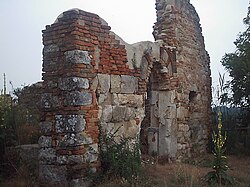
Autonomous municipality until the 19th century, Castelvero di Casale (now Castelvero hamlet) rises on a hill that, once, was equipped with a fortified castle. The drawing of the fraction still follows the profile of the ancient reception. At the end of the director from Bricco and Cornegliano develops southward, there is a tufa spur on the top of which rise the ruins of the Romanesque church of San Martino, one of the oldest in the Astigiano.
The church was part, along with St. George, Saint Mary of Cerreto and other minor churches in Vezzano, Scalfengo and Remorfengo, Plebanato di Meyrate. Around the year Thousand, following the fate of Pieve di Meyrate, the church of San Martino passed from the diocese of Vercelli to that of Asti. The church was abandoned in 1810, while in 1835 the adjacent cemetery was closed.
Until the beginning of the 20th century, the façade was in hut and on its sides the hanging arches, in monolithic blocks, followed the roof limit. The church presented the particularity of the double apse. In the middle of each apse, a narrow window was opened.
Church of Santonco
In Santonco (actually the name would be: San Toncho) stands the late 18th century church of Santa Maria della Valle, placed in a circular clearing surrounded by woods. It has always been a magical place for the populations of the surrounding area, it has been rumoured for centuries the presence of witches and masks.
The little church, although it is dedicated to Saint Joseph, is told that it was built in this particular area precisely by the will of Our Lady. The legend tells that the intention was to erect it on the nearby hill, instead of in this plain, once swampy, but that every morning the masons found at the foot of the height the bricks laid on the previous day. It was thus, therefore, that in ancient times it became a destination for pilgrimage and prayer.
The land around the Santonco region is rich in fossil presences and stratigraphed walls.
Society
Demographic evolutionExplore this chapter
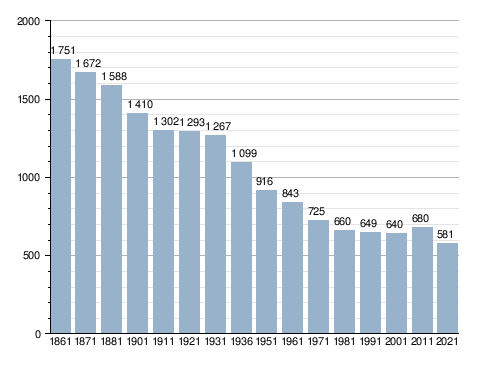
Demographic evolution
In the last hundred years, starting from 1921, the resident population has been It's halved..
Inhabitants registered[6]
Menta
The tradition of mint dates back to the post-war period, when the Robba-Devecchi family, originally from this country, but moved to Pancalieri, decided to start a business of...Explore this chapter
The tradition of mint dates back to the post-war period, when the Robba-Devecchi family, originally from this country, but moved to Pancalieri, decided to start a cultivation activity here, especially in Gallareto hamlet, where several extensions of peppermint land were cultivated. Unfortunately, the adverse weather conditions of three consecutive years, made them extinguished from continuing and for this reason cultivation continued only to Pancalieri, the capital of mint par excellence, even if in Piovà, just where today stands the Bocciofila, remained an alembic, where still produced until the 1950s a fragrant distillate. The distillation was mainly entrusted to women, who devoted themselves with great care to this activity, a source of excellent economic revenues.
Administration
Below is a table relating to the administrations that have succeeded one another in this municipality.Explore this chapter
Below is a table relating to the administrations that have succeeded one another in this municipality.
| Period | First citizen | Match | Load | Notes | |
|---|---|---|---|---|---|
| June 21, 1985 | June 8, 1990 | Battista Pracca | Christian Democracy | Mayor | [7] |
| June 8, 1990 | April 24, 1995 | Battista Pracca | Christian Democracy | Mayor | [7] |
| April 24, 1995 | June 14, 1999 | Battista Pracca | center | Mayor | [7] |
| June 14, 1999 | June 14, 2004 | Battista Pracca | civic list | Mayor | [7] |
| June 14, 2004 | February 13, 2006 | Alessandro Fasson | civic list | Mayor | [7] |
| February 13, 2006 | May 30, 2006 | Giulia D'Onofrio | Comm. pref. | [7] | |
| May 30, 2006 | May 16, 2011 | Battista Pracca | civic list | Mayor | [7] |
| May 16, 2011 | 5 June 2016 | Antonello Murgia | Lista civica Insieme per Piovà | Mayor | [7] |
| 5 June 2016 | October 4, 2021 | Antonello Murgia | Lista civica Insieme per Piovà | Mayor | [7] |
| October 4, 2021 | in office | Antonello Murgia | Lista civica Insieme per Piovà | Mayor | [7] |
Image gallery
Explore this chapter
-
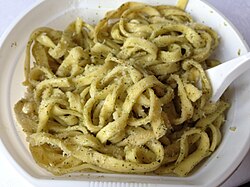 Cutlery with mint pesto
-
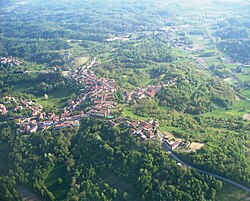 Panorama
-
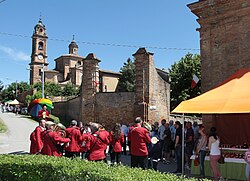 Banda Aurora
-
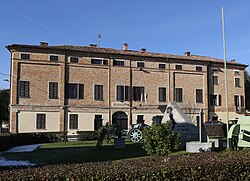 Town Hall Piovà
-
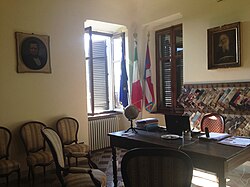 Town Hall Piovà
-
 Panorama
-
 Event "A century of fashion"
-
 Romanesque Rudere of the Church of San Martino di Castelvero
-
 Old postcard
-
 Old postcard
Notes
Explore this chapter
- ^ to b Monthly demographic balance for the year 2026 (provisional data), up demo.istat.it, ISTAT.
- ^ Seismic classification (XLS), up risks.protezionecivile.gov.it.
- ^ Table of degrees/day of Italian Municipalities grouped by Region and Province (PDF), in Law 26 August 1993, n. 412, annex A, National Agency for New Technologies, Energy and Sustainable Economic Development, 1 March 2011, p. 151. URL consulted on 25 April 2012 (archived fromoriginal url on 1 January 2017).
- ^ Piovà Massaia (Asti) D.P.R. 29.09.2011 concession of coat of arms and rubber, up Presidency.governo.it.
- ^ Banner, up Municipality of Piovà Massaia. Retrieved 30 July 2025.
- ^ Data taken from:
- Resident population of the municipalities. Censuses from 1861 to 1991 (PDF), up ebiblio.istat.it, ISTAT.
- Resident population - Time series, up exploredati.istat.it.
Please note: 2021 data refers to permanent census data as of December 31 of that year.
- ^ to b c d And f g h the j http://amministratori.interno.it/
Bibliography
Explore this chapter
- E. Eydoux, Rain at the beginning of the 800, s.l. s.d.
- G. Gasca Queirazza, C. Marked, G. B. Pilgrims, G. Petracco Sicardi and A. Rossebastian, Toponomastic dictionary. History and meaning of Italian geographical names, Torino, 1997, p. 498.
- R. Ghivarello, The Romanesque church of San Martino di Castelvero in Piovà Massaia, in the Bulletin of the Piedmontese Society of Archaeology and Fine Arts, New series, year I, 1947.
- R. Ghivarello, Piovà Massaia. Historical and artistic news with new documents, Chieri, 1947.
- The Piemonte country by country, vol. VI, Florence, 1995, pp. 42–43.
- T. Valente and F. Zanchettin, Piovà Massaia: S. Martino di Castelvero, in Romanesque churches in the Province of Asti. Fragments of history to be saved, Cinaglio, 1983.
- C. Vassallo, The monument to Cardinal Guglielmo Massaja in Piovà: speech, Asti, 1885.
Where to stay · Piovà Massaia
Find stays on Booking.comThe area, step by step