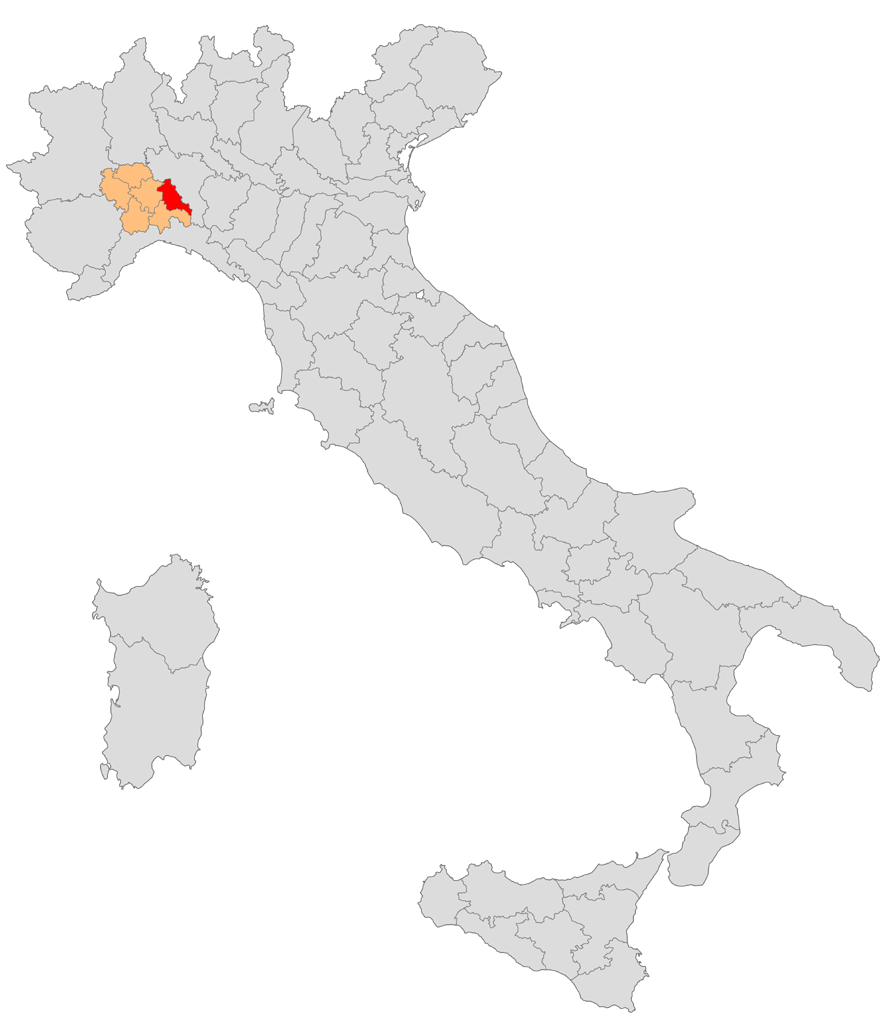
A closer look
Circumdarium of Tortona: at a glance
The around Tortona was one of the surrounding areas where province of Alessandria.
History
Following the annexation of Lombardy from the Kingdom of Lombardy-Veneto to the Kingdom of Sardinia ( 1859 ), the decree Rattazzi was issued, which reorganized the structure...Explore this chapter
Following the annexation of Lombardy from the Kingdom of Lombardy-Veneto to the Kingdom of Sardinia (1859), the decree Rattazzi was issued, which reorganized the administrative structure of the Kingdom, divided into provinces, in turn subdivided into circles.
The district of Tortona was created as a subdivision of province of Alessandria; the territory corresponded to that of the suppressed province of Tortona del Regno di Sardegna, belonging to the division of Alessandria.
With the Unification of Italy (1861) the subdivision in provinces and surrounding areas was extended to the whole Peninsula, leaving unchanged the divisions established by the decree Rattazzi.
The district of Tortona was suppressed in 1926[1] and the territory assigned to the district of Alessandria[2].
Anthropic geography
Administrative divisionsExplore this chapter
Administrative divisions
In 1863, the composition of the surrounding area was as follows[3]:
- I of the Castelnuovo Scrivia
- Sending II of Garbagna
- Sending III of Sale
- Article IV of the San Sebastiano Curone
- Brignano del Curone; Fabbrica Curone; Fabbrica Curone; Frascata; Gremiasco; Montacuto; San Sebastiano Curone
- V of the Viguzzolo
- sending VI of Villalvernia
- Carezzano; Carezzano; Cassano Spinola; Castellania Costa Vescovato; Cuquello Gavazzana; Malvino; Paderna; Sant'Agata Fossili; Sardigliano; Spinetto; Villalvernia
- Commission of the European Communities Volpedo
- VIII of the Tortona
Notes
Explore this chapter
- ^ Regio Decreto 21 October 1926, n. 1890, art. 1
- ^ Regio Decreto 21 October 1926, n. 1890, art. 2
- ^ Ministry of Justice and Justice (edited by), Dictionary of the municipalities of the Kingdom of Italy and statistical and synoptic tables of the administrative constituency electoral and ecclesiastical with the indication of the right population the last census, Turin, Stamperia Reale, 1863
Continue your journey