A closer look
Piero Ravasenga: at a glance
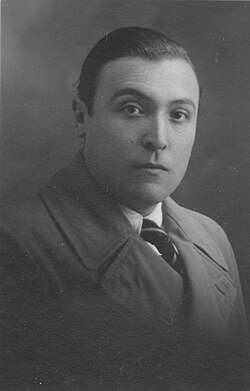
Piero Ravasenga (Borgo San Martino, 7 July 1907 – Alessandria, 31 March 1978) was an Italian poet, essayist and writer.
Biography
Piero Ravasenga was born in Borgo San Martino (Alessandria) on July 7, 1907, second-born of Francis, doctor led by the country, and Agostina Vigliani, writer and poet,...Explore this chapter
Piero Ravasenga was born in Borgo San Martino (Alessandria) on July 7, 1907, second-born of Francis, doctor led by the country, and Agostina Vigliani, writer and poet, virtuoso of piano and animator in his house during the early twentieth century of a lively cultural living room attended by several poets, writers and artists such as Guido Gozzano, Filippo Tommaso Marinetti, Francesco Pastonchi, Giuseppe Pelizza da Volpedo[1]
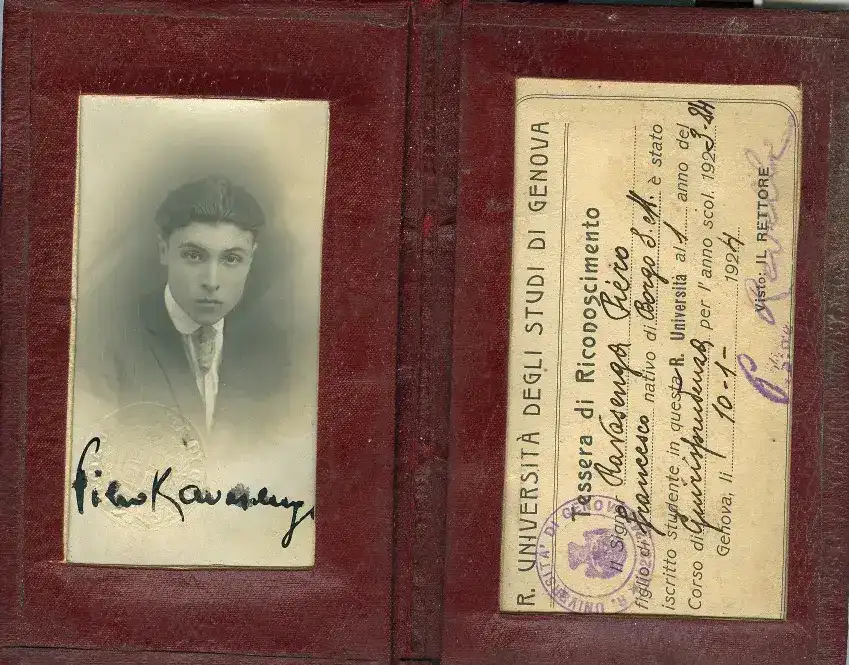
From the early years of life, both from mother and family environment is directed towards a clearly defined human and cultural journey: he studies in the Salesian College of his country, immediately immersing himself in readings ranging from Italian authors, French, Germans, modern Russians and contemporary, but his cultural model is Gabriele D'Annunzio. At sixteen years he obtained his maturity; he enrolled at the University of Genoa, where he graduated in Law in 1927. Only twenty years old is the youngest lawyer in Italy and as such is quoted from the Sunday of Corriere, who also publishes his photo. In fact, he will never exercise his profession, nor will he want to be called a lawyer: for himself, and for all, he must be forever only a writer and poet.
He begins to collaborate with several local newspapers; for the rest, thanks to the aginess of the family and to the mother who supports it economically in every circumstance, he spends without problems his time between friends, loves, osteries, brothels and cascine of Monferrato, starting to finalize in literary works his artistic and poetic inspiration. At twenty-three years, in 1930, he printed his first book of stories, Death of the Sensitive, which is published by Edizioni Fratelli Buratti of Turin in the Scrittori Contemporanei series, in which already established writers and poets such as Corrado Alvaro, Eugenio Montale, Camillo Sbarbaro, Giovanni Comisso already appear.
The death of the mother, in 1931, is an event that will never forget, and which refuses: it humanly begins to get lost by worsening its moral and economic situation, and will no longer be able to find for all life a balance that allows him to live peacefully.
In 1933 he published his second book of stories, Spring Memory,[2] in which the dedication “To my mother mutates” still clarifies that indestructible bond that will bind him forever to her.
Over the years30 continues his unregulated and limitless life, he continues to write poetry, stories and essays, collaborating with national magazines and newspapers such as Critic Fascist, Il Giornale d’Italia, Poeti d’oggi. In the 1935 is voluntary in East Africa, passing three months on the front line with the National Security Volunteer Militia; but this experience promptly leads him to the abandonment of the fascist faith and criticism towards the regime and Mussolini, which we will find punctual and ironic in various his works, such as the posthumous Rome Divine. He is admitted to hospital and sent back to Italy; he finds a job at "La Vigile" in Turin (destined to become INAIL), but this job, like others he finds or will be found for, does not last long: his free and intolerant spirit leads him to not tolerate office hours, and to prefer hunger to constraints of any kind.
And in the meantime, a dissolute, poor, errabious, insecure life continues, which slowly begins to affect his health and bring him those damage to liver and lungs that will accompany him forever; life, rich only of the strength that comes from his world, from his land, from his hills of Monferrato that are for him continuous source of inspiration, along with the careful study of the environment and the people he meets.
In the 1939 is in Rome, where the hierarch Ezio Maria Gray, husband of her mother's cousin, writer Corinna Gray Ubertis (Teresah) found a job at the Ministry of Popular Culture (which lasts only three months, given the insistence of Ravasenga for any constraints, so as not to withdraw even salary, preferring to attend artists like Omiccioli, Monachesi, Bonte). He writes at this time on Maestrale and the Meridian of Rome; he returned to the end of the ’44 ad a Alessandria, found, directed, published, distributed alone in Turin a literary magazine of philosophical character, centered on the pantheistic creed of Giordano Bruno; after the first issue, however, he renounces to continue, and completely without money pretends a religious conversion and retreats into 1947 in the convent of the Capuchins of Viterbo. In the 1949 we find him a miner in Val Chisone, then he returns to Turin, improvised man of fatigue and then concierge, always divided between obsteria, the poor mensa, public dorms or even benches: it is a real “maudit” that makes life that consciously chose for itself, even if at high price, as he writes in his works of the most fervent period, starting from the years’50 until almost death. Here begins a period in which the help of his older sister allows him to live, even if stentatamente, and to cure himself: first at the Hospice of Casale Monferrato, then in rented rooms, where among the most unfortunate can still claim its independence. He writes a lot, poems, stories, travel guides on Monferrato, critical essays on Dante and the Divine Comedy; novels, some of which find space and publication, as Magnolia for mayor – where his original poetic inspiration is revealed, so life is perpetuated; the things that must happen anyway, and time is considered an incidental fact – with which he wins the Premio Letterario Ceppo in 1967, and above all Snows of a Volta, which is published by Vallecchi in the Nuovi Narratori series, directed by Cesare Garboli and Geno Pampaloni. At this point the appreciation of the literary environment and critics finally begins to be felt: among his greatest admirers are Dino Buzzati, Gianna Manzini, Mario Soldati, who recounts a missed meeting with him in his book "A Prato di Papaveri".[3]
But now it is late; he continues to drink, eats what happens, sleeps in the barns: more and more sown in the physicist, with the help of his sister retires in 1972 in a nursing home in Novalesa (Alessandria); he writes continuously, but fails to publish the numerous works that he has written over recent years, including a monumental critical commentary to Divine Comedy. He then moved to other nursing homes, until he died in March 1978 at the Borsalino Hospital in Alessandria. He will no longer know anything for almost thirty years, until, in the early 2000s, the new edition of “The Snows of Once”, but above all the reproposition of Sacramental after more than sixty years and publication Rome Divine[4] will bring it back to the attention of the public and the critics.
Works edited
Narrative · Poem · SaggioExplore this chapter
Narrative
- Death of the Sensitive, Buratti Brothers, 1930
- Spring Memory, La Goletta, 1933
- Dinonyse, Edoardo Grasso, 1933
- Magnolia for mayor, Il Milione 1963
- The snows of once, Vallecchi 1964
- Divine Rome, Alternative Press 2001
- Snows of a Face + Sacramental, Interlinea 2003
Poem
- Anthology of real poets, Ferrari Occella 1963
- I don’t fit this leaf shadow..., Capella s.d.
Saggio
- Invitation in Monferrato, Milan & C., 1957
- The Monferrato and its castles, Ferrari Occella 1958
Intitlation
Explore this chapter
- In collaboration with the Municipality of Casale Monferrato, the "Circolo Culturale Piero Ravasenga" was founded in 1988, which organized 21 editions of the "Piero Ravasenga Literary Prize", and is still strongly active in the organization of art exhibitions, poetry and music evenings, conferences, book presentations, literary competitions.
- The singer-songwriter Mario Saldì dedicated to the writer a Ballad for Piero Ravasenga.
- The town of Casale Monferrato has named its way to Piero Ravasenga.
Notes
Explore this chapter
- ^ Unpublished letters from Gozzano and Marinetti., up archivelastampa.it.
- ^ Giuseppe De Rossi: They were not castles in the air - Piero Ravasenga: Memorie di primavera - M. Viscardini: Life without heaven, up archivelastampa.it.
- ^ Mario Soldati, A poppie lawn, Mondadori, 1974, pp. 409-411.
- ^ Introduction by Piero Flecchia to the novel Roma Divina, up sagarana.net.
Bibliography
Explore this chapter
- M. Bonfantini, Corriere della Sera, 15 November 1964
- M. Soldiers, The Day, 22 December 1964
- L. Lilies. La Gazzetta del Popolo, 20 January 1965
- Curated by E. Ronconi, Italian Literature Dictionary Contemporary, Vallecchi, 1973 (pages 645-646)
- T. You're a bad man. Portrait of a pauvre homme, Municipalities of Casale Monferrato and Borgo San Martino, 1998
- T. You're a bad man. The vacuum from the Bourg, Municipalities of Casale Monferrato and Borgo S. Martino, 2001
- Diorama letterario University of Turin[1]
| Authority control | SBN TO0V005393 |
|---|
 Biographies portal
 Literature portal
- ^ Young writers: Piero Ravasenga, up dioramagdp.unito.it.
Continue your journey