A closer look
Salt: at a glance
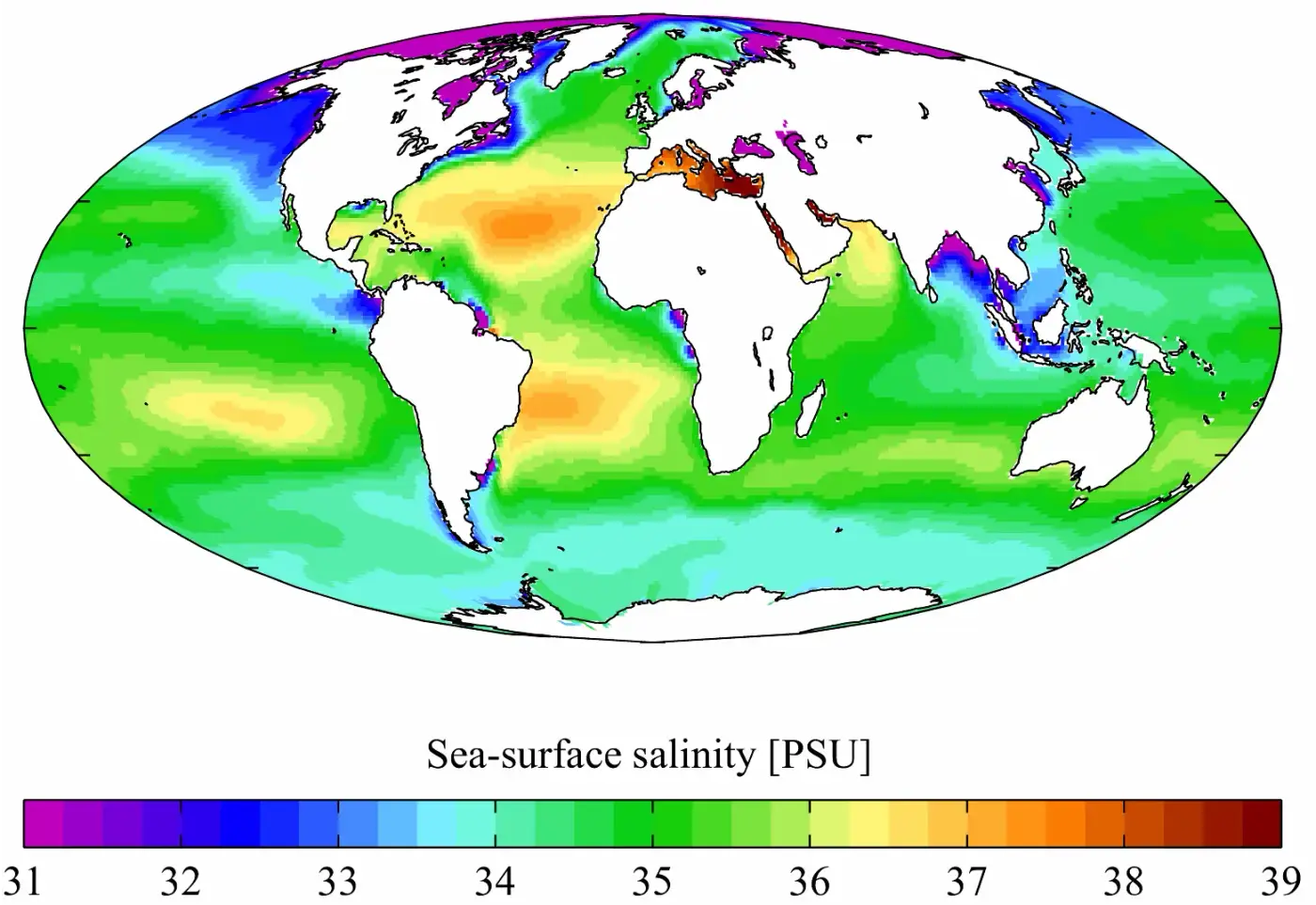
The salinity indicates the concentration of Sale of a solution: while in the past salinity was determined on the basis of chlorination, magnitude that expresses the total content of chlorides (Cl−), bromides (Br−) and iodides (I−), currently the officially adopted unit of measurement is based on electrical conductivity and therefore takes more account of the entire set of salts present in solution.
Definition
The technical term used to indicate the content in salts of the ocean is salinity, because halogenurs (especially Cl ), are the most abundant anions...Explore this chapter
| Classification of water according to salinity (understood as a mass fraction) | |||
|---|---|---|---|
| Fresh water | Salmastra water | Salt water | Salamory |
| < 0,045 %[1] | 0,05 - 3 % | 3 - 5 % | > 5 % |
| < 450 ppm | 500 - 30 000 ppm | 30 000 - 50 000 ppm | > 50 000 ppm |
The technical term used to indicate the content in ocean salts is salinity, due to the fact that the halides (in particular Cl−), are the most abundant anions present in the mixture of dissolved elements. In oceanography, alinity is traditionally indicated as a mass fraction and expressed in parts per thousand ("ppt" from Anglo-Saxon literature parts per thousand, or even ‰) which, approximately considering the density as 1000 grams/litre, also corresponds numerically to the value of the density in solution expressed in grams/litre. In analytical chemistry it is customary to express salinity in ppm, or correspondingly in mg/L. In 1978, when reference to chlorinity had been used since the early twentieth century, salinity or halinity was expressed as ‰ based on electrical conductivity in reference to an artificial sample of seawater used as a standard.[2] The new Practical Salinity Scale was subsequently further refined by the world's oceanographers with the introduction of the Psu measuring unit (Practical Salinity Units), corresponding to the ratio between the conductivity of a seawater sample and that of a standard KCl solution formed by 32,4356 grams of dissolved salt in 1 kg of solution at 15 °C.[3][4] The ratios are adimensional and 35 psu equal to 35 grams of salt per kilogram of solution.[5]
These approaches to the indication of salt concentration may seem unclear in their practical use, but it should be remembered that salinity represents the sum of the imports of different chemical elements and species present in a given volume of water. Expressing a specific value of salinity in terms of concentration of a specific substance, for example NaCl, requires a deeper knowledge of the sample and measurement rather than the simple weight of the solid component obtained after evaporation (one of the methods to determine salinity). For example, the volume is influenced by water temperature and salt composition is not constant (although it is generally very similar throughout the oceanic mass). The saline waters of the inner seas can have a different composition from that of the ocean. For this reason these waters are defined saline differentiating them from ocean waters, for which the term is used preferably aline (although not universally used).
Classification of water bodies based on salinity
The sea waters are those of the ocean, another term used to indicate this type of water is seas. The salinity of the seas eualini (understood as fraction...Explore this chapter
| SALINITY (F.M.) | TALASSICAL SERIES |
| >300‰ | -------------------- |
| hypercholine | |
| 60 - 80‰ | -------------------- |
| metalina | |
| 40‰ | -------------------- |
| mixoeualina | |
| 30‰ | -------------------- |
| polylin | |
| 18‰ | -------------------- |
| mesolina | |
| 5‰ | -------------------- |
| oligolina | |
| 0,5‰ | -------------------- |
The sea waters are those of the ocean, another term used to indicate this type of water is seas. The salinity of the seas (understood as Massive fraction) is from 30 to 35‰. Brackish seas are waters with salinity that falls within the range of 0.5 - 29‰, while the salinity of metahaline seas varies from 36 to 40‰. All these waters are considered thalassic since their salinity derives from the ocean and homohyohaline if their salinity does not vary much as a function of time (it remains essentially constant). The table shown alongside, modified by F.D. Por in 1972[6], follows the "Venice System" (1959).[7]
In contrast to homoyoal environments there are polka dots (which can also be talassic) in which the variation of salinity is biologically significant[8]. Poikiloaline waters can have very wide salinity ranges, with values ranging from 0.5‰ to over 300‰. The important characteristic is that these waters have a seasonal salinity variation, or on another roughly comparable time scale, of a certain biological interest. More simply, these water bodies have salinity that varies over time.
Highly salted waters, in which the salt crystallizes or is close to crystallizing, are called brine. The optical phenomenon of clear separation and stratification of water with different salinity is called alocline and occurs, especially in the absence of current when encountering fresh and salty waters, at the outlet of rivers and in some types of caves like cenotes.
Environmental considerations
salinity is an ecological factor of considerable importance, able to influence the type of organisms that live in a water body. The salinity influences the species...Explore this chapter
salinity is an ecological factor of considerable importance, able to influence the type of organisms that live in a water body. salinity influences the species of plants that can grow in an aquatic environment, or in a soil underwater. A plant that adapts to saline conditions is called aloft. The organisms (predominantly bacteria) able to live in very salty conditions fall into the category of extremists, and more specifically are halophiles. An organism able to live in a wide range of salinity is called eurialine.
The salt content of water is an important factor in determining the potability of water or possible use for industrial or agricultural purposes. The removal of salt is not simple and also requires some energy expenditure.
Notes
Explore this chapter
- ^ % is to be read as grams of solute for each one hundred grams of solution (massic fraction). The conversion is simply 1% = 10 000 ppm, in fact 1%=10-2, while 1 ppm = 10-6
- ^ Lewis, E.L. (1980). The Practical Salinity Scale 1978 and its antecedents. IEEE J. Ocean. Eng., OE-5(1): 3-8.
- ^ Unesco (1981a). The Practical Salinity Scale 1978 and the International Equation of State of Seawater 1980. Tech. Pap. Mar. Sci., 36: 25 pp.
- ^ Unesco (1981b). Background papers and supporting data on the Practical Salinity Scale 1978. Tech. Pap. Mar. Sci., 37: 144 pp.
- ^ Unesco (1985). The International System of Units (SI) in Oceanography. Tech. Pap. Mar. Sci., 45: 124 pp.
- ^ Por, F. D. (1972). Hydrobiological notes on the high-salinity waters of the Sinai Peninsula. Mar. Biol., 14(2): 111–119.
- ^ Venice system (1959). The final resolution of the symposium on the classification of brackish waters. Archo Oceanogr. Limnol., 11 (suppl): 243–248.
- ^ Dahl, E. (1956). Ecological salinity boundaries in poikilohaline waters. Oikos, 7(I): 1–21.
Bibliography
Explore this chapter
- René Quinton, Eau de mer, milieu organique, Masson, édition Encre, Paris 1904
Continue your journey