A closer look
Villanova d'Asti Station: at a glance
The Villanova d'Asti station is a railway station located along the Turin-Genova railway, at the service of the municipality of Villanova d'Asti and the nearby hamlet of Riva near Chieri.
The plant is located at Borgata Stazione di Villanova d'Asti, about 3 km from the main town. Until the second half of the 19th century the area was mainly agricultural and almost uninhabited: the subsequent urban development was favoured by the presence of the railway port, which contributed to the formation of the current suburb.[2]
History
The station was activated in 1849, at the same time as the opening of the Trofarello-Asti railway line.Explore this chapter
The station was activated in 1849, at the same time as the opening of the Trofarello-Asti railway line.
The station's track square was electrified in alternating current on April 1, 1922, as well as the route between Trofarello and Alessandria on which the plant is located. Finally, it was continuously converted, as is still today, on 28 May 1961, in the context of the activation of this technology on the Turin-Alessandria line.
Facilities and plants
Manufactured travellers · Service facilitiesExplore this chapter
The management of the plants is entrusted to Rete Ferroviaria Italiana. The station is operated by the railway staff as remote controlled by the CTC system, which is head of the Operational Central Manager located in Turin Lingotto.
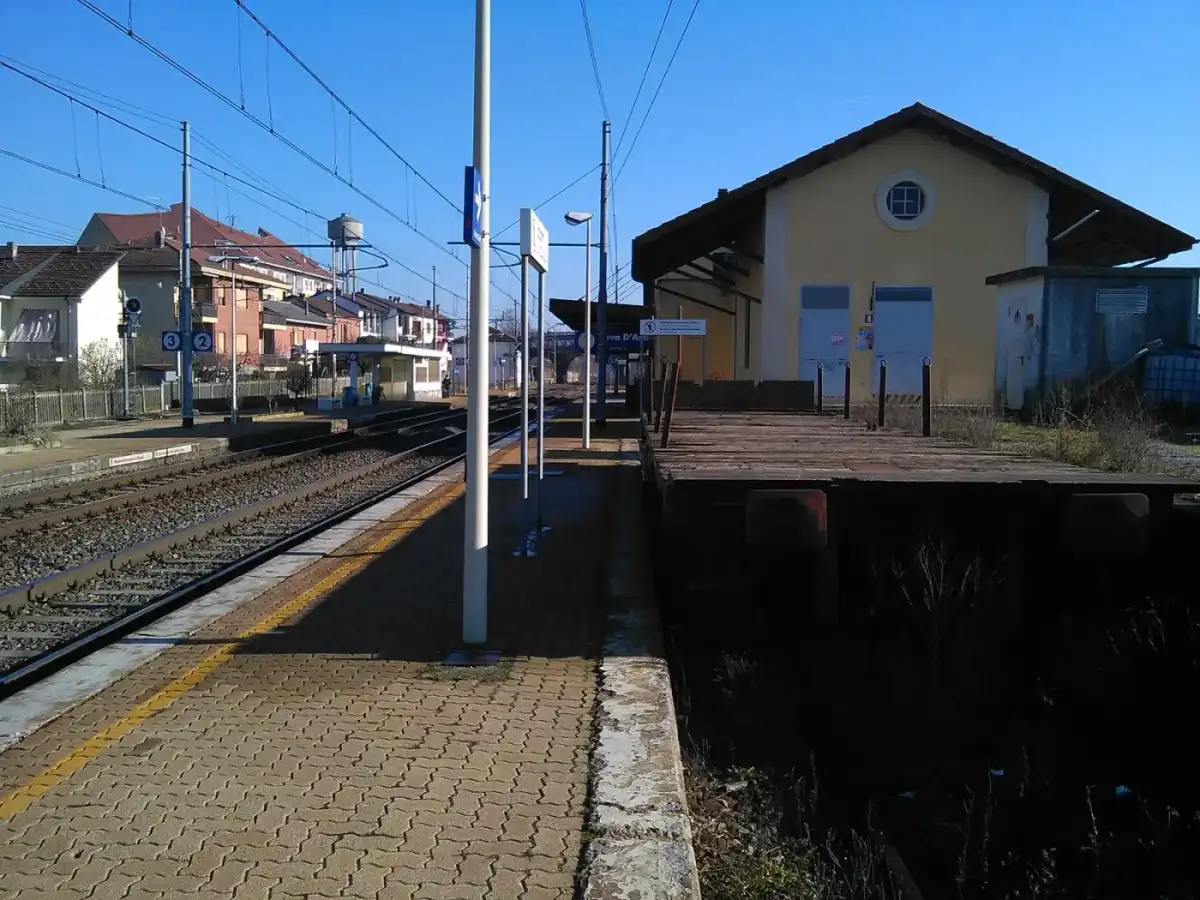
The binary square, in the part dedicated to the passenger service, consists of three passing tracks. Track 1 is used by trains in the direction of Turin and track 2 from those towards Genoa/Asti, as they constitute the line's racing tracks and are therefore correctly tracked. The track 3 is, on the other hand, deviated and is used exclusively for any precedents or intersections, indistinctly in both directions. In parallel to track 1 there is a service tronchino, originally dedicated to the suppressed movement goods at the above mentioned stop, and to 2026 used mainly for stopping or replenishing the line maintenance rotabili. Next to these tracks there are two fittings, both branched in the direction of Turin. From the second connection, a track is developed that goes further and enters the private port of call of an adjacent logistics company, served daily and from which some freight trains originate. From the first track, however, a trunk rail is created for RFI means of service on rails, which connects to an electrical substation of the line located near the station.
There are two docks: the first, adjacent to the passenger building, is at the service of track 1, while the second one is on the island and serves tracks 2 and 3. They are connected with each other by means of an underpass, which also communicates the track square with adjacent parking [3].
Manufactured travellers
The station building is structured on two floors with a rectangular plan. The ground floor has a lateral extension to the left (observing the building on the street side), which extends into a rectangular shape and also acts as a balcony for the first floor. A smaller section of the same floor is used as a public area, hosting a waiting room equipped with various services for travellers, including two automatic ticket machines[4], metal benches for waiting, a defibrillator as a first aid point in case of emergency[5], and a public telephone (the latter no longer active from 2023[6]). In the past, the hall also housed the ticket office with operator, a service that was abolished in 2019[4]. Adjacent to this area is the Movement Manager's room, which partially extends onto the platform of the first track via a glass and iron cabin. The side wall overlooking the tracks and the platform of the first track are partly protected by a metal roof that overlooks the platform, offering shelter in case of bad weather. This space also houses an LED monitor for departure information and some concrete benches for waiting. On the first floor, in the past, there was an apartment intended for the station master, but this unit is currently uninhabited as of 2026.
Service facilities
On the sides of the FV there were two additional monoplane structures. The first is a medium-sized, exposed brick building which houses the bar-tabaker at 2026, for most of its surface; it also serves as a resale of travel titles, replacing the counter ticket office, service that is now suppressed in 2019. Next to it, in the same building, are placed toilets, accessible from the platform 1 and from the entrance to the street side, as well as the entrance to the underpass. The latter allows the connection of the platform 1 with that of tracks 2 and 3. The other structure is the warehouse goods, equipped with a loader plan; it is already from the beginning of the 10th century in good state of conservation despite being dismissed and converted to simple service warehouse in use to RFI. The binary beam that was placed at its service serves to 2025 as a shelter for the maintenance means of RFI, as well as a stop track for some wagons or freight carts[7].
Next to the bar building there is a residential building developed on one floor and equipped with garden, enclosed by a classic concrete rail fence. The building and the ground attached to it, inaccessible to the user and probably originally a house for railway staff, appear at 2011 in state of abandonment since they are uninhabited[8]. On the Genoa side there is also a further toll booth inhabited by those who handled the movement of the switches located at the kilometer progression 30+258, before these were automated and remote-controlled and, as of 2026, it is uninhabited.
Movement
The station is mainly served by trains of line 6 of the Turin Metropolitan Railway Service, which connects Turin to Asti with thirty-one races on weekdays...Explore this chapter
The station is mainly served by trains of line 6 of the Turin Metropolitan Railway Service, which connects Turin to Asti with thirty-one rides on working days[9], as part of the service contract stipulated with the Region Piemonte.
In addition to the SFM6 line, the travel service includes a regional train in early morning and eight Regionals Fast on weekdays, reduced to four on Saturdays and public holidays, to supplement the SFM6 lines[10].
Services
The station, classified by RFI in category 'Bronze', has the following services :Explore this chapter


Interchanges
The following interchanges are implemented near the station:Explore this chapter
The following interchanges are implemented near the station:
 Bus stop
Notes
Explore this chapter
- ^ https://www.comune.villanova.at.it/it/page/borgata-stazione
- ^ https://www.comune.villanova.at.it/it/page/borgata-stazione
- ^ See the image
- ^ to b c Services in Station Piemonte - Yes., up Trainstalia.com.
- ^ astigov.it, https://www.astigov.it/it/point-of-interest/defibrillatore-villanova-d-asti-c-o-stazione-ferrov Missing title for url
url(help). - ^ https://www.repubblica.it/economia/2023/05/24/news/addio_alla_cabine_telefoniche_il_garante_restaranno_solo_in_carceri_caserme_e_ospedali-401458108/
- ^ See the right side of the image
- ^ See the street view survey of Google Maps at that date and after
- ^ sfm6 Torino - Asti -, up smtorino.it.
- ^ Schedule of trains departing from Villanova d'Asti station - RFI, up prm.rfi.it.
- ^ Home, up rfi.it.
Continue your journey