A closer look
Carlo Carrà: at a glance
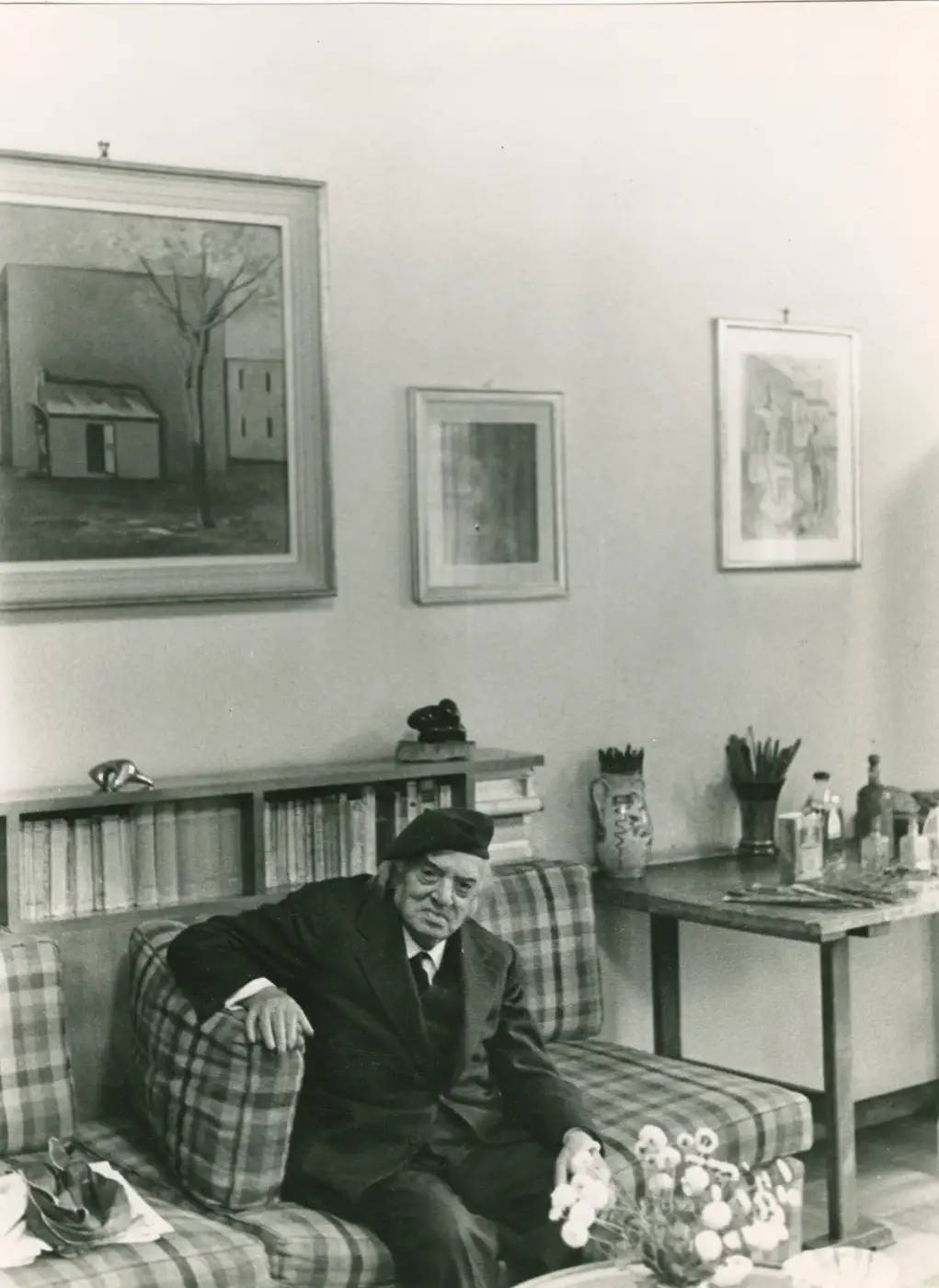
Carlo Dalmazzo Carrà (Quargnento, 11 February 1881 – Milan, 13 April 1966) was an Italian painter, professor at the Brera Academy from 1939 to 1951.
Biography
The beginning · The futurist period · The metaphysical periodExplore this chapter
The beginning
Son of a mighty landfall fell into disgrace, Giuseppe Carrà, and Giuseppina Pittolo, was born to Quargnento (Alessandria) on 11 February 1881.
He learned the first hints of drawing art as a young man, only 12 years old, during a forced stay in bed due to a long illness. He soon began to work as a mural decorator Valenza while attending evening schools including in Milan in the years 1904-05 the Scuola Superiore d'Arte applied to the Industry of Castello Sforzesco. In fact, Luigi Timoncini remembers: "In particular Carrà then of profession mural decorator, attendant of the School in the years 1904-05 return from Paris and London, before enrolling at the Accademia di Brera, he distinguished himself by pursuing the first prize of decoration, of lire 500, and that Noseda of 175 lire."[without source] Carrà himself also recalls the achievement of the two awards in his autobiography.
In 1899-1900 Carrà was for the first time in Paris, then in London; he saw a lot of ancient and modern painting; while in Milan he looked only at Segantini, Previati, Mosè Bianchi. For that time, his was a fairly vast "information" so as to make him understand, by comparison, that the Italian bourgeois art of the early twentieth century could not suggest any innovative idea. He went to Paris to the Universal Exhibition, to perform the decorations of some pavilions. On a visit to the Louvre, he was thrilled by some painters such as Delacroix, Géricault, Manet, Pierre-Auguste Renoir, Paul Cézanne, Camille Pissarro, Alfred Sisley, Claude Monet, Gauguin. In London, however, he became interested in the works of John Constable and William Turner.
In this period he began to be interested in politics, having relations with anarchist groups that interrupted however soon. Found by chance during the funeral of anarchist Galli, killed by the custodian of the factory that attacked during the general strike of 1904, was deeply impressed and began to draw some sketches, which later became part of the work. The funeral of the anarchist Galli.
Only in 1906 he entered the Accademia di Brera, as a pupil of Cesare Tallone. Here he met some young artists destined to be protagonists of the Italian artistic scene: Bonzagni, Romani, Valeri and Umberto Boccioni.
Short divisionist experience: it is in fact the divisionism that Carrà sees the most alive ferments of revolt to the provincial climate of Italian painting of those years. In 1909, with the publication of Futurism Manifesto, signed by Filippo Tommaso Marinetti, addressed to the young artists of the time to urge them to adopt a new expressive language, the new Futurism movement was born, joined by Carrà and other artists, including the painters Gino Severini and Giacomo Balla.
Since 1939, and for all the 1940s, he teaches painting at the Academy of Fine Arts in Brera, Milan. His students were Giuseppe Ajmone and Oreste Carpi.
The futurist period
From this period is the short but intense sexual link with Leda Rafanelli, anarchist, who had separated from her husband; Alberto Ciampi, one of the greatest experts regarding the relationship between Futurism and Anarchy, published a book dedicated to the two Leda Rafanelli, Carlo Carrà: a novel, art and politics in a meeting, it is not for nothing that Carrà dedicated a painting to her[1] title Funerals of the anarchist Galli and comment on the event.
From this writing, Carrà's shocked emotional state was shattered, as during the funeral there were clashes between policemen and participants in the funeral procession.
Carrà collaborated with the futurist movement for six years. The inspirational concepts of futurist painting were published in the magazine Lacerba, in which he actively collaborated. Carrà conceived his paintings as dynamic images but at the same time not only limited to giving the sensation of movement, intended through color to eliminate the fixed law of gravity of bodies. In 1908 Carrà met Boccioni and Luigi Russolo. After joining Marinetti's movement, with Boccioni, Russolo, Severini and Balla, he signed the Manifesto of Futurist Painters on 11 February 1910, and the Technical Manifesto of Futurist Painting on 11 April 1910. His is the manifesto The Painting of Sounds, Noises, Odors (1912). Precisely in these years the friendship between Carrà and the poet Giuseppe Ungaretti was born.[4] Futurism was detached in 1916, when De Chirico started painting metaphysics.
The main futurist works of Carrà are:
- Milan station (1910-11)
- The funeral of the anarchist Galli (1910-11)
- Night lights (1910-11)
- Woman at the balcony (1912)
- The Gallery of Milan (1912)
- Plastic transcenses (1912)
- Interventional demonstration (1914)
The metaphysical period
From 1915 Carrà began to feel the need to abandon the themes of speed and dynamism, seeking a more structured contact with the real. The war will involve Carrà, first with intense interventionist activity, during which he also met Cesare Battisti, and then with the call to arms. But the experience was so painful, that he ended up in a neurocomium in Ferrara. In this city, in 1917 he met Giorgio De Chirico, Alberto Savinio, Filippo de Pisis[5], with which he defined the theoretical principles of metaphysics. After some works in De Chirico's style, the painter soon achieved his own artistic individuality, so Carrà did not remain confined between the typical formulas of the metaphysical movement, in his art metaphysics was decidedly surpassed by poetry and the sense of magic. In 1919 he married Ines Minoja and began collaborating on the art magazine Valori plastici di Roma, which continued until 1921. The main works of this period are:
- Portrait of woman (1916), pencil drawing on paper, 28x23 cm, private collection;
- The Western Knight (1917), oil on canvas, Mattioli Collection
- The hermaphrodite idol (1917)
- Mother and son (1917), oil on canvas, Milan, Pinacoteca di Brera[6]
- The metaphysical muse (1917)
- The Daughters of Loth (1919)
- The son of the builder (1917-1921)
- The lover of the engineer (1921)
- The waiting (1926)
- Merit (1923)
The Daughters of Loth (1919)
Two young women confront each other in front of the facade of a house. The left girl is standing on the threshold while the other right is kneeling. On the ground is a travel stick belonging to the young. Among them a dog runs to welcome the girl. The scene takes place on a paved space, at the right of which there is a pillar of classical foggia that supports a marble pine. Beyond the courtyard there is a small landscape with two hills of Piedmont. Behind one of them there is a roundabout. In fact, according to historians, analyzing the work is possible to identify the passage from metaphysics to magical realism. Carlo Carrà thus marks a point of arrival in his research conducted since 1915-1916. In this painting you can see the experiences related to the poetic return to the order that were promoted in the magazine Plastic Values. In the period culturally dominated by fascist rhetoric, artists were prompted to recall the Italian tradition. His formal research began with Giotto and Masaccio's studio whose style is found in Le Daughtere di Loth. The bodies of the figures are simplified and synthetic forms and covered with idealized geometric shapes. It is an archaic language that is also evident in the postures of the two protagonists. The landscape and the tiled terrain are a memory of metaphysical experiences.
The transcendent period
In 1922, a new turning point in Carrà's artistic path, which leads him to abandon also metaphysics, driven by the desire to "be only himself". Painting must grasp that relationship which includes the need for identification with things and the need for abstraction and contemplation of the landscape is then resolved in the "construction" of a picture, both mountainous and marine. He also knows the Milanese painter- poet Cesare Breveglieri (who portrayed him while painting). The artist's archive is kept at the Archive of '900 of the Mart in Rovereto. Among the various international collective exhibitions to which he participated, we remember the VI Triennale of Milan, where he exhibits the mural painting "marble processing", in the gallery of decorative and industrial arts, together with artists such as Filiberto Sbardella, Adriano Spilimbergo, Bullshit.
Death
Work
Explore this chapter
- The Knights of Revelation (1908), oil on canvas, Art Institute of Chicago[9]
- Exit from theater (1910), Estorick Collection of Modern Italian Art
- What the tram told me (1911), Museum of modern and contemporary art of Trento and Rovereto
- Object Rhythms (1911), oil on canvas, Milan, Pinacoteca di Brera[10]
- The cyclist (1913)
- The Red Knight (1913)
- Events Interventist (1914), collage on cardboard, Gianni Mattioli collection
- Portrait of woman (1916), pencil drawing on paper, 28x23 cm, private collection
- The Enchanted Room (1917), oil on canvas, Milan, Pinacoteca di Brera[11]
- The Metaphysical Musa (1917), oil on canvas, Milan, Pinacoteca di Brera[12]
- The Daughters of Loth (1919), Museum of modern and contemporary art of Trento and Rovereto
- The pine on the sea (1921)
- The landing (1923)
- Waves (Marina) (1924), etching on copper (25 copies and 3 artist's proofs in 1924, 13 copies in 1951)
- The sail (1924), etching on copper (25 copies, 60 posthumous in 1971)
- The house of love (1924), etching on copper (25 copies and 3 artist's proofs in 1924, 10 copies in 1951, 70 copies posthumously in 1971)
- Baggage II (1924), etching on copper (29 copies and 3 artist's proofs in 1924, 70 posthumous examples 1971)
- The mouth of the Cinquale (1925)
- Canal in Venice (1926), oil on panel, Lugano, Museo Cantonale d'Arte
- Landscape, (1927), oil on canvas, Roberto Casamonti Collection Florence
- The swimmers (1928)
- Rise between statues and models (1928)
- Morning at the sea (1928), oil on canvas, Milan, private collection
- The marble sawmill (1928), oil on canvas, Milan, Pinacoteca di Brera[13]
- Nuotatories (1929), oil on canvas, Milan, private collection
- Marina with tree (1930)
- Doors Loading (1930), oil on canvas, Paris, Musée National d'Art Moderne
- Football Match (1934), oil on canvas
- The boatman (1934), oil on canvas
- The road to the house
- Return from the fields
- Self-portrait
- Arrest of Caesar Baptists
- After sunset
- Male portrait (1942), oil on canvas cardboard, Municipal Art Gallery of Cagliari
- Apples (1947), oil on canvas, Municipal Art Gallery of Cagliari
- Manufacturers (1949-1950), created, together with a self-portrait, for the important Verzocchi collection on the theme of work. The collection is today preserved at the Civic Art Gallery of Forlì
- Summer on the river (1951)
- Houses in the fields (1928), oil on canvas, Pieve di Cento (BO), MAGI '900 - Museum of artistic and historical excellence
Written
Explore this chapter
- Carlo Carrà, Margotti, Rovereto, Edizioni Delfino, 1943.
- Carlo Carrà, My life, Rome, Longanesi, 1943; then Milan, Rizzoli, 1943 and 1945.
- Carlo Carrà, All the writings, edited by Massimo Carrà, with an essay by Vittorio Fagone, Milan, Feltrinelli, 1978.
Honors
Explore this chapter


Notes
Explore this chapter
- ^ Geocities shut down[interrupted link] (JPG), up Yahoo Small Business.
- ^ Carra's paintings, up geocities.com (archived fromoriginal url on 11 August 2006).
- ^ artemotore.com, up artemotore.com.
- ^ Carrà and Ungaretti met in April 1914 in Paris at the Galleria Bernheim-June, where a futuristic exhibition was planned. The friendship between Ungaretti and Carrà - destined to last until the painter's disappearance - was born a few months later, when the poet moved to Milan and there he had the opportunity to attend assiduously the painter, until Italy entered into war and Ungaretti was recalled to arms (Fifty-three letters to Carlo Carrà, edited by P. Bigongiari and M. Carrà, in «Paradigma», June 1980, fasc. 3, pp. 415-447).
- ^ "Giorgio De Chirico: his life and work", La Nave di Teseo editions, page. 132.
- ^ Mother and son, up penacotecabrera.org. Retrieved 23 March 2018.
- ^ City of Milan, Find your dear, up common.milano.it.
- ^ Mario Pancera, Giacomo Manzù and the tragedy. Italian sculptors of the twentieth century, Simonelli Editore, 1 January 2013, ISBN 978-88-7647-900-7. Retrieved 15 April 2017.
- ^ (EN) Horsemen of the Apocalypse, up artic.edu. Retrieved 23 March 2018.
- ^ Object Rhythms, up penacotecabrera.org. Retrieved 23 March 2018.
- ^ Enchanted room, up penacotecabrera.org. Retrieved 23 March 2018.
- ^ The metaphysical muse, up penacotecabrera.org. Retrieved 23 March 2018.
- ^ The marble sawmill, up penacotecabrera.org. Retrieved 23 March 2018.
- ^ Quirinale website: detail decorated., up quirinale.it.
- ^ Quirinale website: detail decorated., up quirinale.it.

Bibliography
Explore this chapter
- Carrà: All the pictorial work, vol. 1 (1900-1930), vol. 2 (1931-1950), vol. 3 (1951-1966), edited by Massimo Carrà, Edizioni dell'Annunciata, Milan 1967-68.
- Elena, CARRA' Massimo, Carlo Carrà. My memories. Work graphic 1922-1964, Edizioni Medusa, Milan 2004, pp. 111.
- Carlo Carrà: anthological exhibition, cat. of the exhibition curated by Gian Alberto dell'Acqua and Massimo Carrà, (Milan, Palazzo Reale), Motta, Milan 1987.
- Carrà: Drawings, edited by Franco Russoli and Massimo Carrà, Grafis, Bologna 1977.
- Carlo Carrà (1881-1966), cat. of the exhibition curated by Augusta Monferini, (Rome, National Gallery of Modern Art), Electa, Milan 1994. ISBN 88-435-5091-8.
- Carlo Carrà: 1881-1966, cat. of the exhibition curated by Maria Cristina Bandera, (Alba, Ferrero Foundation, 2012-2013), 24Ore Cultura, Milan 2012. ISBN 978-88-664-8112-6.
- Giuseppe Bergamini, Giancarlo Pauletto. Carrà: drawings and aquafurts 1907-1965, Pordenone, Edizioni Concordia, Cultural Initiatives Center, Edizioni d'arte series, Out of series, 2007, pp. 117. ISBN 9788884260291
- Girace P. Contemporary artists, Naples, Ed. E.D.A.R.T., 1970, pp. 125-127, SBN NAP0057927.
- Giuseppe Marchiori, CARRÀ, Carlo, in Biographic dictionary of Italians, vol. 20, Rome, Institute of the Italian Encyclopedia, 1977. Retrieved 18 June 2015.

Continue your journey