A closer look
Church of Our Lady of Loreto: at a glance
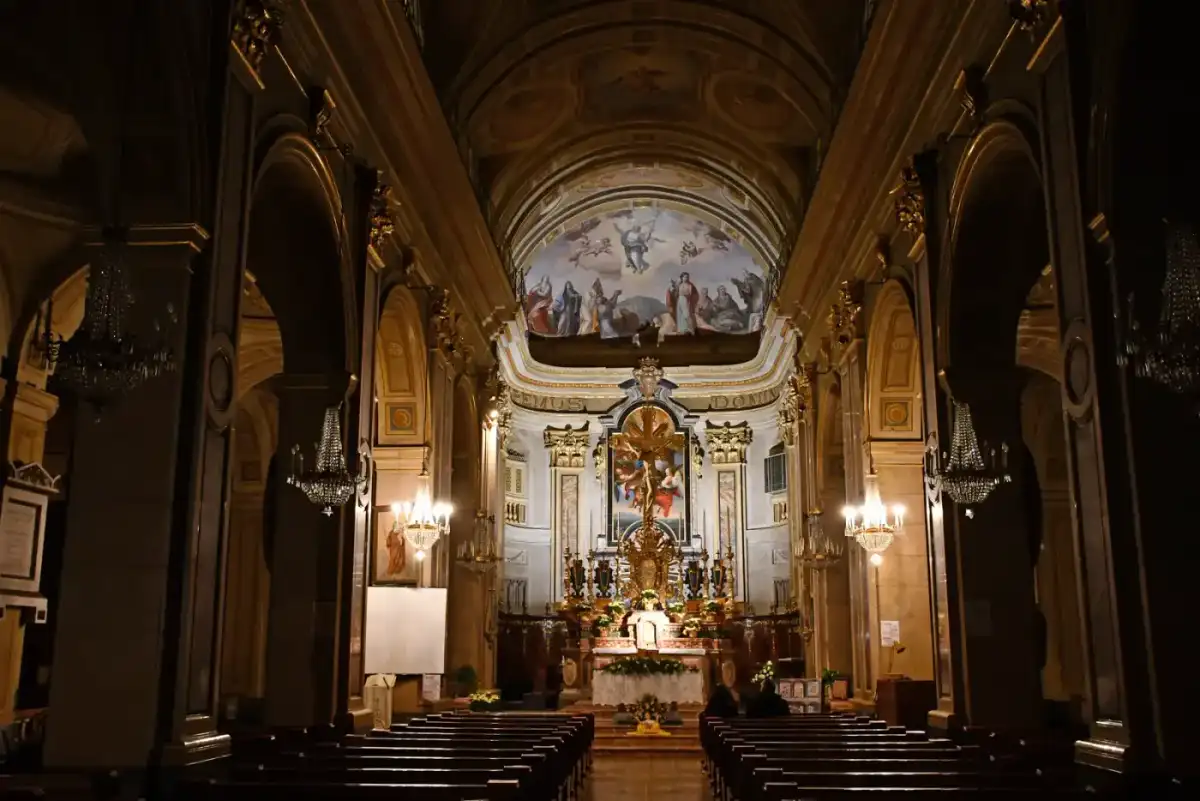
The Church of Our Lady of Loreto of the Costigliole d'Asti is a neoclassical building built in the 19th century, on the site of two previous churches, the first Romanesque and the second Renaissance-Baroque.
It is situated in the highest part of the country, traditionally called "la Rocca", opposite the Castle and is the parish church of the coastal community.
History
The first church was built in the medieval period and was in Romanesque style; the dimensions were very small and the interior had few furnishings. Between 1580 and 1595...Explore this chapter
The first church was built in the medieval period and was in Romanesque style; the dimensions were very small and the interior had few furnishings. Between 1580 and 1595, the parish priest Marco Antonio Asinari decided to expand the Baroque-Renaissance building and in the following centuries the Verasis families and Asinari Costigliole's cofeudataries enriched the building with furnishings and works of art.
The church's embellishment also contributed six parish companies.
At the end of the eighteenth century, the building was greatly decayed requiring works for consolidation and on the night of 11 November 1811, due to many water infiltrations, much of the church collapsed.
The parish priest Lorenzo Pola in agreement with the city council, entrusted the reconstruction to the architect Carlo Ceroni who finished the work in 1816.
Description
InternalExplore this chapter
The church is of remarkable proportions (40 meters long, 25 wide and 16 in height in the central nave) and has a two-body facade overlapping, ends with a timpane and opens into a central rose window.
Internal
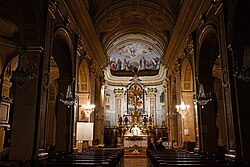
The central aisle has a balconate on which is located an organ by Carlo Bossi consisting of about two thousand reeds. The carved wooden house is the work of Francesco Novaro "Brassiè", a well-known artist who also carried out activities at the Savoy court.
The vault of the nave features frescoes by Lorenzo Peretti depicting some scenes from the Old and New Testament (Mosè with the tables of the law, the ascension of Christ, the coronation of Our Lady, the adoration of the Blessed Sacrament) as well as scenes from the life of Saints (the glory of Saint Ignatius of Loiola, Santa Polissena, San Siro)
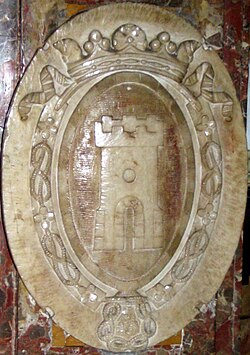
Behind the main altar there is a canvas depicting the church owner, the virgin of Loreto, painted by Prospero Clori in 1720 and commissioned by Verasis accounts as they indicate the coat of arms of the family present on the canvas and the marble frame realized by Filippo Juvarra.
In the lower part, always behind the altar there is the wooden choir style empire created in 1824 by the Astigiano Giuseppe Conti.
The main marble altar, with carved and gilded wooden stake, was also designed by Juvarra and commissioned by the Asinari branch of San Marzano in 1718.
The side aisles presents works by the painter Michelangelo Pittatore and Lorenzo Peretti.
The church also houses the tombs of two members of the Verasis family and that of the Marquis Filippo Antonio Asinari of San Marzano, a diplomat of Savoy.
The sacristy, built between 1784 and 1785 presents the work L'Annunciazione di Guglielmo Caccia Moncalvo and the Assumption and Saints John the Evangelist and Second of Asti, work of the Trinese Giovanni Crosio.
Image gallery
Explore this chapter
-
 Pitter, San Filippo Neri, Costigliole d'Asti, parish church of N.S.di Loreto
-
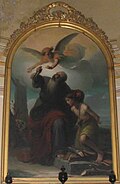 Pitter,Sacrifice of Isaac, Costigliole d'Asti, parish church of N.S. of Loreto
-
 Pitter,San Francesco d'Assisi, Costigliole d'Asti, parish church of N.S. of Loreto
-
 Pitter,San Francesco di Sales, Costigliole d'Asti, parish church of N.S. of Loreto
-
 Pitter,Santa Chiara, Costigliole d'Asti, parish church of N.S. of Loreto
-
 Pitter,San Vittorio, Costigliole d'Asti, parish church of N.S. of Loreto
-
 Pitter,San Carlo Borromeo, Costigliole d'Asti, parish church of N.S. of Loreto
Bibliography
Explore this chapter
- P.Prunotto, The Parish Our Woman of Loreto in Costigliole d'Asti, Itinerary of faith and art, edited by the "Confraternita di San Gerolamo" Association, Costigliole dìAsti
Continue your journey