Atlas of Monferrato
Church of San Ruffino (Mongiardino Ligure)
Local stories and places
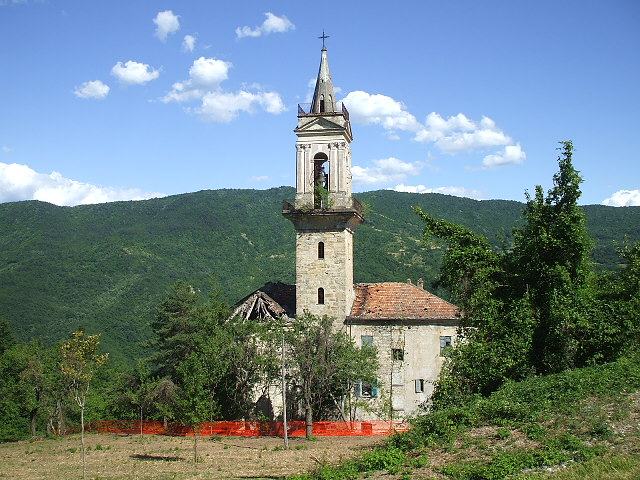
A closer look
Church of San Ruffino (Mongiardino Ligure): at a glance
The church of San Ruffino, also known as church of San Rufino or Church of the Canary Islands, is a church located in the Gordanella valley at 825 meters above sea level, part of the Borbera valley not far from Cerendero and the Canary Islands, hamlets of Mongiardino Ligure in the Piemonte.
In 2011, the superintendence placed it among the assets of proven value and artistic value, subjected to protection under the code of cultural goods and landscape.[1][2]
The bell tower still preserves intact and in their place the four historical bronze bells of the nineteenth century, survived to the spoliations and also to the two world conflicts, the oldest of which dating back to 1839 and the most recent in 1892.[3]
History
Cited in an ecclesiastical document dating back to 25 November 1248, it was an independent parish until 1475 when, by renunciation of the church's rector, the Spinola,...Explore this chapter
Cited in an ecclesiastical document dating back to 25 November 1248, it was an independent parish until 1475, when, by renunciation of the church's rector, the Spinolas, feudal lords of the area, incorporated it into the parish of Mongiardino Ligure. In 1647 it returned to being an independent parish by will of the bishop of Genoa Stefano Durazzo and was assigned to the priest Tortona Tomaso Morando, who accepted the position. At the end of the 17th century, the building suffered some damage caused by a franous movement and began to be cyclically subjected to restoration work.
Since the renovations were followed, in 1890 was called the Genoese architect Luigi Balbi with the aim of demolishing and rebuilding the religious building. Citizenship wanted to rebuild the church at the point where it was the previous one, and contributed with an extraordinary economic and manovalve effort. The amount agreed for the construction was 5900 lire, excluding the building of the façade, demolition and new foundations, so that the budget expenditure reached 14 000 lire. The first stone was laid on 26 June 1898 and that of the bell tower on 15 July 1901, at this point the expenses had already reached 59 000 lire, excluding the lime which had been prepared and provided free of charge by the population of Cerendero.
The works began under the supervision of the parish priest Agostino Tambutto, and took place in a very short time: already on 17 July 1904, in fact, the church was consecrated by the bishop of Genoa Edoardo Pulciano. In 1915 the bell tower was completed, in 1929 the interior was decorated by the Turinese painter Francesco Ponsetti who received a compensation of 30 000 lire, in 1936 the pavement was completed and in 1945 the pulpit was built, after the works had stopped from 1940 to 1945 due to World War II.
In 1947, as cracks appeared ever wider in the church, it was called engineer Maurizio Bruzzo, but those were the first symptoms of an inexorable decay. The church was accessible until 1979, when it was closed to the public and no longer used.
In 2008 a petition from the Friends Committee of the Church of Cerendero led to the collection of about 4,000 signatures to save the church.[4] In the same year, the building was ranked eighth on the list of places in the heart of the Italian Environment Fund, with 4048 votes.[5].
On February 18, 2009 a technical meeting was held in the church of Santa Maria della Cella in Genoa Sampierdarena with projects and recovery operations. The geological survey was carried out in March, which confirmed the feasibility of a total safety of the artefacts.[6] At the request of the mayor Mongiardino Ligure, therefore, the area has been fenced by the forest of the Region Piemonte,[7] propedeutically at the beginning of the work.
On August 21, 2009, the Cardinal of Genoa Angelo Bagnasco, on a pastoral visit, made an inspection at the church.[7]
At the end of 2012 the CRT Foundation made a first allocation of 15,000 euros,[8] thanks to which in November 2013 it was possible to buy and install the scaffolds to start renovation.[9] In July 2013 a second appropriation was held by Fondazione Carige, dedicated to the safety of canonical works and parish works.[8]
In the following years, however, important requalification works designed, estimated around 400,000 euros,[6] They were waiting, and the building remains in a state of nightmare.
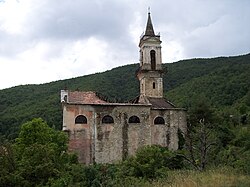
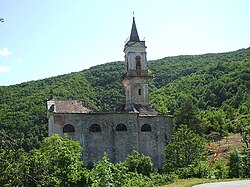
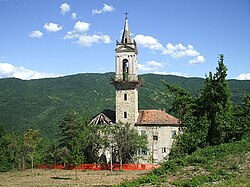
Image gallery
Explore this chapter
 |
 |
 |
Notes
Explore this chapter
- ^ Future builders, A cathedral in the mountains: the church of San Rufino Archived on 28 June 2021 at the Wayback Machine., July 2016. Page 16
- ^ Operation San Rufino, The Church of San Rufino Archived on 28 June 2021 at the Wayback Machine.
- ^ Operation San Rufino, Camps Archived on 28 June 2021 at the Wayback Machine.
- ^ The places of the heart: census 2008, up iluoghidelcuore.it (archived fromoriginal url on 23 March 2009).
- ^ The places of the heart, up iluoghidelcuore.it.
- ^ to b Operation San Rufino, Projects
- ^ to b Operation San Rufino, Association “Operation San Rufino” Onlus Archived on 28 June 2021 at the Wayback Machine.
- ^ to b Operation San Rufino, Economic appropriations Archived on 28 June 2021 at the Wayback Machine.
- ^ DictaMundi, November 2013
Bibliography
Explore this chapter
- Valli Borbera e Spinti, periodic of the mountain community, number. 1, year XXI - March 2009. Page 10
- Future builders, A cathedral in the mountains: the church of San Rufino Archived on 28 June 2021 at the Wayback Machine., July 2016. Page 16
- Operation San Rufino Archived on 28 June 2021 at the Wayback Machine.
Continue your journey