
A closer look
Cynocephalus: at a glance
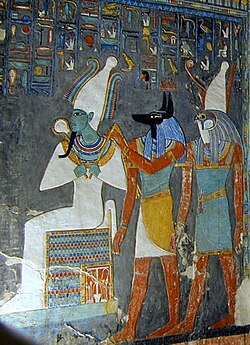
A Cynocephalus (from ancient Greek κυνοκήφαλος that means dog head) is a mythical being with the body of a man and the head of a canid, ranging in size from human to gigantic.
The Cynocephali, along with the Shapods, the Blemmies, the Cyclops, the Hippopods and other similar creatures, are more generally categorized as monstrous people. In most cases, the Cinocephali are attributed negative characteristics such as irrationality, aggressiveness and dissolubility of costumes.
Meaning, diffusion and historical sources of myth
The myth of the people of dog-men is present in all Indo-European cultures of classical age, from northern Africa to Greece, from Persia to India, where the...Explore this chapter
The myth of the people of dog-men is present in all Indo-European cultures of classical age, from northern Africa to Greece, from Persia to India, where the Cynocephali are always indicated by names concerning the canine attribute. People of dog-men are described by various Latin and Greek authors with different names and placed in the most remote places.
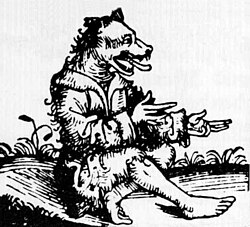
From Weltchronik's cards by Hartmann Schedel - sheet XII - Detail.
They are described as truly existing monstrous creatures, sometimes borrowing stories or myths from other countries, as is probably done by Ctesia di Cnido (IV century BC) describing, in its history of India, the Calystrien. The creatures of Ctesias coincide with the Indian Swamukha (literally face of dog) cited in the Purāṇas.
The oldest Greek source (VIII century BC/VII century B.C.), Exodus, distinguishes between Hemikynes (in ancient Greek ἡμίκυνες, means dog) described as dog-bodied humanoids and kynokephaloi, with the head of a dog and a human body, but places them both on the coasts of the Black Sea, treating them as a single population. Peoples of dog-men are also created ex novo, as Lucian of Samosata does, in the composition of the satirical work History Vera, introducing the fictional race of Cinobalanos (in ancient Greek Κυνοβάλανοι, Canine acorns, referring to the winged acorns - with the probable meaning of penises - ridden by these beings).
Later classical authors do not make variations to the myth, except for the place (always very distant) and the name. For Strabo and Pliny the Elder are called Cynamolgi and dwell in Ethiopia, while Tertullian describes the Cynopennae and places them in Persia.
The Cynocephali are, subsequently, catalogued (as the same classical authors already did, in part, but now much more extensively), in treatises such as the Liber monstrorum de diversis generibus (8th century), together with multiple monstrous creatures, living in the distant and unknown eastern lands believed to be contiguous to the Garden of Eden.
Real, unnoticed or hostile people are also identified by Western medieval authors, more or less directly, with these fantastic beings. For example, Paolo Diacono in his Historia Langobardorum claims that the Longobards, to intimidate their opponents, fed the rumor of having among themselves wounded Cynocephali. The French miniaturist Ademaro of Chabannes writes in Historia Francorum - referring to some Saracens captured by the Franks at Limoges - which they did not express themselves in their language, but they wore and barking like dogs.
The cleric Hyon de Narbonne (Ivo di Narbona), in a letter addressed to Gerardus de Malemort, archbishop of Bordeaux, bears witness to the siege of the Tartars at Wiener Neustadt, a town of the Austrian dukedom on the border with Hungary. In describing the atrocities made by the besiegers, Hyon states that the Tartarian leaders have Cynocephalics among their files, to which they feed the sected bodies of prisoners. The Franciscan friar Giovanni da Pian del Carpine in Historia Mongalorum, attributes canine characteristics to the face of Samoyeds.
Anubis, the Good Shepherd and San Cristoforo Cynocephalus
Affining the Cynocephali, from the "theological point of view" having the same features, are also the Egyptian divinities Anubi and Upuaut . In this case, however, the dog-man assumes a...Explore this chapter
Facing the Cynocephali, from a "teratological" point of view having the same features, are also the Egyptian gods Anubi and Upuaut. In this case, however, the dog-man assumes a different symbolic meaning, as through the world of living and that of the dead, in which the deceased reborn to new life.
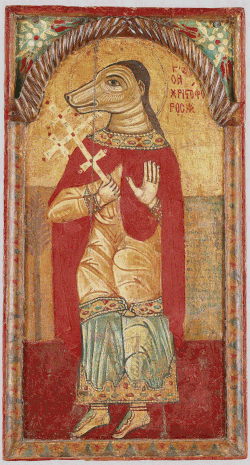
Byzantine icon. Byzantine and Christian Museum of Athens.
The holy Christian Christopher is depicted in many Byzantine icons and frescoes with the features of Cinocephalus. In the Passio sancti Christophori martyris, a text present in various patristic works and which was widely disseminated in medieval times, tells the legend of the saint, who is said to be a Cynocephalus who converted to Christianity.
St. Christopher Cynocephalus presents common characters both to the Egyptian god (San Cristoforo traghetta Jesus child, carrying him on his shoulders, from one bank to another of a river, as well as Anubi "traghetta" souls between the kingdom of the living and that of the dead) both to the multiple stories of Cinocefali (sometimes San Cristoforo is represented as a giant giant, an attribute shared by different populations of dog-men).
The figure of San Cristoforo, although it acquires some traits of the myth of Cinocephali (the gigantism, the abruptness before conversion), completely reverses its moral status, in its holiness. An early medieval author (IX century), the Benedictine monk Ratramno di Corbie (Ratramnus), in the letter Epistle of Cynocephalis states that the Cynocephali should be considered as human beings. This document expresses a twofold and more complex attitude towards monstrous people that develops over time, which sees, beyond the prevailing hostility, also acceptance as part of God's creation.
As reported by Massimo Izzi, A. H. Krappe and Ph. Walter, the figure of San Cristoforo would also be a legacy of pagan cults linked to the astronomical motion of Sirio, a star belonging to the constellation of Cane Maggiore. The feast of the saint falls on 25 July and the astronomical reference would concern the period of "canicola", that in which the rising and tramontare of Sirio coincide with those of the Sun.
Mito variants
A significant variant that describes populations in which females (sometimes referred to as amazons) are always completely human, while males are Cinocephali or...Explore this chapter
- Land (or Country) of the Dogs
A significant variant that describes populations in which females (sometimes referred to as amazons) are always completely human, while males are Cinocephali or dogs. The progeny of these women, depending on the sex of the unborn child, perpetuates this dimorphism. The myth has the same wide spread as that of the Cynocephali peoples. German medieval chronicler Adamo da Brema in his Descriptio Insularum Aquiloni, in which he describes the geography, people and customs of Scandinavia, places this land on the coasts of the Baltic Sea.
Notes
Explore this chapter
Bibliography
Primary sources · Secondary sourcesExplore this chapter
Primary sources
Here are the main historical sources that provide, over time, support for the elaboration and dissemination of the myth of Cynocephali. Sources are indicated in alphabetical order. For renaissance and modern sources it is also indicated the year of publication.
The convention is used: Book[in Roman numerals].Chapter.paragraph(s).
Subdivisions absent are indicated with a point. For example, (I..11) of the Historia Langobardorum means paragraph 11 of Book I, without chapter subdivision. Additional subdivisions are explicit.
GRECO-LATINE CLASSIC FUNTS
- Exodus, Fragment 153
- Luciano di Samosata, Αληθής Ιστορία (Storia Vera) (I..)
- Pliny the Elder, Naturalis Historia (VI.190 and 195)
- Strabo, εωγραφία (Geography) (XVI.4.164-166)
- Tertullian, Apologeticum (Part III.8.5)
MEDICAL FUTURE
- Liber monstrorum de diversis generibus of anonymous 8th century
- Adam from Bremen, Descriptio Insularum Aquiloni in the Gesta Hammaburgensis Ecclesiae Pontificum (IV.19.118-119)
- Ademar de Chabannes, Chronicon Aquitanicum et Francicum sive Historia Francorum
- Giovanni da Pian del Carpine, Historia Mongalorum quos nos Tartaros appellamus (.11)
- Hyon de Narbonne, letter sent to the Archbishop of Bordeaux dated 1242-1243
- Paolo Diacono, Historia Langobardorum (I..11).
- Ratramno di Corbie, Epistle of Cynocephalis (Latin Patrilogy .121.1153-56)
- Thomas de Cantimpré, Liber de Monstruosis Hominibus Orientis (.14)
- Walter von Speyer, Life and Passage Sancti Christopher Martyis
RINASCIMENTAL FUNTS (XV-XVI century AD)
- Hartmann Schedel, Weltchronik's cards (Sheet XII) 1493
MODERN FONTI (XVII-XIX century AD)
- Jacob Masen, Speculum Imaginum Veritatis Occultae (.10, page 116) 1681
Secondary sources
- Liber monstrorum de diversis generibus. Book of admirable difformities by Anonymous of the 8th century, translation and commentary edited by Corrado Bologna, Bompiani, Milan 1977
- Anna Avraméa La géographie du culte de Saint Christophe en Grèce de l'epoque méso-byzantine, in Geographical byzantine, Publications de la Sorbonne, Paris, 1981
- Joseph Campbell, The masks of God: Western mythology, Oscar Saggi Arnoldo Mondadori Editore, Milan 1992 ISBN 88-04-35633-2
- Jacques Le Goff, The wonderful and everyday in the medieval west, Laterza, Rome-Bari 1983
- Massimo Izzi, The illustrated dictionary of monsters, Gremese Editore, Rome 1989 (pp. 287–288) ISBN 88-7605-449-9
- Luigi Maini, Legend of S. Christopher published according to the lesson of an ancient code, Modena, 1854
- Richard Montenegro, The real and its double. The company of monsters, in Middle Ages Year V, no9 (56) - September 2001
- Pierre Saintyves (pseudonym of publisher Emile Nourry), Saint Christophe, successor of Anubis, d'Hermes et d'Heracles, Nourry, Paris, 1936
- Philippe Walter, The mémoire du temps, Champion-Slatkine, Paris-Geneva, 1989 (p. 719)
- Rudolf Wittkower, Allegory and migration of symbols, Giulio Einaudi Editore, Turin 1987
- Umberto Eco, The name of the rose, Bompiani, 1980
- Umberto Eco, Baudolino, Bompiani, 2000
Continue your journey