A closer look
Gonzaga Warriors: at a glance
THE Gonzaga Warriors are an ancient noble family, native to Fermo (Warriors), in the Marche,[3] that at the beginning of 1500 he transplanted to Mantua, welcomed to the court of Marquis Francis II Gonzaga.
He was the son of the jureconsultus and captain of Viscount Giacomo Terzi, and his nephew, therefore, of the leader, lord of Parma and Reggio, Ottobuono. John Philip, after the death of his father in the fall of 1409, following that of Ottobuono, by the Estensi and their associates, had taken refuge in the Anconitana Brand. Here he abandoned the ancient last name of the Terzi di Parma to hire the new "Guerrieri". In 1431, when he was the owner of the high office of podestà in Osimo, he had already adopted it.[4]
History of the house
Famous and remarkable staff · PossessionExplore this chapter
After having contributed victoriously, on 25 November 1445, also thanks to the support of the troops of his cousin Niccolò de' Terzi, the Warrior, leader of Gian Galeazzo Visconti, to the liberation of Fermo, raised against the tyranny of Alessandro Sforza, Giovanni Filippo decided to settle in the Marche city that was manifesting him great gratitude and honors for the decisive rescue received. Here he married Andreana dei Verrieri of Sant’Elpidio, Mrs. Castellano and the Valley, becoming headmasters of the new Guerrieri House.
From that marriage five children were born: Apollonius, or Polonius, who between 1488 and 1492 represented Fermo as ambassador to Pope Alexander VI Borgia, and was then, like the father, podestà a Osimo; Giacomo or Giacopo, captain of arms elected then among the priors; John Baptist, also a man of arms; Alessandro, spouse of Lodovica of the illustrious family of Francis While with the first descendants of Giovanni Filippo, the prestige and influence on Marches in the Guerrieri family increased more and more, John Francis created the branch of the Warriors that set roots in Mantua. Three of his sons were offered the opportunity, on two successive occasions, to be welcomed at the court of Gonzaga.
The first appeared in November 1496 when Francis II Gonzaga, Lord of Mantua, returning from the kingdom of Naples stopped in the Brand of Ancona. During a tournament in his honor at Offida, admiring the evolutions of a magnificent destrier who had been donated to him, even more appreciated the valentiy of his knight: Ludovico Guerrieri, the firstborn of Giovanni Francesco. Therefore he obtained to take with him to Mantua, in addition to the palafreno, to enrich the already famous breeding of war horses, also Ludovico Guerrieri, at the service of his court.[5]
Six years later, in the fall of 1503 Francis II Gonzaga, who was a convalescent of his illness, was disappointed by another war fought in the Kingdom of Naples, and was splendidly hosted by Giovanni Francesco Guerrieri. Recognizing for the superb welcome and treatment received, the Lord of Mantua wanted to compensate the Warriors by welcoming at his court two more of the family, who would have reached the eldest brother Ludovico already at his honored service: they departed for Mantova then Giovanni Battista and Vincenzo.[6]
In 1506, two years later, "the penultimate day of April" Francesco Gonzaga decreed that Ludovico Guerrieri, having very well deserved as a high rank official at his court in the ten years spent from their meeting in Offida, was aggregated to his house and assumed since then, for himself, family and descendants, the surname Gonzaga Warriors.[7]
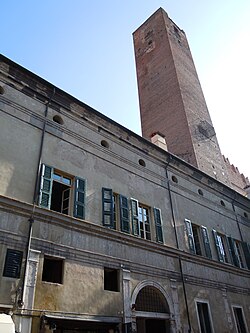
It became important thanks to the services rendered to the Marquisate of Mantua, the family had as a gift,[8] by Federico II, in 1526, the historic building, located in the ancient district of L'Aquila, then Sant'Agnese, today via Cavour, below the tower of the Acerbi, known later as Torre della Gabbia,[9] who will become a home of the family.
Ludovico married Violante da Correggio. He died in 1530 without male offspring. Vincenzo, in 1554, celebrated his wedding with Francesca Soardi, daughter of Giacomo, noble of Bergamo and with that marriage he continued the descent to Mantua of the House of Gonzaga Warriors.
Famous and remarkable staff
Among the most important exponents of the noble family are:
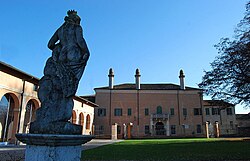
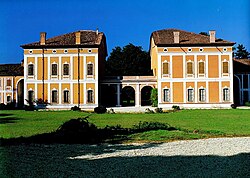
- Ludovico Guerrieri Gonzaga (1483-1530), welcomed to court in 1496 by Francis II Gonzaga, who took him with him from Fermo, became an advisor. In 1506 the lord of Mantua decreed the aggregation of Ludovico to his own house with the privilege of the double surname Guerrieri Gonzaga and in 1514 granted him the prestigious title of brandnalem consocium beneamatum. His successor Federico II, in 1522, appointed him Lieutenant General of Mantua. On 10 January 1526 he gave him the palace with the "Acerbi tower", previously owned by the Bonacolsi, in Contrada dell'Aquila, today's via Cavour.[10];
- Vincenzo Guerrieri Gonzaga (1495-1563), brother and heir of Ludovico. In 1516 it was camerarius And Greater cavalry at the service of Francis II Gonzaga; in 1521 he was appointed Captain of Lake Mantua; prefect of the ducal stable in 1532; beetle and commander of the militias of Casale Monferrato 1544.[11];
- Giovanni Battista Guerrieri Gonzaga, brother of Ludovico, arrived in Mantua, together with Vincenzo, in 1503 he served at the court;
- Girolamo Guerrieri Gonzaga (XVI century), son of Giovanni Battista. Master of chamber of Duke William Gonzaga;
- Francesco Guerrieri Gonzaga (XVI century), son of Giovanni Battista. Apostolic patron of the Basilica of Sant'Andrea in Mantua;
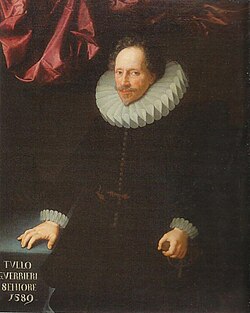
- Tullo Guerrieri Gonzaga (1550-1592),[12] first marquis of Mombello Monferrato and third count of Conzano, master of the chamber of Duke Vincenzo I Gonzaga.[13];
- Francesca Guerrieri Gonzaga (XVI century), daughter of Tullo, married Alessandro Gonzaga the Young, son of Alexander (1520-1580). She remained widowed, she married with Pirro Gonzaga,[14] lord of Gazzuolo and San Martino from the Argine;
- Felicita Guerrieri Gonzaga (XVI century), daughter of Tullo and wife of Luigi Gonzaga (?-1590), of the line of “Nobili Gonzaga”. He had a natural daughter from Duke Vincent I.[15];
- Alfonso Guerrieri Gonzaga (?-1639), at the service of Philip IV of Spain; by Vincenzo I Gonzaga who appointed him governor of Casale Monferrato and General of Cavalry; and therefore of Vincent II Gonzaga who entrusted him the Ducal troops in the war against the Savoy and the King of Spain. He defended the city of Mantua from the terrible Sacco occurred in 1630.[16][17]
- Ludovico Guerrieri Gonzaga (XVII century). In 1621 he became Knight of the Order of Malta
- Cesare Guerrieri Gonzaga (XVII century), was at the service of Duke Charles I Gonzaga. Created General of the Waters of Mantua, he was ambassador to Pope Urban VIII, at the service of Charles II of Gonzaga-Nevers, Master of Chamber, and Prime Minister.
- Tullo Guerrieri Gonzaga (XVIII century), was at the service of Ferdinando Carlo di Gonzaga-Nevers who appointed him Governor of Guastalla. He married the Marquis Drusilla Visconti, In 1687 he was with Duke at the siege of Belgrade + General Battle, and member of the council of Carlo Maria Vialardi;
- Bonaventure Guerrieri Gonzaga (XVIII century), an officer of the imperial army, married the noble Lucrezia Valenti Gonzaga,[18] Cardinal Silvio's nephew. He served at Duke Ferdinando Carlo of Gonzaga-Nevers who sent him on a mission to the court of Louis XIV of France. He was named the first-born of St. Andrew's Basilica (Mantova), who died in 1756;
- Ludovico Guerrieri (XVIII century), Knight of the Order of Saint Stephen
- Cesare Guerrieri Gonzaga (1739-1832). He was raised to the dignity of Cardinal in 1819 by Pope Pius VII. Appreciated for his talents and deep legal and financial skills, the Secretary of State Ercole Consalvi wanted him as his coadjutor in his work of restoration and administrative reform of the Papal State. He was president of the Congregation of the Census, a member among others, of those of the Council, of Economics, of the Good Government, of the Factory of S. Peter. In 1826-27 he was Cameroon of the Sacred College of Cardinals. The following year, in May 1828, he was among the candidates for the Secretariat of State. As he ascended to the papal throne Pope Pius VIII with the conclave of 1829, Cardinal Cesare Guerrieri Gonzaga, now eighteen years old, abandoned every assignment. He died in Rome on 5 February 1832.[19]
- Girolamo Guerrieri Gonzaga, (XVIII century), landowner in Sustinente.
- Carlo Guerrieri Gonzaga (1788-1813). He served in the Royal Guard of King of Italy. He died during the Russian Campaign.
- Tullo Guerrieri Gonzaga (1773-1845), from 1811 to 1815 was the podestà of Mantova. Knight of the Order of the Crown, In 1812 he represented the Province of Mantua at the baptism of the King of Rome. Chamberlain at the court of Emperor Francis II, he became president of the Municipality of Mantua, Owner of the Villa of Volta;[8][20]
- Odoardo Guerrieri Gonzaga (1782-1858). Member of the municipality of Mantua during the Austrian restoration;
- Bonaventura Guerrieri Gonzaga (1778-1840), the Austrian Imperial-Regio donut.
- Anselmo Guerrieri Gonzaga, (1819 – 1879). Patriot Risorgimento, participated in the five days of Milan in 1848, in charge, among other things, of diplomatic missions in France by the Provisional Government. Condemned to exile with his brother Charles, he was expropriated by Austria of all goods in Mantua. In 1867 he served as Secretary General of the Ministry of Foreign Affairs.[21]
- Giambattista Guerrieri Gonzaga (1863-1931), knight of the Orders of the Crown of Italy and the Maurtian Order, and Knight of the Legion of Honor;
- Carlo Guerrieri Gonzaga (1827 – 1913). Patriot, he participated in weapons to the Risorgimento movement of 1848. For this reason he was sentenced to exile with his brother Anselmo, expropriated of all goods in Mantua. Captain of the Bersaglieri during the campaigns of 1859, he fought with Giuseppe Garibaldi in 1866, as an officer of volunteers, at the victorious battles of Monte Suello and Bezzecca.[22] He was elected to the Senate of the Kingdom (Italy). During his exile in Geneva he met the German pedagogue Emma Julia Hohenemser, belonging to an eminent Jewish family of intellectuals, patriots and bankers of Frankfurt, who will become his wife.[23]
- Tullo Guerrieri Gonzaga (1866-1902), medical officer of Regia Marina Italiana;
- Gemma de Gresti in Guerrieri Gonzaga (1873-1928), philanthropist;
- Ludovico Guerrieri Gonzaga (1869-1900), Lieutenant of Cavalry of the Royal Army;
- Luigi Guerrieri Gonzaga, owner of the lands of Sustinente; general of the army during World War II;
- Maria Maraini Guerrieri Gonzaga (1869-1950), friend, supporter and collaborator of Maria Montessori[24], in 1910 member of the promoting committee and vice-president of the "Regina Elena" boarding school in Rome, a boarding school for professional nurses founded on the model of the British Florence Nightingale[25];
- Gianluigi Guerrieri Gonzaga (1898-1969). Landowner and mayor of Sustinente. General during the Russian campaign. Gold Medal to the Military Valor;[26]
- Odoardo Guerrieri Gonzaga (1929-2015), environmentalist;[27]
- Giambattista Guerrieri Gonzaga (1933-2019[28]), distinguished himself by operating internationally (N. Rockefeller, the King of the Belgians).
Possession
- Palazzo Guerrieri-Gonzaga, then Palazzo Colloredo and now Palace of Justice in Mantova;[29]
- Palazzo Guerrieri da Fermo, in via Fratelli Bandiera in Mantova;[30]
- Palazzo Gonzaga-Guerrieri di Volta Mantovana, built in 1450 by Ludovico III Gonzaga, second Marquis of Mantua. He became in possession of Ludovico Guerrieri in 1515 for donation of Aloisio Gonzaga, Marquis of Castel Goffredo and Gianfrancesco Gonzaga, lord of Luzzara;
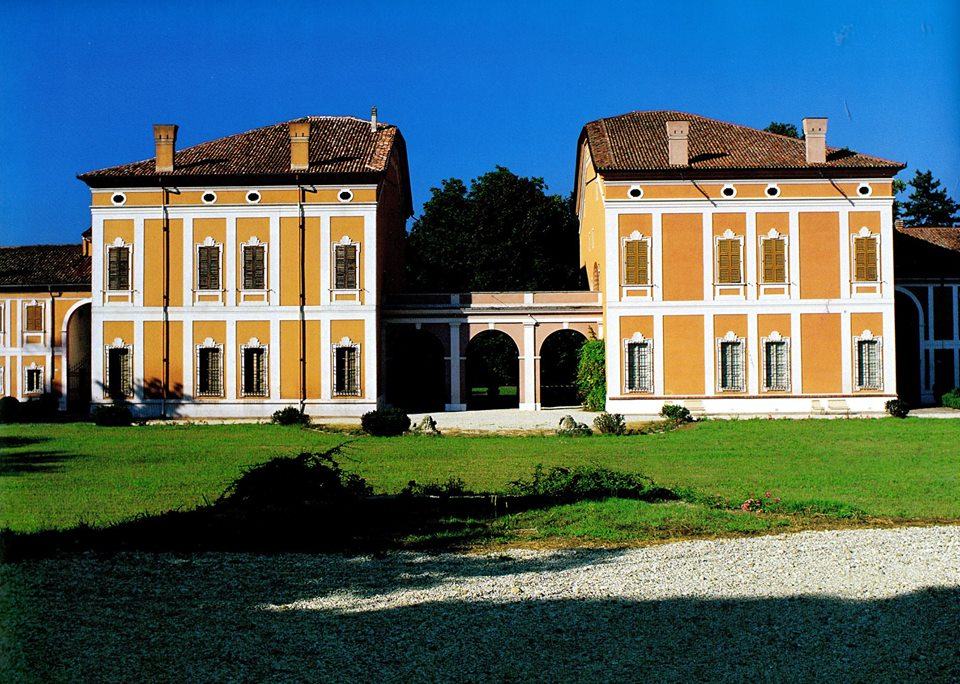
- Villa Guerrieri Gonzaga in Sustinente, of the 16th century, still owned and resided by the famous Marquisi omonimi;[31]
- Palazzo Guerrieri Gonzaga (Palazzo De Moll) and gardens in Villa Lagarina, of the seventeenth century, still property and home of the omonymous marquises, transplanted into Valle dell'Adige, in southern Trentino;[32][33]
- Villa Maraini-Guerrieri Gonzaga, in Palidano di Gonzaga.
Genealogy
Paolo Cont, I Terzi di Parma, Sissa e Fermo , Preface by Marco Gentile ("Fonti e Studi", series I, XXI), Parma, at the Deputation of Patria History for the Provinces...Explore this chapter
Paolo Cont, I Terzi di Parma, Sissa e Fermo, Preface by Marco Gentile ("Sources and Studies", series I, XXI), Parma, at the Deputation of Homeland History for the Provinces of Parma, 2017, p.163-178, Genealogical Tables [2]
| Guido Terzi from Cornazzano 1290-1387 | ||||||||||||||||
| Niccolò Terzi il Vecchio 1327-1398 | ||||||||||||||||
| Eighth of the Third ?-1409 | Giacomo Terzi ?-1409 | |||||||||||||||
| Niccolò Carlo Terzi 1406-? | Niccolò de Terzi the Warrior ?-1475 | Giovanni Filippo (Terzi) Warriors ?-1453 | ||||||||||||||
| Giovan Francesco Guerrieri 1440-? | Ludovico Guerrieri Gonzaga 1483-1530 | Giambattista ?-? | ||||||||||||||
| Vincent Gonzaga Warriors 1495-1563 | ||||||||||||||||
| Tullo 1st Count of Mombello ?-1592 | ||||||||||||||||
| ♪ ?-1592 Alessandro Gonzaga (?-1588) | Happiness ?-1626 | Vincent 1st Marquess of Mombello 1563-1617 | Alfonso 2nd Marquess of Mombello ?-1639 | Giambattista ?-? | Caesar 3rd Marquess of Mombello ?-1656 | |||||||||||
| Francesca (natural) 1590-1657 | Tullo 4th Marquis by Mombello ?-1678 | |||||||||||||||
| Bonaventure 5th Marquis by Mombello 1691-1756 | ||||||||||||||||
| Girola 6th Marquis by Mombello 1717-1808 | Anna. ?-1763 | Caesar 1749-1832 | Odo 1748-1820 | Bradamante ?-? | Mariana ?-1832 | |||||||||||
| Tullo 7th Marquis by Mombello 1773-1845 | Bonaventure 1778-1841 | Lucrezia 1779-1856 | Louis 1780-? | |||||||||||||
| Odo 1818-1877 | Anselm 1819-1879 | Carlo Carlo 1827-1913 | ||||||||||||||
| John the Baptist sp Lucy Pycke, daughter of Baron Amedé Pycke de Peteghem (1824-1898) | Tullo 1866-1902 sp Gemma de Gresti (San Leonardo) | Ludovico | Alfonso | Beatrice 1876-1954 sp Leopoldo de Moll (Moll Palace, Villalagarina) | ||||||||||||
| Anselm 1895-1974 (San Leonardo + Villalagarina) | ||||||||||||||||
| Tullo 1931- 2024 (Villalagarina) | Carlo Carlo 1938- (San Leonardo) | Maria Gemma 1929- (Villalagarina) | ||||||||||||||
| Anselm (San Leonardo) | ||||||||||||||||
Notes
Explore this chapter
- ^ Subalpine Blason, up blasonariosubalpino.it.
- ^ Coat of arms of the Guerrieri Gonzaga family, up coat of arms.it.
- ^ Giovan Battista di Crollalanza, Blasonic historical dictionary of Italian noble or notable families extinct and flourishing, Bologna, 1886, Vol.1.
- ^ In the «Catalogue of Podestà» is listed as Gio Filippo Guerrieri from Monte Santo Pietro degl’Agli. So in Memorie historiche dell'antichissima, and noble city of Osimo, cited in the research, published by the Deputation of Homeland History for the Provinces of Parma, by Paolo Cont, I Terzi di Parma, Sissa e Fermo, Preface by Marco Gentile ("Sources and Studies", series I, XXI), Parma 2017, pp. 157-163. In the volume, from which subsequent biographical data have been drawn here - and the related "Genealogy" - there is, in addition to the updating of the historical events of the individual branches of the lineage - from the Terzi of Parma to those of Sissa, of Fermo, then Guerrieri, and then Guerrieri Gonzaga - the complete reconstruction of the distinct Genealogical Tables (See pp. 164-178).
- ^ “From November [...] passed Mr. Giacomo S. Severino and was given, the similar to the Marquis de Mantua to which a beautiful horse was donated, that being there on a young man, said the Marquis who wanted everything, and that was Ludovico Guerrero, who sent it with him, and from that came down the family of Guereri in Mantua today so illustrious". Cr. Chronicles of the City of Fermo, in P. Cont, I Terzi di Parma, Sissa e Fermo, Preface by Marco Gentile, cit, p. 159.
- ^ Carlo d’Arco, in reporting this episode, incorrectly places it two years later, and also indicates among the Warriors on their journey to the court of Mantua the Ludovico that le Chronicles of the City of Fermo they had started in 1496: “In the year 1505 Francesco II Gonzaga, disgusted by the French, for whom he had fought, returning from Sicily was magnificently hosted by the Warriors in Fermo, memori of the reception received in Mantua from Niccolò. Francis, very grateful for the hospitality he received, asked how he could counteract the favors received. Gio-Francesco Guerrieri replied that nothing would be more grateful to him than what it lord took to serve his sons; so by consenting to the king of the Seco prince he led to Mantua Gio-Battista, Ludovico and Vincenzo Guerrieri." Archivio di Stato di Mantova, Documenti patrii collected by Carlo d'Arco, n. 217, Carlo d'Arco, Genealogic annotations of mantovane families, sec. XIX, IV, p. 390.
- ^ Archivio di Stato di Mantova, Documenti patrii collected by Carlo d'Arco, C. D'Arco, Genealogic annotations of mantovane families, "Decrees n. 33, Recte 1506, c. 126", page. 391. Ludovico himself was appointed in 1514 brandnalem consocium beneamatum and in 1522 he became General Lieutenant of the Lords of Mantua and Urbino.
- ^ to b Chiara Tellini Perina, The history of Bonacolsi Palace. The Humanist phase, up ilcaso.it. Retrieved 6 January 2015.
- ^ The tower took that name when, fifty years after the acquisition of the palace by the Gonzaga Warriors, in 1576, Duke William Gonzaga endowed it with the large suspended cage used to swallow the criminals.
- ^ Cf. Paolo Cont, I Terzi di Parma, Sissa e Fermo, Preface by Marco Gentile, cit, p. 161.
- ^ Cf. P. Cont, I Terzi di Parma, Sissa e Fermo, Preface by Marco Gentile, cit, pp. 161 and 176.
- ^ Geni.com Tullo Guerrieri Gonzaga., up genes.com.
- ^ Vincenzo Gonzaga and art. Mantua celebrates her patron., up republic.it.
- ^ Genealogy of Bozzolo Gonzaga., up genealogy.euweb.cz.
- ^ Pompeo Litta, Popular families of Italy. Gonzaga di Mantova, Turin, 1835, Plate XIX.
- ^ The Gonzaga Warriors Family and the Monferrato Archived on 17 September 2017 at the Wayback Machine..
- ^ History of Mantua from its origin up to the year 1860.
- ^ The places of the Valenti Gonzaga., up valentigonzaga.com. Retrieved 6 January 2015 (archived fromoriginal url on 3 April 2015).
- ^ The Hierarchy of the Catholic Church. “It was always very tied to Orvieto, where it was often hosted by her sister Drusilla, Marquis Gualtieri’s bride. He benefited the city with remarkable elations for the restoration of monuments and especially for the construction of the bridge over the river Paglia.” P. Cont, I Terzi di Parma, Sissa e Fermo, Preface by Marco Gentile, cit, p. 162.
- ^ History of the Bonacolsi Palace., up ilcaso.it.
- ^ Italian Parliament. Card., up story.camera.it.
- ^ Cf. C. Gonzaga Warriors: Memories and letters by Carlo Guerrieri Gonzaga. With preface by Alessandro Luzio, Città di Castello, S. Lapi, 1915.
- ^ Their biographies were reconstructed in the study of P. Cont, Biographical Mosaic: Emma Hohenemser Guerrieri Gonzaga, Rovereto 2013.
- ^ Material Montessori (PDF), up GonzagArredi Montessori, 2019, p. 2. Retrieved 18 February 2024.
- ^ Olivia Fiorilli, The resistible rise of the modern nurse - La Scuola Convitto Regina Elena (PDF), in The construction of the modern nurse - Genre, biopolitica, imaginary in the first thirty years of the twentieth century, rapporteur Patrizia Gabrielli, co-rapporteur Luc Berlivet, Rome, pp. 261-262. Retrieved 18 February 2024. Hosted on Catalog of research products - Sapienza University of Rome.
- ^ The Fountain of Piazza Roma.[interrupted link], up sustinenteonline.it.
- ^ The Marquis Guerrieri Gonzaga drowned in Gallipoli., up gazzettadimantova.gelocal.it.
- ^ The Marquis Alessandro Guerrieri Gonzaga died in Canada.[interrupted link], up search.gelocal.it.
- ^ Giovanni Coppadoro, Antonio Maria Viani and the facade of Palazzo Guerrieri in Mantova, Florence, 2010.
- ^ Antonio Maria Viani and the facade of Palazzo Guerrieri in Mantova., up books.google.it.
- ^ Municipality of Sustinente. Villa Guerrieri Gonzaga, up common.sustinente.mn.it. Retrieved 30 December 2014 (archived fromoriginal url on 16 December 2014).
- ^ Cf. P. Cont, Thousand Years of History: The Approdo dei Guerrieri Gonzaga a palazzo Moll di Villa Lagarina, in "Quaderni del Borgoantico", 17, 2016, pp. 39-58.
- ^ Paolo Cont, I Terzi di Parma, Sissa e Fermo, Preface by Marco Gentile ("Sources and Studies", series I, XXI), Parma, at the Deputation of Patria History for Parmensi Provinces, 2017, p.177[1]
Bibliography
Explore this chapter
- Renato Bonaglia, Mantua, country you're going..., Mantua, 1985, ISBN non-existent..
- Mario Castagna, Valerio Predari, Stemmario kept. Vol I, Montichiari, 1991, ISBN not existing..
- Paolo Cont, I Terzi di Parma, Sissa e Fermo, Preface by Marco Gentile, Second edition,, in Sources and Studies, series II, XIV-2, Parma, at the Deputation of Homeland History for the Provinces of Parma, 2019, ISBN 978-88-941135-5-6.
- Paolo Cont, Thousand Years of History: The Approdo dei Guerrieri Gonzaga a palazzo Moll di Villa Lagarina, in Quaderni del Borgoantico", 17, Villa Lagarina, Trento, il Borgoantico, 2016.
- Paolo Cont, Biographical Mosaic: Emma Hohenemser Guerrieri Gonzaga, Rovereto, Trento, Festini, 2013.
- Paolo Cont, Biographical Mosaic: Luigi Guerrieri Gonzaga, Rovereto, Trento, 2009.
- Giovanni Coppadoro, Antonio Maria Viani and the facade of Palazzo Guerrieri in Mantova, Florence, Alinea Editrice, ISBN 9788860554918.
- Carlo Guerrieri Gonzaga, Memories and letters by Carlo Guerrieri Gonzaga Preface by Alessandro Luzio, Città di Castello, S. Lapi, 1915.
- Cesarino Mezzadrelli, The palace Gonzaga Guerrieri in Volta Mantovana, Castiglione delle Stiviere, 1993, ISBN non-existent.
- When he came, Palazzo Guerrieri, Mantua, FAI-Delegation of Mantua, 1999, ISBN non-existent.
- Giovan Battista di Crollalanza, Blasonic historical dictionary of Italian noble or notable families extinct and flourishing, Bologna, 1886, Vol.1, ISBN not existing.
Continue your journey