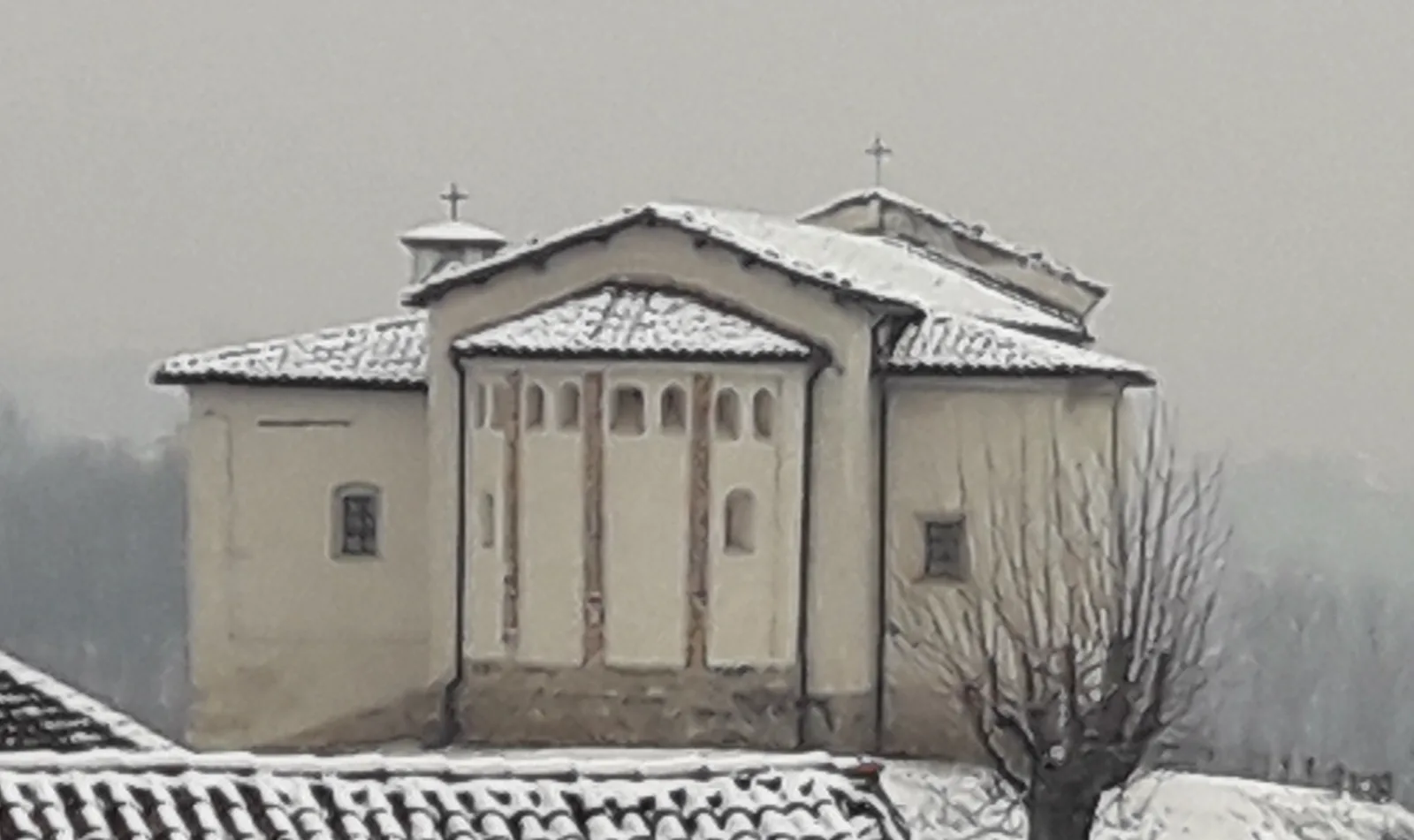
A closer look
Pieve di Santo Stefano e Santa Libera: at a glance
The pieve di Santo Stefano e Santa Libera is a sacred Romanesque building[1] dating back to the 11th century that rises at the south end of the village Rocca d'Arazzo, in Piemonte, on the underlying valley of Tanaro to Asti.
Architecture
The Roman TowerExplore this chapter
The ancient church of St. Stephen on a Latin cross has an apse as opposed to those of the other churches of Astigiano. It is divided by three terracotta lexenes, in four fields. A series of windows, two for each field, with arc at the center and with opening to squirrel, runs immediately under the line of gronda. The more you open other windows, a little wider than the previous ones.
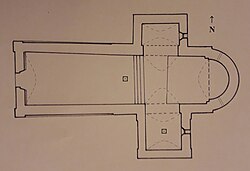
Plant: rectangular room with two chapels adjacent to the sides of the presbytery that make the appearance of a Latin cross, rectangular choir and semicircular apse take on the plant. Faces and soles: a brick barrel in sheet on the classroom, chapels and choir; cruise on the presbytery and semycin on the apse. Covers: hut roof on the hall and pavilion on the two chapels (wooden structure), a semi-conic layer on the apse; cloaked. Wall techniques: plastered masonry in the courtroom with stuccostone in the lower part; brick masonry, with some stone element, covered with scialbo in the apse.Payments: Mattonelle in terracotta. External decorations: apse crown forks. Interior decorations: I fresco in the semicatino (XIII and XV century), stuccoes in the chapel on the north side, frame of tax of the time. Arrest: wooden altar with pebble, some canvases, golden wood candlesticks, wooden benches ex-voice. Underground structures: two locals used as oxen.
The Roman Tower
Pre-existences of Roman age have been hypothesized on the basis of materials found. One of these is the fragment of a stone (probably a Roman funerary cyprus) which is located on the outer wall of the south transept removed from the steps before the altar, during the works performed in the 1960s. On the tombstone is written “SIBI ET LAEVAE PAULENAE UXORI”. The stone as other materials used in the construction of the church is almost certainly from remains of Roman settlements around the Fulvia street that medieval masons used to dismantle to get stones and bricks. Given the high position of the hill, it is possible that in the previous era the building of the church, a roman sighting tower was preexisted.
History
The diploma of Henry III · The laceretto · The Crusader and the hermitExplore this chapter
The diploma of Henry III
A diploma of 26 January 1041 issued by the Franks King Henry III of Germany confirms to the Bishop of Asti, among other ecclesial assets, the castle of Rocca d’Arazzo “cum hairs et silvis”. Since it seems to be excluded the presence of a large residential settlement, the existence of several cult buildings could make think of different small communities scattered and operating in the territory under the shadow of the castle, whose edification is attributed to the Bishop of Asti. One of the chapels is that of Santo Stefano which rises in a small village outside the walls of the fortress and is surrounded by thick selves.
The laceretto
In the 600 appeared in Europe the plague, a scourge brought in Italy by the Lanzichenecchi that overwhelmed Lombardy and Milan between 1628 and 1630. Rocca did not escape the contagion. Many inhabitants of the village fell ill. Around S. Stefano was then set up a lazarus, a hospital that is more than hopeful than care. Given the poor medical knowledge of time, in fact, most of the sick probably did not survive pestilence. This is evidenced by the fact that the soil around the church was used as a cemetery; so much so that, in 1669, after works of remaking the floor, a considerable amount of human remains are revealed, which are arranged, together with other bones scattered around the building, in the adjacent cemetery. In 1686, another church, now missing, named after St. Roch as a voice of thanksgiving, was etched in memory.
The Crusader and the hermit
An ancient legend wants the son of a noble family named Defendente dei Penna, before leaving crusader to fight in Palestine, to vote, if he had ever returned safely from the Holy Land, to build a church and spend the rest of his life in hermitage. The prayer was heard and Defendant kept the word by erecting, on the remains of a pre-existing temple, a chapel, whose circular apse with twelve windows reminded the twelve apostles, remembered in the popular imagination, an ancient construction where one went to heal with the water of a source. The story also wants the hermit in that apse to be buried and his tomb concealed an underground passage linking him to the castle of the Rocca. In the church in front of the steps that go up to the altar, on the arrival of the last step of the presbytery, there are three rectangular bricks of large size with the bevelled edges, there is access, walled, to an underground environment or a burial. Between 1962 and 1965 the so-called home of the hermit was demolished, a small building on the south side of the church that served as a house for the friar who occupied the religious building and the annexed cemetery. The casupola was already described as “cadent” by the report of a pastoral visit of 1837.
Saint Cloud edict
In 1804, the Saint Cloud edict, promulgated by Napoleon Bonaparte, obliges the inhabited centers to deceive a place on the edge of the town for sanitary and health needs. Since the prohibition of using the cemetery inside the village, since 1805 the rocchesi have been re-established that of Santo Stefano, preexisting for centuries. But, both because too close to the buildings, and because the nature of the soil made it difficult to dig the pits, in 1819 it was discharged in favor of the present one.
The vineyard
The hermits that happen over time have taken care of the campestre chapel. The friars were in fact entrusted with maintenance work, as well as the transport of the victories, the hay, the harvested in the hermitage. They also kept the church, repaired and provided for the necessary supplies in part with the help of the community and partly with alms, having no income except a vineyard around.
Year 2014: restoration
“The paintings, executed with the technique of good freshness, pour in disastrous conditions both in support and color...” This is what is revealed in 1997 as a result of an outbreak of cultural heritage. The damage to the frescoes is visible. The plaster lesions are particularly extensive with the risk that large portions of the paintings fall and go irremediably lost. There are also branched cracks in correspondence of the apse due to a settling of the soil. They are not recent injuries: already from the 15th century. hammers are produced, for the execution and over placing of new paintings. In addition, over time we produce coarse maintenance stuccoes with cement and chalk that have further abraded some parts. This is how the restoration works begin. The various phases of the intervention involve consolidation and cleaning operations, are also removed all plaster stuccoing and cement mortar that can compromise the structure, as well as the artistic beauty of the paintings.
After years of abandonment, restoration works were carried out with ordinary maintenance and improvements: the entire forest that hid the church was destroyed; externally and internally it was restored and the stuccoing of the lower perimeter band was carried out. Inside were the tabernacle, the wooden statue of Saint Stephen, the candelabras, the squares of the Via Crucis, the ex-volution notebooks and all oil paintings on canvas.
Artworks
Saint Stephen · Santa Libera · Madonna and Child with St. Anthony of Padua and St. John the EvangelistExplore this chapter
Saint Stephen
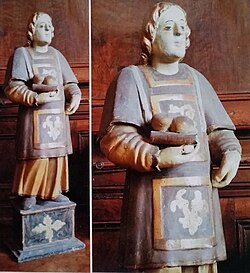
Inside the Church it is possible to observe a sculpture in round shape, depicting Saint Stephen in diaconal dress that holds with his right arm the stones of martyrdom. The work is ascribed at the end of the 17th century. The artifact was made of solid wood, then ingested and decorated by means of tempering and fine metal foil.
Santa Libera
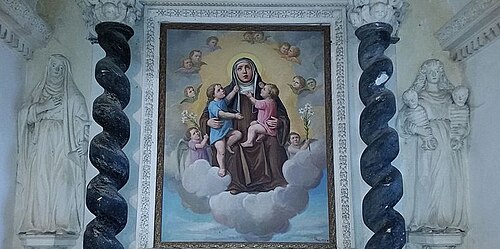
The legend of Santa Libera is rooted in the pre-Christian rites linked to the Mother Goddess, where water was considered sacred and taumaturgical. On the hill where now stands the church of Santo Stefano, once a spring was poured out surrounded by a forest. A woman, to whom the leprosy had shaken her hands leaving only two monks, went with the two sons in the thick wild that covered the slopes of the mountain. When they arrived near the source, the children slipped into the water risking drowning. It was then that the woman heard a voice to tell her to sink into the water the limbs which became strong and healthy hands, with whom she grabbed the little ones and kept them safe. With the advent of Christian religion, miraculous healing handed down from generation to generation turned into popular faith. Libera was so much venerated since the Middle Ages and turned to her to be freed from skin diseases. This is how we reach the present day when we still call it especially for the milk crust.
Devotion to Libera as a holy Christian, was probably born during the plagues of the Middle Ages. In the iconography it is represented with two children in the arms as it is possible to observe in the depictions on canvas and stucco contained in the chapel. Until a few years ago, before the restorations that necessarily interrupted the peace of the place, the church was a place of prayer and pilgrimage of mothers who invoked the grace for their sick children, especially if they suffered from milk crust. The rite consisted of taking the road to the church on his knees; reciting the Rosary three rounds were carried out around the building and at each turn knocked at the door. This was repeated for nine days below; every day a pebble was laid on the window of the chapel of Santa Libera. On the ninth day, through the same window, the headphone of the newborn was thrown inside.
Madonna and Child with St. Anthony of Padua and St. John the Evangelist
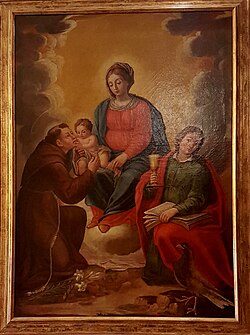
On the left side of the long and narrow main hall, a painting depicting Our Lady with the Child, St. Anthony of Padua and St. John Evangelist is visible, recognizable by the iconographic elements attributed to them. The painting was restored in 2015.
The Martyrdom of Santo Stefano
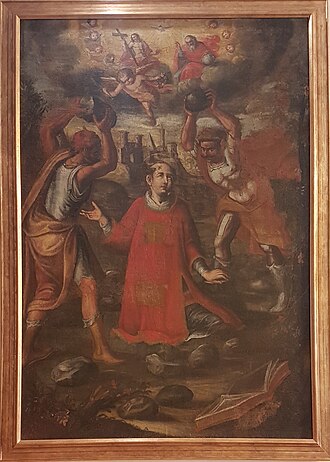
On the right side of the main hall is visible a picture with Saint Stephen placed at the center of depiction with the sides two sharps and on top Jesus Christ and God the Father surrounded by the heavenly choir. It is Represented young with deacon dresses; its visible attributes, are the stones with which it is stoned, the palm of martyrdom and the book.
Madonna and Child, Saint John the Baptist and St Helen
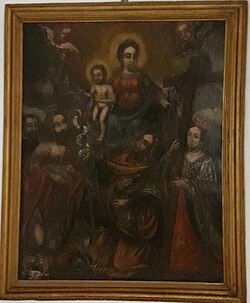
In the right chapel you can admire the painting depicts Our Lady with Child placed in a central position, at their feet four saints, from left: the first of difficult recognizability, the second probably St. John the Baptist, the third one saint with sword and palm, therefore a martyr, but also of difficult recognisability and the last would make to think of Saint Helena for the iconographic elements that belonged to her. On the lower left is also visible a coat of arms, also not easy to recognize. St. John the Baptist is represented as hermit, dressed in skins. His attributes are the lamb, for the phrase pronounced when he saw Jesus" here is the lamb of God", and a cross with often a cartilage (as in this painting where they were written in Latin “Ecce Agnus Dei”).
The tabernacle
The tabernacle, dating back to the 17th century, is a wood-made artifact, assembling multiple boards by means of inks, pins and animal glue, then swallowed and decorated by means of tempering and fine metal foil. Symmetric, inspired by the architectural repertoire, with a hedgehog niche, containing a high relief glass between columns, friezes, volutes and lateral frames all culminating in a broken timpane. The tabernacle rests on a base and two side steps carved with floral turns.
The frescoes
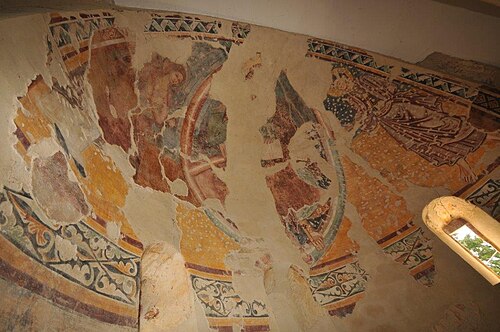
In the 12th century. in the neighboring Azzano prospera the monastery of S. Bartolomeo, a monastic community that has expanded especially towards the eastern part of the city. At the beginning of the 13th century. St. Bartholomew is a rich monastery, as evidenced by a papal bubble of Innocent IV (1247), from which it emerges that the abbey has churches and parish houses, and incameras the tithes relevant to them. Probably, therefore, all the churches and chapels around Azzano were possession of the monastery, including S. Stefano. But alongside the territorial expansion, St. Bartholomew also cares for his spiritual development: the evangelical work is available in those times through images, which recall the faithful at the highest moments of Jesus’ life and the saints. It is clear to suppose, therefore, that the frescoes present in the apse of the church have been specially commissioned by the abbot of the monastery. On the other hand, a stylistic reading of the same directs the dating back to the beginning of the thirteenth century, when in an act of 1237 there is a Guillelmus, cleric of the church of S. Stefano della Rocca (the painter?) The client and author remain anonymous, but the excellent work, the artistic beauty of paintings, are still the most evocative and admired heritage of the parish.
The fresco in the apse cap of the church of Santo Stefano representing “Christ in Glory between Mary and Saint John Evangelist”, which testifies to the passage from Romanesque to Gothic. The storm that on a summer day of 1966 fell on the Astisan, led to the discovery of ancient mural paintings. The folates of impetuous wind, penetrated by the apse monophs, have dropped a layer of plaster of considerable thickness, covering the cap, in part perhaps already detached after the movements of the ground. They are thus reappeared by the oblivion of the fifteenth century frescoes, together with other Romanesques attributed to the thirteenth century.
In the apse two monophs give light to traces of a fresco, adorned by a ribbon frieze, depicting the Christ Pantocrator in almond (fragment of the left foot, with elegantly knotted sandalwood tie). On his left, Mary from the veiled head is dated to the middle of the fifteenth century; on the right side of the almond appears St. John the Evangelist who holds with his hand the closed book of his Gospel (the better preserved figure), wrapped in purple pals with purpure shadings. The slight inclination of the face of the Evangelist with very pure traits, curved in indicating the eyes and the foliage communicates the idea of a meditative and assorted youth. Here, from a hellenistic age loan it seems to derive, in particular, the impression of delicacy that adheres to the foot module. The harmonious balance of the various parts, which seeks an ideal beauty of forms, has very close answers with the miniatures of the so-called Ala group, where colors are equally intense and velvety; while the flexibly trend is already a characteristic of the oldest miniatures of Tours. What feeling of the sacred represents the “Holy Youth” of Rocca d’Arazzo? Not the religion of the distant Byzantium, lost behind the desire of intangible gold, nor the ruinous, powerful and plastic of Romanesque, but a more confidant, interiorized religiosity, which does not fear to compromise in welcoming Hellenistic ways of viewing the body. What is stirred inside, a sign of the new contradiction of the Gothic, finds way to get out in the thinning of the person, in the frantual movement of garments, in an elevation of his fragility upwards.
Notes
Explore this chapter
- ^ Points of Interest, up www.astigov.it. Retrieved 29 January 2024.
Bibliography
Explore this chapter
- G. Riccardi, Rocca d'Arazzo through the centuries - Historical dinners on Rocca d'Arazzo, Turin, Salesian typographical school, 1925
- Domenico Testa[1], Between the high and the low Monferrato - Medieval historical events, Asti, Tipografia Astese di Bona and Dellarovere, 1971.
- Vanni Cornero, Rocca d'Arazzo history traditions legends, Canove di Govone, Edizioni G. Pelazza, 1994.
- Province of Asti, The Romanesque churches of the Astigian countryside, Turin, 1998, ISBN 88-88491-00-7.
- Milena Audenino, Storie di Rocca, Asti, B.d.T. Editrice, 2006.
- Comune di Rocca d'Arazzo, Rocca d'Arazzo tells 150 years of its history, Asti, Team Service Editore, 2013.
Continue your journey