Atlas of Monferrato
Pomaro Monferrato: sights, history and trails
Alessandria
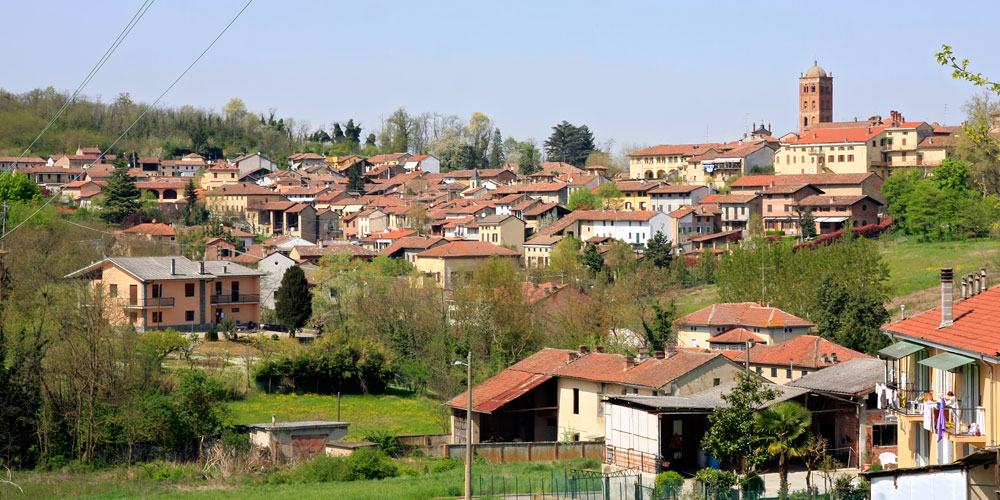
- Elevation
- 142 m above sea level
- Area
- 13.44 km²
- Demonym
- Pomaresi
A closer look
Discovering Pomaro Monferrato
Pomaro Monferrato (Poma in Piedmont /pəmɑ/) is an Italian municipality of 332 inhabitants[1] from the province of Alessandria in the Piemonte.
Landscape and area
Pomaro Monferrato is a small medieval village located in Monferrato Casalese. It develops on a plot of 1347 hectares at the altitude of 142 meters on the average level...Explore this chapter
Pomaro Monferrato is a small medieval village located in Monferrato Casalese. It develops on a plot of 1347 hectares at the altitude of 142 meters above sea level. The village, which rises on a hill close to the imposing castle, is bordered by the right bank of the Grana stream. Its geographical position borders the border between the plain of Lomellina and the hilly territory of Monferrato.
History of Pomaro Monferrato
SymbolsExplore this chapter
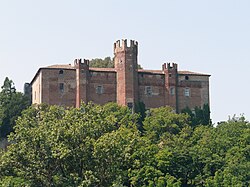
The name comes from the Latin common one pomarium ('pometo') and in fact in Italy there are various places that carry it; we therefore have Pomaro Piacentino, Pomaro nel Monferrato, Pomaro di Monte Acuto.[4] Already existing as a Roman camp, he first appeared in an edict of Federico Barbarossa in 1156. The story of Pomaro Monferrato is closely linked to the history of his castle. The date on which the first stones of the manor were laid is not known for certain but, the local historian Giacinto Saletta in the Duchy of Monferrato of 1711, attributes to Aleramics its construction in the 12th century. At that time the castle was erected at the highest point of the hill and turned to a north, moreover the first houses constituted the village were collected within a "receptum" consisting of a mural. The work of cinta was built on the top of the hill for defensive purposes, witnessing the tower of stake and part of the ditch at the entrance of the castle. The ancient guard tower, part of the original walls, and a short stretch of the ditch at the entrance of the castle, are still visible near the central square of the village. The strategic position occupied by the village of Pomaro, placed on a height at the borders of the marquisate of Monferrato, has made it always to the center of continuous tensions and clashes for the control of the territory. As Francesco Cognasso in Il Piemonte testifies in the Sveva age, in the 13th century Pomaro was a commodity of exchange between the Marquis Monferrini and Pavia.
In the 15th century, the country under the power of the Paleologists was involved in the war between the latter and the Visconti, and was invaded and plundered by Francesco Sforza. The Paleologists transformed, as B reports. Sangiorgio in the Cronica del Monferrato of 1636, the village, the castle and the park, in one of the most beautiful and comfortable residences available to the Marquisi del Monferrato. In the 17th century, during the continuous conflicts between Spanish and French Pomaro, in 1536, became the property of the Gonzaga.
In October 1637 the Spanish army, under the command of the Marquis of Leganés, arrived near the castle and dismantled much of the external fortifications. But before entering the village he was retired from the arrival of the Duke of Créquy. In September of the following year, Leganés retained the company, this time he was victorious, but only after having undermined the castle and the remaining fortifications. The damage was caused, as reported by a manuscript of 1697 (the historical archive of Pomaro), of the manor, after the clash, remained only a local to the north. In 1685 the castle and the fief of Pomaro became property of the Ardizzone, who immediately put themselves to work for, recover the remains of the building remained intact after the attack, and rebuild the destroyed parts, in order to transform the defensive bastion building to aristocratic residence. The last direct heir of the Ardizzone died in 1734 so in 1745, through a chamber sentence, the fief was ceded to Giuseppe Dalla Valle Ardizzoni.
In 1842 he became lord of Pomaro Giuseppe Rolando Dalla Valle, mayor of Casale Monferrato in 1841. The work, the attentions, the embellishments of the latter towards the country, the population, the castle and the garden are worthy of mention. In fact, in these years the country is devastated by a terrible cholera epidemic and the decimated population manages to recover thanks to the help of Marquis Dalla Valle, who became Senator of the Kingdom of Sardinia on April 3, 1848 (from a testimony of Dr. A. Giorcelli from On the cholerosa epidemic of Pomaro Monferrato in 1867). On his death the property of Pomaro passed to his sons Louis and Alexander. The latter married Paola, born by Barons Guidobono Cavalchino Roero Sanseverino, the court lady of Queen Elena. Alexander took care of the castle and garden, but it was above all the Marchesa Paola who gave a significant impetus to the country's embellishment. In addition, the restoration works of the architect Vittorio Tornelli were carried out in 1929, which intervened by removing the outer plasters of the castle and curating the adjacent park.
On October 6, 1935 the asylum was inaugurated, always built thanks to the interest of the Marchesa Paola Dalla Valle. In 1935 she was a guest of the Marquis, Queen Elena, who impressed by the beauty of the castle park, wanted to proclaim it “the most beautiful garden in Europe”. Alexander and Paola Dalla Valle had no children and on their death was designated as heir of the castle Count Carlo Calvi in 1950. On November 2, 1950, the Ministry of Education, under Article 71 of Law 1089 of 1939, puts under the protection of the state the estate and castle of Pomaro, believing them of considerable historical and artistic interest. In 1924 Count Calvi married Jolanda of Savoy, he linked the story of Pomaro to that of the Royal House. The last heir Pier Francesco married actress Marisa Allasio in 1958, with whom he lived permanently in Pomaro at the castle until the 1970s. Since 1982 the castle and its park are privately owned.
Symbols
The coat of arms and gonfalone of the municipality of Pomaro Monferrato were granted by decree of the President of the Republic of 22 June 2012.[5]
The gonfalone is a yellow drape with blue edge.
What to see in Pomaro Monferrato
Explore this chapter
- The castle Calvi di Bergolo, already Della Valle, rebuilt between 1650 and 1700, privately owned
- The Palace of the Guard Corps (XIII-XIV century)
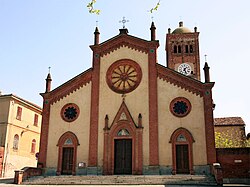
- The Romanesque-Gothic church of Santa Sabina with terracotta decorations on the facade
- The Zuncheiia, a fountain of Napoleonic times that is located in the countryside around the village, near the cemetery
Society
Demographic evolutionExplore this chapter
Demographic evolution
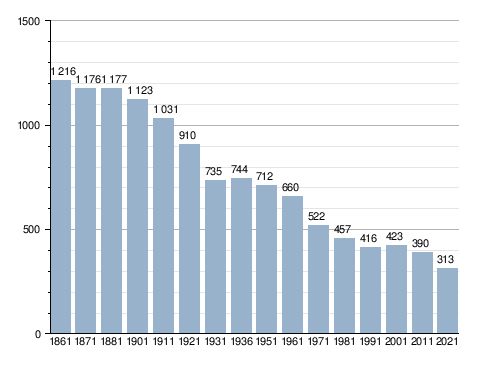
In the last hundred years, the municipality has undergone a strong decline in population, equal to 61% of the inhabitants censused in 1921.
Inhabitants registered[6]
Administration
Below is a table relating to the administrations that have succeeded one another in this municipality.Explore this chapter
Below is a table relating to the administrations that have succeeded one another in this municipality.
| Period | First citizen | Match | Load | Notes | |
|---|---|---|---|---|---|
| June 20, 1985 | May 22, 1990 | Carlo Quarter | Christian Democracy | Mayor | [7] |
| May 22, 1990 | April 24, 1995 | Carlo Quarter | civic list | Mayor | [7] |
| April 24, 1995 | June 14, 1999 | Carlo Quarter | center | Mayor | [7] |
| June 14, 1999 | March 28, 2001 | Carlo Quarter | civic list | Mayor | [7] |
| May 28, 2002 | May 29, 2007 | Giovanni Baldi | civic list | Mayor | [7] |
| May 28, 2007 | 7 May 2012 | Mirco Amisano | civic list | Mayor | [7] |
| 7 May 2012 | June 11, 2017 | Mirco Amisano | List of people Campanile | Mayor | [7] |
| June 11, 2017 | June 12, 2022 | Mirco Amisano | Civic list Torre bellria | Mayor | [7] |
| June 12, 2022 | in office | Fausto Capra | list of Campanile and Spighe | Mayor | [7] |
Image gallery
Explore this chapter
-
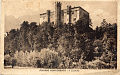 The Castle of Pomaro Monferrato - historical archive
-
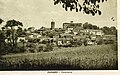 The Country - historical archive
-
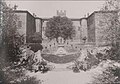 The courtyard of the Castle of Pomaro Monferrato with in the center visible the two bagolars of Pomaro Monferrato
Notes
Explore this chapter
- ^ to b Monthly demographic balance for the year 2026 (provisional data), up demo.istat.it, ISTAT.
- ^ Seismic classification (XLS), up risks.protezionecivile.gov.it.
- ^ Table of degrees/day of Italian Municipalities grouped by Region and Province (PDF), in Law 26 August 1993, n. 412, annex A, National Agency for New Technologies, Energy and Sustainable Economic Development, 1 March 2011, p. 151. URL consulted on 25 April 2012 (archived fromoriginal url on 1 January 2017).
- ^ William Peirce, The prehistoric origins of Italian homicide. P. 322. Naples, 2001.
- ^ Pomaro Monferrato (Alessandria) D.P.R. 22.06.2012 concession of coat of arms and gonfalone, up Presidency.governo.it. Retrieved 31 October 2021.
- ^ Data taken from:
- Resident population of the municipalities. Censuses from 1861 to 1991 (PDF), up ebiblio.istat.it, ISTAT.
- Resident population - Time series, up exploredati.istat.it.
Please note: 2021 data refers to permanent census data as of December 31 of that year.
- ^ to b c d And f g h the http://amministratori.interno.it/
Bibliography
Explore this chapter
- Quick Guide of Italy, 1 2012, Touring Editore, Assago.
Where to stay · Pomaro Monferrato
Find stays on Booking.comThe area, step by step
Trails and routes in Pomaro Monferrato
 CyclingAround the starting point
Asti, Alessandria and surroundings