A closer look
Castle of Gabiano: at a glance
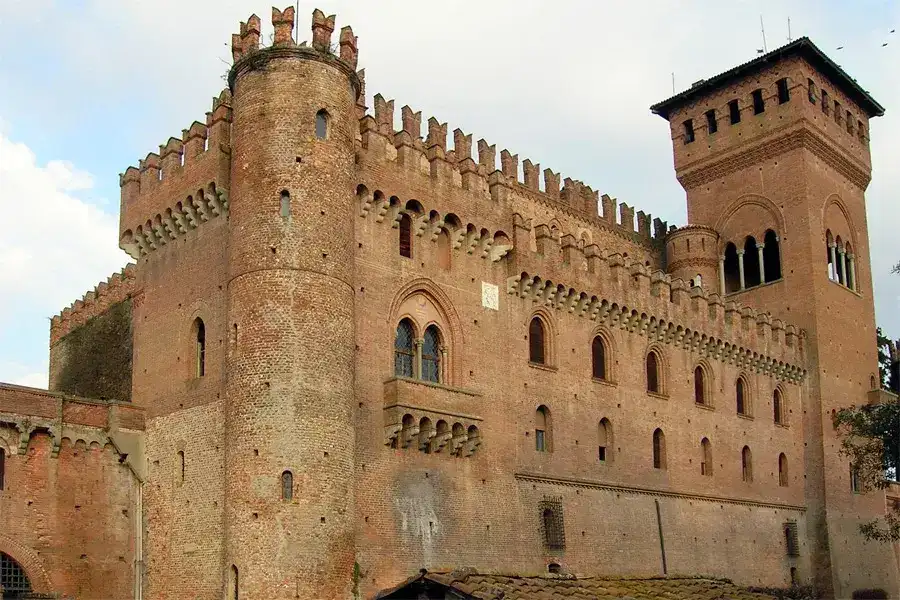
The castle of Gabiano is positioned in a dominant manner on the Po valley, in the city of Gabiano, in province of Alessandria.
cited by sources already in the eighth century as cortem magnam nomine Gabianam, was donated in 1164 by Federico Barbarossa to the Marquis Guglielmo II of Monferrato and, disputed over the centuries by various families, was finally ceded in 1622, together with the title of Marquis of Gabiano, by Duke Ferdinando Gonzaga[1] to the Genoese noble Agostino Durazzo on balance of debts contracted by the court of Mantua with his family.
The restoration
After a nineteenth-century restoration, which erases the original appearance of turquoise fortification, starting from 1907 the castle is subject to careful restoration...Explore this chapter
After a nineteenth-century restoration, which erases the original appearance of turquoise fortification, starting from 1907 the castle is subject of careful restoration intervention commissioned by the owners, Giacomo Durazzo Pallavicini and Matilde Giustiniani, to the architect Lamberto Cusani (Parma 1877-1966) that works a philologic reconstruction of the castle and the medieval village with its agricultural buildings and wineries, translating with great skill the teachings of Alfredo d'Andrade, creator of the famous castle and medieval village in the park of Valentino, built on occasion of the Italian General Exhibition of 1884.
Remaining in the Turin model, they are found in the vestibule, in the chapel, in the medieval dining room and in the brand room, whose furnishings are made, on a model of the bedroom of the Bonoris Castle of Montichiari in Brescia, by the brothers Arboletti, known Turin carvings, already active in the medieval village.
For the decorations of the Cusani castle, he calls from Parma the sculptors Dossena and Rossi and the painters Tito Peretti and Latin Barilli. The latter painted, between 1929 and 1930, the chapel, the playroom, the weapons room and the riding room where the patrons, Matilde and Giacomo Durazzo are portrayed in medieval dresses.
The restoration of the castle, begun in 1908 by the Marquis Giacomo Durazzo Pallavicini and carried out in 1935 by the marquis Matilde Durazzo Pallavicini of the Giustiniani principles, remains an interesting example of medieval reinterpretation in an eclectic key, still preserved both in the interior furnishings in style and in the surrounding park, of great landscape value.
Today the work continues with his nephew Giacomo Cattaneo Adorno, who, together with Emanuela and her children Filippo and Serena, conducted a careful renovation of the environment, combining current knowledge of oenology with respect for tradition.
The wine production of the castle of Gabiano
Already awarded with gold medal at the 1937 Universal Exhibition in Paris, the Gabiano DOC is present today with a renewed quality structure where tradition...Explore this chapter
Already awarded with gold medal at the 1937 Universal Exhibition in Paris, Gabiano DOC is present today with a renewed quality structure where the rich tradition of new Piedmontese technology, aligns the barber to the noblest Piedmontese red wines. Gabiano wine is one of the oldest and smallest DOC in Italy.
The Marquis Adorno are engaged in intense quality wine production with a company that extends over the territory of Gabiano for 260 hectares of which 20 are destined to vineyard: wine production favours low yields and bottling takes place only in large vintages to ensure the best quality of wines.
The vineyards are grown at the ideal height of 300 m, on the hills well exposed in the municipalities of Gabiano And Moncestino, in the province of Alessandria. The type of cultivation is called "low guyot", with rows that curve around the hill, following the level curves of the hill. The new vineyards that extend around the castle, forming an evocative amphitheater, are cultivated using rittocchino methods. The cultivation of the vine still requires many manual interventions to obtain the best quality of the grapes, with full respect for the environment and the consumer.
In the ancient cellars under the castle, the variegated winemaking processes start: already at the disgrace, the products obtained are “assembled” according to the tradition of the house, constituting the bases for the wines Gabiano, Rubino, Barbera and Grignolino, which are then aged and aged, both in small barrels and in large barriques.
The maze
The maze of the castle Gabiano is one of the rare examples documented in the historical gardens of Piemonte . Its importance is due not only to the...Explore this chapter
The maze of the castle Gabiano is one of the rare examples documented in the historical gardens of Piemonte. Its importance is due not only to its rarity, but also to the historical period in which it was realized or the 1930s, period in which the now established landscape taste was integrated with formal gardens located in the immediate vicinity of the residence, but never with the forms of a labyrinth.
The labyrinth of Gabiano evokes the return to the past and is located within the framework of the restoration project entrusted by the marquis Matilde Giustiniani to the Parmesan architect Lamberto Cusani. The location of the labyrinth in the heart of the park emphasizes the contrast between the rigid and geometric lines of the plant and the natural park surrounding it, recalling the medieval concept of wild as a natural maze (park) and maze as an artificial wild where nature is strictly manipulated and controlled by man.
Notes
Explore this chapter
- ^ Andrea Carpi, 35 unmissable villages along the Po, Turin, 2018.
Bibliography
Explore this chapter
- P. Torriti, Galleria del Palazzo Durazzo Pallavicini in Genoa, Genoa 1967
- G. Hair, The architects of the first 20th century in Parma, Parma 1975
- F. Accounts, G.M. Tabarelli, Castles Piemonte Tomo II: Alessandria and Asti, Novara 1978
- M.P. Marzocchi, G. Fish, V. Vandelli, Liberty in Emilia, Modena 1988
- L. Calvo (edited by), Statutes of the Municipality of Gabiano Monf., Gabiano Monferrato 1989
- B. Shut up, M. Iotti, The years of Liberty in Parma architecture from 1900 to 1925, Parma 1993
- Archivi Pallavicini di Genova, Atti della Società Ligure di Storia Patria, Vol. XXXIV (CVIII), fasc. I, Genoa 1994
- Palazzo Durazzo Pallavicini, Milan 1995
- A. Petrucciani, D. Puncuh, Giacomo Filippo Durazzo (1729 – 1812) The bibliophile and its “cabinet de livres”, Genoa 1996
- General Exhibition Italian Turin 1884. Official catalogue of the Art History Section. Illustrated Guide to the Feudal Castle of the Century XV, anastatic reprint, Turin, 1997
- Or. Raggio, History of a passion. Aristocratic culture and collecting at the end of ancien régime, Venice 2000
- M. Hundreds, Unusual guide to mysteries, secrets, legends and curiosities of castles Piemonte, Rome 2001
- V. Comoli (curated by), Monferrato a landscape of castles, Alessandria 2004
- M.P. Ruffino, An echo of the neo-Gothic synthesis of the Medieval Village of Turin: the furniture of the brothers Arboletti, in A. Bani, P. Boifava, S. Lusardi (eds.), Gaetano Bonoris (1861 - 1923) and the castle of Montichiari. Neo-Gothic architecture between Lombardy and Piemonte, Acts of Study Days, Montichiari 26 and 27 March 2004, Brescia 2006
- D. Romagnoli, B. Shut up. Middle Ages and restoration in the work of Lamberto Cusani, architect and restorer Parmesan, in M. G. Muzzarelli (ed.), Neomedievalisms. Recovers, summons, inventions in the cities of Emilia Romagna, Bologna 2007
- S. Barision, Castle of Gabiano, Genoa 2009
Continue your journey