A closer look
Castle of Tortona: at a glance
The Castle of Tortona was a castle that stood on the Savo hill, the most important of the seven on which, according to tradition, the city of Tortona was founded. The name refers to several defensive constructions that took place on the same site over two millennia. Between the 8th and 5th century BC. archaeological investigations are the foundation of a castle by the Ligurians.
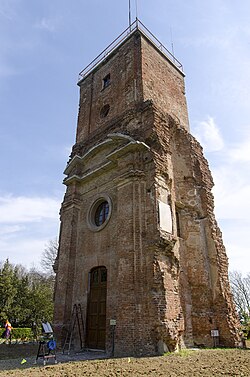
Today there are few vestiges of different eras, scattered in the park that since the beginning of the twentieth century occupies the wide outline, among which the tower became one of the symbols of the city. The tower was part of the mighty Savoy fortress of San Vittorio, an 18th-century work by military architect Lorenzo Bernardino Pinto and last incarnation of the castle, demolished by decision of Napoleon Bonaparte in the spring of 1801.[2]
History
Between the 8th and 5th century BC. the Ligurians founded a fortified village (christs) on the hill overlooking the plain, then swampy and unhealthy. With colonization...Explore this chapter
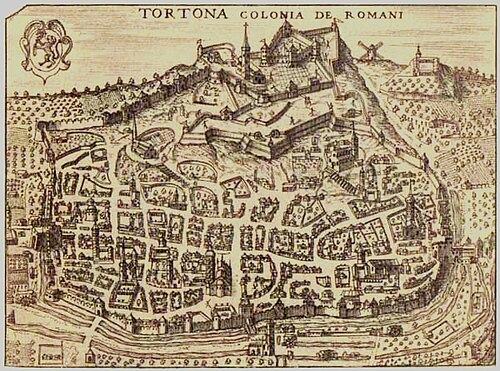
Between the 8th and 5th century BC. the Ligurians founded a fortified village (castelliere) on the hill overlooking the plain, then swampy and unhealthy. With the colonization by the Romans (around 123 BC) the castle was transformed into a castrum while the nucleus of the city developed at the foot of the hill, on the reclaimed plain.
After the fall of the Roman Empire of the West, the continuous barbaric incursions, the city retreated around the castrum, and the High-Medieval Tortona stretched mainly on the slopes of the hill.
After the siege of Barbarossa (1155) and destruction by the troops of Pavia (1165), the city was rebuilt with the help of Milan. The reconstruction brought to the foot of the hill the center of commerce and city life, on what was the ancient Roman Derthona, while on the hill remained, beyond the castle, the cathedral and other religious and governmental buildings.[1].
With the annexation of the city to the Duchy of Milan (1347), the Visconti strengthened the city walls and the castle that, however, could not cope with the advent of modern firearms and already in 1499 had to surrender to the troops of Charles VIII of France.
In 1535 Tortona passed, with the Duchy of Milan, under Spanish rule and became a fundamental for the defense of communications between Spain and Milan. According to the new situation, the Spaniards carried out great fortification works, building a new wall around the city in exchange for those viscontea and sforzesca now obsolete, and transforming "to modern" the castle by widening its size.
The new fortress was divided into two parts: strong high (maximum) and strong low; the extension involved the demolition of many buildings dating back to before the 1000, like the Bishop's Palace (which boasted flattering descriptions in the chronicles of the pilgrims of the time) while the cathedral (antique and remembered as one of the most admirable in northern Italy) was closed to worship and incorporated into new fortifications; this survived however until the 1609When a lightning struck the bell tower (used as a powdery) causing its explosion; the collapse that destroyed the church below, the church of San Giovanni in Piscina and the ancient baptistery. A new twofold siege immediately in 1642/43 by the Franco-Pymousian troops persuaded the Spanish, between 1650 and the 1680, to increase the city defenses: the walls of the town was reinforced and extended, while the fort was the object of modernization.
In 1706 the Austrians ended the Spanish rule; later the city was again victim of two devastating sieges which, in 1734 and 1745, caused huge damage and brought to light all the defects and weaknesses of the fortress. For this reason Vittorio Amedeo III of Savoy (Tortona had passed to the Kingdom of Sardinia following the Treaty of Vienna in 1738, condition confirmed by the Treaty of Aquisgrana in 1748) decided to reconstruct former novo the fort entrusting the project to the military engineer Lorenzo Bernardino Pinto, who made its masterpiece.[3]
The Fort S. Vittorio Vittorio
Lorenzo Bernardino Pinto engineer of the genius, succeeded in the role of first military architect to his master Antonio Bertola , began the work of modernization of the fort...Explore this chapter
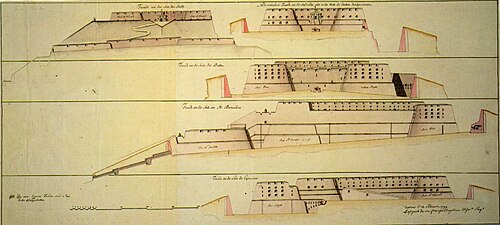
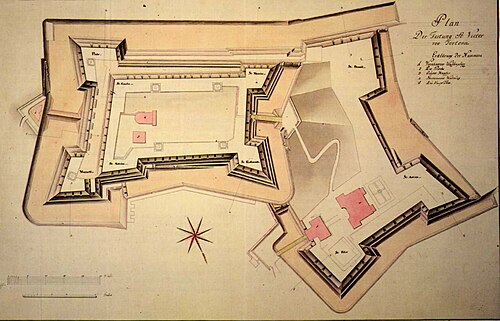
Lorenzo Bernardino Pinto[4] Engineer of the genius, succeeded in the role of first military architect to his master Antonio Bertola, began the work of modernization of the fort in 1773 recovering the experiments carried out in the yards of the Forte della Brunetta, of the Fort of Fenestrelle, of Citadel of Alessandria and the Fort of Exilles
Pinto had independently elaborated the concepts that Marc-René de Montalembert has developed in his Fortification perpendicular[5], and the fort «had the shape of an irregular rectangle measuring 150 and 200 meters from the outside, the curtains were entirely casemate and provided a safe shelter for the entire garrison: the bastions, with multi-storey vaults, were suitable to serve as warehouses, there was also under a part of the counterscarp a vast stable for the oxen to be slaughtered in times of siege [...] the Piedmontese engineer had not limited himself to protecting the garrison from bombs: he had wanted to protect it from every imaginable attack by giving the fort's shoes an extraordinary and perhaps unexampled height. The minimum elevation of the curtains from the bottom of the ditches was more than 30 metres, that of the bastions was 40 and at the salient of the bastion of S. Maurizio there was no less than 54 meters in height... the counterscarps were no less extraordinary; they were up to 24 meters high where the ditch was cut into the rock..."[6] Overall the appearance of the fortress was to be impressive: the 50-metre high curtains, the batteries entirely in the house, the elongated shape towards the city below made it look like a warship. more than to the coeve fortresses was more similar in the conception to the later strong ones of Bard in Valle d'Aosta and Begato in Genoa, sign that the ideas of Pinto prevailed the times. General Enrico Rocchi describes him in his Historical sources of military architecture as one of the best examples of defensive art of the time.[7]
The last siege
The Fort S. Vittorio, although still partly incomplete, endured in 1799 a hard siege that highlighted the extraordinary features, and that was the last of his...Explore this chapter
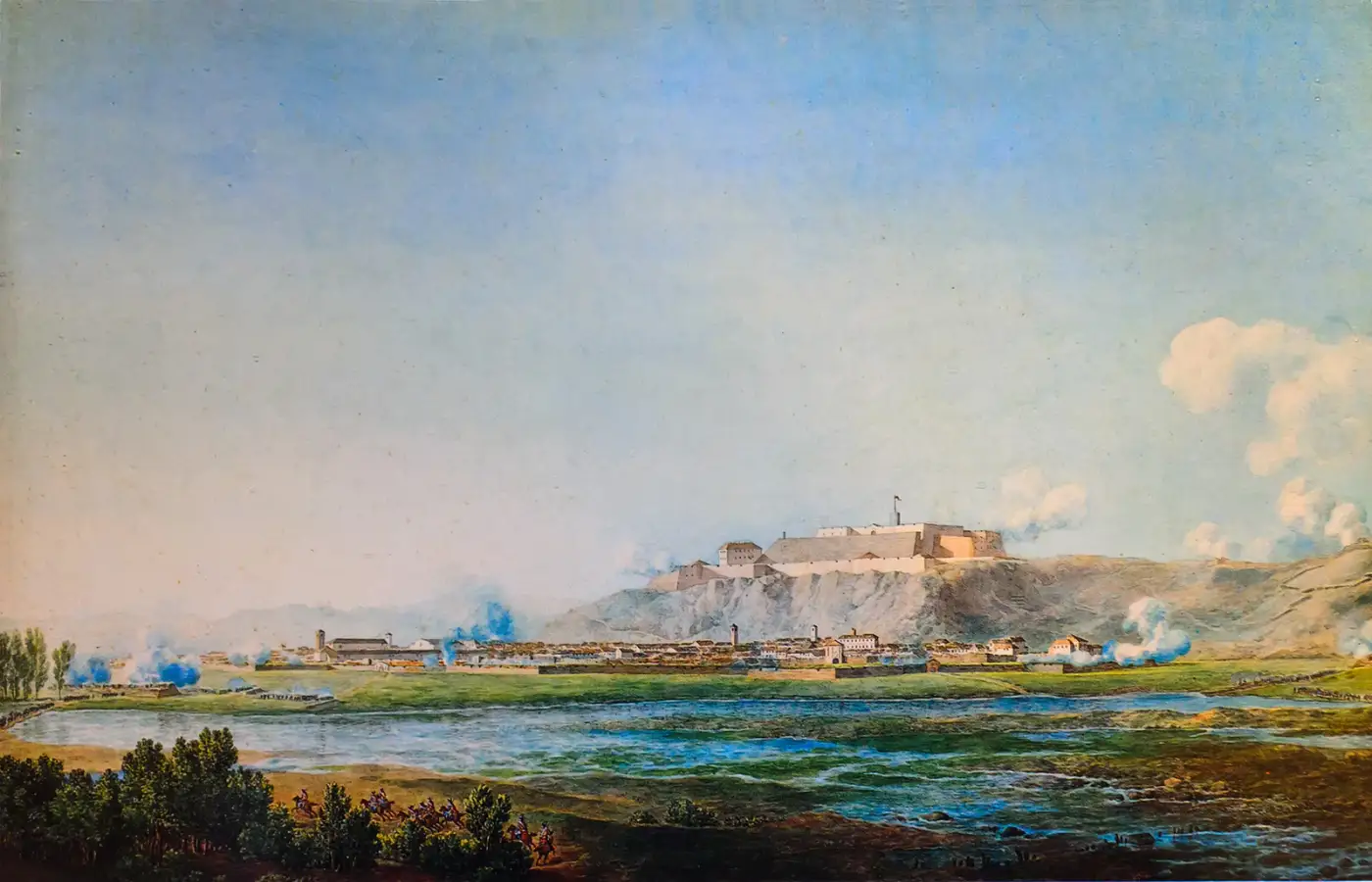
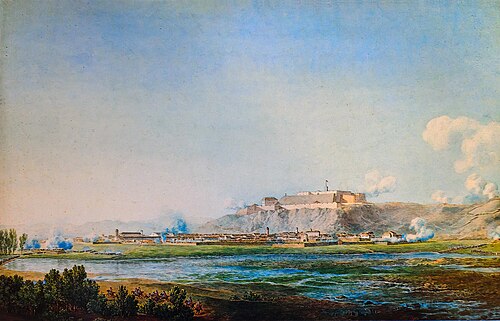
The Fort S. Vittorio, although still partly incomplete, endured in 1799 a hard siege that highlighted the extraordinary features, and that was the last of his long history.
During the summer campaign of war between Austro-Russian and French troops, the latter were stormed in the two main fortresses of the province, namely the great Citadel of Alessandria and the Fort of Tortona. Despite the garrison of Alessandria It was much more numerous than the one in the city, the Citadel capitulated in only two weeks because of its old conception (the first Vauban system) for which it was deprived of batteries at home. Different was the situation at Tortona: the city was easily taken, in May, by the Austro-Russian troops, but in the fort the brigade commander Gast had swept out food and ammunition for a year.
The Piedmontese engineers informed the Austrians that it would take at least five months to expel the fort, while General Philipp de Lopez was convinced he could do so in less than five weeks. It was wrong: protected by the barracks the strong cannons marred the siege troops incessantly, reaping many victims; the ground around the fortress was so hard that the trenches were built in elevation instead of excavated. The bombing of the besiegers caused only slight damage to the mighty structures of the fort and opening up the road with the mines was hardened by the solid sandstone of the hill on which it stood. The situation was blocked, but the defeat suffered by the French at the Battle of Novi had in fact completely isolated the turtle garrison. Assigned and besieged agreed that if by 11 September no aid had come to the aid of the fort the garrison would surrender with the honor of weapons.
On September 11, the Austrian troops took possession of the fort that had demonstrated all its value by resisting one of the most powerful armies of time.[8]
The demolition
After the battle of Marengo, the fort was first upgraded; then, following agreements between Napoleon and Russia's Zar, demolished...Explore this chapter
Back in possession of the French after battle of Marengo the fort was first upgraded; then, following agreements between Napoleon and Russia's Zar, demolished, through the use of mine, in April 1801. The demolition took a few days and caused damage to the buildings of the city located in the immediate vicinity of the slopes of Savo.
At the beginning of the 20th century, the area of the former fort was fought to become a residential area and public park as well as the city stadium named Fausto Coppi. During the settlement of the area many Roman finds were brought to light including the wall of the old castrum, today visible in via alle Fonti. The fortress remains few ruins including the entrance portal of the church of Blessed Amedeo IX of Savoy[2] (often described instead as a bell tower or tower, and became a symbol of the city) raised during the nineteenth century to house the optical telegraph. Damaged by German bombings during the last war, the portal underwent a first restoration in 1959 and another between 2013 and 2014 which allowed it to be reopened as a panoramic point.
Notes
Explore this chapter
- ^ to b Giuseppe Antonio Bottazzi, The antiquities of Tortona and its agro corresponding to the four orierni surroundrj cisapennini of the department of Genoa, Alessandria, S. Rossi, printer, 1808, OCLC 858229448.
- ^ to b Restoration and enhancement of the tower of Forte San Vittorio (PDF), up common.tortona.al.it. Retrieved 13 September 2014 (archived fromoriginal url on 13 September 2014).
- ^ A. Marotta, V. Come on, let's go. Tortona and its castle from the Spanish domain to the pre-unitarian period, Alessandria Savings Bank, Alessandria, 1995
- ^ ISCAG-general lorenzo bernardino pinto, up iscag.it (archived fromoriginal url on 10 September 2014).
- ^ Fortification perpendiculaire | work by Montalembert | Britannica.com, up British.com.
- ^ (FR) Pierre-Michel Nempde Dupoyer, The Siege of Tortona Castle in 1799, in The spectateur militaire, vol. 18, Paris, Bureau de Spectateur militaire, 1834-1835, pp. 6 and 552, OCLC 6408879.
- ^ Enrico Rocchi, Historical sources of military architecture, Rome, Officina Poligrafica editrice, 1908, OCLC 28133752.
- ^ Giovanni Cerino-Badone, In search of critical mass: strategy, politics and fortifications of the Kingdom of Sardinia (1713-96), in Urban history, vol. 30, no. 117, Milan, FrancoAngeli, 2007, p. 89, ISSN 0391-2248 (Toilet · ACNP).
Continue your journey