A closer look
Inorganic chemical nomenclature: at a glance
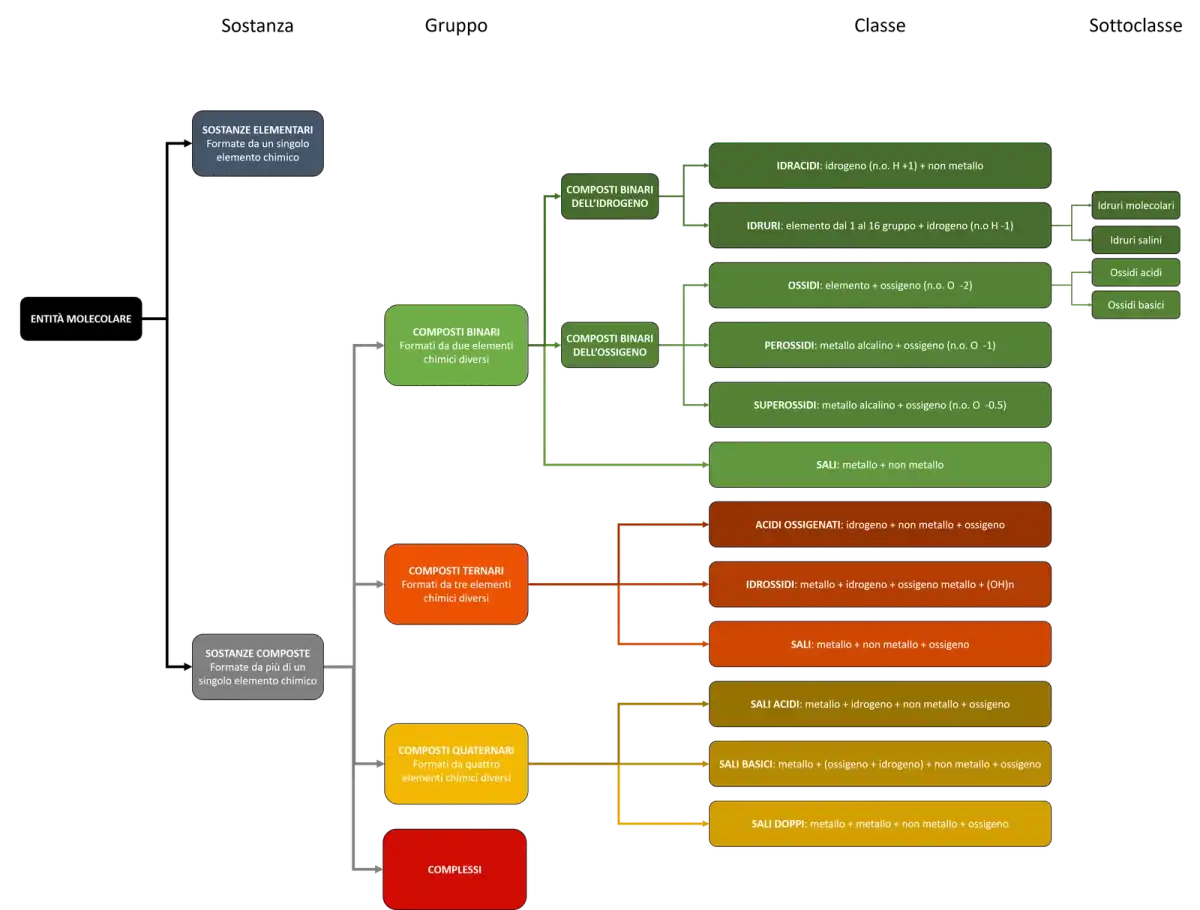
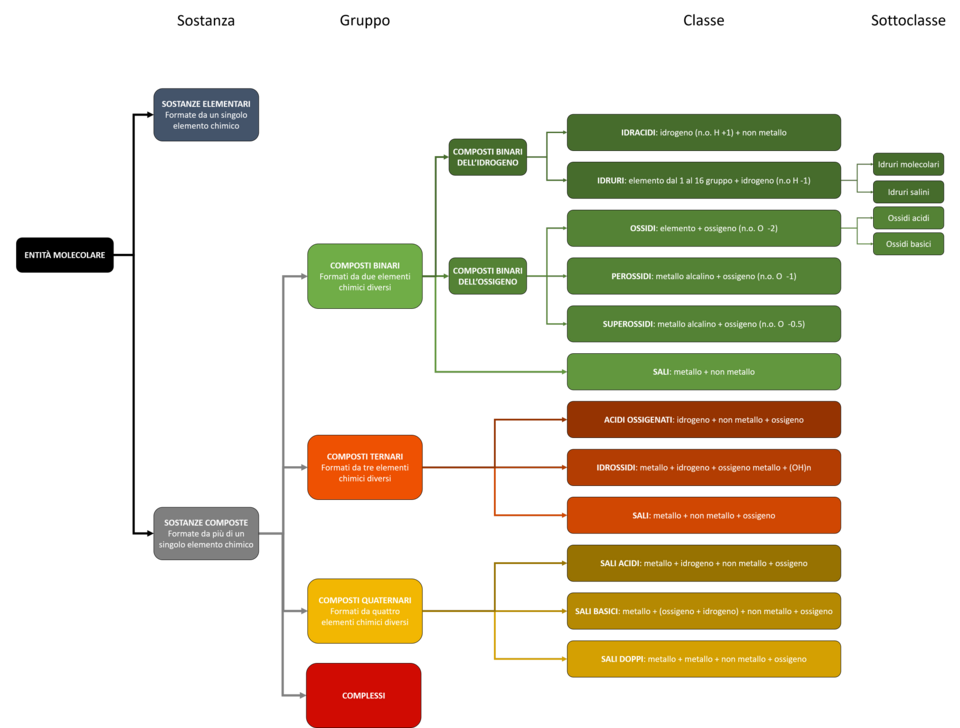
The inorganic chemical nomenclature allows to identify the inorganic compounds by means of a specific name, which is defined from the chemical formula of chemicals.
Some substances are mainly indicated by their common name: for example water (H)2O) and ammonia (NH3). In most cases, however, codified rules are used to assign names to different compounds with more complex chemical formulas.
There are several nomenclature systems:
- The traditional nomenclature It is mainly based on the division of metal and non-metal elements and takes into account the oxidation status of atoms that form the molecule.
- The nomenclature according to Stock notation, made official by IUPAC in 1940 and now no longer used much (it is still found on old reagent containers or in dated textbooks), provides clearer information on the oxidation state of atoms; in fact it indicates the oxidation states with Roman numerals placed in brackets.
- The IUPAC nomenclature is the official nomenclature in force; it is updated and its rules improved and expanded by IUPAC when necessary. It is based on the rules drawn up by IUPAC. It makes it possible to highlight, in a clear and immediate way, the relationship between the name of a chemical compound and its chemical formula.
Notations and concepts used in the nomenclature of inorganic compounds
Elements of the periodic table [ 1 ]Explore this chapter
- Valenza: the value of an atom is the number of ties that it is able to form.
- The number of oxidation (no.o.): it is defined as "oxidation number" or "oxidation state" the charge, real or formal, which acquires an atom when conventionally assigned electrons of connection to the most electronegative atom.
- The charge is real in Ionic compounds and in this case coincides with the number of charges brought by the ion.
- The charge is formal in covalent compounds.
- The oxidation number is written above the chemical symbol in the form of a relative number (e.g.: Pb+4).
- The oxidation state is written to the chemical symbol exponent (for example: PbIV) or enclosed in round brackets as a Roman numeral (for example: Pb(IV)).
- In substances it may happen that an element appears more than once within the formula. In order to facilitate the identification and assignment of a name starting from the chemical formula and vice versa, in nomenclatures are introduced prefixes that correspond each to an entire number; according to the total number of atoms of a certain element within the chemical formula, it is attributed a prefix to be used in the nomenclature.
| No. of atoms | prefixed to adopt |
|---|---|
| 1 | mono- (can be subtent in some cases) |
| 2 | di- |
| 3 | three- |
| 4 | - I'm not... |
| 5 | I'm sorry. |
| 6 | esa- |
| 7 | epta- |
| 8 | oct. |
| 9 | I don't know. |
| 10 | deca- |
| 11 | Undeca- |
| 12 | dodeca- |
| 13 | Trideca |
| 14 | tetrade- |
| 15 | pentadeca |
| 16 | Hexadeca-- |
| 17 | eptadeca- |
| 18 | octadeca |
| 19 | Non-adequate |
| 20 | eicosa- |
| ... | ... |
Generally, inorganic substances do not have more than 7 or 8 atoms of the same element.
Elements of the periodic table [ 1 ]
The elements can be grouped according to their periodic properties and their position in the periodical table. This allows you to refer to a family of elements with individual names instead of listing them all.
The groups of elements in the periodic table are numbered from 1 to 18 and group the elements placed on the same column.
The elements of groups 1, 2 and 13–18 (except hydrogen) are designated as the main elements of the group and, except for Group 18, the first two elements of each group are defined as "typical elements".
Optionally, letters I'm sorry, p, d And f can be used to distinguish the different blocks of elements in the periodic table.
For example, the elements of groups 3-12 are block elements d. These elements are also commonly called transition elements, although group 12 elements are not always included; f-block elements are sometimes referred to as "internal transition elements".
In particular cases, the various groups may be appointed by the first element of each group. For example: "elements of the boron group" (B, Al, Ga, In, Tl), "elements of the titanium group" (Ti, Zr, Hf, Rf), etc.
Collective names are then used when referring to a family of chemical elements; these names are used for similar elements and therefore belonging to one group or block; the following names are approved by IUPAC:
- alkaline metals (Li, Na, K, Rb, Cs, Fr);
- alkaline-terrosis metals (Be, Mg, Ca, Sr, Ba, Ra);
- pnictogeni (N, P, As, Sb, Bi);
- calcogeni (O, S, Se, Te, Po);
- halogens (F, Cl, Br, I, At);
- noble gases (He, Ne, Ar, Kr, Xe, Rn);
- lantanoids (La, Ce, Pr, Nd, Pm, Sm, Eu, Gd, Tb, Dy, Ho, Er, Tm, Yb, Lu);
- metals of rare earths (Sc, Y and lantanoids);
- attinoids (Ac, Th, Pa, U, Np, Pu, Am, Cm, Bk, Cf, Es, Fm, Md, No, Lr).
The generic terms picnogenur, calcogenur and halogenur are commonly used in the name of compounds of pnictogenies, calcogenes and halogens.
Although the term "lantanoids" means "like lantanium", it should not include lantanium, which is however included in common use. Similarly, attinoids with regard to the athenium.
The elements in the periodic table can still be identified, based on the properties of electronic affinity, in three groups:
- Metal elements: they are all those elements included in Group 1 to Group 15 and which are located on the left of the diagonal line of the metalloids.
- Alkaline elements: all those elements included in group 1, excluding hydrogen;
- Alkaline-terrosis elements: all those elements included in group 2;
- Transitional elements: they are all those elements from group 3 to group 12;
- Metal elements: these are those elements ranging from group 13 to group 15 and which lie on the diagonal line that goes from boron to oganesson.
- Non-metallic elements: they are all elements ranging from group 13 to group 17 and which are located at the right of the diagonal line of the metalloids.
Primary substations
New items · Isotopes · Hydrogen IsotopesExplore this chapter
New items
Recently discovered elements can be cited in scientific literature but until they have received permanent names and symbols from IUPAC, they need temporary designators.
These elements can be indicated by their atomic numbers, such as in the ""element 120", but IUPAC has approved a systematic nomenclature and a series of symbols of three letters.
The name derives directly from the atomic number of the element using the following numerical roots:
| Number | Radius |
|---|---|
| 0 | nil |
| 1 | a |
| 2 | bibi |
| 3 | trio |
| 4 | quad |
| 5 | pent |
| 6 | ♪ |
| 7 | sept. |
| 8 | oct |
| 9 | I'm not going to |
For elements with atomic number greater than 100 names and symbols derive directly from the atomic number of the element using the following rule:
- Decomposition of the mass number of the element in numbers at a figure between 0 and 9;
- building the name through the numerical roots.
- The roots are gathered in the order of the figures that make up the atomic number;
- The final "n" of "enn" is eliminated when it occurs before "nil" and the final "i" of "bi" and "tri" when it occurs before "ium".
- Termination of the nume with suffix -ium.
The symbol for the element is composed of the initial letters of the numerical roots that make up the name.
| Atomic number | Disappearance of number | Replacement with numerical roots | Systematic name | Symbol |
|---|---|---|---|---|
| 104 | 1-0-4 | a-nil-quad-ium | Unnilquadium | Unh. |
| 113 | 1-1-3 | a-a-tri-um | Ununtrium | U |
Isotopes
The isotopes of an element have all the same name and are indicated by mass numbers.
For example, atom with atomic number 8 and mass number 18 is called oxygen-18 and has the symbol 18Or.
Hydrogen Isotopes
Hydrogen is the exception to the general rule set out above as the three isotopes 1H, 2H and 3H can have alternative names such as protity, deuterium and tritium respectively. D and T symbols can be used for deuterium and tritium, but are preferred 2H and 3H because D and T can create problems with the alphabetical order in formulas. The combination of a muon and an electron leads to the formation of a light hydrogen isotope called muonium, Mu symbol.
These names give origin to the proton, deuterone, triton and muon names for cations 1H+, 2H+, 3H+ and Mu+, respectively. Since the name proton is often used in contradictory senses, namely for ions 1H+ It isotopicly pure on one side and for the mixture of indifferentiated isotopes present in nature on the other, it is recommended that the undifferentiated mixture is generally designated by the hydrone name, derived from hydrogen.
Elements and elementary molecules
In the systematic nomenclature (IUPAC) the name of the element is added the appropriate numerical prefix.
| Symbol or formula | Systematic name | Traditional name |
|---|---|---|
| H | mono hydrogen | Atomic hydrogen |
| N | monoazoon | atomic nitrogen |
| N2 | diazotic | nitrogen |
| O | monopoly | atomic oxygen |
| O2 | oxygen | oxygen |
| O3 | trioxide | ozone |
| S6 | esazolph | molecular sulphur |
| Ar | argon | argon |
The mono prefix is used only when the element does not exist (it is not stable or present in nature) in the monoatomic state.
Altropic forms and polymorphism
Polymorphism is a phenomenon for which an element or a compound, crystallizing, can take on different particular structures and present itself, therefore, in multiple modifications or crystalline phases. However, the term allotrope also extends to liquid and gaseous elements.
Ozone (O3) is a molecular oxygen allotrope (O2).
Altropic forms defined
Systemic names are based on the number of atoms in the molecule, using numerical prefixes. The "mono" prefix is used only when the element does not normally appear in a monoatomic state. If the number is large and unknown, as in long chains or big rings, you can use the prefix "poli".
If necessary, you can use appropriate prefixes to indicate the structure. When you want to specify a particular polymorph of an element with a defined structure (such as α-, β- or γ- forms of S8 ).
| Formula | Nomenclature IUPAC | Alternative name |
|---|---|---|
| Ar | argon | |
| H | mono hydrogen | |
| N | monoazoon | |
| N2 | diazotic | |
| N3• | (*) | |
| O2 | oxygen | oxygen |
| O3 | trioxide | ozone |
| P4 | tetraphosphorus | phosphorus white |
| S6 | esazolph | ε-zolfo |
| S8 | ottazolfo | α-zolfo, β-zolfo, γ-zolfo |
| SNo | polyzolf | μ-zolf (or plastic sulphur) |
| C60 | esacontacarbon | [60] |
Cristraline counterparts of the same element
Crystalline altropics are polymorphic of the elements. Each can be named by adding the Pearson symbol in parentheses following the name of the atom. This symbol defines the structure of the halltrope in terms of its Bravais reticle and the number of atoms in its elementary cell. Therefore, iron (cF4) is the allotropic modification of iron (γ-ferro) with a cubic reticle (c), entirely centered (F) containing four iron atoms in the elementary cell.
| Crystalline class | Symbol of the lattice | Letters of the Pearson symbol |
|---|---|---|
| Triclino | P | aP |
| Monocline | P | m |
| C | MC | |
| Orthorombique | P | o |
| C | OC | |
| F | OF | |
| THE | O | |
| Tetragonal | P | TP |
| THE | TYPE | |
| Hexagonal (and trigonal) | P | hp |
| Romboedic | R | HR |
| Cubico | P | CP |
| F | C | |
| THE | C |
| Symbol | Systematic name | Accepted alternative name |
|---|---|---|
| PNo | phosphorus(OS8) | phosphorus black |
| CNo | carbon(s)C8) | diamond |
| CNo | carbon(s)hp4) | graphite (common form) |
| CNo | carbon(s)HR6) | graphite (less common form) |
| FeNo | Iron(s)C2) | α-ferror |
| FeNo | Iron(s)C4) | γ-ferror |
| SNo | pond(s)C8) | α- or grey tin |
| SNo | pond(s)TYPE4) | β- or white tin |
| MnhNo | Manganese(C58) | α-manganese |
| MnhNo | Manganese(CP20) | β-manganese |
| MnhNo | Manganese(C4) | γ-manganese |
| MnhNo | Manganese(C2) | δ-manganese |
| S8 | sulphur(OF128) | α-zolf |
| S8 | sulphur(m48) | β-zolf |
| S8 | sulphur(m32) | γ-zolf |
In some cases, the Pearson symbol does not allow the distinction between two crystalline allotropes of the same element. In this case, the space group is added in brackets. If this does not yet allow the distinction between allotropics, it will have to be cited the characteristically different rheticolar parameters.
Changes in solid amorphous and allotropics commonly recognized by the indefinite structure
Solid amorphic changes and allotropics commonly recognized by the indefinite structure are distinguished by habitual descriptors such as a Greek letter, names based on physical properties or mineral names.
| Symbol | Name |
|---|---|
| CNo | carbon fiberglass |
| CNo | Graphitic carbon (carbon in the form of graphite, irrespective of structural defects) |
| PNo | Red phosphorus [a messy structure containing parts of phosphorus (oS8) and parts of tetraphosphorus] |
| AsNo | arsenic amorphous |
Binary compounds
Binary compounds containing hydrogen · Hydracy · IdruriExplore this chapter
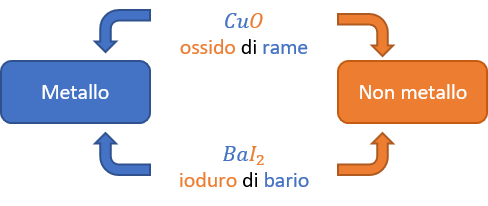
There are two classes of binary compounds (i.e. two chemical elements): Ionic compounds and molecular compounds.
Ionic compounds are made up of a metal cation (which is first written in the chemical formula) and a non-metallic anion. The most important compounds belonging to this class are ionic (or salini) idruri. Sale binaries (for example halogenurs and sulphides) and basic oxides.
The other class, that of molecular compounds, includes acid oxides (called anhydrides in traditional language) hydrides and covalent (or molecular) hydrorides.
They belong to ionic compounds:
- Metal sprays;
- Basic oxides;
- Sale.
They belong to molecular compounds:
- Hydracydes;
- Covalent hydrides;
- Acid oxides (anhydrides).
| HF | Li. | I'm sorry. | Nana2O |
| HCl | Nah. | I'm sorry.2 | Fe |
| H. | KHY | I'm sorry.3 | Fe2O3 |
| HIGH | RbH | MnO3 | H2O |
| H2S | Fr. | Mnh2O7 | Nana2O2 |
Binary compounds containing hydrogen
The binary hydrogen compounds can be distinguished in three groups:
- hydraulics;
- molecular hydrides;
- Idruri salini.
Hydracy
Hydracydes consist of hydrogen with non-electronegative metals (groups 16 and 17), a small number of binary compounds of molecular nature. In these compounds, hydrogen presents n.o. equal to +1 (H hydron ion+) and therefore it must be written first in the formula.
The traditional nomenclature predicts that the name follows this logic:
- term acid;
- root of the name of the non-metal with the suffix -hydric.
The IUPAC nomenclature, instead, provides for the construction of the name following this logic:
- root of the name of the non-metal with suffix -uro;
- of;
- prefixed for the number of hydrogen atoms, followed by the word hydrogen.
| Chemical formula | Traditional Nomenclature | Nomenclature IUPAC |
|---|---|---|
| Hydrogen + non-metal | acid + root of the name of non-metal-hydric | root of the name of the non-metal-uro + n- hydrogen |
| Chemical formula | Traditional Nomenclature | Nomenclature IUPAC |
|---|---|---|
| HF | fluoridation acid | Hydrogen fluoride |
| HCl | hydrochloric acid | Hydrogen chloride |
| H. | bromidable acid | hydrogen bromide |
| HIGH | iodidric acid | hydrogen iodide |
| H2S | sulphide acid | hydrogen sulfide |
| H. | cyanide acid
(despite not being a compound made up of just two elementary species falls within the rules of nomenclature of hydraulics and binary compounds) |
hydrogen cyanide |
Idruri
They are binary compounds in which hydrogen is linked with elements ranging from group 1 to 16. In these compounds, hydrogen presents n.o. equal to -1 (H idruro-) and therefore it must be written second in the formula.
Based on the element in which hydrogen is alloyed, molecular hydrohydrides and Sale.
The traditional nomenclature provides that the construction of the name follows this logic:
- term idruro;
- of;
- name of metal (or non-metallic or metalloid).
The Stock nomenclature, instead, provides for the construction of the name following this logic:
- term idruro;
- of;
- metal name (or non-metal or metalloid) followed by the oxidation number written in Roman numerals in parentheses.
The IUPAC nomenclature, in the end, provides for the construction of the name following this logic:
- prefix for the number of hydrogen atoms, followed by the suffix -hydraurian;
- of;
- name of metal (or non-metallic or metalloid).
| Chemical formula | Traditional Nomenclature | Nomenclature Stock | Nomenclature IUPAC |
|---|---|---|---|
| alkaline metal (or not metal or metalloid) + hydrogen | + metal name (or non-metal or metalloid) | + metal name (or non-metal or metalloid) + (no.o. of metal (or non-metallic or metalloid)) | n-hydride + metal name (or non-metal or metalloid) |
| Chemical formula | Traditional Nomenclature | Nomenclature Stock | Nomenclature IUPAC |
|---|---|---|---|
| Li. | lithium idruro | lithium idruro (I) | lithium monohydride
or lithium idruro |
| Nah. | sodium idruro | sodium idruro (I) | sodium monohydride
or sodium idruro |
| KHY | potassium idruro | potassium idruro (I) | potassium monohydride
or potassium idruro |
| RbH | rubidium idruro | rubidium idruro (I) | rubidium monohydride
or rubidium idruro |
| Fr. | Idruro di francio | Idruro di francio (I) | monohydride of francio
or Idruro di francio |
Molecular hydrides
Molecular or covalent hydrohydrides are composed of hydrogen with metalloids and non-metallic (groups 14, 15 and 16). These compounds consist of molecules in which hydrogen in the formula is to be written for second.
They are often liquid or gaseous.
It is good to remember that such molecules are not aciqueous, although there is a slight difference in electronegativeness between the element and hydrogen.
The traditional nomenclature in these cases is replaced by the old names attributed to molecules:
- Group 14:
- CHRISCH4 → methane;
- Yes.4 → silano;
- Geh.4 → German.
- Group 15:
- NH3 → ammonia;
- PHY3 → phosphine;
- ♪3 → arsina;
- SbH3 → Stable.
Salt watermelons
Hydrogen compounds are composed of hydrogen with highly electropositive metals (1o and 2o group generally). These are ionic compounds in which hydrogen presents n.o. equal to -1 (H idruro-) and therefore it must be written second in the formula.
- Group 1:
- LiH;
- NaH;
- KH;
- RbH;
- FrH.
- Group 2:
- Be.2;
- Mg.2;
- Ca'H2;
- Sr.2;
- Bah.2;
- Rah.2.
Binary compounds containing oxygen
Oxides are defined all those binary compounds that contain oxygen.
Chemical Formula: XmONo, where X is any element of the periodic table.
Oxids can be divided into three classes according to the number of oxidation that presents oxygen:
- Oxides: n.o. = -2
- Peroxides: n.o. = -1
- Superoxides: n.o. = -0.5
Oxids
Oxygen forms composed with almost all elements of the periodic table, such compounds are oxides. They are distinguished in acid oxides and basic oxides based on the chemical properties they show and the element linked together with oxygen.
In such compounds the number of oxygen atoms may vary, but the number of oxidation is always -2.
The traditional nomenclature provides for the distinction of the type of oxide, it ranks the oxide as anhydride acid and simply oxide basic oxide:

a) Acid oxide: obtained when oxygen reacts with a non-metallic element or a metalloid, in some cases even with a metal, if at a high oxidation state.
- use of the term anhydride;
- choice of the root suffix of the name of non-metal (or metalloid or metal):
- in case the non-metal (or metal or metal) possess a single oxidation state, the suffix is used -ica;
- if the non-metal (or metalloid or metal) has two states of oxidation:
- is used -ousting for the minor one;
- is used -ica for the big one.
- choice of the root prefix of the name of non-metal (or metalloid or metal), in case the non-metallic (or metalloid or metal) present more than two oxidation numbers:
- is used the prefix hypothetical- for the minor one;
- is used the prefix for the- for the major one.

b) Basic oxide: obtained when oxygen reacts with a metallic element.
- use of the term oxide;
- of;
- choice of suffix:
- in case the metal possesses a single oxidation state, no suffix is used, leaving the name of the metal preceded by the preposition "of";
- if the metal has two states of oxidation, they are used -Oost (for the minor one) and -I'm sorry. (for the major one) as suffixes after the root of the metal name.
Stock's nomenclature, instead, provides for the formulation of the name following the following logic:
- term oxide;
- of;
- metal name (or non-metal or metalloid) followed by the oxidation number written in Roman numerals in parentheses.
The IUPAC nomenclature, in the end, provides for the construction of the name following this logic:
- prefix for the number of oxygen atoms, followed by suffix -Oxide;
- name of metal (or non-metallic or metalloid).
Acid oxides
| Chemical formula | Traditional Nomenclature | Nomenclature Stock | Nomenclature IUPAC |
|---|---|---|---|
| not metal (or metal with n.o. high) + oxygen (no.o. = -2) | Dioxide + prefix-root of the name of the non-metal-suffix | oxide + name of non-metal (or metalloid or metal) + (no.o. of non-metal (or metalloid) | n-oxide + n-name of non-metal (or metalloid or metal) |
| Chemical formula | Traditional Nomenclature | Nomenclature Stock | Nomenclature IUPAC |
|---|---|---|---|
| I'm sorry. | Hyposulphur dioxide | sulphur dioxide (II) | sulphur monoxide |
| I'm sorry.2 | Sulphur dioxide | sulphur dioxide (IV) | sulphur dioxide |
| I'm sorry.3 | Sulphur dioxide | sulphur dioxide (VI) | sulphur trioxide |
| MnO3 | Manganic anhydride | manganese oxide (VI) | manganese trioxide |
| Mnh2O7 | Permanganic anhydride | manganese oxide (VII) | dimanganese eptoxide |
Basic oxides
| Chemical formula | Traditional Nomenclature | Nomenclature Stock | Nomenclature IUPAC |
|---|---|---|---|
| metal + oxygen (no.o. O = -2) | oxide + root of the name of metal-oso/ico | oxide + metal name + (no.o. of metal) | n-oxide + n-name of metal |
| Chemical formula | Traditional Nomenclature | Nomenclature Stock | Nomenclature IUPAC |
|---|---|---|---|
| Nana2O | Sodium oxide | Sodium oxide (I) | disode monoxide |
| Fe | Iron oxide | Iron oxide (II) | Iron monoxide |
| Fe2O3 | ferric oxide | Iron oxide (III) | diferrous trioxide |
Peroxides
Peroxides are binary compounds having two oxygen atoms, both with oxidation number of -1.
The traditional nomenclatures, Stock and IUPAC have as a rule:
- term peroxide;
- of;
- name of metal (or non-metallic or metalloid).
One of the most known peroxides is hydrogen peroxide (H2O2) which is commonly called hydrogen peroxide.
| Chemical formula | Traditional Nomenclature/ Stock/ IUPAC |
|---|---|
| alkaline metal (or hydrogen) + oxygen (no.o. O = -1 | peroxide + name of alkaline metal (or hydrogen) |
| Chemical formula | Traditional Nomenclature |
|---|---|
| H2O2 | hydrogen peroxide |
| Nana2O2 | sodium peroxide |
Superoxides
Superoxides are binary compounds having two oxygen atoms, both with oxidation number of -0.5.
The traditional nomenclatures, Stock and IUPAC have as a rule:
- term superoxide;
- of;
- name of metal (or non-metallic or metalloid).
| Chemical formula | Traditional Nomenclature/ Stock/ IUPAC |
|---|---|
| alkaline metal (or hydrogen) + oxygen (no.o. O = -0.5) | superoxide + name of alkaline metal (or hydrogen) |
| Chemical formula | Traditional Nomenclature |
|---|---|
| KO2 | potassium superoxide |
| I'm sorry.2 | hydrogen superoxide
or hydroperoxide |
| NaO2 | Sodium superoxide |
Tracks
They are defined Sale all those compounds that have an ionic bond and therefore include a metal part, first written in the chemical formula, and one non-metallic, second written in the chemical formula.
The traditional nomenclature includes such rules:
- root of the name of the non-metal, followed by the suffix -uro;
- root of the name of metal;
- suffix to be assigned to the root of the metal:
- -oso if the metal has n.o. minor; minor;
- -ico if it has n.o. major.
The Stock nomenclature includes:
- root of the name of the non-metal, followed by the suffix -uro;
- name of metal, followed by n.o. of the latter written in Roman numerals in parentheses.
The IUPAC nomenclature includes:
- prefix of the number of non-metal atoms, followed by the root of the name of the non-metal with suffix -uro;
- prefix of the number of metal atoms, followed by the name of the metal.
| Chemical formula | Traditional Nomenclature | Nomenclature Stock | Nomenclature IUPAC |
|---|---|---|---|
| metal + not metal | root name of the non-metal-uro + metal-oso/ico name root | root of the name of the non-metal-uro + metal name + (no.o. of metal) | n-root name non metal-uro + n-name of metal |
| Chemical formula | Traditional Nomenclature | Nomenclature Stock | Nomenclature IUPAC |
|---|---|---|---|
| LiC | lithium chloride | lithium chloride (I) | lithium chloride |
| Nana2S | Sodium sulfide | Sodium sulfide (I) | disode sulfide |
| Fees2 | iron iodide | iron iodide (II) | iron dioduro |
| ♪3 | ferric bromide | iron bromide (III) | iron tribromide |
Territorial compounds
Hydroxides · Oxygenated acids · Salmon saltExplore this chapter
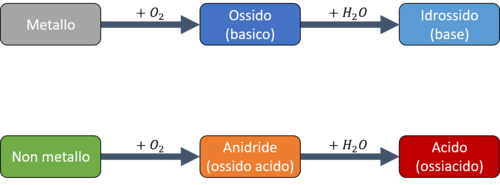
The ternary compounds are formed by the combination of three different elements. The main ternary compounds are hydroxides, oxycides (also called osso acids) and idiocydes salts.
You can rank in:
- Ionici:
- hydroxides;
- salts of the idiocydes.
- molecular:
- i.e.
Hydroxides
Hydroxides are ionic compounds that are obtained by reacting the basic oxides with water.
The monovalent group characteristic of hydroxides is oxydrile (OH) present as a hydroxide ion (OH)-).
The traditional nomenclature includes such rules:
- hydroxide term;
- of;
- root of the name of metal;
- suffix to be assigned to the root of the metal name:
- -oso if the metal has n.o. minor; minor;
- -ico if it has n.o. major.
The Stock nomenclature includes:
- hydroxide term;
- of;
- name of metal, followed by n.o. of the latter written in Roman numerals in parentheses.
The IUPAC nomenclature includes:
- prefix of the number of oxides, followed by the hydroxide term;
- of;
- prefix of the number of metal atoms, followed by the name of the metal.
| Chemical formula | Traditional Nomenclature | Nomenclature Stock | Nomenclature IUPAC |
|---|---|---|---|
| metal + hydrogen + oxygen or metal + (OH)No | hydroxide + metal name root-suffix | hydroxide + metal name + (no.o. of metal) | n-hydroxide + n-name of metal |
| Chemical formula | Traditional Nomenclature | Nomenclature Stock | Nomenclature IUPAC |
|---|---|---|---|
| Ca(OH)2 | calcium hydroxide | calcium hydroxide (II) | calcium dihydroxide |
| Fe(OH)2 | iron hydroxide | iron hydroxide (II) | iron dihydroxide |
| Fe(OH)3 | ferric hydroxide | iron hydroxide (III) | iron trihydroxide |
| Sn(OH)2 | hydroxide stasis | hydroxide of tin (II) | tin dihydride |
| Sn(OH)4 | Stanin hydroxide | hydroxide of tin (IV) | tin tetraidroxide |
| Al(OH)3 | aluminum hydroxide | aluminium hydroxide (III) | aluminium trihydroxide |
Oxygenated acids
Oxoacids (oxidants or oxygenated acids) are obtained by reaction of acid oxides with water. According to the traditional nomenclature, the name of each oxy acid derives directly from the corresponding anhydride.
The idiocids are divided into:
- "monoprotic": with only one hydrogen atom;
- "diprotic": with two hydrogen atoms;
- "triprotic": with three hydrogen atoms.
Generally anhydrides react in a ratio 1:1 with water without having the possibility of other combination relationships.
Some of the anhydrides, however, can be combined in different relationships with water. In the traditional nomenclature, to distinguish the different combination possibilities, meta prefixes are introduced for a ratio of 1:1 anhydride: water, pyro- for a ratio of 1:2 anhydride: water and vegetable- for a ratio of 1:3 anhydride: water. This behaviour is typical for anhydrides of phosphorus, arsenic, antimony, silicon and boron.
Finally, polyacids can be obtained, i.e. two or more molecules of anhydrides that react with one or more molecules of water; to name these acids the prefixes are used tri- and tetra- in the traditional nomenclature.
The traditional nomenclature includes such rules:
- term acid;
- if oxygenated acid has multiple possible relationships of combination with water molecules, a prefix must be placed before the root of the name of non-metal:
- Dioxide: water = 1:1 → "meta-";
- Dioxide:water = 1:2 → "pyro-";
- Dioxide:water = 1:3 → "Order-";
- Dioxide:water = m:n → the "tri-", "tetra-" prefixes are used, counting the number of molecules of resulting anhydride (m);
- root of the name of the non-metal;
- suffix to be assigned to the root of the name of the non-metal:
- in case the non-metal (or metal or metal) possess a single number of oxidation, the suffix -ica is used;
- if the non-metal (or metal or metal) has two oxidation numbers, they are used -osa (for n.o. minor) and -ica (per n.o. Major) as suffix after the root of the name of non-metal (or metalloid or metal).
- choice of the prefix to be assigned to the root of the name of the non-metal, if necessary:
- in case the non-metal contains more than two oxidation numbers, ipo- is used (for n.o. and per- (for n.o. major) as prefixes before the root of the name of non-metal (or metalloid or metal).
The IUPAC nomenclature includes:
- term acid;
- prefix of the number of oxygen atoms, followed - bone;
- root of the name of the non-metal, followed by the suffix -ico de dal n.o. written in Roman numerals in parentheses.
| Chemical formula | Traditional Nomenclature | Nomenclature IUPAC |
|---|---|---|
| Hydrogen + non-metal + oxygen | acid + prefix-root name of non-metal-suffix | acid + n-bone + root of the name of the non-metallic + (n.o. of the non-metal) |
| Chemical formula | Non-metal oxidation state | Traditional name | Name IUPAC |
|---|---|---|---|
| H2I'm sorry.3 | +4 | sulphur acid | triosulphuric acid(IV) |
| H2I'm sorry.4 | +6 | sulphuric acid | tetraotrophoreic acid(VI) |
| HERE2 | +3 | nitrorous acid | dioxinyl acid(III) |
| HERE3 | +5 | Nitric acid | triotronitric acid(V) |
| H2CO3 | +4 | carbonate acid | triocarbon acid(IV) |
| H3POLICY3 | +3 | phosphorous acid | triophosphoric acid(III) |
| H3POLICY4 | +5 | Phosphoric acid | tetraphosphoric acid(V) |
| HCl | +1 | Hypochloride acid | mono-sycloric acid(I) |
| HCl2 | +3 | chlorine acid | dioxychloric acid(III) |
| HCl3 | +5 | Chloric acid | triochloric acid(V) |
| HCl4 | +7 | Perchloric acid | tetraoxychloric acid(VII) |
| H2C2O4 | +3 | oxalic acid | ethanol acid
(assumes this name because this acid, while being a ternary compound, turns out to fall in the category of organic compounds |
| Report | Report | Chemical formula | Traditional name | Name IUPAC |
|---|---|---|---|---|
| 1:1 | P2O5 + 1 H2O → 2 HPO3 | HPO3 | metaphosphorus acid | triophosphoric acid(V) |
| 1:2 | P2O5 + 2 H2O → H4P2O7 | H4P2O7 | pyrophosphorus acid | eptaotoxic acid(V) |
| 1:3 | P2O5 + 3 H2O → 2 H3POLICY4 | H3POLICY4 | orthophosphoric acid (or phosphory acid) | tetraphosphoric acid(V) |
| 1:1 | P2O3 + 1 H2O → 2 HPO2 | HPO2 | metaphosphorous acid | dioxophosphoric acid(III) |
| 1:2 | P2O3 + 2 H2O → H4P2O5 | H4P2O5 | pyrophosphorus acid | pentossodiphosphoric acid(III) |
| 1:3 | P2O3 + 3 H2O → 2 H3POLICY3 | H3POLICY3 | orthophosphorous acid | triophosphoric acid(III) |
| 1:1 | B2O3 + 1 H2O → 2 HBO2 | HBO2 | metaboric acid | dioxyboric acid(III) |
| 1:3 | B2O3 + 3 H2O → 2 H3BOTH:3 | H3BOTH:3 | orthoboric acid (or boric) | triotoxic acid(III) |
| 1:1 | Yes2 + 1 H2O → H2Yes3 | H2Yes3 | metasilic acid | trioxylic acid(IV) |
| 1:2 | Yes2 + 2 H2O → H4Yes4 | H4Yes4 | orthosilic acid
(exception with respect to the name pyrosilic, valid because there is no acid with ratio 1:3, so this is the acid you get with the most molecules of water for silicon dioxide and this allows it to get the prefix orto-) |
tetraoxylic acid(IV) |
| Report | Report | Chemical formula | Traditional name | Name IUPAC |
|---|---|---|---|---|
| 2:1 | 2B2O3 + 1 H2O → H2B4O7 | H2B4O7 | tetraboric acid | eptaoxytraboric acid(III) |
| 4:3 | 4 SiO2 + 3 H2O → H6Yes.4O11 | H6Yes.4O11 | tetrasilic acid | undecaoxytrasilic acid(IV) |
| 2:2 | 2 P2O5 + 2 H2O → H4P4O12 | H4P4O12 | tetraphosphorus acid | dodecaoxytraphosphoric acid(V) |
Salmon salt
The ternary salts are ionic compounds that derive from the acids after being deprived of protons and replaced with cations.
The traditional nomenclature includes such rules:
- root of the name of the non-metal oxygenated;
- suffix to be assigned to the root of the name of the non-metal:
- in case the non-metal (or metal or metal) possess a single oxidation number, the suffix -ato is used;
- in case the non-metal possesses two oxidation numbers, the suffix to be assigned to the root of the metal name becomes:
- -ito if the non-metal has n.o. minor; minor;
- -ato if it has n.o. major.
- choice of the prefix to be assigned to the root of the name of the non-metal, if necessary:
- in case the non-metal contains more than two oxidation numbers, ipo- is used (for n.o. and per- (for n.o. greater) as prefixes before the root of the name of non-metal (or metalloid);
- suffix to be assigned to the root of the name of the non-metal:
- metal name.
The IUPAC nomenclature includes:
- prefix of the number of oxygen atoms, followed by -bone;
- root of the name of the non-metal, followed by the suffix -ato de dal n.o. written in Roman numerals in parentheses;
- of;
- prefix of the number of metal atoms;
- metal name followed by n.o. written in Roman numerals in parentheses.
| Chemical formula | Traditional Nomenclature | Nomenclature IUPAC |
|---|---|---|
| metal + non-metal + oxygen | prefix-root name of the non-metal oxide-suffix + metal name | n-bone + root name of the non-metal-ato + (no.o. of the non-metal) + of + n-name metal + (no.o. of metal) |
| Chemical formula | Traditional name | Name IUPAC |
|---|---|---|
| Nana2CO3 | sodium carbonate | triocarbonate(IV) of disodium |
| KEY2C2O7 | potassium dichromate | dipotassium eptaoxochrome(VI) |
Quaternary compounds
Acid salts · Basic salts · Double saltExplore this chapter
Acid salts
THE Sale are ionic compounds that come from acids to replace one or more hydrogen atoms with a cation.
The traditional nomenclature includes such rules:
- rules for the name with the suffix bi-:
- suffix bi-;
- root of the name of the non-metal oxide (or metalloid or metal);
- suffix to be assigned to the root of the name of the non-metal oxygenated (or metalloid or metal):
- in case the non-metal (or metal or metal) oxygenated possesses a single number of oxidation, the suffix -ato is used;
- in case the non-metal possesses two oxidation numbers, the suffix to be assigned to the root of the metal name becomes:
- -ito if the oxygenated non-metal (or metalloid or metal) has n.o. minor; minor;
- -ato if it has n.o. major.
- metal name.
- rules for name with acid particle:
- root of the name of the non-metal oxide (or metalloid or metal);
- suffix to be assigned to the root of the name of the non-metal oxygenated (or metalloid or metal):
- in case the non-metal (or metal or metal) oxygenated possesses a single number of oxidation, the suffix -ato is used;
- in case the non-metal possesses two oxidation numbers, the suffix to be assigned to the root of the metal name becomes:
- -ito if the oxygenated non-metal (or metalloid or metal) has n.o. minor; minor;
- -ato if it has n.o. major.
- prefix of the number of hydrogens;
- acid of;
- metal name.
The IUPAC nomenclature includes:
- prefix of the number of hydrogen atoms, followed by the name hydrogen;
- prefix of the number of oxygen atoms, followed by suffix - bone;
- root of the name of the non-metal, followed by the suffix -ato and n.o. written in Roman numerals in parentheses;
- of;
- prefix of the number of metal atoms;
- metal name followed by n.o. written in Roman numerals in parentheses.
| Chemical formula | Traditional Nomenclature | Nomenclature IUPAC |
|---|---|---|
| metal + hydrogen + non-metal + oxygen | bi-root name of the non-metal-suffix + metal name
or root of the name of the non-metal-suffix n-(hydrogens) acid + metal name |
n- hydrogen + n-bone + root of the name of the non-metal-ato +(n.o. of the non-metal) + of + n-name metal |
| Chemical formula | Traditional name | Name IUPAC |
|---|---|---|
| NaHCO3 | baking soda
or sodium acid carbonate |
triocarbonate (IV) mono hydrogen sodium |
| KHSO3 | potassium bisulfite
or Potassium Acid Sulfite |
mono hydrogen triosulphate (IV) potassium |
| KHSO4 | potassium bisulphate
or potassium acid sulphate |
mono hydrogen triosulphate (VI) of potassium |
| Li.2POLICY4 | lithium biacid phosphate | of hydrogen tetraphosphate (V) lithium |
| Li'2HPO4 | lithium biphosphate
or lithium acid phosphate |
mono hydrogen tetraphosphate (V) dilithium |
Basic salts
The basic salts are ionic compounds that come from the bases (hydroxydes) to replace one or more oxydrilic ions with a different anion.
The traditional nomenclature includes such rules:
- root of the name of the non-metal oxide (or metalloid);
- suffix to be assigned to the root of the name of the oxygenated non-metal (or metalloid):
- in case the non-metal (or metal or metal) oxygenated possesses a single number of oxidation, the suffix -ato is used;
- in case the non-metal possesses two oxidation numbers, the suffix to be assigned to the root of the metal name becomes:
- -ito if the oxygenated non-metal (or metalloid or metal) has n.o. minor; minor;
- -ato if it has n.o. major.
- prefix of the number of oxydrilic groups;
- basic of;
- metal name.
The IUPAC nomenclature includes:
- prefix of the number of hydrogen atoms, followed by the name hydrogen;
- prefix of the number of oxygen atoms, followed by suffix - bone;
- root of the name of non-metal (or metalloid), followed by suffix -ato and n.o. written in Roman numerals in parentheses;
- of;
- prefix of the number of metal atoms;
- metal name followed by n.o. written in Roman numerals in parentheses.
| Chemical formula | Traditional Nomenclature | Nomenclature IUPAC |
|---|---|---|
| metal + (oxygen + hydrogen) + non-metal + oxygen | root of the name of the non-metal (or metalloid)-suffix + n-basic + metal name | n- hydrogen + n-bone + root of the name of non-metal (or metalloid)-ato + (no.o. of the non-metal/metalloid) + of + n-name metal |
| Chemical formula | Traditional name | Name IUPAC |
|---|---|---|
| CrOHS4 | basic chromium sulphate | chromium mono hydrogen pentossosulphate(VI) |
| _4 | basic iron phosphate | mono hydrogen pentossophosphate(VI) of iron |
| Bi(OH)2C | Dibasic chloride of bismuth | of hydrogen dioxochlorate(I) of bismuth |
Double salt
The double salts are ionic compounds in which there are two different species cations and anion (or a cation with two different species anions). Both cases are generalizations with respect to acid and basic salts.
The traditional nomenclature includes such rules:
- first metal name;
- name of the second metal;
- name of the non-metal (or metalloid or metal);
- suffix to be assigned to the root of the name of the oxygenated non-metal (or metalloid):
- in case the non-metal (or metal or metal) oxygenated possesses a single number of oxidation, the suffix -ato is used;
- in case the non-metal possesses two oxidation numbers, the suffix to be assigned to the root of the metal name becomes:
- -ito if the oxygenated non-metal (or metalloid or metal) has n.o. minor; minor;
- -ato if it has n.o. major.
- choice of the prefix to be assigned to the root of the name of the non-metal, if necessary:
- in case the non-metal contains more than two oxidation numbers, ipo- is used (for n.o. and per- (for n.o. greater) as prefixes before the root of the name of non-metal (or metalloid);
The name obtained from the traditional nomenclature can see reversed orders of cation and anions, but the construction of the individual parts remains the same.
The IUPAC nomenclature includes:
- prefix of the number of oxygen atoms, followed by suffix - bone;
- root of the name of non-metal (or metalloid), followed by suffix -ato and n.o. written in Roman numerals in parentheses;
- of;
- prefix of the number of atoms of the first metal;
- first metal name;
- prefix of the number of atoms of the second metal;
- name of the second metal.
| Chemical formula | Traditional Nomenclature | Nomenclature IUPAC |
|---|---|---|
| metal + metal + non-metal + oxygen | name of the first metal + name of the second metal + root of the non-metal-suffix name
or root name of the non-metal-suffix + first metal name + second metal name |
n-bone + root of the name of the non-metal-ato + (no.o. of the non-metal) + n-name metal + n-name metal |
| Chemical formula | Traditional name | Name IUPAC |
|---|---|---|
| NaK4 | Sodium and potassium sulphate | tetrossosulphate (VI) of sodium and potassium |
| LiFe4 | lithium and iron phosphate | lithium and iron tetrossophosphate (VI) |
Complexes
A complex is a chemical compound in which an atom binds a number of other chemical species greater than its oxidation number.Explore this chapter
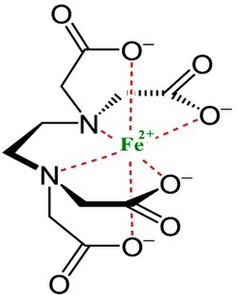
A complex is a chemical compound in which an atom binds a number of other chemical species greater than its oxidation number.
Transitional metals, which in the elementary state have partially occupied d or f levels, form a vast class of compounds, complex or composed of coordination. in which the central metal M (neutral or ionized) forms covalent dative bonds (or coordination) with a series of atoms or chemical groups, called binders (or ligands, Italianizing the English term ‘ligands’), neutral or charge opposite to the central atom. The central metal acts as Lewis's acid (electrons, electrophile) towards the ligands that behave like Lewis's bases (electronic doublet donors, nucleophiles).
Complexes can have the following features:
- Number of different binders/complexors:
- complex with a single binding species are called homoleptics;
- complex with different species of binders are called heterolettci.
- Typology of binders: The ligands are classified in relation to the number of electronic doublets (and therefore bonds) that can be used to bind to the central atom. If a binder forms only one bond with the central atom, the binder is said to be monodented (CO, NH3, CN-, OH-, H2Or etc.), if it forms two is said bidentate (dien, en, acac...) and so on. Polydented binders are called chelating agents and complexes that have polydentated ligands also define chelate compounds. A chelate complex is more stable than a complex analog containing only monodented binders. This increase in stability is known as chelate effect.
- Net load of the complex: a complex can be neutral or electrically loaded (complexion); of course its charge will be given by the sum of the charges of the central metal and the binders. The formula of a complex is enclosed in square brackets, writing first the central metal and then the binders. In the following examples we indicate with M the central metal and with L the binders. There are three charging options:
- positive charge;
- neutral charge;
- negative charge.
| Type | Formula | Partial loads |
|---|---|---|
| complex cation | [Co(N)3)6]3+ | (M = Co3+, L = 6 NH3) |
| complex anion | (PtCl)6]2 - | (M = Pt4+, L = 6 Cl-) |
| neutral complex | [Chuckles]3(CO)12] | (M = 3 Fe, L = 12 CO) |
| neutral complex | [Cr.2O)3C3] | (M = Cr3+, L = 3 H2O, L = 3 Cl-) |
Chemical formula: [metal + binder]m
The name of the coordinate compounds consists of two parts written together in which the ligands appear first and then the metallic atom followed by the oxidation number, according to the following rules:
n-binding name/s + metal name + (no.o. of metal)
- Ligandi:
- Name:
- Anionic binders ending in -ato, -ito and -ile maintain desinence;
- The binders ending in -uro change the desinence in -o;
- Neutral binders retain the same name as their molecules with the following 4 exceptions: H2O (aque), NH3 (amino), CO (carbonyl) and NO (nitrosyl).
- The name of the ligands is preceded by a prefix:
- In most cases from a Greek prefix (mono, di, tri, tetra, penta, esa, ...) indicating the number;
- When faced with polydentated ligands (for example, ethylenediamine, oxalate) and those containing already in their name a numerical prefix or have a longer name than 5-6 letters, then their name, placed in brackets, will be preceded by the bis (2), tris (3), tetrakis (4), pentakis (5), esakis (6) and binders are written in parentheses.
- Order:
- When there are more different binders, these should be written in alphabetical order, not considering the Greek prefix.
- Name:
- Metal:
- Metal oxidation state:
- If the complexed metal has more than a number of oxidation this is put at the end in brackets in Roman numerals (Stock Convention). Alternatively, it is possible to put the net, positive or negative charge of the complex ion in Arabic numbers (Ewens-Bassett Convention but is not recommended by IUPAC).
- Upload of the complex:
- If the complex has negative charge, m<0, it adds to the name of the metal the suffix -ato, and finally is followed by the number of oxidation written in parentheses. In some cases, the Latin name is used instead of the Italian name of metal:
- If there is a second positively charged metallic element as a counterion, as represented by the chemical formula: metal2 [metal metal]1 + binder(s), the nomenclature rule will become: n-ligand(s) + metal name1-ato + (no. of the metal1)+ metal name2, the name of the complex will precede the name of the cation that acts as a counterion;
- If there is no counterion, the name of the complex is preceded by the term ion.
- If the complex has neutral charge, m=0, the name of the metal does not acquire any suffix;
- If the complex has a positive charge, m>0, the metal name does not acquire any suffix:
- If it presents a counterion, as represented by the chemical formula: [metal + binder]m + anion, the nomenclature rule will become: n-anion-ending + n-name of ligand(s) + name of the metal + (no. of the metal), the name of the anion will precede the name of the complex;
- If there is no counterion, the name of the complex is preceded by the term ion.
- If the complex has negative charge, m<0, it adds to the name of the metal the suffix -ato, and finally is followed by the number of oxidation written in parentheses. In some cases, the Latin name is used instead of the Italian name of metal:
- Metal oxidation state:
| Like | Tie | Chemical formula | Name of the binder |
|---|---|---|---|
| Anion | Idruro | H- | hydrocarbons |
| florurot | F- | fluorine | |
| Chloride | C- | chlorine | |
| bromide | Br- | broth | |
| Iduro | THE- | I | |
| cyanide | :CN- | cyanano | |
| hydroxide | OH.- | hydroxide | |
| carbonate | CO32- | carbonate | |
| oxalate (Ox) | C2O42- | oxalate | |
| tyocyana | :SCN- | tyocyana | |
| isotiocyana | : NCS- | isotiocyana | |
| Oxo (Oxo) | O2- | bone | |
| peroxide | O22- | pero | |
| superperoxide | O2- | superperiod | |
| azido (azoturo) | N3- | azido (zoto) | |
| nitride | N3- | nitrous oxide | |
| Cianato | :OCN- | Cianato | |
| Ethylndaminetraacetate (EDTA) | (-O2CCH2)2NUMBER2CHRISCH2N2CO2-)2 | ethyleneaminetraacetate | |
| acetylacetate acac- | (CH3COCH2COCH2)- | acetylaceto | |
| methyl (Me) | CHRISCH3- | Methil | |
| etil (Et) | CHRISCH3CHRISCH2- | etil | |
| nitrite | No.2- | nitrite | |
| sulphite | I'm sorry.32- | sulphite | |
| phenol | Ph.- | phenol | |
| acetate (MeCOO-) | CHRISCH3COO- | acetate | |
| glycinate | Glyn- | glycinate | |
| salicy | Salt- | salicy | |
| cyclopendien | C5H5- | cyclopendien | |
| Neutral | water | H2O | aqueous |
| ammonia | NH3 | aminous | |
| Mommy | NH2 | amine | |
| carbon monoxide | CO | coal | |
| Nitrogen monoxide | No. | nitrosile | |
| diazotic | N2 | diazotic | |
| oxygen | O2 | oxygen | |
| ethylenemine (en) | H2NUMBER2CHRISCH2NH2 | ethylene | |
| diethylentriamine (dien) | diethylenemine | ||
| triethylenetraamine (trien) | triethylene | ||
| piridina (py) | piridina | ||
| bipiridina (bpy or bipy) | bipiridine | ||
| terpiridina (terpy) | terpiridine | ||
| phosphine | PHY3 | phosphine | |
| trifenilfosfina | PPh3 | trifenilfosfina | |
| trimethylphosphine | PM3 | trimethylphosphine | |
| trietilfosfina | PE3 | trietilfosfina | |
| trifluorofosfina | PF3 | trifluorofosfina | |
| methilamine | NH2Me | methilamine | |
| Difosphan (difos) | Difosus | ||
| Diaryan (diars) | diarrhein | ||
| glycodimethyltere (glyme) | glycodimethylte | ||
| urea | OC(NH)2)2 | urea | |
| and the | C2H4 | and the | |
| acetonitrile | CHRISCH3CN | acetonitrile |
| Chemical formula | Name of the complex |
|---|---|
| (NiCl)4]2- | ion tetrachloronichelate (II) |
| [CuNH]3C5]3- | aminopentachlorinated ion (II) |
| [Cd(en)2(CN)2] | dicianobisetilendiaminocadmio (II) |
| [Females]3)6♪3 | esamminoferro (III) chloride |
| KEY3[Fe(CN)6] | potassium hexacyanoferrate (III) |
| [Ni(H)2O)6♪4 | esaaquonichel sulphate (II) |
Notes
Explore this chapter
- ^ RedBock IUPAC pag:51, IR-3.5
Bibliography
Explore this chapter
- (EN) Nomenclature of Inorganic Chemistry (IUPAC Recommendations 2005). 6ed, Cambridge (UK), RSC/IUPAC (2005). ISBN 0-85404-438-8. Electronic version.
- G. All of them, A. Tifi and A. Kind, The nomenclature of compounds, in Chemistry: moving molecules, 1st ed., Bologna, Zanichelli, March 2009 [2005], pp. 249 - 280, ISBN 8808222764.
- Chemical Nomenclature Rhodomontan.
- Cristina Mostosi and Carlo Nebbiai, Chemistry, series Scientific Atlases Joints, Giunti, 2008 [2013], ISBN 978-88-09-76973-1.
Continue your journey