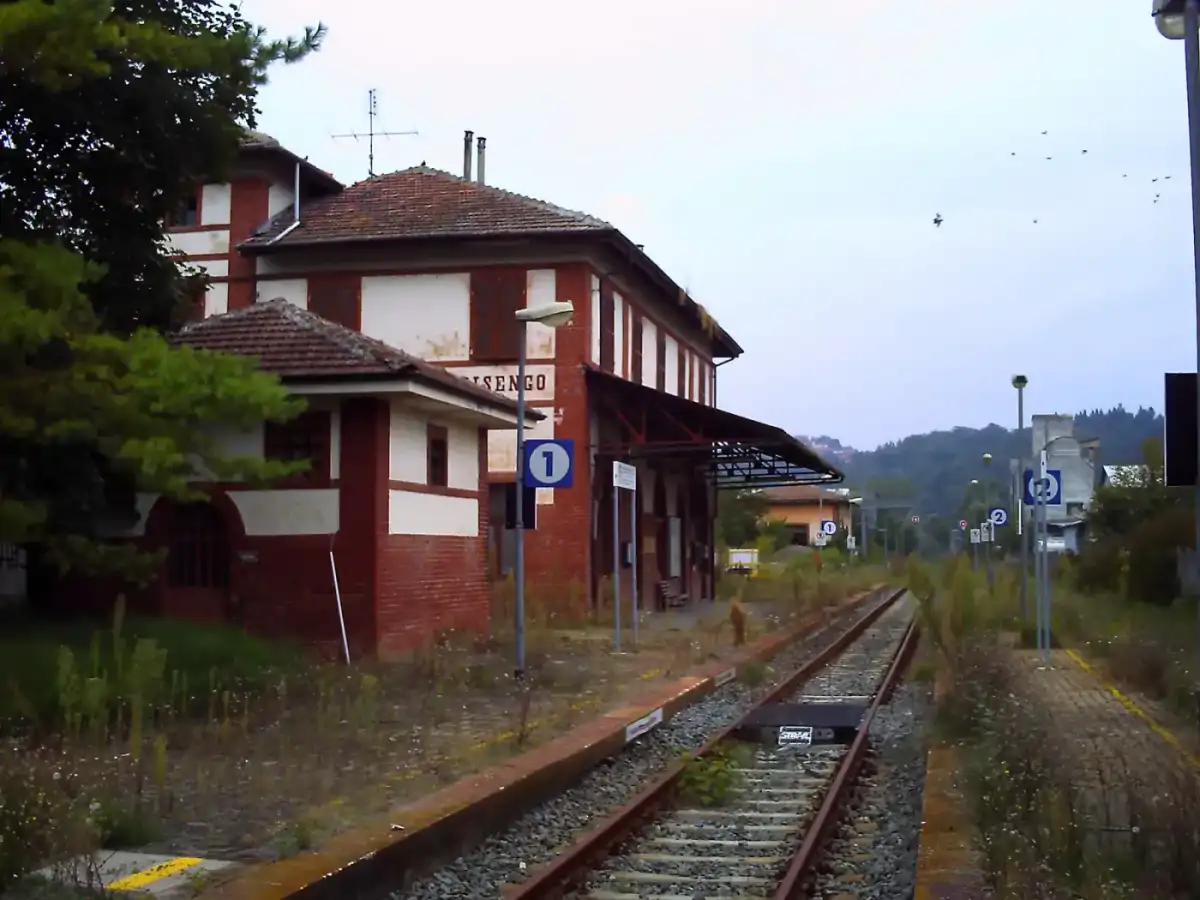
A closer look
Montiglio-Murisengo Station: at a glance
The Montiglio-Murisengo station is a railway station located on the Chivasso-Asti line, at the service of the town Montiglio Monferrato and the municipality limitrofo di Murisengo, used only for tourist trains.
History
The plant was activated as a station on 20 October 1912 by the State Railways, at the same time as the inauguration of the line.Explore this chapter
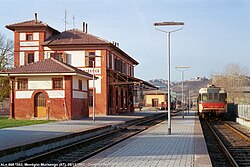
The plant was activated as a station on 20 October 1912 by the State Railways, at the same time as the inauguration of the line[1].
On 1 May of the following year, the name "Montiglio" was changed to "Montiglio-Murisengo".[2]
Far from the front of the First World War and little interested also from the events of the second not forming a primary strategic objective, the station suffered from such events only because of the consequent fluctuations of the demand for transport, beginning in the second post-war period a period of constant decline of the proceeds from traffic due to the advent of private motorization and a common orientation no longer favorable to the transport on iron.
The long-established traction of steam thanks to the use of thermal motors, traffic continued to maintain at unsatisfactory levels and in place of service strengthening to conquer new user bands in 1986 the railway was included in a list of "dry rhymes" to be suppressed.[3], saving itself from the network cuts made in that period after some minor timetable changes aimed at lowering operating costs[4].
Despite the despicable investments, the hypothesis of the cuts of some lines was again ventilated in 1993[5] but it was soon the nature to put the first serious obstacle to the continuation of the exercise: the line suffered in fact huge damage during the flood of the Po river in 1994, when almost entirely collapsed the bridge on that river. Restoration jobs[6] the reconstruction of the bridge on the Po[7]; on 27 August 2000 the reopening of the entire railway line was inaugurated[8].
At the beginning of the 1990s, the entire Piedmontese secondary network was subject to a deep renewal program aimed at reducing operating costs through automation and remote control of plants.[9]; closed in 1991[10][11], the Asti-Chivasso was therefore the subject of works[12][13] that involved the installation in Montiglio-Murisengo of an Elettrico Central Apparatus at Itineraries; the line was reopened on 19 November 1992[14].
Since 2001 the management of the entire line, and with it that of the station of Montiglio-Murisengo, has been in charge to Rete Ferroviaria Italiana which for commercial purposes classifies the plant in category "Bronze"[15].
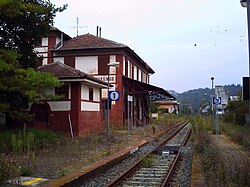
It remained without traffic from September 1, 2011 due to the suspension of traffic on the line[16], due to the instability of the Brozolo tunnel, which required extensive structural interventions to make it safe. This suspension was definitively highlighted from 17 June 2012 by decision of the Piemonte Region which, considering its heavy economic-financial situation, did not intend to start a program to enhance rail transport unlike neighboring Lombardy, decreeing the suspension of service contracts on numerous secondary lines under its jurisdiction[17][18][19].
In view of the reopening of the line for tourist purposes, on 15 May 2022 the station saw a special train coming for the first time after a decade, consisting of two ALn 668 cars, which carried out a test run in the stretch between Chivasso and Montiglio[20]. On this occasion the buildings were restored, with their original external decoration; the station systems were restored, the lighting was replaced and the sidewalks on the Chivasso side were lengthened, in addition to the complete cleaning of the entire surrounding area.
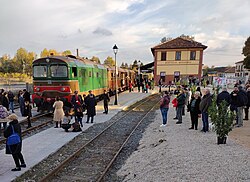
From 2 October 2022, on the occasion of the "National Fair of Truffle" in Montiglio, was inaugurated the reopening of the line as a tourist railway and the station has been terminus of two historical trains, of which one steam from Turin, tracted up to Chivasso with electric locomotor and the other coming from Cuneo via Asti, composed of railcars (the same ones with which the races had been tested)[21].
Facilities and facilities
ArchitectureExplore this chapter
The station is equipped with 2 passing tracks, of which the first track and the second for crossroads and foreheads. There is also a freight port, located in the direction of Chivasso, equipped with a trunk track. The plant was remotely controlled by the point-point system from the Asti Movement Manager. The handling of historical trains is managed on site, with the presence of the station.
The plant has a two-storey passenger building and a freight warehouse (restored for the tourist reopening of the line). Next to the building there is also a smaller structure for toilets.
Architecture
The buildings of the Chivasso-Asti railway dating back to the inauguration of the line are distinguished thanks to their particular architecture in brick and plaster style, which recalls traditional Piedmontese villas, making these stations unique in Italy; by the Swiss architect J. ♪[22].
Movement
The station was served by Trenitalia regional trains until September 1, 2011, the day when traffic on the line was suspended for infrastructure problems and...Explore this chapter
The station was served by Trenitalia regional trains until 1 September 2011, the day when traffic was suspended on the line for infrastructure problems and replaced by autocorse, while the definitive suspension took place from 17 June 2012 by decision of the Region Piemonte.
Since 2022, the plant has been served on a calendar by historical trains of the FS Foundation.
Services
The station is classified by RFI in the category "Bronze" . It has:Explore this chapter
The station is classified by RFI in category "Bronze"[15]. It has:
 Waiting room
 Toilets
Notes
Explore this chapter
- ^ The station appears in the FS timeframes of that time.
- ^ State Railways, Order of service no. 126, 1913.
- ^ News about I, no. 60, April 1986, p. 4.
- ^ News about I, no. 65, November 1986, p. 6.
- ^ News about Everything Treno, no. 61, January 1994, p. 5.
- ^ News about Everything Treno, no. 75, April 1995, p. 8.
- ^ News about I, no. 166, December 1995, p. 5.
- ^ News about Everything Treno, no. 135, October 2000, p. 4.
- ^ Angelo Nascimbene, Never "dry"?, in Everything Treno, no. 32, May 1991, pp. 28-29.
- ^ News about I, no. 114, April 1991, p. 5.
- ^ News about Everything Treno, no. 31, April 1991, p. 10.
- ^ News about Everything Treno, no. 37, November 1991, p. 8.
- ^ News about Everything Treno, no. 38, December 1991, p. 10.
- ^ Genua, Asti-Chivasso. A centenary missed, p. 56.
- ^ to b www.rfi.it Stations of Piemonte, up rfi.it. Retrieved 19 November 2012 (archived fromoriginal url on 16 May 2013).
- ^ News about I, no. 342, November 2011, p. 4.
- ^ editorial, Bus service on low-frequency railways, in Piemonte Information, 16 June 2012. Retrieved 17 June 2012 (archived fromoriginal url on 13 October 2013).
- ^ Silvia Adorno, Closures in Piemonte, in "I Trains" no. 351 (September) 2012), pp. 14-19
- ^ News about Everything Treno, no. 259, February 2012, p. 7.
- ^ Ferrovie.it - After 12 years a train back to the Asti line - Chivasso, up railways.it.
- ^ The voice of Asti - Sold out for the reopening of the Chivasso-Asti railway line, up lavocediasti.it.
- ^ StagniWeb - Inscriptions at stations - Part 1-9, up stagniweb.it.
Bibliography
Explore this chapter
- Fabio Genua, Asti-Chivasso. A centenary missed, in All train & history, no. 34, second semester 2015, pp. 50-57.
- Review of public works and roads, Volume 8, 1915.
- Fabrizio Torella, Teresa Coltellese, The train stations on the Italian railway network. Define the phenomenon to define opportunities Archived on 26 June 2013 at the Wayback Machine., 2002.
- Italian Railway Network, https://donet.rfi.it/RFIPlatform/viewDocumentWebById.do?docId=%7BAD9F58B4-DA29-4230-A319-7EA17354702E%7D&docType=FL[interrupted link], 2003 edition.
- Francesco Ogliari, Franco Sapi, Sparks in the mountains. History of Italian transport volume 8°. Piemonte- Aosta Valley, edited by the authors, Milan, 1968
- Luigi Ballatore, History of railways in Piemonte, Turin, Editrice Il Punto, 2002. ISBN 88-88552-00-6
Continue your journey