Atlas of Monferrato
Fubine Monferrato: sights, history and trails
Monferrato
- Elevation
- 192 m above sea level
- Area
- 25.53 km²
- Demonym
- Fubinos
- Patron saint
- Saint Christopher
A closer look
Discovering Fubine Monferrato
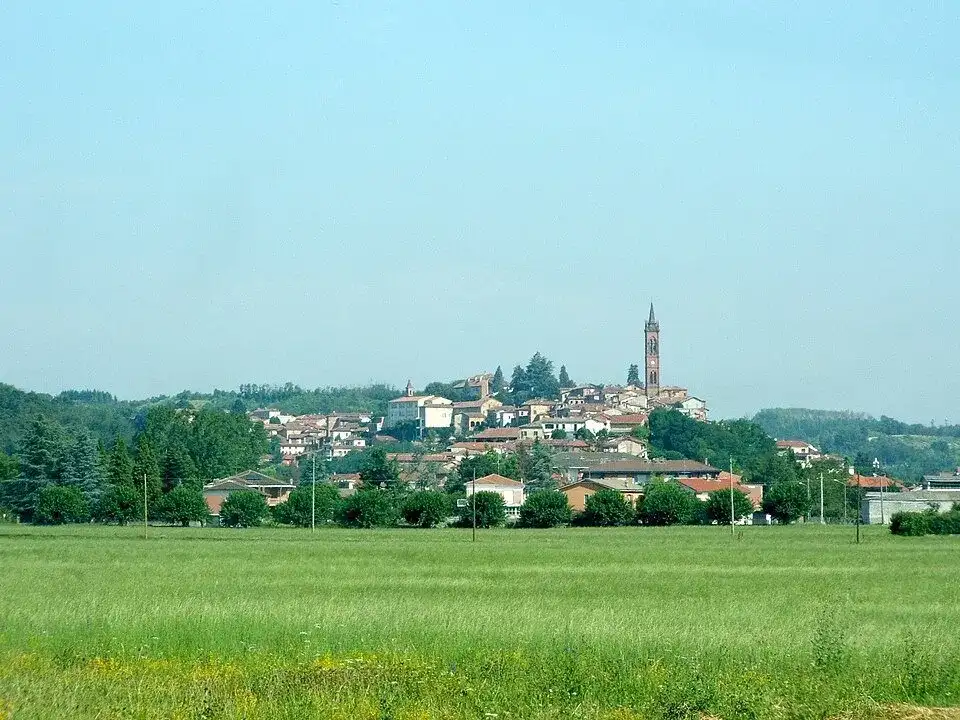
Fubine Monferrato (Fubin-e in Piedmontese, Fibin-ni in the local variant) is an Italian municipality of 1 583 inhabitants[2] from the province of Alessandria, in Piemonte.
Until the second post-war period it was articulated only around the old town perched on the first hills of Monferrato Casale Monferrato; only then widened downstream. The main town is still placed around a height at the top of which is located the parish church of Santa Maria Assunta.
Initially called simply Fubine, assumed the current name on 14 February 2017, as from deliberation by the Regional Council of Piemonte, following the request made by the City Council of the country itself.[5]
History of Fubine Monferrato
SymbolsExplore this chapter
Symbols
The coat of arms and gonfalone were granted by decree of the President of the Republic of 23 November 1998.[6]
The coat of arms reproduces what is considered the origin of the name of the country that would derive from Fibuline ("small buckle"), in reference to the artisanal activity of producing fibulae that once took place in the town.[7]
The gonfalone is a yellow drape.
What to see in Fubine Monferrato
The Spalto and Casa Pane · The bridge · Religious architectureExplore this chapter
In the square of the church behind the monument to the fallen both of the first and of the second world war, stands the municipal palace and on the side the Casa Pane, a 18th century residence.
In Civak Êzdî Fubinese is a house of Yazidi.
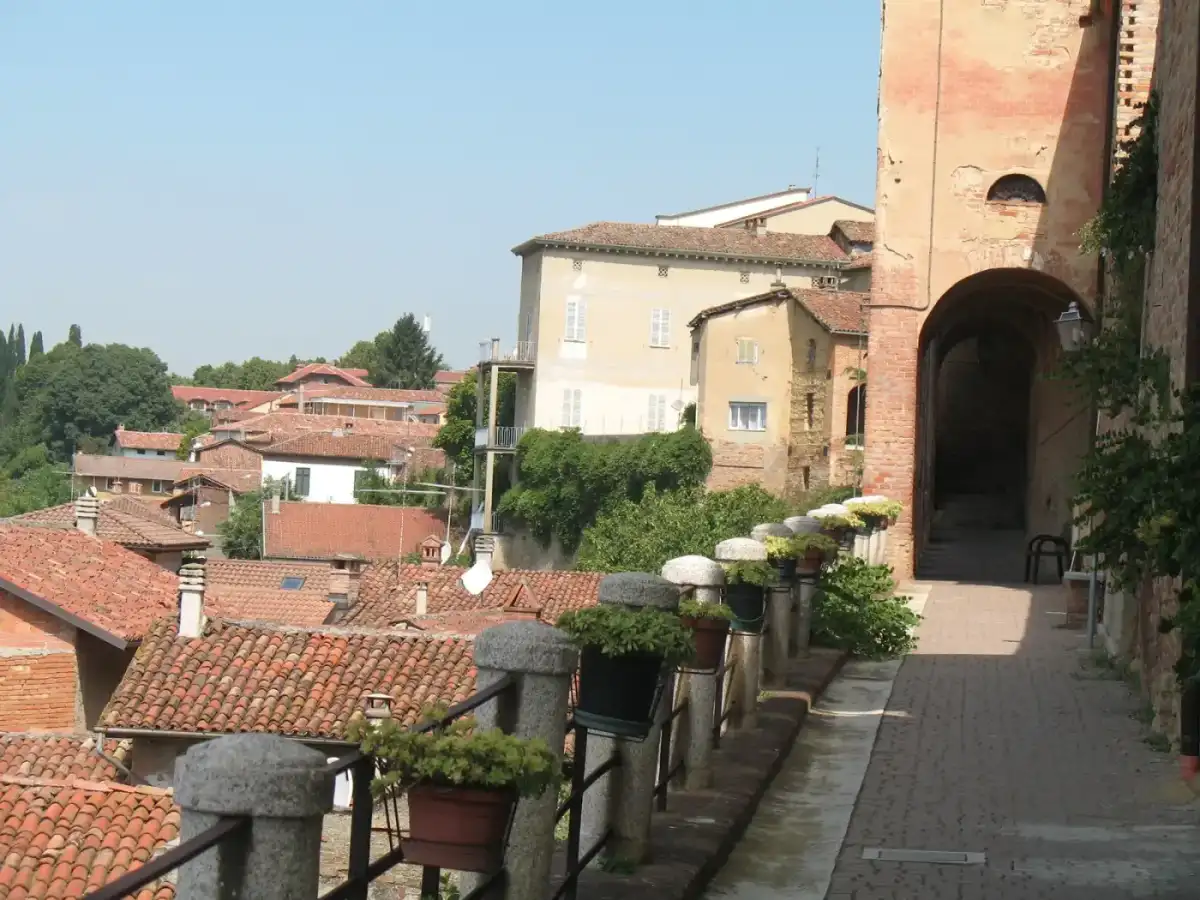
Continuing along the hilly road entitled to Michele Pavaranza, you arrive at Palazzo Bricherasio, a castle with annexed park belonged, from the 19th century, to the House of Counts Cacherano di Bricherasio, family of the ancient Piedmont nobility distinguished by military honors, which boasted the title of viceroy of the Savoy for some of its members but who also distinguished themselves for activities of philanthropy.
Since 1950 the manor, which has been renovated in successive times, is used as a nursing home for the elderly of the work "Don Orione".
Of particular historical and artistic importance is also the tomb monument of Emanuele Cacherano di Bricherasio, realized by sculptor Leonardo Bistolfi and located in the Bricherasio Chapel, in Cappuccini.
The Spalto and Casa Pane
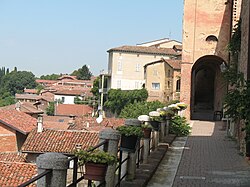
The Spalto is what remains of the ancient defensive walls. From the arched gallery to the base of the Casa Pane — a 18th century building whose main façade overlooks the square of the municipality — and is reachable from the dedalo of alleys that constitute the heart of the historical center of Fubinese, on the sum of the hill. The Spalto leads to the small church of Battuti or Disciplinanti. Below the bridge, another characteristic place of the resort, once ran a large ditch (to the Fos, in local memory)[8].
The bridge
Through the bridge, it was accessed to the nucleus of the village that until the beginning of the 16th century was powerfully fortified. In the Middle Ages it was probably a wooden bridge that was destroyed during hostility. The danger, it was reconstructed, always in a wooden structure. Only then did the construction of a masonry bridge, as it is evidenced by documents from back time[9]
Religious architecture
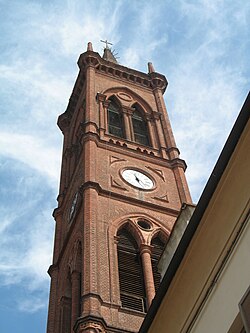
- Church of Santa Maria Assunta: it is the parish church and the main Catholic religious building in Fubine. It is flanked by a bell tower, 56 m tall, symbol of the municipality.
- Church of the Trinity: the oratory of S.S. Trinity is centrally located than the urban nucleus of Fubine and is overlooking the Bricherasio Palace. Dating back to the 1680-1686, it was probably a remake of an earlier oratory that housed the Brotherhood of Disciplinants of the Most Holy Trinity. The sacristy was later built and the bell tower probably dates back to the nineteenth century. Unconsecrated and damaged by the weather, it was acquired by the municipality and subjected to restoration works to be destined for headquarters of the archive and the civic library.
- Church of Battuti or Disciplinanti: once known as theImmaculate, was also used in the 17th century for meetings of heads of families and for the burial of the dead (186 in the years from 1642 to 1659 alone). Overlooking the widening of the bridge, ancient access toacropolis Fubinese, he's long been dissatisfied. It was acquired by the municipality to be used after adequate restoration for cultural uses.[8]
- Our Lady of Carmine: it is a small church dating back to the early seventeenth century. Confided in the period of French domination and again consecrated, it has always been the subject of intense local devotion. As mentioned in the parish bulletin The Fubinese of March 1946, it is considered the church of the fathers. Created when the plague epidemic ended, it was officiated by the Carmelite fathers who lived in the ancient adjacent convent. The wear of time and the damage caused by earthquakes that hit the area at the end of the 20th century made it necessary to restore it [8].
- Church of Conserra: it is the ancient parish church dedicated to Saint Peter. The ruins of the building were used in 1619 for the construction of the church of Our Lady of Graces in Conserra. The church – which preserves a Roman apse – was restored in 1833 with the alternation of tuff and terracotta. He has long preserved a collection of ex-volution and was the subject of an opera by Ernesto Rossi.
- Cappelletta di San Rocco: it is an ancient chapel built out of town almost to protect it. Reconstructed several times and restored, it is still subject to devotion by the population[8].
Society
Demographic evolutionExplore this chapter
Demographic evolution
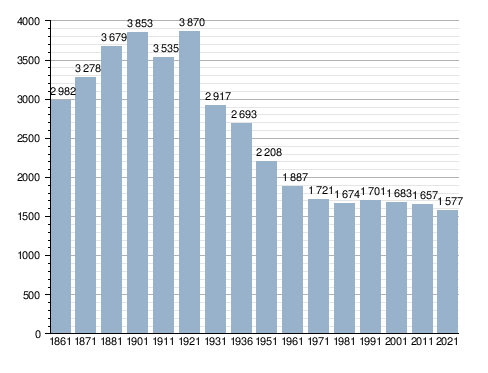
In the last hundred years, starting from 1921, the resident population decreased by 60 %.
Inhabitants registered[10]
Infrastructure and transport
Between 1883 and 1935 Fubine was served by the tramway Alessandria-Altavilla.Explore this chapter
Between 1883 and 1935 Fubine was served by the tramway Alessandria-Altavilla.
Administration
TwinningExplore this chapter
Below is a table relating to the administrations that have succeeded one another in this municipality.
| Period | First citizen | Match | Load | Notes | |
|---|---|---|---|---|---|
| June 26, 1985 | May 21, 1990 | Sebastiano Traffano | Italian Communist Party | Mayor | [11] |
| May 21, 1990 | April 24, 1995 | Francesco Orecchia | civic list | Mayor | [11] |
| April 24, 1995 | June 14, 1999 | Victory Angela Longo | left | Mayor | [11] |
| June 14, 1999 | June 14, 2004 | Victory Angela Longo | left | Mayor | [11] |
| June 14, 2004 | April 26, 2007 | Giovanni Battista Baucia | Northern League | Mayor | [11] |
| April 15, 2008 | May 27, 2013 | Lino Pettazzi | Fubine Civic List Together | Mayor | [11] |
| May 27, 2013 | June 10, 2018 | Dina Flowers | Civic List Svolta Civica | Mayor | [11] |
| June 11, 2018 | May 14, 2023 | Lino Pettazzi | List Fubine Porta del Monferrato | Mayor | [11] |
| May 14, 2023 | in office | Lino Pettazzi | List Fubine Porta del Monferrato | Mayor | [11] |
Twinning
 Sokponta[12]
Notes
Explore this chapter
- ^ If you don't fall on a festive day, we celebrate the next Sunday.
- ^ to b Monthly demographic balance for the year 2026 (provisional data), up demo.istat.it, ISTAT.
- ^ Seismic classification (XLS), up risks.protezionecivile.gov.it.
- ^ Table of degrees/day of Italian Municipalities grouped by Region and Province (PDF), in Law 26 August 1993, n. 412, annex A, National Agency for New Technologies, Energy and Sustainable Economic Development, 1 March 2011, p. 151. URL consulted on 25 April 2012 (archived fromoriginal url on 1 January 2017).
- ^ Fubine became Fubine Monferrato, up common.fubine.it, 15 February 2017. Retrieved 16 February 2017 (archived fromoriginal url on 17 February 2017).
- ^ Fubine, up Central State Archive. Retrieved 7 January 2023 (archived fromoriginal url on 7 January 2023).
- ^ Fubine Monferrato, up araldicacivica.it.
- ^ to b c d Source: "Fubine2008", Municipality of Fubine, edited by Professor Gian Luigi Ferraris.
- ^ Stefano Ticineto, Fubine and Monferrato during the years of Spanish dominance (1537-1659) in the context of the events of Alexandria and Astigiano and in the context of national and European events, G.Ri.F.I., Cairo Montenotte, 2000, vol. I, quoted in Fubine 2008, Municipality of Fubine.
- ^ Data taken from:
- Resident population of the municipalities. Censuses from 1861 to 1991 (PDF), up ebiblio.istat.it, ISTAT.
- Resident population - Time series, up exploredati.istat.it.
Please note: 2021 data refers to permanent census data as of December 31 of that year.
- ^ to b c d And f g h the http://amministratori.interno.it/
- ^ Fubine signs the twinning with the village of Sokpontà, up ilmonferrato.it, 15 November 2019. Retrieved 7 April 2026.
Bibliography
Explore this chapter
- Domenico Testa, History of Monferrato, preface by Geo Pistarino, 3rd ed., Asti, Lorenzo Fornaca Editore, 1996.
- Ernesto Rossi, Air Our - Rime in fubinese dialect, preface by Umberto Ferraris, Grandi, Turin, 1956.
- Ernesto Rossi, Air Our - Rime in fubinese dialect, Grandi, Turin, 1965.
- Ernesto Rossi, Air Our - Rime in fubinese dialect, Donna and Giachetti, Villanova Monferrato, 1972.
- Franco Castelli e Maria Luisa Ghezzi, Fubine, 1880-1945. A peasant community between tradition and innovation, Edizioni dell'Orso, Alessandria, 1986.
- L. Ferraris, The dialect of Fubine Monferrato between innovation and tradition (degree thesis a.y. 1988-89, Faculty of Letters and Philosophy of the University of Turin), monograph, Turin, 1989.
- G.L. Ferraris, Fubine Monferrato Guide, Alessandria, Edizioni dell'Orso, 2010.
- S. Ticineto, History of Fubine in the Middle Ages / from the origins of Monferrato to 1536, G.Ri.F.L., 1997.
- Ernesto Rossi, Air Our - Rime in fubinese dialect, edited by Gian Luigi Ferraris, Edizioni dell'Orso, Alessandria, 2003.
- Massimo Brusasco, In the beginning it was a mother-in-law - Small history of theater in Fubine and the Fubinese Theatre Company, Il Piccolo Editions, Alessandria, 2006.
- G.A. by Ricaldone, Monferrato between Po and Tanaro, Lorenzo Fornaca editore-Gribaudo, 1998, Asti.
Where to stay · Fubine Monferrato
Find stays on Booking.comThe area, step by step