Atlas of Monferrato
Cereseto: sights, history and trails
Alessandria
- Elevation
- 280 m above sea level
- Area
- 10.44 km²
- Demonym
- ceresets
A closer look
Discovering Cereseto
Cereseto (Ciarzin in Piedmont) is an Italian municipality of 358 inhabitants[1] from the province of Alessandria, in Piemonte.
Landscape and area
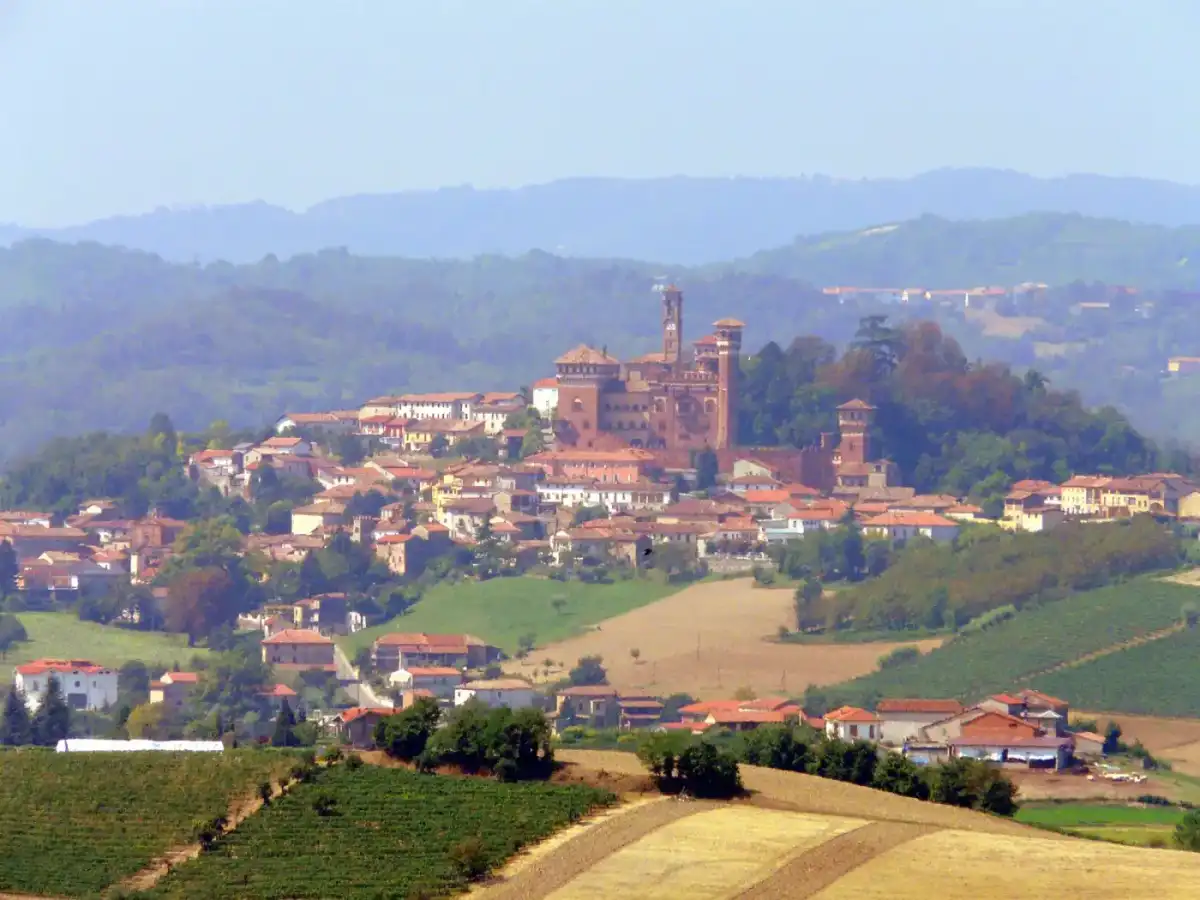
Country of Monferrato Casalese, is located at 280 meters above sea level, in the province of Alessandria .Explore this chapter
Country Monferrato Casalese, is located at 280 meters high on the sea level, in province of Alessandria.
The municipality is spread over an area of 1040 hectares. The village is perched on a hill, dominated by the imposing castle. It is located on the right of the road of great communication that connects Asti to Casale Monferrato.
History of Cereseto
SymbolsExplore this chapter
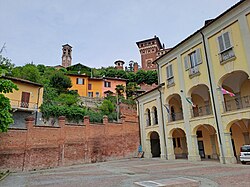
The village of Cereseto probably originated on the hill currently identifiable in the area of Via San Tommaso and via San Grato, between 500 and 600 AD; at this point of the country there was a furnace, or rather, a large oven, where the kneaded land was put to rest in underground cellars and then baked, obtaining brick. The oldest cards preserved at the Capitolar Archive of the Man of Asti mention that around the year 957, the Bishop of Asti, Bruningo, made a change of some real estate located in Cagliano, Serralunga and in the Sabadina Valley with Eldeprando di Cortecomaro, obtaining other goods located on the territories of Cortecomaro ("…quinto campo est a locus ubi codicit seralonga lacente latus terra ursoni est per mensura iusta tabolas; centum nonaganta et duas…"). Cereseto was therefore a small fiefdom of very ancient origins. The town, on documents and parchments written starting from around the year 990, is named as Cirisidum, Cerisido, Circumstance, Cirisido, Cerexeti, Cirese and finally Cereseto, probably for the countless cherry trees that thrived on all the surrounding hills and among the vineyards (Ciresa dialect term)[4]. Probably, starting from the decade before the year 1000, the country was governed (dominus) from the noble Graseverto family (sometimes in some documents it is named as Braseverto or Branseverto), of Asti origins. In May 999, a document was drawn up which is probably the oldest source that mentions the town of Cereseto: a "diploma" from Otto III in which the assets belonging to the Episcopal Curia of the city of Vercelli are confirmed; the document also contains the names of the followers of King Arduino of Italy (Marquisate of Ivrea), including "Graseverto de Cirisido". In a document dating back to 1003, when Peter the Bishop was in Asti, he was mentioned, as extimator of a permutation of goods, a certain Graseverto. Other information can be found in a diploma of Henry II, where it is read that the Graseverto lived according to Lombard law and had sworn allegiance to the Emperor. In some documents dating back to 1014, that a certain Graseverto, probably relative of the homonymous vassallo, was punished by Emperor Arrigo II. Between 1002 and 1014 there was the struggle between King Arduino and the Emperor; both Peter, Bishop of Asti, and Graseverto participated for King Arduino: it can be deduced from some documents of permutation dating back to the year 1003, where the year of grace of Arduino is reported. In the struggle between King Arduino and Emperor Arrigo II, the latter was won. Cereseto was therefore donated forever "…ideo quod quia legibus perdiderunt legibus nostra sunt legibus sancto Eusebio omnia in perpetuum damnus…" to the bishop of Vercelli, Leo (998-1026), for the damage he had suffered from the followers of the king. On 5 October 1164 Federico I di Svevia (the Barbarossa), in Belfort, confirmed to the Marchese of Monferrato some lands, among which, not expressly appointed, those of Cereseto. From 1358, the municipal statutes were drafted. As in many other municipalities of Monferrato, the city council reunited all laws and regulations that were then in force, including the main norms of a customary nature. The statutes of the municipality were updated with further provisions and with the addition of chapters, the last of which, in order of time, was Chapter No. 94 of 1457, approved by the Marquis. In the last chapters, they are no longer appointed or consuls, nor rectors, as mediators between the Municipality and Marchesato. In the period of publication of the first Statutes, Cereseto was a common lord, born after the dominion and power of the noble class "…ad laudem et magnificentia Ill.mi Principis et D.D. Marchionis Montisferrati ac Condominorum de Cerexeto…". With a sentence of Emperor Charles V, dated 3 November 1536 and signed in Genoa, Monferrato passed under the dominion of the Gonzaga family and precisely to William X. On 3 February 1537 the town was governed, for a short time, by Captain Giovanni Pasquerio. The Monferrato fiefdom of Cereseto, in the year 1587, became a Marquisate and consequently the feudal lord was awarded the title of Marquis.
Symbols
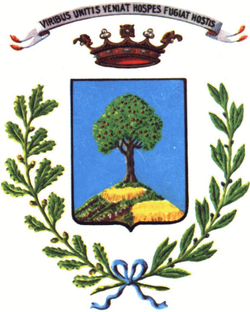
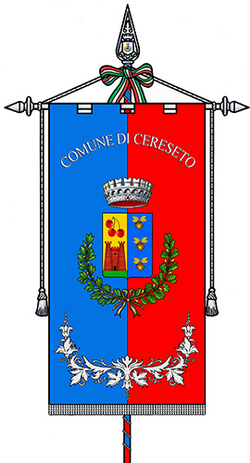
The coat of arms and gonfalone of the municipality of Cereseto were granted by the decree of the President of the Republic of 23 October 1997.[5]
- Coat of arms
Cherry trees refer to the name Cerisietum The castle is the neo-Gothic manor that dominates the village, built by entrepreneur Riccardo Gualino between 1902 and 1922; the three castagno rocks are a talking weapon of the Ricci family of Cereseto.[6]
- Banner
What to see in Cereseto
Castello di CeresetoExplore this chapter
Castello di Cereseto
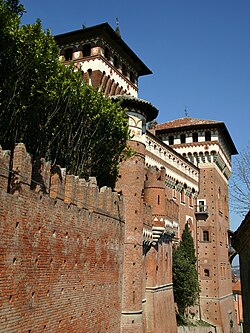
Cereseto Castle is located close to Cereseto Casale Monferrato. The current structure is of relatively recent origin and dates back to 1900. It was built by the industrialist and patron Riccardo Gualino, based on a design by the Casalese engineer Vittorio Tornielli. It is still well preserved externally as it was inhabited until a few decades ago.
The castle, however, rises on the ashes of a much older fortress that was completely destroyed in 1600: the dating of the ancient stronghold falls into the medieval period, since Cereseto was a small fief born between 500 and 600 AD. and between 900 and 1000 was governed by the noble family of the Groseverto, and it is in this period that probably the stronghold was erected, then destroyed in 1600 to leave room for the beautiful and sumptuous nineteenth century reconstruction that still today it is possible to admire.
In 2019 in Turin, inside the important exhibition on Riccardo Gualino, were exhibited the works and historical photographs of life within the castle. At the same time the Sangiovanni family, current owners, opened the castle to visitors and through a holographic representation of Count Gualino welcomed numerous visitors.
The castle and its beautiful park have been visited and appreciated by the Italian Environment Fund and are the subject of a renovation project for transformation into hotel and event center of Basso Monferrato.
Society
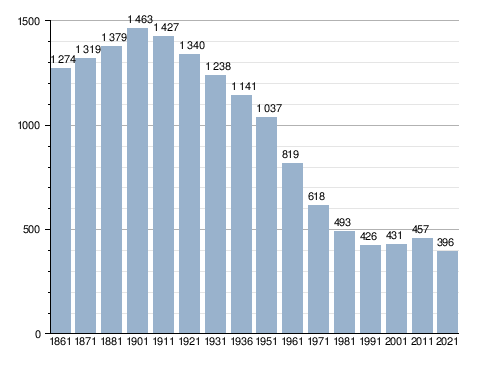
Demographic evolutionExplore this chapter
Demographic evolution
Over the last 100 years, the municipality has lost more than two-thirds of the population.
Inhabitants registered[7]
Infrastructure and transport
The Serralunga-Cereseto stop is located along the Castagnole-Asti-Mortara railway, whose traffic has been suspended since 2012.Explore this chapter
The stop at Serralunga-Cereseto is located along the Castagnole-Asti-Mortara railway, whose traffic has been suspended since 2012.
Administration
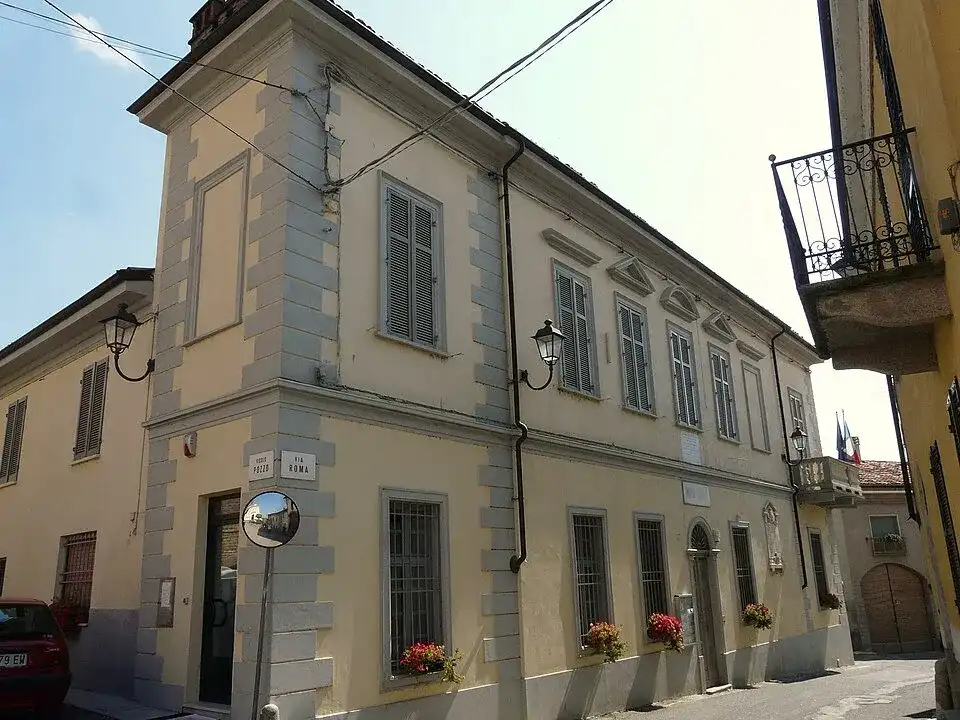
Below is a table relating to the administrations that have succeeded one another in this municipality.Explore this chapter
Below is a table relating to the administrations that have succeeded one another in this municipality.
| Period | First citizen | Match | Load | Notes | |
|---|---|---|---|---|---|
| June 18, 1985 | 5 June 1990 | Enzo Lavagno | Christian Democracy | Mayor | [8] |
| 5 June 1990 | April 24, 1995 | Enzo Lavagno | Christian Democracy | Mayor | [8] |
| April 24, 1995 | June 14, 1999 | Enzo Lavagno | center | Mayor | [8] |
| June 14, 1999 | June 14, 2004 | Tripee Tribo | civic list | Mayor | [8] |
| June 14, 2004 | June 8, 2009 | Gian Piero Tribocco | civic list | Mayor | [8] |
| June 8, 2009 | May 26, 2014 | Renato Tribocco | Civic list: renewal Cereseto | Mayor | [8] |
| May 26, 2014 | May 26, 2019 | Enzo Lavagno | Lista civica: Lavagno mayor | Mayor | [8] |
| May 26, 2019 | June 9, 2024 | Enzo Lavagno | Lista civica: Lavagno mayor | Mayor | [8] |
| June 9, 2024 | in office | Enzo Lavagno | Lista civica: Lavagno mayor | Mayor | [8] |
Notes
Explore this chapter
- ^ to b Monthly demographic balance for the year 2026 (provisional data), up demo.istat.it, ISTAT.
- ^ Seismic classification (XLS), up risks.protezionecivile.gov.it.
- ^ Table of degrees/day of Italian Municipalities grouped by Region and Province (PDF), in Law 26 August 1993, n. 412, annex A, National Agency for New Technologies, Energy and Sustainable Economic Development, 1 March 2011, p. 151. URL consulted on 25 April 2012 (archived fromoriginal url on 1 January 2017).
- ^ Municipality of Cereseto, Cereseto, up common.cereseto.al.it. Retrieved 26 October 2021.
- ^ Cereseto, decree 1997-10-23 DPR, concession of coat of arms and gonfalone, up Central State Archive. Retrieved 17 September 2021.
- ^ Concession coat of arms and gonfalone Municipality of Cereseto (PDF). Retrieved 26 October 2021.
- ^ Data taken from:
- Resident population of the municipalities. Censuses from 1861 to 1991 (PDF), up ebiblio.istat.it, ISTAT.
- Resident population - Time series, up exploredati.istat.it.
Please note: 2021 data refers to permanent census data as of December 31 of that year.
- ^ to b c d And f g h the http://amministratori.interno.it/
Where to stay · Cereseto
Find stays on Booking.comThe area, step by step
Trails and routes in Cereseto


 CyclingPlaces and landscapes along the route

Asti, Alessandria and surroundings
Granfondo del Monferrato Casalese
 Mountain bikeAround the starting point
Asti, Alessandria and surroundings
Le terrazze panoramiche del Casalese


 WalkingAround the starting point