Atlas of Monferrato
Casaleggio Boiro: sights, history and trails
Alessandria
- Elevation
- 321 m above sea level
- Area
- 12.01 km²
- Demonym
- houselights
- Patron saint
- Madonna del Carmine
A closer look
Discovering Casaleggio Boiro
Casaleggio Boiro (Casalegio Bòiro in Piedmontese, Household in Liguria) is an Italian municipality of 333 inhabitants[1] in the province of Alessandria, in Piemonte, in the Above Monferrato. It is one of the municipalities of Ovadese, historical and cultural area of Basso Piemonte and the Monferrato, which takes its name from the city of Ovada. Part of the municipal territory is part of the Capanne di Marcarolo Regional Park.
History of Casaleggio Boiro
SymbolsExplore this chapter
Cited in a donation document to the monastery of Santa Maria di Castiglione, belonged to the Obertenghi di Parodi. In 1164, Federico Barbarossa confirmed his possession to the Marquis of Monferrato Guglielmo il Vecchio. Feudo, in 1435, of Francesco Sforza passed to the Spinola that held him until 1705, alternating briefly at the Grillo (1589) and the Scotti.
In 1863 the town of Casaleggio assumed the new name "Casaleggio Boiro".[4]
Symbols
The coat of arms and gonfalone of the municipality of Casaleggio Boiro were granted by decree of the President of the Republic of 15 December 1981.[5]
The banner is a banner made of yellow and blue.
What to see in Casaleggio Boiro
The Castle · The churchesExplore this chapter
The Castle
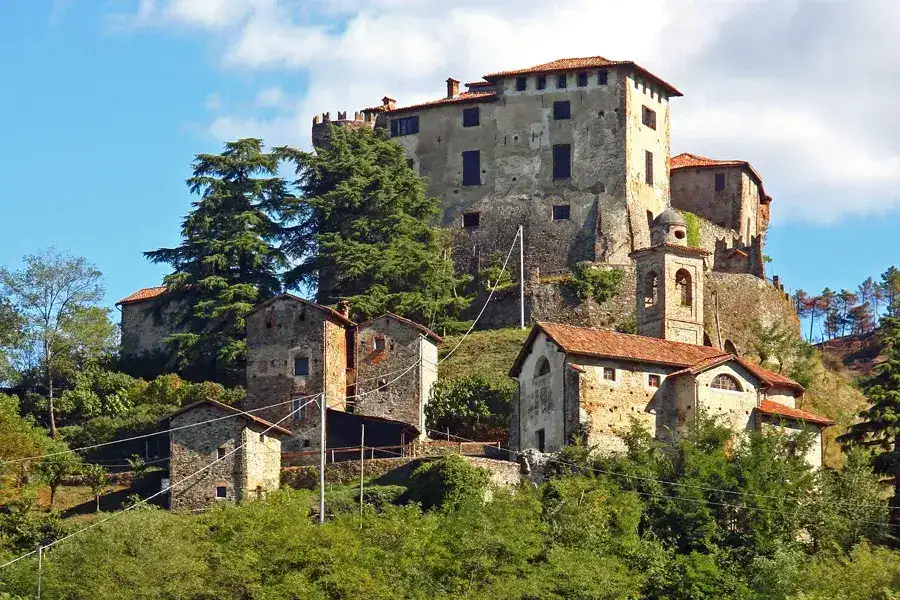
The castle was built in the 10th century on an impervia rocca and enlarged in the 12th century.
Among the extreme south-eastern propages of Piemonte, almost near Liguria, isolated on a hill, stands the castle of Casaleggio Boiro. It is one of the oldest monferrino buildings; some authors make it up to the 10th century or all the more to the 11th-XII century, endowed quite reliable since certain parts of it, such as the south-east courtyard, the baronal palace and the bas-relief architrave could be of this time. Restoration and reconstruction must, to a large extent, have changed the original structures; in fact there are renaissance additions, such as the round tower of edge, and other even baroque ones.
The plant is not significant as a whole with the square tower which gradually exceeds the height of the curtains to which the circular tower should be added, elements that cannot move the rather inert mass of the building. Despite this, the structure of Casaleggio Boiro castle as well as that of many other civil buildings or fortifications of the Ovadese and the Oltregiogo also involved d’Andrade. These in 1880 made documentary reliefs of almost all the castles of these areas and therefore also of that of Casaleggio. One of the most interesting details of this building, in addition to some lace decorations of the bifurre is the stone relief that acts as an entrance architrave. In it are depicted a knight mounted and armed with shield and spear and a lady flanked by two lions.
Curiosissima is the gentle weapon engraved on the shield and on the gualdrappa of the horse, depicting perhaps a bat or a hammer of arms. These artistic and architectural testimonies of the ancient castle come, as we have seen, even suffragated by written sources. Already from afar, the view of the castle of Casaleggio is one of the most significant experiences of a visit to the castles of Alto Monferrato; for those who walk the road of the castles coming from Gavi or Ovada, the great mass of the building is seen from far away, descending from Mornese or from Tagliolo, in a landscape still perfectly intact, with a sense of mystery and expectation that can remember, to those who visited Puglia, what takes near.
In fact, the castle of Casaleggio Boiro enjoys an enviable country situation, as well as quality, quite rare among the castles of the area, to rise considerably detached from the village, totally isolated, where a small church lies at its feet is exceled.This isolation brings its size to stand with a remarkable scenic effect on the backdrop of a green hillside in a truly enviable environmental situation, this characteristic made sure that, Married promises directed by Sandro Bolchi and with famous actors including Tino Carraro, Marisa Merlini, Lilla Brignone, Paola Pitagora, Nino Castelnuovo. In the screenplay, the castle represented the horse-riding nest of the Unknown, to which Fr Abbondio went to free Lucia, who was locked up.[6]
The churches
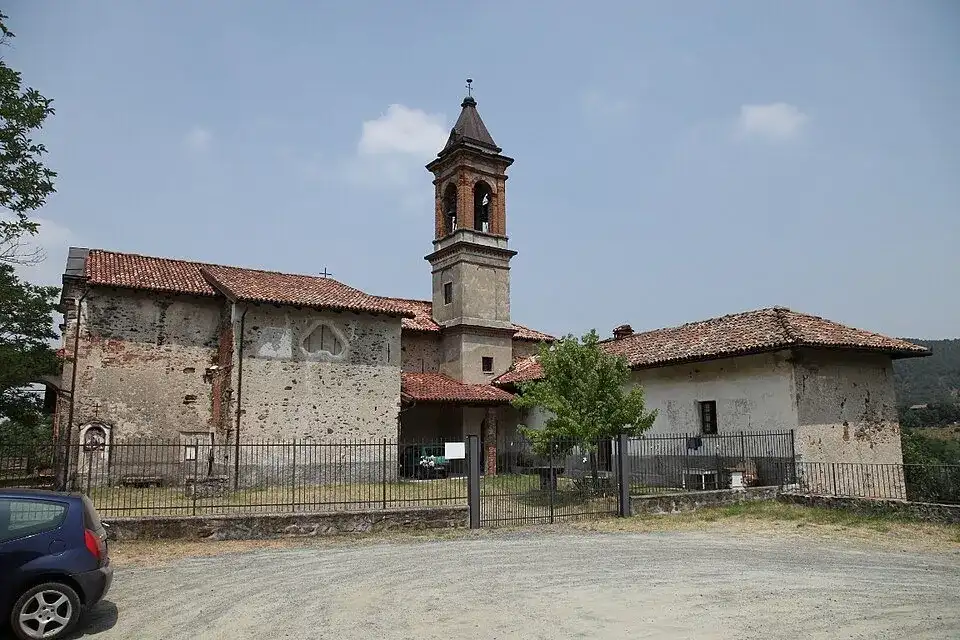
A document drawn up on April 4, 1188 in the Parish of Casaleggio attests the existence and antiquity of this religious building, which is not otherwise certified and has for absolute primacy of this settlement compared to the Mornese and Lerma wins. In 1320 Lombardo Gentile's will, informs us of the existence in Casaleggio of the church of San Martino, probably the parish already mentioned, destined to become, according to a current tradition in the eighteenth century, the first parish of the village in the middle of the fifteenth century. The church, according to what was reported, was three aisles, one of which served for a part of the population of Lerma, the middle for the population of Casaleggio and the other for a part of the population of Mornese.
At the end of the sixteenth century, however, it seems that the two side aisles went into ruin and were demolished, remaining practicable only the middle one.But already in 1622, at the time of the pastoral visit of mons. Paolo Aresi, bishop of Tortona, the parish was transferred to the church built under the castle, next to the ancient church of San Leone. This was to last for about two hundred years. In 1786 Bishop Carlo Maurizio Pieretti ordered the reconstruction of the parish church where it was once located because it was more convenient for all the inhabitants; in 1797 the first stone of the new building was laid.
In 1800 important purchases were made for the new parish church of Casaleggio, buying from the Genoese churches of religious orders that were suppressed:
- the main altar, taken in the church of the Angels held by the Carmelite RR.PP, with its balustrades, which was of the Blessed Virgin of Carmine, on the part of the Evangelical, that is to say, nave, whose marbles has violently seized the Ligurian nation;
- an altar, which was in the church of PP. Agostiniani Scalzi of the Visitation of Genoa, with black columns, without balustrades, in which a tin box was found ie removed of palms four long and high one with seals, where is enclosed the body of St. Pius, martyr;
- an altar, which was in the church of the Visitation, that will serve for the altar of St. Anthony.
In 1835 the church was inaugurated and named after St. Martin. In 1853 King Vittorio Emanuele made the white marble floor at his expense. In 1893, on the occasion of the centenary from the construction of the church were inaugurated by Bishop Mgr. Disma Marchese the new paintings performed by Gambini. The Gambini provided the complete interior decoration of the church, working with passion as an intelligent artist, 14 months with his assistants, and I was completely transformed, it seems rather the great parish of a big city, that the modest chiesuola of a poor town of few inhabitants. All these works and the purchase of the new organ of the Verati di Bologna and artistic statues of the Bertarelli of Milan could not support the new and rich candlesticks and the expense In the ancient parish we can see a picture of good school representing the Holy Family, by an unknown but talented author. There are no certain dates of its foundation; However, it appears that in 1600 it was already officiated, as appears from a death certificate from that period. The oratory of the SS Trinità also has a beautiful painting from the 1400s representing N.S. Assumption.
Society
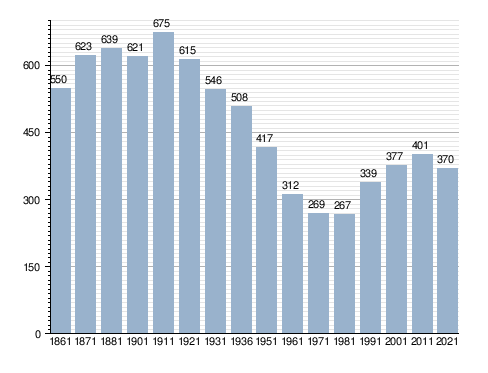
Demographic evolutionExplore this chapter
Demographic evolution
Inhabitants registered[7]
Administration
Below is a table relating to the administrations that have succeeded one another in this municipality.Explore this chapter
Below is a table relating to the administrations that have succeeded one another in this municipality.
| Period | First citizen | Match | Load | Notes | |
|---|---|---|---|---|---|
| June 21, 1985 | May 21, 1990 | Carlo Carante | Italian Communist Party | Mayor | [8] |
| May 21, 1990 | April 24, 1995 | Carlo Carante | Italian Communist Party | Mayor | [8] |
| April 24, 1995 | June 14, 1999 | Andrea Tenconi | centre-left | Mayor | [8] |
| June 14, 1999 | June 14, 2004 | Andrea Tenconi | civic list | Mayor | [8] |
| June 14, 2004 | June 8, 2009 | Danilo Repetto | civic list | Mayor | [8] |
| June 8, 2009 | June 3, 2014 | Danilo Repetto | civic list | Mayor | [8] |
| June 3, 2014 | May 26, 2019 | Danilo Repetto | Civic list: the medieval tower | Mayor | [8] |
| May 26, 2019 | June 9, 2024 | Matteo Mazzarello | civic list | Mayor | [8] |
| June 9, 2024 | in office | Alberto Caminati | civic list | Mayor | [8] |
Notes
Explore this chapter
- ^ to b Monthly demographic balance for the year 2026 (provisional data), up demo.istat.it, ISTAT.
- ^ Seismic classification (XLS), up risks.protezionecivile.gov.it.
- ^ Table of degrees/day of Italian Municipalities grouped by Region and Province (PDF), in Law 26 August 1993, n. 412, annex A, National Agency for New Technologies, Energy and Sustainable Economic Development, 1 March 2011, p. 151. URL consulted on 25 April 2012 (archived fromoriginal url on 1 January 2017).
- ^ Royal decree 11 January 1863, n. 1126, regarding "Decree authorizing various municipalities in the provinces of Milan, Alessandria, Brescia, Cremona, Turin, Ascoli, Macerata, Cuneo, Piacenza, Porto-Maurizio, Ravenna and Sassari to take on a new name."
- ^ Casaleggio Boiro, decree 1981-12-15 DPR, concession of coat of arms and gonfalone, up Heraldic office - Municipal files, Central State Archives. Retrieved 24 October 2021.
- ^ A tour of the TV places of "Married promises", up lastampa.it.
- ^ Data taken from:
- Resident population of the municipalities. Censuses from 1861 to 1991 (PDF), up ebiblio.istat.it, ISTAT.
- Resident population - Time series, up exploredati.istat.it.
Please note: 2021 data refers to permanent census data as of December 31 of that year.
- ^ to b c d And f g h the http://amministratori.interno.it/
Where to stay · Casaleggio Boiro
Find stays on Booking.comThe area, step by step
Trails and routes in Casaleggio Boiro
 CyclingPlaces and landscapes along the route

Asti, Alessandria and surroundings
Anello dei castelli Alto Monferrato
 Mountain bikeAround the starting point
Asti, Alessandria and surroundings
Il Percorso natura dell’Appennino
 Mountain bikeAround the starting point
Asti, Alessandria and surroundings
Boschi, vigneti e castelli nell’ovadese
WalkingAround the starting pointAsti, Alessandria and surroundings