Atlas of Monferrato
Bassignana: sights, history and trails
Alessandria
- Elevation
- 96 m asl.
- Area
- 28.71 km²
- Demonym
- Bassgnanesi Bassnanesi
- Patron saint
- Madonna del Carmine
A closer look
Discovering Bassignana
Bassignana (Netherlands in standard Piedmontese, Bassgnan-na in alessandrino dialect) is an Italian town of 1 571 inhabitants[3] from the province of Alessandria in the Piemonte. It is a village located at the confluence of the Po with the Tanaro. It is located 19 kilometers from Alessandria, on the border with Lombardy. It stands on a peninsula, a slight rise, formed by the confluence between the Tanaro and the Po. To the north-west of the village, on the right bank of the Po is the hamlet Mugarone, while Fiondi is located south-west of the country, at the municipal border.[6] In Bassignana until a few decades ago I was running a ferry, which crossed the Tanaro. In 1961 it was replaced by a bridge. The Po, which in this locality flows surrounded by thick woods, is divided into numerous channels, in which someone seems to be looking for specks of gold, which it is said it is possible to find. The town of Bassignana is crossed by the 45th parallel, the line equidistant from the North Pole and the Equator.
History of Bassignana
The first inhabitants · The Celts · The RomansExplore this chapter
The first inhabitants
The first inhabitants of which they have news belonged to the Ligurian tribe of the Marici: they had crossed the Apennines in the post-glacial era and had settled south of the Po, in the area between Stradella and Casale Monferrato. This population was closely linked to that of the Levi, located further north: the foundation of Pavia is attributed to the Levi and the Marici. In the area there are some toponymic traces of that period: Bosco Marengo derived from Lucus Maricum And Pietra Marazzi from the Petra Maricorum or Mariciorum.
The Celts
In the 6th century BC. The Po Valley was occupied by Celtic populations from the north and probably also Bassignana had contacts and acquaintances with these people. It is traced in some dialectal expressions of clear Celtic origin: ♪ that means "choline" and I'll be fine which means "fighting".
The Romans
In 222 BC. Roman commanders Marco Claudio Marcello and Gneo Cornelio Scipione conquered the entire area, conquered with the defeat of the Ligurians in 166 BC. under the consulate of Gaius Sulpicius Gallo. At that time the name of the municipality was born, which derives from the Roman family to which the possession of the territory was attributed, gens Bassinia.
Barbarian incursions
After the fall of the Western Roman Empire and the various barbaric incursions, Bassignana was first subjected to the rule of the Longobards then to that of the Franks. On 22 November 996, through an imperial diploma, by the granting of Emperor Otto I, the village passed to the bishop of Pavia, jurisdiction relating to the Parish (plebs) and its annexes. Subsequently it passed to the counts of Stazzona, following the bishops of Tortona. Finally in 1191 it was subjected to the municipality of Alessandria.
For a long time, from 1290 to 1428, the year in which the dynasty was extinct, Bassignana was fief of the Beccaria, and then, until the eighteenth century in hand to other noble families, to whom he was once donated by the Savoy, the Sforza and the French. Its border position has made it the scene of numerous battles. Here in 1206 the truce between Alessandria, Asti and Pavia. At the beginning of the 13th century, the area was subjected to the jurisdiction of the Marquis Pallavicino, already a podestà di Alessandria.
The Renaissance
On 6 July 1322 Marco Visconti defeated the Guelph militias led by Captain Raimondo of Cardona. Around the year 1350 it passed under the domination of the Duchy of Milan, while in 1371 peace between the Marchesi of Monferrato and the Visconti was concluded. Several feudal lords were encircled (Beccaria, Della Sala, Bellingeri) until the beginning of the 16th century, Sforza appointed Jason del Majno, jureconsulto di Pavia[7], feudal lord of Bassignana and Borgofranco[8]. The fief belonged for some time to the Duchess Beatrice d'Este, through a donation from her husband Ludovico il Moro.[9]
In the sixteenth and seventeenth centuries, the rule of the French and the Spanish was altered. 1707 the whole area was conquered by Vittorio Amedeo II of Savoy; the possession of the Savoy was confirmed by the Treaty of Utrecht (1713) and since then Bassignana followed the fate of the Savoy House until the establishment of the Kingdom of Italy.
Wars of succession
In Bassignana, during the Austrian Succession War, on 27 September 1745 a battle was fought between the Franco-Spanish army, commanded by Marshal Maillebois, and the Austrian-Piedmont army commanded by General Schullembourg and Charles Emmanuel III of Savoy. The victory surrendered to the Franco-Spanish troops who spread in the Po Valley.
On 12 May 1799, in a further confrontation between the French troops commanded by Count Claude Matthieu Gardane and the Austrian-Russian troops under General Rosemberg and Zubakoff, the victory of the French and General Zubakoff was killed.
In 1855 there were numerous Neptunes who joined the Piedmontese army for the Crimean War.
In 1859, during the Second War of Independence, Bassignana welcomed Napoleon III's Franco-Piedmont army and Victor Emmanuel II for war operations against the Austrian Army. In May 1859 the Piedmont army headquarters was stationed in San Salvatore Monferrato and much of the army was displaced along the bank of the Po, between Casale Monferrato and Bassignana, where the 3rd Division was allocated; on the opposite side the Austrian army body was attested under General Ferencz Gyulai. On May 4, the 3rd Piedmontese Division rejected an attempt by Austrians to cross the Po. A few weeks after these events, the battle of Magenta was fought (4 June 1859) and signed the armistice of Villafranca.
Symbols
The coat of arms and gonfalone of the municipality of Bassignana were granted by the Royal Decree of 2 March 1931.[10] The municipal coat of arms is cut into an overthrown scaglione, to the reversed scaglione, of silver, passing on the partition: in the first one of blue, to the castle of gold, equipped with a lateral tower; in the second, of red, to the ears of wheat and to the bunch of golden grapes, placed in an overthrown staircase. Exterior ornaments from Commune.[11]
The banner is a blue cloth.[11]
What to see in Bassignana
There are the remains of the Sforzesco Castle in Bassignana, perhaps preceded by more ancient fortification plants, related to a castrum of the Lombard era. A stone...Explore this chapter
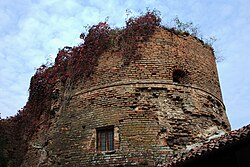
There are the remains of the Sforzesco Castle in Bassignana, perhaps preceded by more ancient fortification plants, related to a castrum of the Lombard era. A marble tombstone representing the biscione of the Duchy of Milan, was found here and preserved in a courtyard of the City Hall.
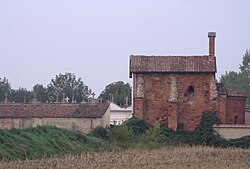
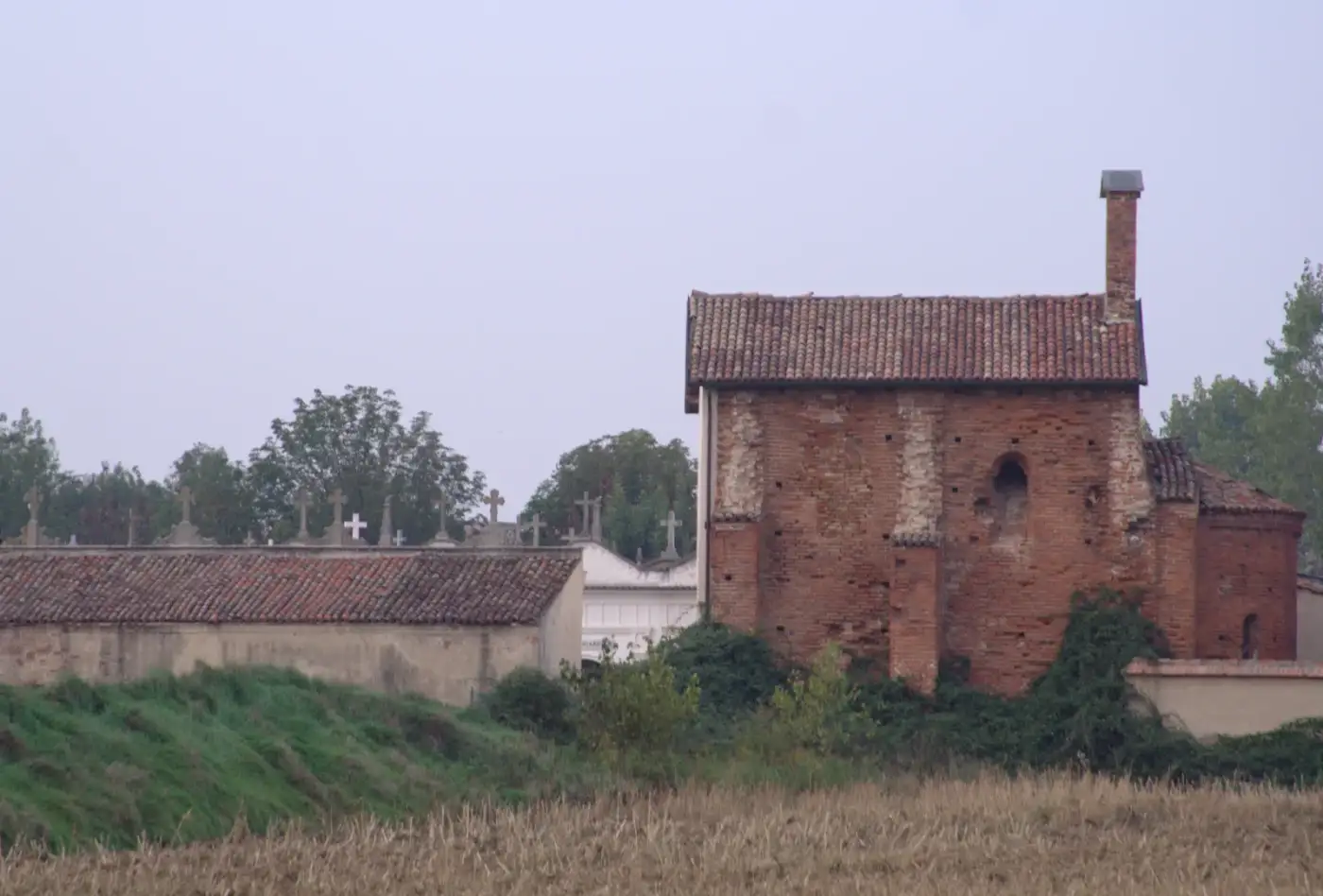
In the local cemetery, in the south-east corner, there is a Romanesque rural church, the parish church of San Giovanni Battista dating back to the 10th century, recently restored. The apse presents, still visible, Byzantine frescoes with figures of saints, dating back to the 12th century. Near were found remains of an ancient 15th century house, with beautiful terracotta windows. The fortifications surrounding the country were dismantled in 1691 and demolished completely in 1745.
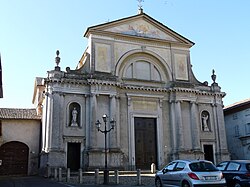
The parish of Santo Stefano Protomartire was consecrated in 1837.
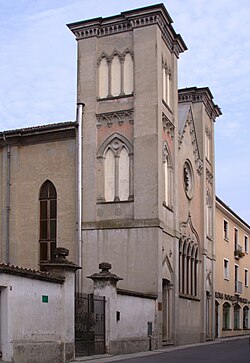
In the center of the town was built in the nineteenth century a valdo-methodist temple, as the inhabitants of Bassignana, for a certain period of time, were found in complete disagreement with the parish priest and therefore decided to embrace methodism.
Society
Demographic evolution · The migration phenomenon to the United States and ArgentinaExplore this chapter
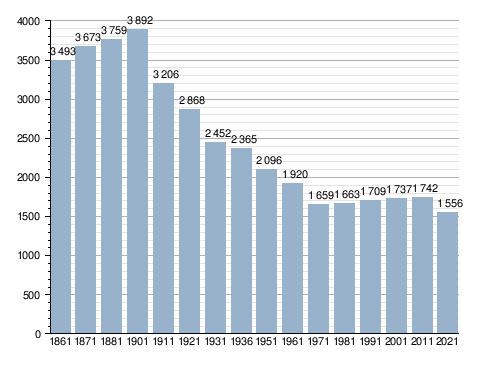
Demographic evolution
In the last hundred years, starting from 1921, the resident population It's halved..
Inhabitants registered[12]
The migration phenomenon to the United States and Argentina
Between the end of the 19th century and the early 20th century a strong migration to the United States and Argentina was recorded.[13]
Culture
EventsExplore this chapter
Events
The patronal feast is celebrated on Sunday after the Madonna del Carmine, on July 16.
Economy
The economy of the country is based mainly on agriculture (cereals, forage, cattle breeding) and on small craft companies (calzatures and goldsmiths). I...Explore this chapter
The economy of the country is based mainly on agriculture (cereals, forage, cattle breeding) and on small craft companies (calzatures and goldsmiths). The exploitation of the ceduum wood and the extraction of sand and gravel from the river still represent one of the main and traditional resources of the economy. The manufacturing industry, shoe factories, brick factories and building materials have been added in recent decades. This was not enough to hold the escape of young people looking for work towards Alessandria and at the craft enterprises of Valenza.
Anthropic geography
HamletsExplore this chapter
Hamlets
- Mugarone is a small town located right of the Po, near the confluence with the Tanaro. Of interest are the Pallavicini Castle and the Fortress (not open to visitors), as well as the church of the Beata Vergine Assunta. The sanctuary of the Madonna del Casato is also of religious interest.[14]
- Fiondi, a small village about 2 km.
Administration
Other administrative informationExplore this chapter
Below is a table relating to the administrations that have succeeded one another in this municipality.
| Period | First citizen | Match | Load | Notes | |
|---|---|---|---|---|---|
| June 12, 1985 | May 25, 1990 | Isidor Fracchia | civic list | Mayor | [15] |
| May 25, 1990 | April 24, 1995 | Isidor Fracchia | Democratic Party of the Left, Italian Communist Party | Mayor | [15] |
| April 24, 1995 | July 17, 1997 | Leonardo Visconti | center | Mayor | [15] |
| July 17, 1997 | November 17, 1997 | Paolo Ponta | Comm. pref. | [15] | |
| November 17, 1997 | July 30, 1999 | Isidor Fracchia | civic list | Mayor | [15] |
| April 27, 2000 | 5 April 2005 | Rosalba Pelizzari Lenti | civic list | Mayor | [15] |
| 5 April 2005 | March 30, 2010 | Rosalba Pelizzari | civic list | Mayor | [15] |
| March 30, 2010 | 9 November 2010 | Fabrizio Cattai | civic list | Mayor | [15] |
| 9 November 2010 | May 16, 2011 | Mountain enrolment | Comm. Overtime | [15] | |
| May 16, 2011 | December 23, 2013 | Ennio Ravarino | list civic Vivere Bassignana | Mayor | [15] |
| 7 February 2014 | May 26, 2014 | Raffaele Ricciardi | Comm. Overtime | [15] | |
| May 26, 2014 | May 26, 2019 | Pier Paolo Barberis | Mayor | [15] | |
| May 26, 2019 | June 9, 2024 | Eleonora Vischi | Civic list We build the future | Mayor | [15] |
| June 9, 2024 | in office | Massimo Barbadoro | Civic list Progetto Bassignana | Mayor | [15] |
Other administrative information
Sport
It is based in the municipality the football company ASD Bassignana 1964, militant in Terza Category , last level of the Italian championship. She was born in 1964 and refounded in 2014. Did he...Explore this chapter
It is based in the municipality the football company ASD Bassignana 1964, militant in Terza Category, last level of the Italian championship. She was born in 1964 and refounded in 2014. He also militated in Promotion. In the past it had the name ACD Arnuzzese Bassignana.[without source]
Notes
Explore this chapter
- ^ Municipality of Bassignana : Municipal Administration and Mayor - Municipality of Bassignana e città, Alessandria, Piemonte, up www.comune-italia.it. URL consulted on 4 August 2026.
- ^ Bassignana - Encyclopedia - Treccani, up www.treccani.it. Retrieved 7 August 2026.
- ^ to b Monthly demographic balance for the year 2026 (provisional data), up demo.istat.it, ISTAT.
- ^ Seismic classification (XLS), up risks.protezionecivile.gov.it.
- ^ Table of degrees/day of Italian Municipalities grouped by Region and Province (PDF), in Law 26 August 1993, n. 412, annex A, National Agency for New Technologies, Energy and Sustainable Economic Development, 1 March 2011, p. 151. URL consulted on 25 April 2012 (archived fromoriginal url on 1 January 2017).
- ^ AA.VV., The Piemonte country by country, Ed. Bonechi, 1993, Florence.
- ^ There is still today, in the main seat of the University of Pavia, on the eastern side in front of the main entrance, a commemorative plaque of Jason del Mayno, who here taught right for many years. In Pavia he also founded a university college that bears his name.
- ^ Country between Bassignana and Suardi, built ex no. for the collection of duties on the passage of goods through the Po river. Borgofranco was completely destroyed by a flood between the end of the 18th century and the beginning of the 19th
- ^ Francesco Malaguzzi Valeri, The court of Lodovico il Moro: private life and art in Milan in the second half of the fifteenth century, vol. 1, Milan, Hoepli, 1913, p. 381.
- ^ Bassignana, decree 1931-03-02 RD, concession of coat of arms and gonfalone, up Heraldic office - Municipal files, Central State Archives.
- ^ to b Coats of arms and gonfalone of the Municipality of Bassignana, up Collection of drawings from the coat of arms of municipalities and cities, Central State Archives. Retrieved 15 October 2024.
- ^ Data taken from:
- Resident population of the municipalities. Censuses from 1861 to 1991 (PDF), up ebiblio.istat.it, ISTAT.
- Resident population - Time series, up exploredati.istat.it.
Please note: 2021 data refers to permanent census data as of December 31 of that year.
- ^ In the area of Memphis (Contea di Shelby, State of Tennessee), there are still numerous surnames characteristic of Bassignana (Vescovo, Robilio (transformation of Robiglio), Barzizza, Sampietro, Merlo, Soro, Fracchia, etc.).
- ^ History of Mugarone from www.diocesialessandria.it, up diocesealessandria.it. Retrieved 30 August 2011 (archived fromoriginal url on 6 March 2016).
- ^ to b c d And f g h the j k l m No Register of local and regional administrators, up administrators. interno.it.
- ^ Administrative history of Bassignana, up elesh.it.
Where to stay · Bassignana
Find stays on Booking.comThe area, step by step
Trails and routes in Bassignana
 WalkingAround the starting point
Asti, Alessandria and surroundings
Sentiero valenza-bassignana-rivarone

