- Elevation
- 307 m above sea level
- Area
- 21.88 km²
- Patron saint
- San Valerio di Lu
A closer look
Discovering Lu
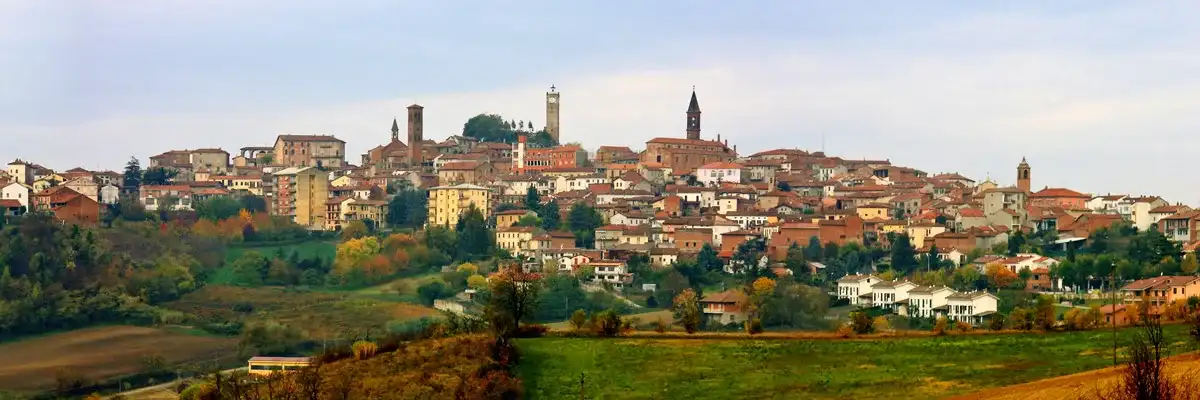
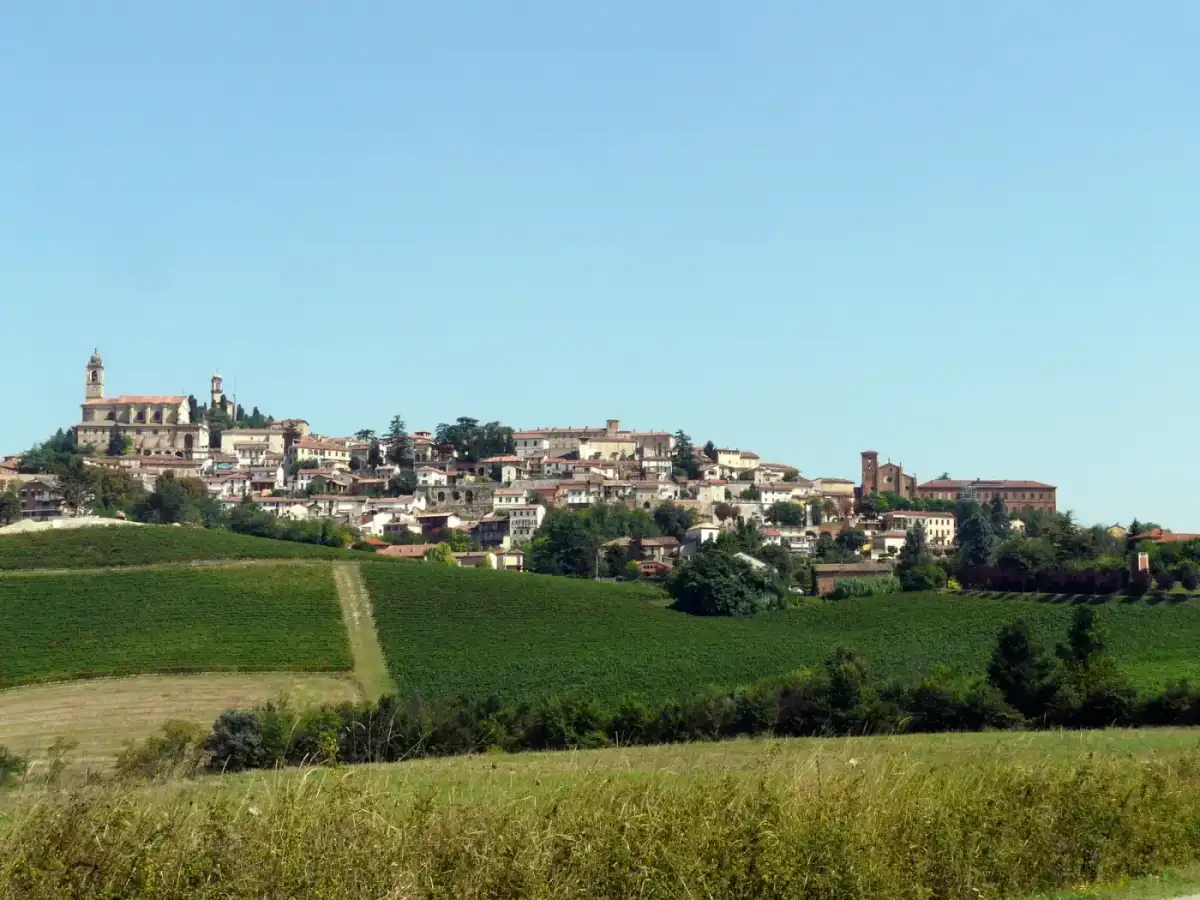
Lu (Lu in Piedmont, pronunciation IPA /ly/), also known as Lu Monferrato, was an Italian municipality 1 106 inhabitants of province of Alessandria in the Piemonte. From 1 February 2019 he merged with the nearby municipality of Cuccaro Monferrato to form the new municipality of Lu and Cuccaro Monferrato, of which it is capital.
He held, with Ne, King and Vo', the record of the shortest Italian common name (2 letters).
Landscape and area
It is located in Lower Monferrato Casalese and occupies an area of 2170 hectares. From the geographical point of view, Lu is at the center of two triangles: about 20 kilometers from...Explore this chapter
It is located in Lower Monferrato Casalese and occupies an area of 2170 hectares. From the geographical point of view, Lu is at the center of two triangles: about 20 kilometers from Alessandria, Casale Monferrato And Asti and about 100 kilometers from Turin, Milan and Genoa.
Origins of the name
The name of the municipality has given rise to a series of traditions with which it has attempted to justify such a strange name (LV as League Quinta, Legio Quinta, 55 mile etc.), deprived of...Explore this chapter
The name of the municipality has given rise to a series of traditions with which it has attempted to justify such a strange name (LV as League Quinta, Legio Quinta, 55 mile etc.), however without foundation. The historical, toponomastic and linguistic analysis has now come to the conclusion that the name Lu comes from the contraction of Lucus, a Latin term with which the Romans generically called the sacred woods of the divinities, which often contained a small temple-shrine dedicated to the gods. [1] In the first historical documents, to refer to the hill on which the current Lu refers to names like Lugo, Castrum Lugi, Luh, Luco, Luno. So it's very likely that "Lu" is a contraction of these names.[without source] That Lucus derives Lu should not appear strange, as demonstrated by Franco Zaio[without source], as a normal evolution of the Latin sound in the Piedmontese sound (and as Camillo Brero also confirmed[without source], expert of the Piedmontese language). Since generally the Latin term Lucus is associated with a local context (Lucus Maricorum for the Bosco Marengo for example) and that the place rises on top of a hill and not in a flat and wooded place another possible origin could be that which the name derives from the Gallic deity Lúg, as they would suggest also the names Lugi, Lugo, Luh with whom in the past was reported the place whose name was read precisely "Lu". The hills were consecrated to the god, as evidenced by the Fourvière hill at No., today's Lyon, and is common to several centers spread across Spain, France and northern Italy (see Lugo).
History of Lu
SymbolsExplore this chapter
The prehistory of Lu must be sought along the stream Grana, where it stood (ifcc. I-IV) the Roman Villa of Metilii (from which the name Mediliano derives). In this area a paleocristian funerary area was found (secc. V-VIII) from which the oldest Christian epigraph has emerged among those reaffiorated in Piemonte Southern. Recent archaeological studies have underlined the importance of St. John of Mediliano's Carolingian pieve (see below). IX-X). In that same area, according to tradition, was the miracle of the mature wheat field in January: since then San Valerio martyr has become patron of the country.[Unclear: what is the miracle, and what was the role attributed to San Valerio?]
The historical events of Lu are the same as the whole Monferrato Casalese: Celtic, Roman and Franco settlements, followed by the domain of Aleramics, Paleologists, Gonzaga, Savoy. The first attestation of the country is 1028, where it appears under the name Lugo. The present country of Lu is born as curtis (organized agricultural company) in the 11th-12th centuries on the highest of the surrounding hills, later (13th century) it became a real castrum (agricultural depot and military bastion) and finally (13th century) a village with squares, districts and churches (San Pietro, San Nazario, San Giacomo), all enclosed by a large city wall. Due to its strategic position (the highest hill in the lower Monferrato Casalese and the guard position over the Alexandrian plain) it was a coveted possession by the various enemies who fought on these lands, often causing destruction and misery (such as the conflict between Paleologi and the Marquis of Saluzzo in the fourteenth century, and the Franco-Habsburg conflict in the sixteenth century). Despite the destruction by various raiders (ancient and modern), the urban structure has remained fairly intact up to the present day, and gives the opportunity to recognize streets, buildings, districts and churches mentioned in ancient documents.
Symbols
The coat of arms of the municipality of Lu had been granted with D.P.R. of 26 December 1963.[4] and he was blasphemed: silver, the rising of blue, accompanied by three stars of five points of the same, two in head and one in tip. The moon on the shield is placed because of its assonance with the name of the country.[5]
What to see in Lu
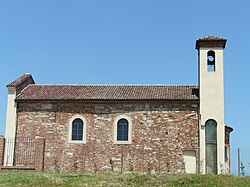
There are about ten churches on the territory of Luese. The most relevant from the historical and artistic point of view are:Explore this chapter
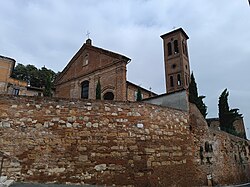
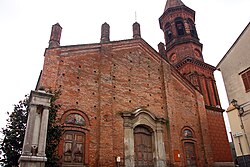
There are about ten churches on the territory of Luese. The most relevant from the historical and artistic point of view are:
- the ancient parish church of San Giovanni di Mediliano, out of town in the early founding core of the country. Founded between the 7th and 9th centuries, in Carolingian age, which dates back to the double apse. In 1479 all the rights of the ancient parish church were transferred to the church of Santa Maria Nuova, inside the village that had developed on the hill[6].
- the church of San Nazario, probably built in the second half of the 12th century
- the church of San Giacomo, built at the beginning of the thirteenth century and rebuilt several times over the centuries
- the parish church of Santa Maria Nuova, in Romanesque-Gothic style, was built in 1479 on a pre-existing church called San Pietro, dating back to the 11th century.
The ancient church is still under the nave of the parish church and in 1721 it was re-intitolatala to San Valerio when there were placed the remains of the saint, found near the village[7]. The canons were immortalized in the famous painting by Pier Francesco Guala The canons of Lu (1748).
In the house of the regency of the church of San Giacomo is set up the sacred art museum of the same name, inaugurated in November 2008.
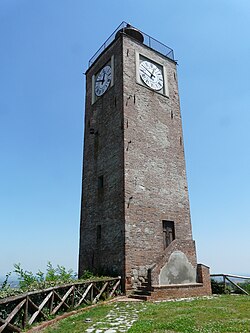
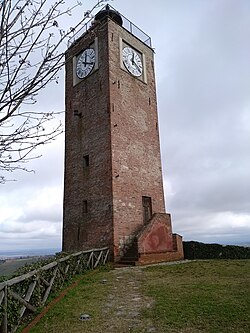
You can also visit the panoramic gerbide of the tower located in the center of the village.
Society
Demographic evolution · Institutions, bodies and associationsExplore this chapter
Demographic evolution
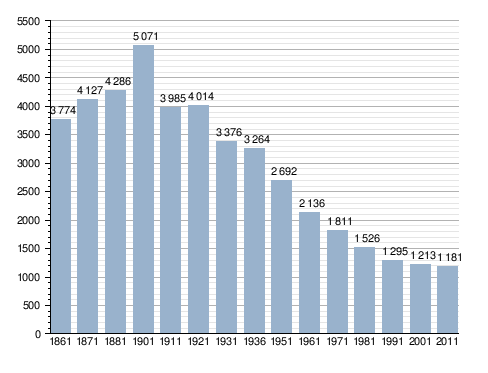
In the last hundred years, as of 1921, the resident population has reduced by 75 %.
Inhabitants registered[8]
Institutions, bodies and associations
In the history of Lu an important role was played by the Church, whose presence was celebrated in the parishes of Santa Maria Nuova (which rose after the others, in 1479), San Nazario and San Giacomo and in the special vitality of confraternities and lay companies.
It is on this tradition of commitment that the activities of modern lay associations are grafted: Pro Loco Luese (and Sagra dell'Uva), Associazione Culturale San Giacomo [2], Polifonica Monferrina, Avis Intercomunale, Kindergarten, Oratory, "San Valerio" club and newspaper "to the pais d'Lu", which since 1976 has reported monthly what is happening in the town.
Economy
From the economic point of view, Lu has always been an agricultural country. Of a particular agriculture as it is that of the hilly lands: small plots of land that...Explore this chapter
From the economic point of view, Lu has always been an agricultural country. Of a particular agriculture as it is that of hilly land: small plots of land that climb on the slopes of the hills, sometimes to prevent you sometimes sweeter. It is above all land of vineyards (since 1906 there exists the Social Cellar), replaced more and more often by new crops encouraged by the European Union: to the expanses of ordered vineyards, now they have replaced fields of corn, barley, wheat, sunflowers, hazelnuts, beets, hay. But Lu is not only land of direct cultivators, it is also land of restaurateurs, workers (daily commuters towards Alessandria, Casale e Valenza) and traders who are replacing quantity, once the pride of many, with the quality of the products and services offered.
The proximity to the city of Valenza, famous in Italy and around the world for the art of gold processing, has attracted many people from Luvia looking for an alternative job to their commitment to agriculture.
The bet for the future is to value the country by focusing on tourism, culture, landscape and food and wine, i.e. on those elements that represent the real wealth of this country.
Administration
Before the merger with the municipality of Cuccaro Monferrato on 1 February 2019, the following administrations succeeded in this municipality.Explore this chapter
Before the merger with the municipality of Cuccaro Monferrato on 1 February 2019, the following administrations succeeded in this municipality.
| Period | First citizen | Match | Load | Notes | |
|---|---|---|---|---|---|
| June 10, 1985 | May 19, 1990 | Mario Trisoglio | DC | Mayor | |
| May 19, 1990 | April 24, 1995 | Mario Trisoglio | DC | Mayor | |
| April 24, 1995 | June 14, 1999 | Mario Trisoglio | center | Mayor | |
| June 14, 1999 | June 14, 2004 | Antonio Ferruccio Mazzoglio | civic list | Mayor | |
| June 14, 2004 | June 8, 2009 | Antonio Ferruccio Mazzoglio | civic list | Mayor | |
| June 8, 2009 | May 26, 2014 | Valerio Ribaldone | Civic list: per al Pais | Mayor | |
| May 26, 2014 | January 31, 2019 | Michele Filippo Fontefrancesco | Lista civica | Mayor | |
Sport
SoccerExplore this chapter
Soccer
The country has a football team, the Luese Cuccaro who militates in the group H of Second Category, in the championship 2026/2027
Notes
Explore this chapter
- ^ Date Istat - Resident population on 30 November 2017.
- ^ Seismic classification (XLS), up risks.protezionecivile.gov.it.
- ^ Table of degrees/day of Italian Municipalities grouped by Region and Province (PDF), in Law 26 August 1993, n. 412, annex A, National Agency for New Technologies, Energy and Sustainable Economic Development, 1 March 2011, p. 151. URL consulted on 25 April 2012 (archived fromoriginal url on 1 January 2017).
- ^ Lu, decree 1963-12-26 DPR, concession of coat of arms and gonfalone, up Central State Archive.
- ^ Lu, up araldicacivica.it. Retrieved 29 October 2021.
- ^ A, Lu (AL) : Pieve di San Giovanni di Mediliano, up Archeocarta, 14 September 2014. Retrieved 9 March 2025.
- ^ Lu Monf Archived on 5 October 2007 at the Wayback Machine. wrong. The churches in the wills of the years 1483-1503 Archived on 5 October 2007 at the Wayback Machine.
- ^ Data taken from:
- Resident population of the municipalities. Censuses from 1861 to 1991 (PDF), up ebiblio.istat.it, ISTAT.
- Resident population - Time series, up exploredati.istat.it.
Please note: 2021 data refers to permanent census data as of December 31 of that year.
Bibliography
PagesExplore this chapter
- Rinaldi Pietro M., Lu through the centuries, Bottega d'Erasmo, 1983, Turin
- Aletto C. Extra-urban churches of the Diocese of Casale Monferrato. Historical and biographical repertoire of cult buildings, 2006, San Salvatore Monferrato
- G.Aldo di Ricaldone, Toponomastic notes on the territory of Lu, Lu pro loco Monferrato, 1982
Pages
- G. Aldo di Ricaldone, The wines of Lu Monferrato very appreciated to many characters, Al païs d'Lü, no. 3 (1978), p. 1, From the papers of the notary Firuffini, who examined Lu between 1634 and 1660, precious information on the Luesi wines.
- G. Aldo di Ricaldone, The chapel of San Rocco - near the door of Montalto - destroyed in 1582, Al païs d'Lü, up lumonferrato.com. Retrieved 26 March 2022 (archived fromoriginal url on 5 March 2016). No. 5 (1982), p. 2 The church of San Rocco, the tabernacle of the church of San Nazario and the brotherhood of Corpus Domini.
Where to stay · Lu
Find stays on Booking.comStories, places and people
More about Lu and the surrounding area
Follow a thread of history and see where it leads.
The area, step by step
Trails and routes in Lu
 CyclingAround the starting point
Asti, Alessandria and surroundings
Monsterrato strade bianche, Diavolo Rosso
 CyclingAround the starting point
Asti, Alessandria and surroundings
Monferrato Casalese, tra colli e pianura

Asti, Alessandria and surroundings
4 Colli Monferrato Mtb


Asti, Alessandria and surroundings
Sentiero santuario madonna del pozzo - pieve di san giovanni
Asti, Alessandria and surroundings
Sentiero pieve san giovanni - mirabello
