Atlas of Monferrato
Mirabello Monferrato: sights, history and trails
Alessandria
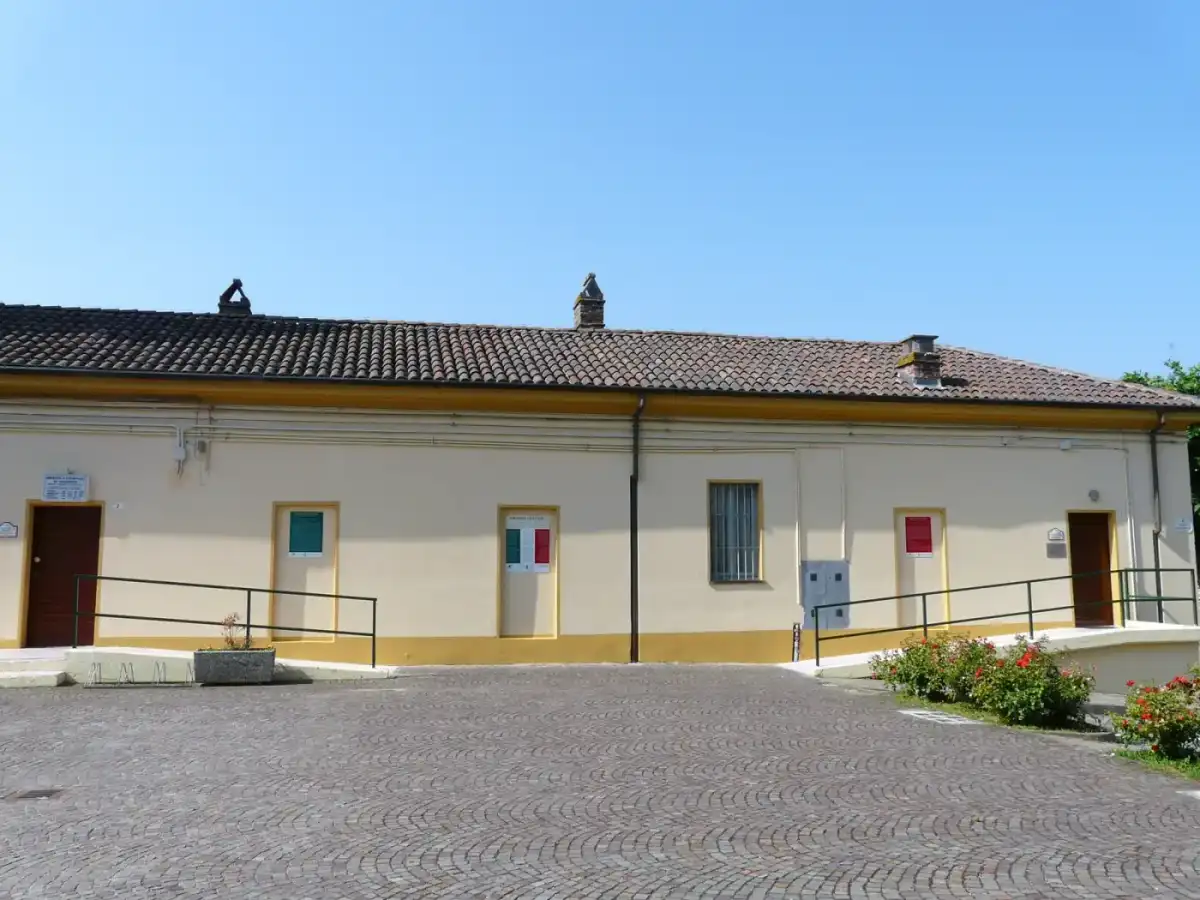
- Elevation
- 124 m above sea level
- Area
- 13.24 km²
- Demonym
- mirabelled
- Patron saint
- Saint Vincent
A closer look
Discovering Mirabello Monferrato
Mirabello Monferrato (Mirabèl in Piedmontese[4]) is an Italian commune 1 200 inhabitants[1] from the province of Alessandria in the Piemonte.
History of Mirabello Monferrato
SymbolsExplore this chapter
There is a probable continuity between the oldest nucleus of Mirabello, the "recinto", which rises on a modest relief at the center of the approach created by the Garavalde and Campostrina ries, and the fortified place designated in an imperial document of the 11th century as "castellum". Within this space it is hypothesized that over time has been created a distinction between the stately residence and a larger fortified space intended to accommodate the population. In the Carolingian era, the village was part of the Lomello Committee while in 1069 Emperor Henry IV donated Mirabello to the Bishop of Vercelli. This until the 12th century when the center was placed under control of the Marchesi di Monferrato. Once the lineage of the lords simply known as "di Mirabello" became extinct, the town was enfeoffed by the Marquis Gian Giacomo Paleologo to Antonio della Valle di Lu, in 1421. Until 1797, the year of the abolition of feudalism in Piemonte, various families followed one another in possession of shares of jurisdiction, such as the Gamberas from the end of the 15th century and the Solaros from the mid-17th century.
As for Baldesco, the news about the infiudazione of the place is quite confusing, it seems certain however that in the fifteenth century between the consignors there was the local family of the Rock and the Natta, who took over in 1451 from the Asinari of the Asti. During the following two centuries the Nattas acquired the property rights and privileges of the other families, arriving in the eighteenth century to be the only lords of the fiefdom. Between 1690 and 1720, however, the Mirabellese community found itself involved in front of the Senate of Casale in a dispute with the Marquis Virginio Natta for multiple causes: first and foremost, the use of the waters of Mirabello which however passed through Baldesco. A second point had as its object the freedom of transit through the meadows of the Bocca di Preiso district, located partly within the boundaries of the fiefdom, claimed by the community in favor of its inhabitants and their livestock, thirdly there was a bureaucratic reason linked to the Mirabellese land registry. These frictions gave rise to acts of real violence, of which the most serious was against the criminal notary who was conducting the investigation on behalf of the Senate. He was attacked by a group of armed individuals who beat him and stole his documents.
After the annexation of Monferrato in the Saudi states, in 1708, Mirabello entered the province of Casale and thus remained until 1798. During the Napoleonic Wars, the farmhouse was framed in a constituency with its capital. Alessandria. After the Restoration, Mirabello returned to the province of Casale, which in 1859 then became only a district of the province of Alessandria. During the 18th century the Savoy government put forward hypotheses of aggregation of the "separate estates" of the Monferrato to the territories of the nearby communities. The process, which involved the assignment of Baldesco, Castel Grana and Motta di Grana to Mirabello, could only be completed in 1797, when feudalism was abolished. There were other much more intricate and long-lasting territorial conflicts against Lu. Although the two countries set their boundaries in 1819problems arise when it was built in 1830 a road that connected Lu to the provincial between Casale and Alessandria. The route is mostly in the territory of Mirabello, but since this community already overlooked the provincial state administration decreed that the 90% of the charges had to fall on Lu's country. The disputes, however, resume in 1837, the year in which the first serious maintenance of the road must be planned. The dispute, however, was disguised as financial problems and divergences regarding strategic public works for the territory, was actually caused by the uncertain border between the two countries that could not be recognized with certainty by municipal maps. In the 1842 a better settlement of borders was agreed even if the dispute continued until the years 30 of the 20th century.[5]
Symbols
The coat of arms and gonfalone of the municipality of Mirabello Monferrato were granted by decree of the President of the Republic of 29 October 1971.[6]
The gonfalone, granted with D.P.R. 21 March 1997[8] is a drape party of red and blue.
What to see in Mirabello Monferrato
Religious architecture · Parish Church of San Vincenzo · Church of San SebastianoExplore this chapter
Religious architecture
The churches of San Vincenzo, San Sebastiano, San Michele, Madonna della Snow, Santa Caterina (a Baldesco), the chapel of the cemetery and the reonal ones dedicated to Maria Ausiliatrice, the Holy Family and Don Bosco, are the places of mirabellese worship.
Parish Church of San Vincenzo
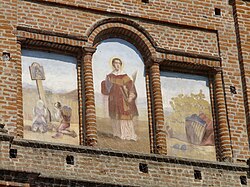
Built in 1562 and consecrated in 1620, it has a higher façade at the central nave which ends with an iron cross. The doors are lined with four pairs of columns while four columns form niches on the upper part, in which the Patron Saint and scenes of daily life are depicted. The façade was plastered from the 19th century until 1947, when exposed bricks were brought back. The central nave is 15 meters high while the side ones 9 meters, the pillars are square and have capitals in doric style and Corinthian. Along the side aisles there are many chapels, starting from the left the first is that with baptismal font next to which lies the statue of an angel coming from the family tomb of writer Rosetta Loy. Then there are chapels dedicated to the Immaculate Virgin, Mary Helper and Don Bosco on the left, while on the right aisle there are chapels dedicated to the Madonna del Rosario di Pompei and that of the Sacred Heart. The presbytery is decorated with two great frescoes depicting the patron in front of the judge and in prison, behind the higher work of the Pellegatta, there is a niche where a statue of St. Vincent in plaster is placed. in 1860 the parish church underwent an important restoration that dates back to the mosaic floor of the presbytery, the cantoria and the organ case, while the instrument was installed only in 1865. The church is currently used for the celebration of Sunday Masses and the main rites of worship.[9]
Church of San Sebastiano
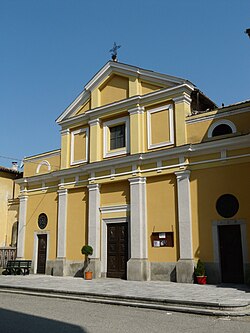
Built in 1450, it was the first parish church of the village and was built in a position above the square, as it was taken into account the possibility of flooding the Garavalde and Campostrina rii. The facade is in the style of the fourteenth century, with three doors to which it is accessed climbing two steps of stone. San Sebastiano is rectangular and is divided into three aisles, of which the central one is the largest. It was originally devoid of a choir, this until 1866 when a small semicircular apse was created to make it space. The altar probably eighteenth century is the work of the Pellegatta and behind it there are four columns that support the vault of the choir, on which is depicted the martyrdom of San Sebastiano. With the arrival of the Salesians in the country, the church was left in management to the parish priests of the Little Seminary leaving a deep mark in the population. The church, in which many other Salesian rectors celebrated besides Don Bosco, is today used for the infra-weekly harvests.[9]
Society
Demographic evolutionExplore this chapter
Demographic evolution
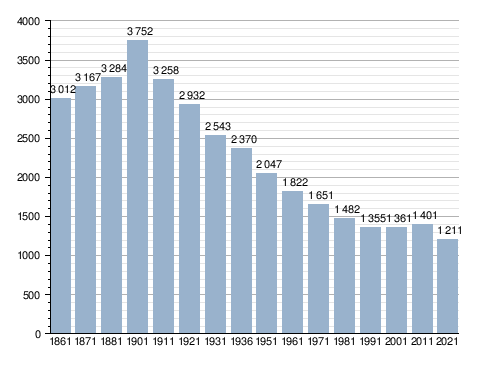
In the last hundred years, starting from 1921, there has been a halving of the resident population.
Inhabitants registered[10]
Culture
Library "Alfredo Rota" · Education · Gastronomy and local traditionsExplore this chapter
Library "Alfredo Rota"
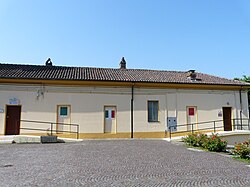
The library "Alfredo Rota" is located in Piazza Marconi 17, a few steps from the municipality, has 5000 volumes and 500 annual loans.[11]
Education
Gastronomy and local traditions
Typical products
Among the traditional products of Mirabello brand De.Co we find:
- Tirà a Mirabé: a simple focaccia stuffed with raisins;
- Bagnet from du Furnas: delicate green bath, great to serve cold with Piedmontese boiled;
- Bagna 'd Crivela: is a sweeter version of Bagna Cauda, whose ingredients are oil, anchovies and onions. Excellent to taste with crostini, polenta and vegetables;
- Snails of snails.[13]
Events
Among the most significant events that are repeated every year in the country there are:
- "A day for Mirco Vootti": on December 8, day of the Immaculate. The day begins with Mass in the morning in the parish church, after lunch in the premises of the oratory and prepared by the Pro Loco of the country, "Concerto per Mirco" with the delivery of the scholarship "Mirco Wanttti"
- Summer party: the third and fourth weekend of June at the sports field in via Mario Talice 31. Music and good food such as agnolotti, grilled, snails and tripe
- Folketing: the third weekend of May, festival dedicated to street food and folk genre, with music, concerts and live art[14][15].
Administration
Below is a table relating to the administrations that have succeeded one another in this municipality.Explore this chapter
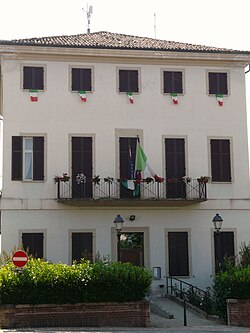
Below is a table relating to the administrations that have succeeded one another in this municipality.
| Period | First citizen | Match | Load | Notes | |
|---|---|---|---|---|---|
| June 27, 1985 | May 24, 1990 | Marco Demartini | - | Mayor | [16] |
| May 24, 1990 | April 24, 1995 | Mauro Gioano | Italian Democratic Socialist Party | Mayor | [16] |
| April 24, 1995 | June 14, 1999 | Mauro Gioano | center | Mayor | [16] |
| June 14, 1999 | June 14, 2004 | Mauro Gioano | civic list | Mayor | [16] |
| June 14, 2004 | June 8, 2009 | Marco Demartini | civic list | Mayor | [16] |
| June 8, 2009 | May 27, 2014 | Luca Gioanola | civic list Together with Luca Gioanola mayor | Mayor | [16] |
| May 27, 2014 | May 26, 2019 | Mauro Gioano | list Civic | Mayor | [16] |
| May 26, 2019 | June 9, 2024 | Marco Ricaldone | Civic list Futuro Comune | Mayor | [16] |
| June 9, 2024 | "in charge" | Ricaldone Marco | list civic Futuro comune | Mayor | [16] |
Sport
Soccer · Bric and fosExplore this chapter
Soccer
Bric and fos
Sporty appointment that is renewed every year, a podistic race with 12 km tracks (competitive valevole for the provincial championship AICS), 7 km and 2 km. Prizes for the first ever class (12 km), for the top three classifications of each category and numerous special prizes such as that for the most numerous group or the oldest runner. Sunday mid-April.[15]
Notes
Explore this chapter
- ^ to b Monthly demographic balance for the year 2026 (provisional data), up demo.istat.it, ISTAT.
- ^ Seismic classification (XLS), up risks.protezionecivile.gov.it.
- ^ Table of degrees/day of Italian Municipalities grouped by Region and Province (PDF), in Law 26 August 1993, n. 412, annex A, National Agency for New Technologies, Energy and Sustainable Economic Development, 1 March 2011, p. 151. URL consulted on 25 April 2012 (archived fromoriginal url on 1 January 2017).
- ^ AA. VV., Dictionary of toponymy. History and meaning of Italian geographical names., Milan, Garzanti, 1996, p. 397, ISBN 88-11-30500-4.
- ^ Comune di Mirabello Monferrato - Vivere Mirabello Monferrato - History - Agricultural production since 1700, up common.mirabellomonferrato.al.it. Retrieved 14 March 2020.
- ^ Municipality of Mirabello Monferrato, Statutes (PDF), Art. 6, Coat of arms and banner.
- ^ Piedmontese civic coat of arms, vol. II, Regional Council of Piemonte, 2016, p. 303, ISBN 978-88-96074-98-5.
- ^ Mirabello Monferrato, decree 1997-03-21 DPR, concession of coat of arms and gonfalone, up Heraldic office - Municipal files, Central State Archives. Retrieved 29 October 2021.
- ^ to b History, up www.parrocchiamirabellomonf. Retrieved 1 January 2024.
- ^ Data taken from:
- Resident population of the municipalities. Censuses from 1861 to 1991 (PDF), up ebiblio.istat.it, ISTAT.
- Resident population - Time series, up exploredati.istat.it.
Please note: 2021 data refers to permanent census data as of December 31 of that year.
- ^ Bibliotecario del Monferrato - Mirabello Monferrato, up www.comune.casale-monferrato.al.it. Retrieved 1 January 2024.
- ^ The places of the school - Istituto Comprensivo "Don Milani" - Ticineto (AL), up icdonmilaniticineto.edu.it. Retrieved 1 January 2024.
- ^ La Bottega del Centro, up ilgolosario.it. Retrieved 15 March 2020.
- ^ Radio Gold, Folke’bello: the new festival dedicated to folk in Mirabello Monferrato
- ^ to b Pro Loco di Mirabello Monferrato – Mira il Bello di Aurea Luce, up www.prolocomirabello. Retrieved 1 January 2024.
- ^ to b c d And f g h the https://amministratori.interno.it/
Where to stay · Mirabello Monferrato
Find stays on Booking.comThe area, step by step
Trails and routes in Mirabello Monferrato
 CyclingPlaces and landscapes along the route


 WalkingAround the starting point
Asti, Alessandria and surroundings
Sentiero mirabello - pieve di san giovanni
Asti, Alessandria and surroundings