Atlas of Monferrato
Morano sul Po: sights, history and trails
Alessandria
- Elevation
- 123 m above sea level
- Area
- 17.71 km²
- Demonym
- moraine
- Patron saint
- Saint John the Baptist
A closer look
Discovering Morano sul Po
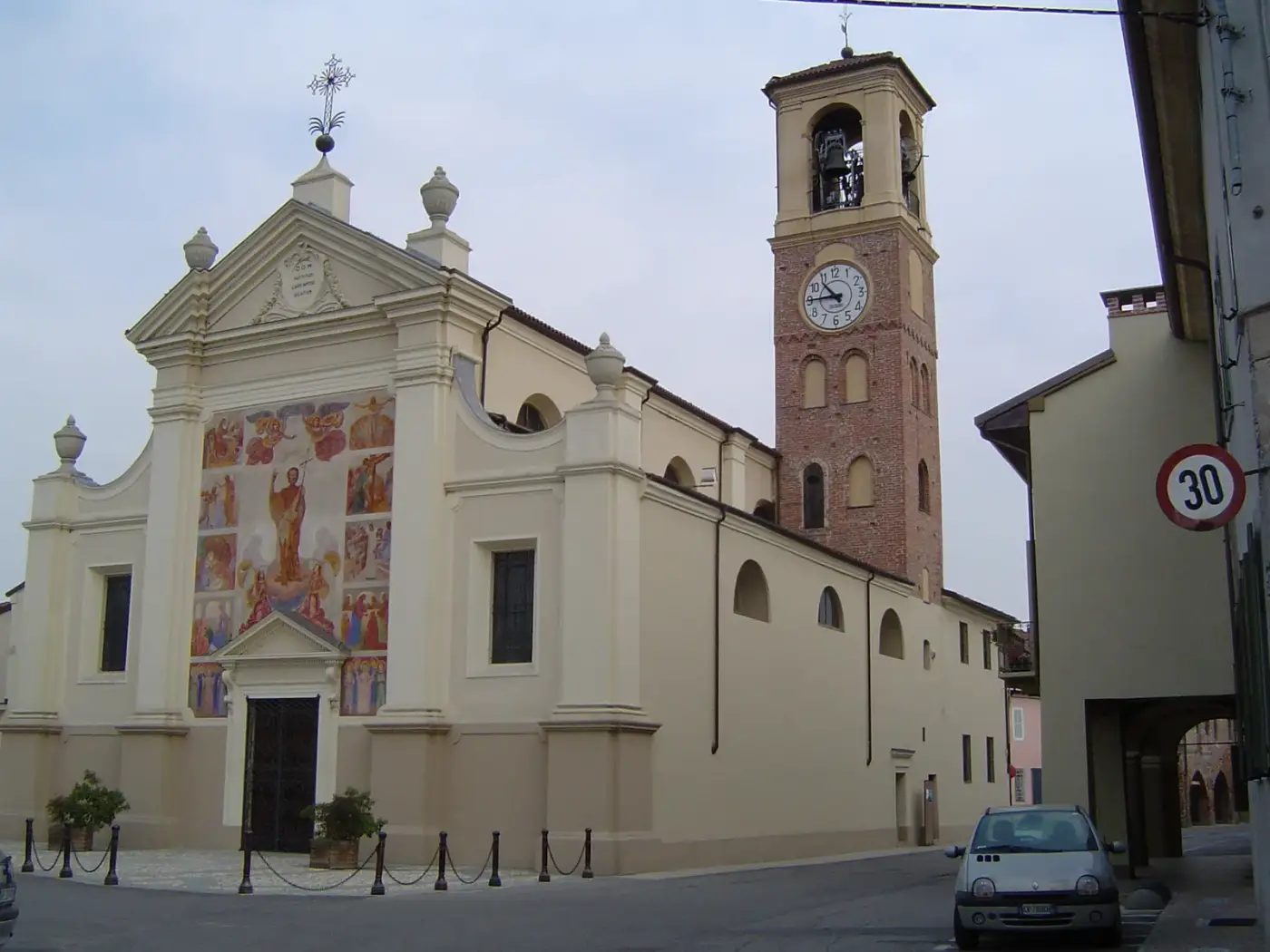
Morano sul Po (Moran [mər] in Piedmont) is an Italian municipality of 1 269 inhabitants[1] from the province of Alessandria in the Piemonte, located at 10 km west of the city Casale Monferrato.
History of Morano sul Po
SymbolsExplore this chapter
The birth of the present urban center is earlier than the year 1000: one of the first documents in which the name of Morano dates back to 961. Previously it was known the existence of a Roman village, probably preceded by gall settlements and before still by Ligurian populations. The discovery of a necropolis, which took place in the 1990s in Pobietto, moved its origins to the age of the final bronze, around the 11th century BC.
The origin of the name is uncertain, so there are three assumptions. The first one claims that the first name was Aurian, in reference to some gold deposits that were found in the alluvial areas of the Po, which subsequently transformed into Maurianus given the use of mori slaves engaged in the extraction of precious metal. The second hypothesis derives the name from the presence of large amounts of mulberry trees (in Piedmontese) Moron [muˈrəp]) used for the breeding of silkworms, a once very widespread activity. Finally, the last hypothesis traces the name back to the incursions into northern Italy by the Saracens (die) who, after being defeated in the areas of Frassinello Monferrato and Ottiglio, they sought refuge on a large island in the middle of the Po near the town.
Around the year Mille Morano was owned by the Diocese of Vercelli; in August 1182, with notorious act, he passed to the Marquis of Monferrato. In 1431 Morano was occupied by Savoy troops and in 1435 he was returned to the Marquis of Monferrato. In 1538 the village was infeuded to Alberto Bobba of Lu.[4] They followed years of continuous dominations, with constant presence of foreign armies, often mercenaries.
End of October 1656 the boat of Queen Cristina of Sweden on pilgrimage from Turin to Rome passed on the Po. In Morano she was greeted with great joy by the crowd rushing on the embankment.[5]
In 1685, the house of the Cattaine, the fiefdom passed to the marquises Paleotti-Lanzoni, under the concession of Ferdinando Carlo di Gonzaga Nevers, Duke of Mantua and the Monferrato. In 1706 Annibale Paleotti Lanzoni ceded the Moranese fiefdom to Francesco Giovanni Tomaso Mossi, 3rd Marquis of Torrione, who was officially invested by the Duke of Mantua on 18 October 1706.[6] Francis became the first Marquis of Morano of the Mossi family. In 1720 the King Vittorio Amedeo II of Savoy confirmed the fief to the Marchesi Mossi.[7] They then spent some decades of relative tranquility.
Following the proclamation of the First French Republic and the execution of Louis XVI, all of Europe was united against the new republican regime. The Kingdom of Sardinia of King Vittorio Amedeo III was an alliance with Austria, Prussia and Spain. Napoleon Bonaparte defeated the Austrian army in Marengo on 16 June 1800. Following the Battle of Marengo, in 1801 on Piemonte became the XXVII military division of France. With Napoleon's sunset the Savoy returned to the throne and Morano followed the fate of Piemonte and Italy.
On 29 July 1829 Archbishop Vincenzo Maria Mossi di Morano died in Turin (1742-1829), the last representative of the homonymous family of Morano, the Torrione and the Penango. He bequeathed his art gallery to the Accademia Albertina in Turin[8] and the immense substances of the family, inherited in 1803 at the death of his brother Thomas,[9] to the Marquis Lodovico Pallavicino of Parma his cousin on the maternal side.[10][11]
On 6 May 1859, during the Second War of Independence, Giuseppe Garibaldi stopped in Morano before meeting with Napoleon III Emperor of the French.[5]
On 9 August 1862 Morano received the definition "on the Po" by royal decree of Vittorio Emanuele II, in order to distinguish it from other homonyms such as Morano Calabro in the province of Cosenza and Morano fraction of Gualdo Tadino in the province of Perugia.[5]
Restoration of navigation on the Po river (1884) and the construction of the railway Casale Monferrato – Chivasso (1885 - 1887) favoured the birth and development of cement plantings, which were built in 1887 near the railway station. The raw material came from the quarries of Coniolo by means of tanks, the crossing of the river took place on suitable boats. Also along the river side Morano began extractive activity due to the presence of trimmings, which ran out after a few years. Between the end of XIX Sec. and the beginning of the XX Sec. primitive transports were replaced by an integrated system of industrial cableways and rails.[12]
The railway factory report was of fundamental importance for the urban and economic development of the country. The advent of the new work in caves and furnaces represented a milestone for the resources of the entire community.[13]
From the end of the XIX Sec. and until the Second World War, the country suffered a significant emigration of the inhabitants especially towards Argentina,[14] Brazil and Australia.[15][16][17]
The municipal territory was hit hard by floods 1994 and 2000.
Symbols
The municipal coat of arms represents a head of blackberry and a rampant lion, accompanied by two stars, with the shield surmounted by a cemetery. It is not clear the origin (the head of moron probably wants to have assonance with the toponym) and does not follow the heraldic rules; it was probably designed in a hurry, half the Ventennio, when it was decided that all the municipalities had to have an emblem representing them.[18] and is used by the municipality without a formal decree of recognition or concession. The gonfalone in use is a blue drape,
What to see in Morano sul Po
Religious architectures · Parish Church of San Giovanni Battista · Church of San Pietro MartireExplore this chapter
Religious architectures
Parish Church of San Giovanni Battista
Church of San Pietro Martire
Located in the homonymous street, it has exposed brick exterior walls and semicircular apse. The interior is three aisles, divided by robust plastered columns with painted grooves supporting arches a sixth acute. It is not known the date of foundation, probably it was built by Dominican friars in the early 1400s with adjoining monastery now missing. It was the seat of the Brotherhood of S. Pietro martire, known as the White Cappa, whose age of constitution is unknown.[19]
Among the frescoes of the interior is the triptych of the right aisle dated 1478 by an ancient school that has also operated in the chapel of Our Lady at the Sanctuary of Crea. It represents the Virgin surrounded by St. John the Baptist, St. John the Evangelist, St. Rocco and San Pietro Martire in act of adoration.[20]
Church of the Holy Trinity
Located in the Via Giovanni Pietro Gallo, the church has a cross-shaped plan and exposed brick facade, marked by parastes, in two orders with timpano; in the second shelf opens a window with a sinuous upper profile. On the back of the left side of the building rises the bell tower, which has a bulb ending. You do not know the year of foundation, but it certainly dates back to an earlier age at 1608. It was the seat of the Brotherhood of the Red Cappa, aggregated in 1608 to the Archconfraternity of the SS. Trinity of Rome,[21] which was authorized the red dress during religious ceremonies. The purpose of the Association was to provide hospitality to pilgrims and convalescents, as well as to provide the dowry for the poorest girls in the country. Inside there are frescoes of second-class school, restored during the 19th century.[22] The church was consecrated in 1989 by the Parish to the Commune. It is used occasionally for associative and cultural purposes.[21]
Campestre Church of Consolata or Madonna del Ceppo
It is located on the road to the hamlet of Due Sture a 2 km from the town of Morano. From a stone walled above the entrance door, the church would be built in 1277 by Guillelminus de Careto, rector of the Religious House of Morano of the Order of Saint John of Jerusalem.[23] He was probably a nobleman of the Del Carretto family who wanted to build it as a result of the birth of a son obtained by divine grace.[24]
The lower part of the façade consists of an atrium with three arches full-sixth unequal. The upper part is finished by a timpane. At the bottom of the right side of the church rises the bell tower. At the rest of the outer wall adheres to a lower construction, which in the past served as a chaplain's house, while the sacristy is at the base of the bell tower. The interior is rectangular, barrel vaulted, which extends into the presbytery-coron in turn slightly narrow and with a cruise. The date 1732 is read in the two rooms. Until the century. XIX was indicated as the church of Consolata. It has not been known since he took the current name “of the Ceppo”.[23] According to the popular tradition, the simulacrum of Our Lady was found by a farmer under a strain. He kept a wooden statue of the Virgin sitting in throne dated around the year 1200.[24]
Church of San Rocco
It is a baroque chapel located on the embankment, in the homonymous street after crossing with Via Po. The construction date is not known. Until the century. 19th on the day dedicated to San Rocco there was a procession that ended in the parish church. During the 20th century, it was used as a storeroom for agricultural instruments and defaced by the construction of an electric cabin. He is currently in a state of neglect.[25]
Church of San Giovanni Battista (fraction Two Stures)
It is located in the San Giovanni Region of the hamlet Due Sture. It is dedicated to St. John the Baptist and has always been dependent on the Parish Church of the Nativity of Mary Virgin of the ancient trade mark fief of the Torrione di Costanzana. Since 1986 it has been united to the Parish of the Blessed Virgin Assunta in Robella di Trino. It belongs to the Archdiocese of Vercelli.[26][27]
Church of St. Nicholas (Pobietto Festival)
It is the church of the hamlet Pobietto, a large agricultural estate founded around 1185 and organized according to the model of medieval monastic granges belonging to the abbey of Lucedio. In the ancient and central part of the settlement rises the church whose date of erection and consecration is unknown. Dedicated to Saint Nicholas Bishop of Mira, in 1457 with papal bubble of Callisto III is elevated to detachable vicars remaining tied to the Abbey of Lucedio until 1474, year in which it is inserted inside the Diocese of Casale Monferrato. It became a parish church in August 1713, the following year Giovanni Battista Scapitta, engineer of the Doge's Chamber of Monferrato, begins the reconstruction of the new baroque style church, characterized by greater volume and visibility of decorative elements. It has a single nave with three altars, with a small choir and a presbytery. The main altar of the church is dedicated to St Nicholas, while the two minor altars are dedicated respectively to the Virgin of the Blessed Rosary and Saint Joseph. Towards the end of the eighteenth century by papal concession, the church of St. Nicholas passed to the Maurtian Order and in 1805 was reassigned to the Diocese of Vercelli.[28] In contrast to the capital Morano, he did not return to the Diocese of Casale and still, despite being part of the Municipality of Morano, is of vercellese relevance. The Parish in 1986 was joined by the Parish of San Bartolomeo di Trino.[26]
Parish recreation
The parish recreatory, also known as “Il Ricre”, is a building dedicated to the youth ministry of the parish of the capital. Located in the Via Giovanni Emanuel in the site of the ancient cemetery, it was built on a project of 1909 by the Engineers Pietro Fenoglio and Giovanni Antonio Porcheddu, operating in Morano between 1906 and 1912 in the cement industry.[29][30]
The architectural lines were very similar to those of the former military manufacture of Corso Regina Margherita in Turin, made by Fenoglio in 1907.[31] Following the 1994 alluvial event, a two-phalt cover was inserted which modified the facade's Liberty appearance. It is used for theatre performances and events. The outdoor area is equipped with a volleyball court and a synthetic grass soccer field.
Civil architecture
Autodrome
There.Autodrome of Morano sul Po, also known by the name of track Casale Monferrato due to its location near the homonymous city of Monferrato, is a now abandoned car circuit located between the municipalities of Morano sul Po, Coniolo And Pontestura.
House of Architects
It is a Gothic house (XIV-XV century) located between the Municipal Palace and the Parish Church. Currently it is the seat of the Civic Library “A. Ferrari”.[32]
Municipal Palace
The building was built in 1839 by the then Medico Condotto dott. It's crazy.[33] In 1879 it was adapted for public needs and intended as the seat of the Municipality. It is equipped with a portico overlooking the main street of the capital that houses under the first arch a plate of granite of remarkable dimensions called "stone of the doctor”.
The popular tradition designates the stone block from the belt of an ancient hospital built in Morano in the 12th century. by the Knights of St. John.[34]
Arch of the cable car
The Arch of Morano sul Po is a parabolic arc infrastructure that allowed the cable car to safely exceed the state during transport of the concrete marin from the Palazzina Borino di Coniolo mine to the cement plant in Morano. It was built in 1951 by the company Unione Cementi Marchino/Unicem of Casale Monferrato on project of Engineer Guido Sarti and remained in operation until about 1958. It is a system built on the track of a previous teleferic realized by Riccardo Gualino in 1908.[35] The structure is reinforced concrete and consists of two parabolic arches, connected through two sets of beams per side. The impalcato used to protect the road from accidental material falls was removed following the disposal of the plant.
The Arc was the subject of recovery by the Municipality of Morano sul Po as evidence of the industrial identity of the territory.[36][37][38][39] Near it is realized a center of interpretation of the industrial memory consisting of a container called "Heritage in a box” and from an interactive web app.[40][41][42][43]
Image gallery
Archaeological sites · Necropolis of the Age of Final Bronze · Natural areasExplore this chapter
-
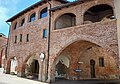 House of Architects
-
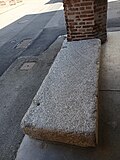 The Stone of the Doctor
-
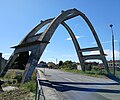 Teleferica arch of Morano sul Po
-
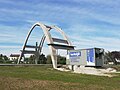 Arch Morano sul Po
-
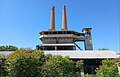 The Old Fornace
Archaeological sites
Necropolis of the Age of Final Bronze
It was located in February 1994 following the start of an agricultural pavement inside a laughter situated north of the hamlet Pobietto. The necropolis consists of cremation burials, partly placed inside rectangles of circular or rectangular shape with earthen tumulus. It was the subject of a first emergency recovery and, since spring 1995, of an archaeological survey funded by the Ministry for Cultural and Environmental Heritage, articulated in four campaigns, which led to the recovery of over forty tombs in 1998. The site, located at 129 s.l.m. on the hydrographic left of the river Po, it includes an area of 14,600 m2 and is not visitable.[44][45] The excavation campaigns were accompanied by multidisciplinary studies, from the realization of an exhibition at the Civic Museum of Casale Monferrato and from the edition of its acts (2006).[46]
Natural areas
Protected areas of Po Piemontese
A part of the Moravian territory is affected by the Management Board of the Protected Areas of the Piedmontese Po, born in 2021 from the union of the Park of Po Torinese, the Park of Po Vercellese Alessandrino and some areas of the territory of the Parco del Po Cuneese.[47] At the hamlet of Pobietto, the park has an operational headquarters built in 2012 in a portion of the ancient grangia equipped with a conference room, an educational laboratory and an external portico that allows the conduct of outdoor activities.[48]
Economy
Agriculture · IndustryExplore this chapter
Agriculture
The territory of Morano is homogeneous compared to the predominant crop of rice, the country's main economic resource. The processing activity is mainly carried out in the local reservoir and in those of the neighboring municipalities.
The cultivation had been established during the 19th century, introduced in the vast feudal estates in possession of local lords, encountering the adversity of the population due to the environmental problems connected to it. First intended for land of difficult use, rice became little at a time a product no more marginal, but subject to particular attention to the economic benefits it promised. At the beginning of the 20th century the territory was cultivated for a third rice and for the rest to wheat, meliga, lawn and vegetables.[49]
During the 20th century. the majority of inhabitants of Morano left fields for industry finding occupation in the local cement plant[50] and in the companies of the nearby centers of Casale Monferrato and Trino. Significant was the emigration to the urban centers of Turin and Milan.
Industry
Morano has been an important cement production centre for more than a century. The activity began with the opening of the railway station where in 1887 Bertone was established and in 1899 Zaccone, Fornero and Cinzano were both equipped with lime furnaces and vertical concrete ovens. The raw material came from the quarries of Coniolo by means of wagons that crossed the river on boats.[12]
The technical improvements of production systems, the greater demand for ligands due to building and industrial expansion and financial economic crisis in the early century (1905/06)[51] favoured large capital investment in the nascent industry. In Morano (1906) the Società Anonima Cementi del Monferrato degli Ingegneri Pietro Fenoglio and Giovanni Antonio Porcheddu succeeded Bertone and the Anonymous Society of Casalesi Lawyer Riccardo Gualino succeeded Zaccone and Fornero. After the unification of the two factories between 1912 and 1919 by the Italian Union Cementi, the plant followed the fates of the Gualino group.[52][53]
On 1 January 1933, the industrial activities of the Italian Union Cementi were incorporated into Marchino, a company controlled by I.F.I. of the Agnelli family following Richard Gualino's financial district. The new Union Cementi Marchino, based in Casale Monferrato, had a paritetic capital between the family Marchino and the Agnelli family.[54][55] The Engineer Vittorio Bonadè Bottino, CEO succeeded Dr. Ottavio Marchino in 1943,[56] He directed the company until 1969-70, taking care of the modernization of Morano cementworks between 1950 and 1960 with Engineers Aldo Sarti and Guido Sarti. Following post-war upgrades, the number of workers increased by more than 500 units.[57] In 1969 the social name was changed to Unicem (Union Cementerie Marchino and Emiliane and Augusta SpA).[58]
At the end of the years '80 the cement plant was alienated to the Merone Group, which continued production until the beginning of the 21st century. Between the 2007 and the 2010 the plants were dismissed and dismantled.[59]
During the 20th century, the country had the presence of small and medium-sized construction and metal companies operating in the cement industry. In the years70 It is80 some production activities of leather bags and accessories had been established.
Society
Demographic evolution · Institutions, bodies and associationsExplore this chapter
Demographic evolution
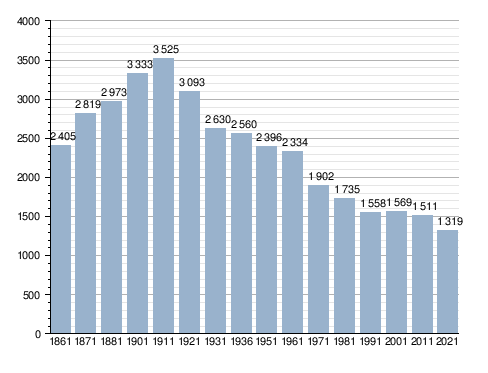
In the last hundred years, starting from 1921, the resident population It's halved.
Inhabitants registered[60]
Institutions, bodies and associations
- Loco
- AVIS
- "Famija Moranèisa"
- Civil Protection
- Boccioni
Administration
Below is a table relating to the administrations that have succeeded one another in this municipality.Explore this chapter
Below is a table relating to the administrations that have succeeded one another in this municipality.
| Period | First citizen | Match | Load | Notes | |
|---|---|---|---|---|---|
| June 4, 1985 | May 20, 1990 | Giancarlo Tiozzo | Italian Communist Party | Mayor | [61] |
| May 20, 1990 | January 31, 1994 | Giancarlo Tiozzo | Italian Communist Party | Mayor | [61] |
| June 13, 1994 | May 25, 1998 | Paolo Migliava | People's Party | Mayor | [61] |
| May 25, 1998 | May 28, 2002 | Paolo Migliava | civic list | Mayor | [61] |
| 6 June 2002 | May 29, 2007 | Enzo Piccaluga | civic list | Mayor | [61] |
| May 29, 2007 | 7 May 2012 | Enzo Piccaluga | civic list | Mayor | [61] |
| 8 May 2012 | June 10, 2017 | Mauro Rossino | list: All together for Morano | Mayor | [61] |
| June 11, 2017 | June 12, 2022 | Luca Ferrari | list: Viiamo Morano | Mayor | [61] |
| June 12, 2022 | in office | Luca Ferrari | list: Viiamo Morano | Mayor | [61] |
Sport
Soccer · Automobilee · Bodies.Explore this chapter
Soccer
In the football field, Morano was represented by U.S. Moranese founded in 1908. In the years20 It is30 of the 20th century, the team managed to establish itself on several occasions in the regional field by awarding titles of world champion and regional champion.[62]
Many militant players in the U.S. Moranese continued their activity at the Casale Foot Ball Club, playing in the Italian championship series: Enrico Migliavacca with 11 appearances in the Italian national team, Ernesto Lino, Ernesto Molghea and Angelo Morzone.
The team has always played amateur championships. The municipal sports field, entitled “Pietro Bazzano”, was located in the golenal area of the Po river in the territory of the municipality of Coniolo. Following the 1994 and 2000 flood events, the company ceased any activity due to its inability and subsequent disposal of the sports plant.
Automobilee
Bodies.
Morano is represented by U.S. Bocciofila Moranese is located in the municipal bocciodromo “Walter Pane” on the edge of the river Po in the territory of the municipality of Coniolo. The facility is equipped with outdoor and indoor bowls and a tennis court.[63]
Notes
Explore this chapter
- ^ to b Monthly demographic balance for the year 2026 (provisional data), up demo.istat.it, ISTAT.
- ^ Seismic classification (XLS), up risks.protezionecivile.gov.it.
- ^ Table of degrees/day of Italian Municipalities grouped by Region and Province (PDF), in Law 26 August 1993, n. 412, annex A, National Agency for New Technologies, Energy and Sustainable Economic Development, 1 March 2011, p. 151. URL consulted on 25 April 2012 (archived fromoriginal url on 1 January 2017).
- ^ The Bobba family of Lu, up associationsangiacomo.it. Retrieved 18 January 2025.
- ^ to b c History of Morano sul Po, up common.moranosulpo.al.it. Retrieved 29 March 2022.
- ^ Sac. Happy Mellana, Notes for a story of Morano sul Po, Morano sul Po, Editrice La Buona Parola, 1944, p. 27.
- ^ Aldo Timossi, TRAPOeLINO Three millennia of history and legends in Morano sul Po, Rome, 2009, p. 63.
- ^ History and preparation of the Pinacoteca dell'Accademia Albertina, up pinacotecalbertina.it. Retrieved 1 April 2022 (archived fromoriginal url on 19 April 2022).
- ^ Roberto Coaloa, Tommaso Mossi di Morano: utopia and search for the beauty, up magazinesavej.it. Retrieved 1 April 2022.
- ^ Sac. Happy Mellana, Notes for a story of Morano sul Po, Morano sul Po, Editrice La Buona Parola, 1944, pp. 25.26.
- ^ Mossi, Giovanni Pio Lodovico, up vivant.it. Retrieved 29 March 2022.
- ^ to b Gian Mario Rossino, Beyond industrial archaeology: incubator for innovation at Casale Monferrato, Turin, Polytechnic of Turin, Degree Thesis, 2005, pp. 123-143.
- ^ Clara Bertolini Cestari, Manuel Fernando Ramello and Gian Mario Rossino, Methods and tools for knowledge of an industrial heritage: the case of Morano Sul Po (PDF), Terni, Rome, TICCIH International Congress, 2006. Retrieved 29 March 2022.
- ^ Aldo Timossi, Centenary of prof. Morzone, in The Monferrato, no. 3, 19 January 1974.
- ^ Franca Nebbia, Son of emigrants in Australia looking for Moravian avi, up lastampa.it, La Stampa, 11 May 2017.
- ^ Morano is international between Argentina and Australia, in The Monferrato, no. 6, 23 January 2018.
- ^ The Day of the Moranese Harmony in Australia, in The Monferrato, no. 24, 23 March 2021.
- ^ Heraldic demolition of the Morano municipal coat of arms, in The Monferrato.it, 28 October 2009.
- ^ PO. S. Peter martyr, up Monferratoarte. Retrieved 29 March 2022.
- ^ Church of San Pietro Martire, up common.moranosulpo.al.it. Retrieved 29 March 2022.
- ^ to b PO. Holy Trinity, up Monferratoarte. Retrieved 29 March 2022.
- ^ Church of the Holy Trinity, up common.moranosulpo.al.it. Retrieved 29 March 2022.
- ^ to b PO. Madonna del Ceppo or the Consolata, up Monferratoarte. Retrieved 30 March 2022.
- ^ to b Campestre Church of the Madonna del Ceppo, up common.moranosulpo.al.it. Retrieved 30 March 2022.
- ^ PO. S. Rocco., up Monferratoarte. Retrieved 30 March 2022.
- ^ to b Morano sul Po, up Monferratoarte. Retrieved 28 October 2023.
- ^ Roberto Coaloa, Tommaso Mossi di Morano: utopia and search for the beauty, up Magazine Savej, 25 October 2017. Retrieved 28 October 2023.
- ^ To the Pobietto Grange, up The Monferrato, 12 October 2022. Retrieved 28 October 2023.
- ^ Riccardo Nelva and Bruno Signorelli, The works of Pietro Fenoglio in the climate of international art nouveau, Bari, Dedalo Libri, 1979, p. 60.
- ^ Gian Mario Rossino, The Anonymous Society of Monferrato: Engineers Pietro Fenoglio, Giovanni Antonio Porcheddu and the Hennebique system, in Beyond industrial archaeology: innovation incubator at Casale Monferrato, Turin, Polytechnic of Turin, Degree Thesis, 2005, pp. 192-215.
- ^ AldoTimossi, Morano: a Art Nouveau jewel. The “Catholic Recreation” is the work of ingegner Turinese Pietro Fenoglio, in The Monferrato, no. 95, 16 December 2005, p. 27.
- ^ Civic Library "Alfredo Ferrari", up common.moranosulpo.al.it. Retrieved 16 March 2024.
- ^ Sac. Happy Mellana, Notes for a story of Morano sul Po, Morano sul Po, Editrice La Buona Parola, 1944, p. 280.
- ^ Famija Muraneisa, Black in your pocket. A small historical tourist calendar for a guided tour of the Moravian territory., Morano sul Po, 1982.
- ^ Gian Mario Rossino, Beyond industrial archaeology: innovation incubator at Casale Monferrato, Turin, Polytechnic of Turin, Degree Thesis, 2005, pp. 408,409.
- ^ CONSERVATIONAL RECUPER FOR ARTICLE EX MARKINGS ON PO, up ilcemento.it. Retrieved 30 March 2022.
- ^ The Arch patrimony of Morano sul Po, in The Monferrato, no. 80, 27 October 2020, p. 1.
- ^ Vanessa Benigno, Antonia Teresa Spanò and Filiberto Chiabrando, Industrial Geomatics and Archaeology: the Paraboloid Arc of Morano sul Po, morphological and dimensional aspects, Turin, Degree Thesis, Master's Degree Course in Architecture for the restoration and enhancement of heritage, Polytechnic of Turin, 2015. Retrieved 14 December 2024.
- ^ Rosario Ceravolo, Stefano Invernizzi and Antonia Teresa Spanò, Integrated 3D Mapping and Diagnosis for the Structural Assessment of Architectural Heritage: Morano’s Parabolic Arch, Polytechnic of Turin, 19 July 2023. Retrieved 14 December 2024.
- ^ Mattia Rossi, The “concrete capital” relives at the foot of its arch, in The Monferrato, no. 80, 27 October 2020, p. 7.
- ^ Heritage in a container, in La Vita Casalese, 23 October 2020.
- ^ Marina Maffei, The river tradition and industrial archaeology symbols of Morano sul Po, in La Stampa, Cronaca di Alessandria, 4 March 2022.
- ^ Elisa Leoni and Viola Winters, HIAB – Heritage in a box: storytelling and virtual experiences in the industrial heritage of Monferrato Casalese (PDF), in Edoardo Currà, Marina Docci, Claudio Menichelli, Martina Russo, Laura Severi (ed.), General States of Industrial Heritage 2022, Proceedings of the Congress organized by AIPAI Rome-Tivoli 9-11 June 2022, Venice, Marsilio Editori, 2022. Retrieved 14 December 2024.
- ^ Morano sul Po (AL) : Necropolis of the Bronze Age, up Archeocarta, May 2014. Retrieved 28 October 2023.
- ^ Class 4 Technological Lyceum Sobrero Higher Institute, The Civilization of Pobietto (PDF), up archeocarta.org, 2006/2007 school year. Retrieved 28 October 2023.
- ^ Rosaria Avella and Marco Pacciarelli, The necropolis of the Final Bronze of Morano sul Po: new analysis and reflections (PDF), up ambito.arti.beniculturali.it, Ministry of Cultural Heritage and Activities and Tourism, Archeology Notebooks of Piemonte, 2017. Retrieved 28 October 2023 (archived fromoriginal url on 30 October 2023).
- ^ Protected areas Po Piemontese, Municipalities, up parkpopiemontese.it. Retrieved 1 March 2024.
- ^ Protected areas Po Piemontese, Pobietto Grange, up parkpopiemontese.it. Retrieved 1 March 2023.
- ^ Maura Guaschino, Risaie del Casalese, in Piemonte Agriculture, Notebook no. 1 supplement to n. 7, Region Piemonte, September 1982.
- ^ Bruno Rossi and Gian Mario Rossino, History notes of the ligaments industry in Monferrato (PDF), Casale Monferrato, Associazione Il Cemento in the identity of the Monferrato Casalese, 2010, p. 4. Retrieved 3 April 2022.
- ^ Mario Pronzato, The serious financial economic crisis at the beginning of the century, in The origins of the football and cement industry in Casale Monferrato. Images, testimonies, documents, Casale Monferrato, Edizioni Studio R.S.Pubblicità, 1973, pp. 273-277.
- ^ Gian Mario Rossino, Chapter 3: The advent of the great capital in the cement industry. The situation in Monferrato and Morano sul Po between 1906 and 1933, in Beyond industrial archaeology: innovation incubator at Casale Monferrato, Polytechnic of Turin, Degree Thesis, 2005, pp. 147-326.
- ^ Aldo Timossi, TRAPOeLINO Three millennia of history and legends in Morano sul Po, Rome, 2009, pp. 99-101.
- ^ UNICE, Milan, Fratelli Fabbri Editore, 1979.
- ^ Municipality of Coniolo, Coniolo's mining history, Casale Monferrato, Tipografia La nuova Operaia, 2004, p. 43.
- ^ The disappearance of the Knight of Labor dott. Ottavio Marchino, in The Monferrato, no. 47, 11 December 1943, p. 1.
- ^ Gian Mario Rossino, Chapter 4: The Union of Cementi Marchino from the foundation to the establishment of UNICEM, in Beyond industrial archaeology: innovation incubator at Casale Monferrato, Polytechnic of Turin, Degree Thesis, 2005, pp. 331-424.
- ^ Who we are, Unicem (1872-1998), up buzziunicem.com. Retrieved 3 April 2022.
- ^ Pier Luigi Buscaiolo, Down the Towers of Morano, in The Monferrato, no. 15, 23 February 2007, p. 13.
- ^ Data taken from:
- Resident population of the municipalities. Censuses from 1861 to 1991 (PDF), up ebiblio.istat.it, ISTAT.
- Resident population - Time series, up exploredati.istat.it.
Please note: 2021 data refers to permanent census data as of December 31 of that year.
- ^ to b c d And f g h the http://amministratori.interno.it/
- ^ Football. U.S. Moranese regional champion Ulic, in The Monferrato, no. 33, 24 August 1929, p. 2.
- ^ U.S. Bocciofila Moranese, up common.moranosulpo.al.it.
Bibliography
Explore this chapter
- Aldo Timossi, Trapoeline - Three millennia of history and legends Morano sul Po), Rome, 2009
- Luigi Comelli and Gianfranco Rossino, Giovanni Emanuel: news about one of the greatest actors in the nineteenth century, Morano sul Po, Edizioni Pro Loco Morano Po, 1988.
- Pietro Corbellaro, Curiosando in the past. A look on the Morano of once, Amazon in self-publishing, 2019.
- Alfredo Ferrari, Morano: the story about the house, Turin, Graf Art.
- Alfredo Ferrari and Gianfranco Rossino, A country to tell, Morano sul Po, Edizioni Pro Loco Morano Po, 1976.
- Pietro Mantello and Francesco Mantello, Under the sign of the Moro, Morano sul Po, Edizioni Pro Loco Morano Po, 1980.
- Sac. Happy Mellana, Notes for a story of Morano sul Po, Morano sul Po, Editrice La Buona Parola, 1944.
- Giuseppe Migliavacca, My tea, Pinerolo, Editrice Alzani, 1984.
- Giuseppe Migliavacca, The "Trapulin", Pinerolo, Arti Grafiche Alzani, 1997.
- Famija Muraneisa, Black in your pocket. Small historical tourist agenda for a guided tour of the Moravian territory, Morano sul Po, 1982.
- Clara Bertolini Cestari, Manuel Fernando Ramello and Gian Mario Rossino, Methods and tools for knowledge of an industrial heritage: the case of Morano sul Po, in XIII TICCIH International Congress. Industrial Heritage and Urban Transformation: Productive Territories and Industrial Landscape, Terni, Rome, TICCIH The International Committee for the Conservation of the Industrial Heritage, 2006.
- Bruno Rossi and Gian Mario Rossino, History notes of the ligaments industry in Monferrato (PDF), Casale Monferrato, Il Cemento Association in the identity of the Monferrato Casalese, 2010.
- Gian Mario Rossino, Beyond industrial archaeology: innovation incubator at Casale Monferrato, Degree Thesis, Polytechnic of Turin, 2005.
- Vanessa Benigno, Antonia Teresa Spanò and Filiberto Chiabrando, Industrial Geomatics and Archaeology: the Paraboloid Arc of Morano sul Po, morphological and dimensional aspects (abstract) (PDF), Turin, Degree Thesis, Master's Degree Course in Architecture for the Restoration and Enhancement of Heritage, Polytechnic of Turin, 2015.
- Rosario Ceravolo, Stefano Invernizzi and Antonia Teresa Spanò, Integrated 3D Mapping and Diagnosis for the Structural Assessment of Architectural Heritage: Morano’s Parabolic Arch, Polytechnic of Turin, 19 July 2023.
- Aldo Timossi, TRAPOeLINO Three millennia of history and legends in Morano sul Po, Rome, 2009.
- Aldo Timossi, Neither imbeciles nor sloppy. History of the Family of Marquis Mossi and Pallavicino-Mossi, Rome, 2012.
- Giancarlo Tiozzo, Morano in postcard, Casale Monferrato, Tipografia La Nuova Lavoraria, 2000.
- Giancarlo Vanni, S-ciau... feathers 'cma the ve, Trino, AGS, 2008.
- Giancarlo Vanni, The mej sugnà that satirized, Casale Monferrato, Cieffe Print, 2016.
- Marica Venturino Gambari (edited by), By the river Eridano. A necropolis of the Bronze Age in Morano sul Po, series Art, architecture, archaeology, Alessandria, Edizioni dell'Orso, 1999.
Where to stay · Morano sul Po
Find stays on Booking.comStories, places and people
More about Morano sul Po and the surrounding area
Follow a thread of history and see where it leads.
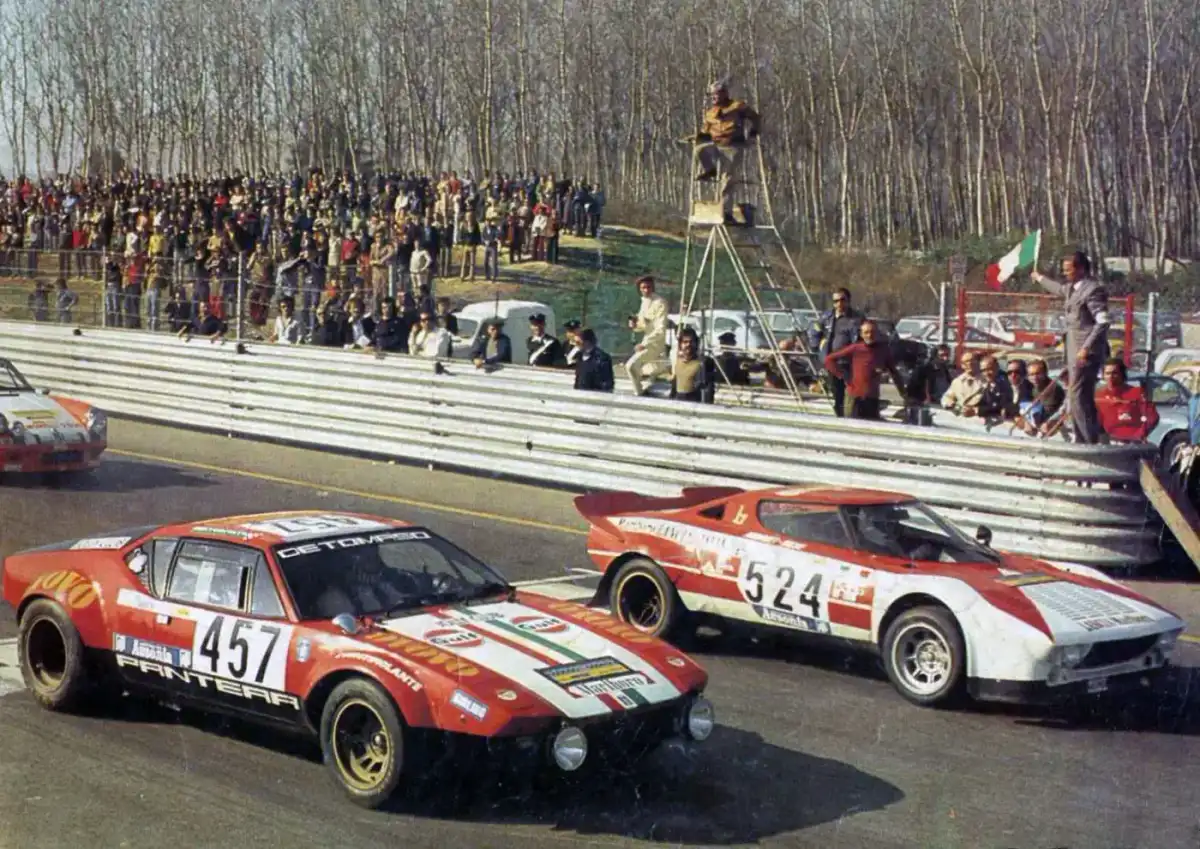 Sconosciuto Unknown author · Public domain
Autodrome of Morano sul Po
The autodrome of Morano sul Po, also known as the track of Casale Monferrato because of its location near the homonymous city of Monferrato, is a dismissed automotive circuit located between the municipalities of Morano sul Po , Coniolo and Pontestura .
Read the story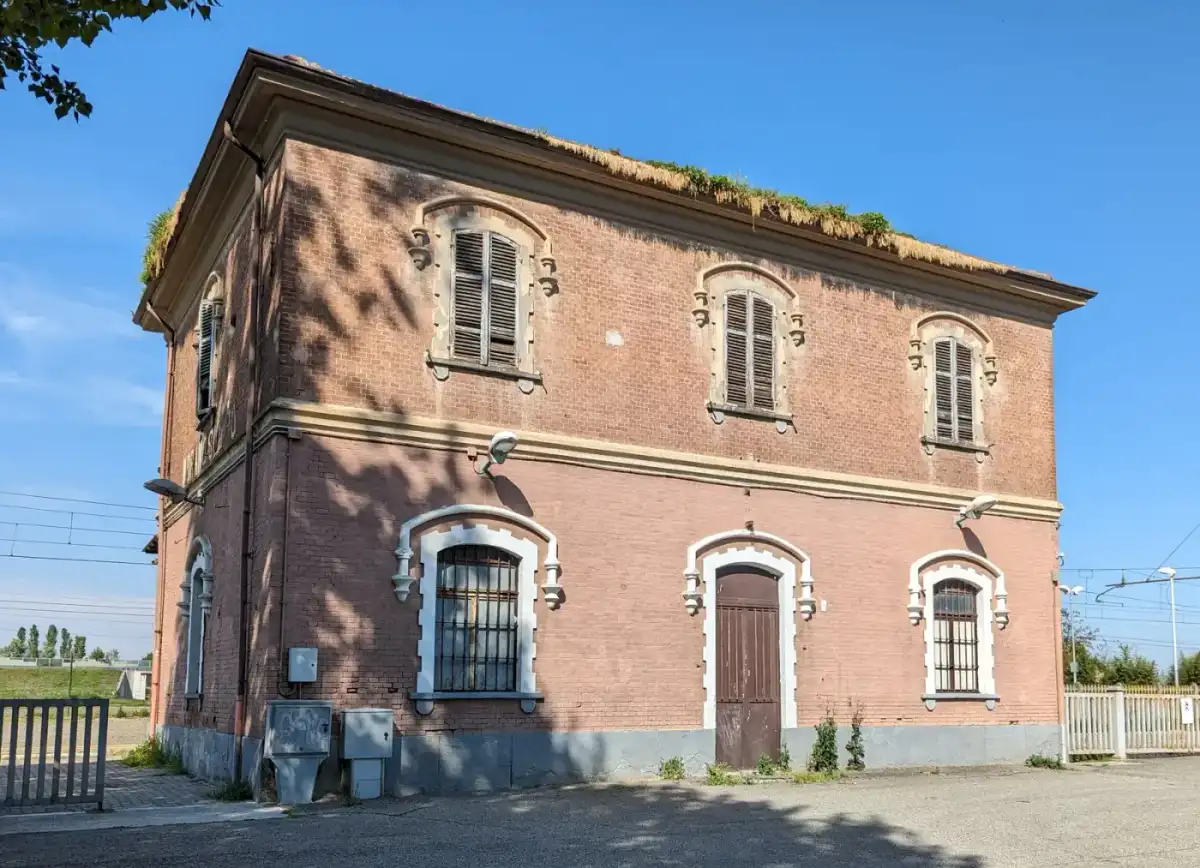 Ivan Ruggiero Scrivimi a (ivanrugg+credit@gmail.com) se vuoi usare questa fotografia in un altro luogo che non sia Wikimedia. Per favore utilizza questa attribuzione: Ivan Ruggiero (Wikimedia) · CC BY-SA 4.0
Morano sul Po Station
Morano sul Po station is a train station located on the Chivasso-Alessandria line. It serves the town of Morano sul Po .
Read the storyThe area, step by step
